Multi-Agent Orchestration: Why Your AI Agents Need to Work as a Team
Agentic AI
 Midhula Jeevan
June 12, 2026
Midhula Jeevan
June 12, 2026



 Midhula Jeevan
June 12, 2026
Midhula Jeevan
June 12, 2026
Enterprises do not lack AI. What they lack is AI that actually works as a team.
Individual agents do their specific jobs well enough. They answer queries, process invoices, and generate reports. But enterprise operations are not a collection of individual tasks. There are dozens of interconnected processes that need to be executed coherently, across systems and stakeholders, in real time. And isolated agents simply cannot do that.
That is exactly where multi-agent orchestration comes in. Instead of deploying disconnected tools, organizations are now building coordinated networks of specialized agents that collaborate, share context, and drive workflows from start to finish.
For the past decade, businesses poured millions into AI initiatives, including individual chatbots, standalone automation tools, and single-purpose ML models, only to discover a painful truth: a single AI agent, no matter how sophisticated, hits a ceiling.
It can answer a question, process an invoice, and can flag an anomaly. But it cannot run your business.
The real inflection point has arrived. Enterprises are now transitioning from deploying individual AI agents to orchestrating entire AI teams. These are networks of specialized agents that collaborate, reason, and adapt in real time to accomplish complex business goals. This is multi-agent orchestration, and it is rapidly becoming the backbone of enterprise AI workflow automation. It may also be the most consequential architectural decision your organization will make in the next 24 months.
The numbers back this up:
Definition
Multi-agent orchestration is the coordinated management of multiple AI agents that work together as a unified system to achieve a business objective. Instead of being isolated tools, specialized agents work together through an orchestration layer, which has the responsibility to manage communication between agents, share context, allocate and execute tasks across the workflow.
The essence of multi-agent orchestration is to ensure that each agent is providing their domain knowledge, while still working toward a common objective. It is the responsibility of the orchestration layer to determine which agent should perform a task, manage dependencies between actions, maintain shared context, and consolidate outputs into a coherent result.
In practice, an orchestrated AI system might:
Retrieve customer data from a CRM through a data retrieval agent
Validate regulatory and compliance requirements through a compliance agent
Generate personalized proposals, reports, or communications through a content generation agent
Coordinate approvals and scheduling through workflow-specific agents
Log activities, decisions, and outcomes through governance and audit agents
All of these actions occur within a single, connected workflow. Agents exchange information in real time, adapt to changing conditions, and execute tasks in parallel when required.
The result is a more intelligent and scalable approach to enterprise AI workflow automation. Instead of automating individual tasks, organizations can automate entire business processes across departments, systems, and functions while maintaining governance, visibility, and control.
Single AI agents are effective for specific tasks; however, enterprise workflows normally do not operate in isolation. Most of the time, when you look at a business process, there are various systems, employees, and decision points that need to be coordinated and aligned with the same data.
Now that more and more companies are adopting AI to help their business, it has become evident that stand-alone agents cannot perform their function completely. Automating individual tasks is valuable, but in order to automate end-to-end business workflows (i.e., business processes), multiple agents must work in coordination with each other.
While stand-alone agents are powerful, they are strictly limited. That is, they excel within a narrow domain (e.g., one functional area or type of transaction). But when a business workflow crosses multiple systems, departments, or through more than one decision point, stand-alone agents perform inadequately.
As business complexity grows, isolated agents become bottlenecks rather than enablers. A single agent usually fails to effectively manage all responsibilities.
Organizations frequently encounter:
Data trapped in silos — These bottlenecks slow execution and reduce operational agility.
Manual handoffs between teams — These bottlenecks slow execution and reduce operational agility.
Limited visibility into workflow status — These bottlenecks slow execution and reduce operational agility.
Compliance delays — These bottlenecks slow execution and reduce operational agility.
Duplicate decision-making processes — These bottlenecks slow execution and reduce operational agility.
Modern enterprises are adopting role-specialized agent systems designed around modularity and collaboration.
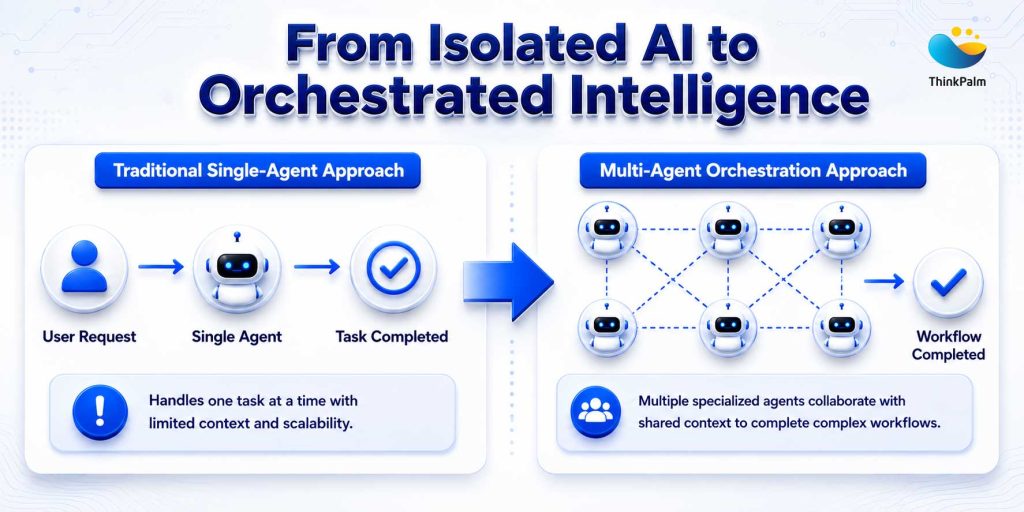
Instead of one agent performing every task, specialized multi-agents focus on specific functions while an orchestration layer manages workflow design and execution.
This approach improves:
Understanding the AI agent orchestration architecture matters for decision-makers because it directly determines what your AI can and cannot scale to do.
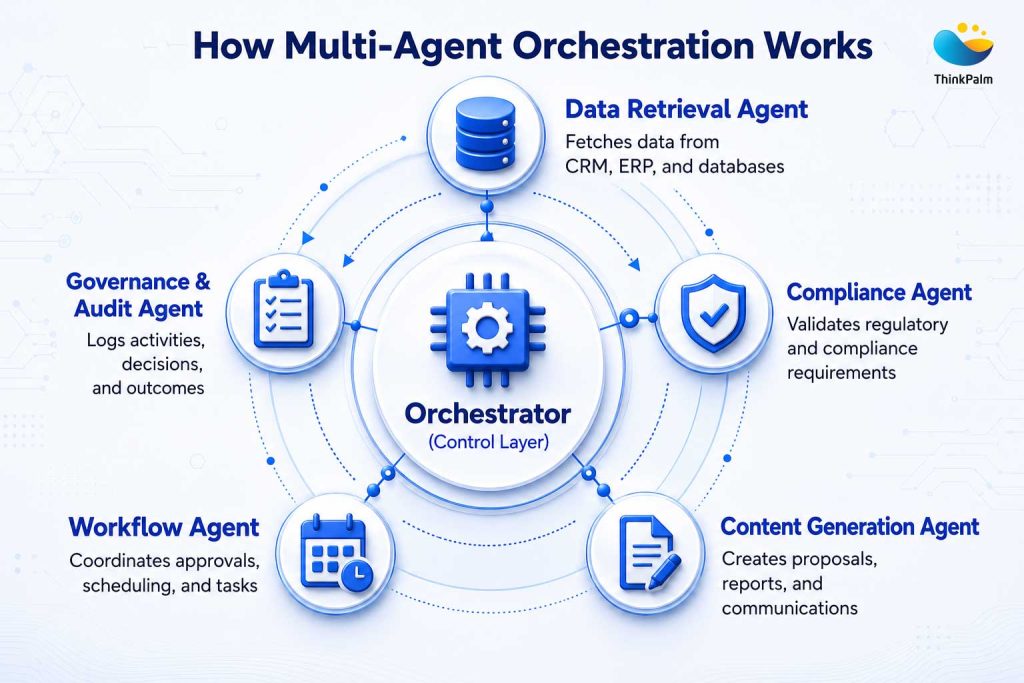
Receives a goal, breaks it into subtasks, assigns tasks to capable agents, monitors execution, enforces governance, and synthesizes results. It adapts in real time if conditions change.
Purpose-built agents for finance, compliance, HR, customer service, logistics, coding, QA, and more. They operate with domain expertise but collaborate through shared orchestration protocols.
A persistent store of context, decisions, and institutional knowledge. Continuity is preserved across agents, and the system learns over time.
Agents connect directly into ERP, CRM, HRMS, data warehouses, and APIs. Outcomes are executed, logged, and auditable within your operational infrastructure.
Role-based access control, compliance enforcement, audit trails, and escalation paths for human oversight when confidence thresholds are low or stakes are high.
From orchestration architecture and governance frameworks to domain-specific AI agents, ThinkPalm helps organizations deploy secure, scalable, and business-aligned agentic AI solutions.
While implementations may vary across organizations and platforms, most multi-agent systems follow a similar execution lifecycle. The orchestration layer guides tasks from initial request to final outcome, ensuring agents collaborate efficiently, maintain context, and adapt to changing conditions throughout the workflow.
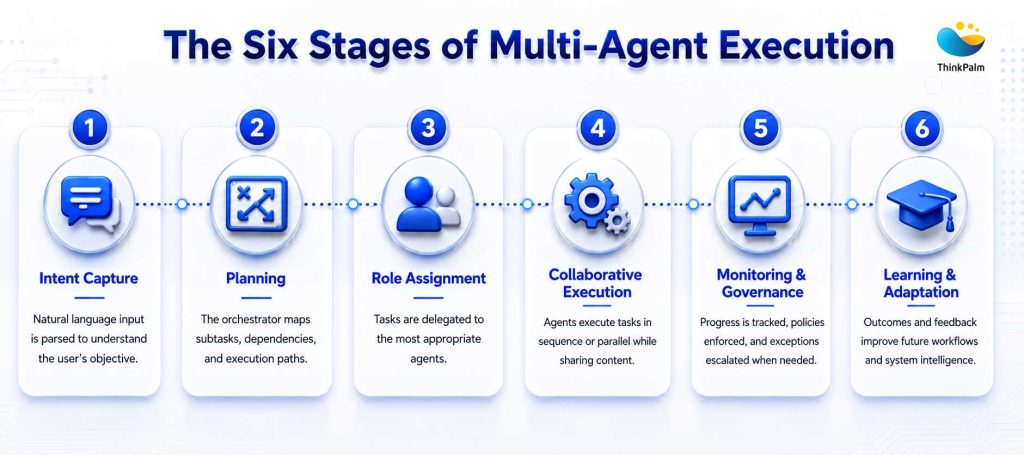
Natural language input is parsed, structured, and disambiguated to identify the user’s objective.
The orchestrator maps subtasks, dependencies, execution paths, and fallback strategies required to achieve the goal.
Tasks are delegated to the most appropriate agents based on capabilities, permissions, and context.
Agents execute tasks in sequence or parallel while sharing information and maintaining a common context.
Progress is tracked continuously, with observability controls detecting anomalies, enforcing policies, and triggering human escalation when necessary.
Outcomes, decisions, and feedback are captured to improve future workflows and strengthen institutional intelligence over time.
Technology leaders often focus on agent intelligence. The harder problem is agent communication. Without effective coordination, even highly capable agents create inconsistent outputs.
Successful orchestration depends on reliable A2A communication.
This includes:
An orchestrator agent acts as the traffic controller, ensuring information flows efficiently between participants.
Advanced implementations may also include:
Together, these systems improve resilience while reducing operational risk.
This distinction is very important when looking at the business case.
Traditional automation just performs a series of pre-set instructions. It’s inflexible and often stops working if there are any changes in conditions. It can automate one repetitive task. Multi-agent orchestration coordinates several independent AI agents that can think, adapt, and cooperate in real-time in order to achieve complicated objectives. It can automate whole cross-functional workflows, including the decision-making process, dealing with exceptions, and making ongoing improvements.
Key Difference
The main difference is quite clear: orchestration can adapt to the context, whereas traditional automation cannot.
| Capability | Traditional Automation | Multi-Agent Orchestration |
|---|---|---|
| Logic model | Pre-set instructions; inflexible | Agents think, adapt, and cooperate in real time |
| Scope | One repetitive task | Whole cross-functional workflows |
| Context adaptability | Stops working when conditions change | Adapts to context continuously |
| Decision-making | None | Includes decision-making and exception handling |
| Improvements | Manual reconfiguration required | Ongoing, automated improvements |
There are four main challenges that stop enterprises from performing their best. Multi-agent orchestration has been designed to overcome these challenges by managing coupled and intelligent workflows.
Let’s take a closer look at where traditional processes are not efficient and how orchestration improves the situation.
Each handoff increases the possibility of failure. Context is lost, there are unread emails, and it is difficult to stay accountable. Orchestration comes into the picture because you can manage the entire process in one system that keeps everything connected.
In industries where compliance is essential, such as fintech, maritime, manufacturing, or healthcare, regular compliance checks slow down daily operations. Multi-agent orchestration includes compliance agents in each workflow process. These checks are done in real time automatically.
Enterprise data lives in dozens of disconnected systems. Orchestrated agents are natively integrated with your data ecosystem — they retrieve, cross-reference, and act on information from multiple sources within a single execution cycle.
Operational scaling typically means hiring. Hiring is slow and expensive. Multi-agent orchestration scales horizontally: new agents are deployed as modular components, and the orchestration layer ensures they integrate without disrupting existing workflows.
For decision-makers who need to frame ROI, the value drivers are measurable:
Beyond immediate efficiencies, the long-term advantage lies in institutional intelligence.
Every workflow generates decision logs, knowledge, and process improvements that can be reused across future operations.
The result is a system that becomes more valuable over time.
The next generation of enterprise AI will not consist of larger individual models.
It will consist of collaborative agent networks operating within sophisticated orchestration frameworks.
Future developments are likely to include:
Advanced systems detect and resolve bottlenecks autonomously before they impact operations.
Autonomous workflow optimization continuously rebalances task allocation and execution paths based on real-time performance signals.
Compliance policies embedded directly into orchestration logic, applied at every decision point automatically.
A unified orchestration layer managing AI workflows across the entire organization simultaneously.
Every workflow, decision, and outcome preserved and reused, compounding organizational intelligence over time.
In many ways, orchestration is becoming a new abstraction layer between business objectives and execution.
Organizations that master this layer will gain significant strategic advantages in productivity, adaptability, and innovation.
Whether you’re modernizing legacy systems, building AI-powered applications, or deploying agentic workflows, our AI experts help turn ideas into production-ready solutions.
The future of enterprise AI is not about deploying more agents. It is about enabling those agents to work together effectively.
Multi-agent orchestration provides the foundation for this shift, connecting specialized agents, enterprise systems, and governance controls into a unified operational framework. The result is greater efficiency, scalability, and agility across business processes.
At ThinkPalm, we help organizations design and implement agentic AI solutions that align with their business objectives. From orchestration architecture to enterprise integrations, we enable businesses to build scalable and secure AI ecosystems that deliver measurable outcomes.
As AI adoption accelerates, the organizations that can orchestrate intelligence across the enterprise will be best positioned to unlock its full potential.
Midhula Jeevan is a passionate content writer with a focus on SEO and technical writing. With a love for words and a curiosity for the technical side, she blends creativity with strategy to craft content that stands out. When not writing, you could find her usually reading books, enjoying a good cup of coffee, or chasing golden sunsets.