Agentic AI in Payroll: 6 Capabilities That Are Redefining Automated Payroll Processing
Agentic AI
 Midhula Jeevan
May 20, 2026
Midhula Jeevan
May 20, 2026



 Midhula Jeevan
May 20, 2026
Midhula Jeevan
May 20, 2026
Most payroll platforms automate the calculation itself. Very few automate everything around it.
Exceptions still pile up in inboxes. Approvals still get chased through email threads. Errors still get discovered after the payroll run closes. For payroll teams, that operational layer is where most of the time, pressure, and risk still live.
This is the gap that AI agents in payroll processing are beginning to close.
Instead of replacing the payroll engine, agentic systems add an intelligent orchestration layer on top of it. They monitor workflows continuously, detect anomalies before they escalate, make decisions within defined boundaries, and take action automatically where the outcome is clear.
The result is a shift from passive payroll automation to autonomous payroll processing.
In a Nutshell
Agentic AI is transforming payroll from basic rule-based automation into intelligent, autonomous workflow management. AI agents can detect payroll anomalies before runs begin, resolve routine exceptions, monitor ERP-payroll integrations, automate compliance updates, and streamline payroll close processes with minimal human intervention. This helps payroll teams reduce errors, improve efficiency, and scale operations more effectively.
This article explores six production-ready capabilities already reshaping automated payroll processing across payroll platforms, bureau operations, and enterprise HR systems.
Traditional payroll automation follows rules.
If an employee works more than 40 hours, calculate overtime. If a tax code changes, apply the updated rate from the effective date. These automated payroll systems are reliable because they execute exactly what they are instructed to do.
But they have a limitation.
They only respond to situations someone anticipated in advance. If a payroll issue falls outside those predefined rules, the system usually does nothing until a human notices the problem.
Payroll AI agents work differently.
Instead of waiting for a trigger, they continuously monitor payroll workflows, employee records, integrations, and operational signals. They detect deviations from expected patterns, evaluate the likely impact, and decide whether the issue can be resolved automatically or escalated to a specialist.
This is the core difference between traditional payroll automation and agentic AI.
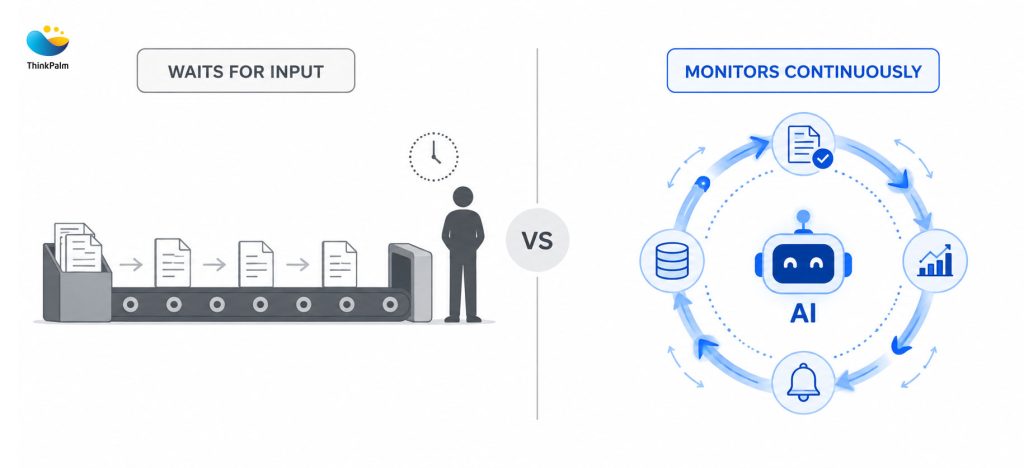
Comparison between traditional payroll processing that waits for manual input and an AI-powered payroll system that continuously monitors data, reports, and alerts.
Traditional systems execute instructions. Agentic systems actively manage operational workflows within clearly defined boundaries.
| DIMENSION | TRADITIONAL AUTOMATION | AGENTIC AI |
|---|---|---|
| How it works | Follows rules you define | Monitors, detects, decides, and acts autonomously |
| When it acts | Triggered by users or schedules | Operates continuously in real time |
| Exception handling | Flags issues and waits for human intervention | Classifies, resolves known issues, and escalates novel cases |
| Compliance changes | Requires manual rule updates | Applies validated policy updates automatically |
| Human involvement | Needed at nearly every step | Required only for strategic or exceptional decisions |
| Output | Processed payroll | Processed payroll with continuous intelligence and optimization insights |
For payroll teams, that shift means fewer surprises at run time, faster resolution cycles, and less manual coordination work across the payroll close process.
See how ThinkPalm helps payroll platforms build production-ready agentic AI capabilities with intelligent automation, workflow orchestration, and secure enterprise integrations.
Below are the six agentic AI capabilities redefining automated payroll processing today:
These capabilities are no longer experimental concepts.
They are already appearing in production payroll environments where platforms need to reduce operational overhead, improve payroll accuracy, and scale across larger employer or bureau portfolios.
Each capability solves a specific operational bottleneck that traditional payroll automation still struggles to handle efficiently.
Pain point: Payroll errors are discovered after the run closes instead of before it begins
Teams detect most payroll errors too late.
A payroll run completes, someone reviews the output, and only then notices that an employee’s gross pay has increased unexpectedly or that a leaver is still appearing as active in the payroll system. At that stage, the calculation has already happened. Correcting the issue means reopening the run, issuing adjustments, or processing corrections after submission.
A pre-run payroll validation agent moves detection upstream.
Before payroll calculation begins, the agent scans employee records against multiple reference points simultaneously:
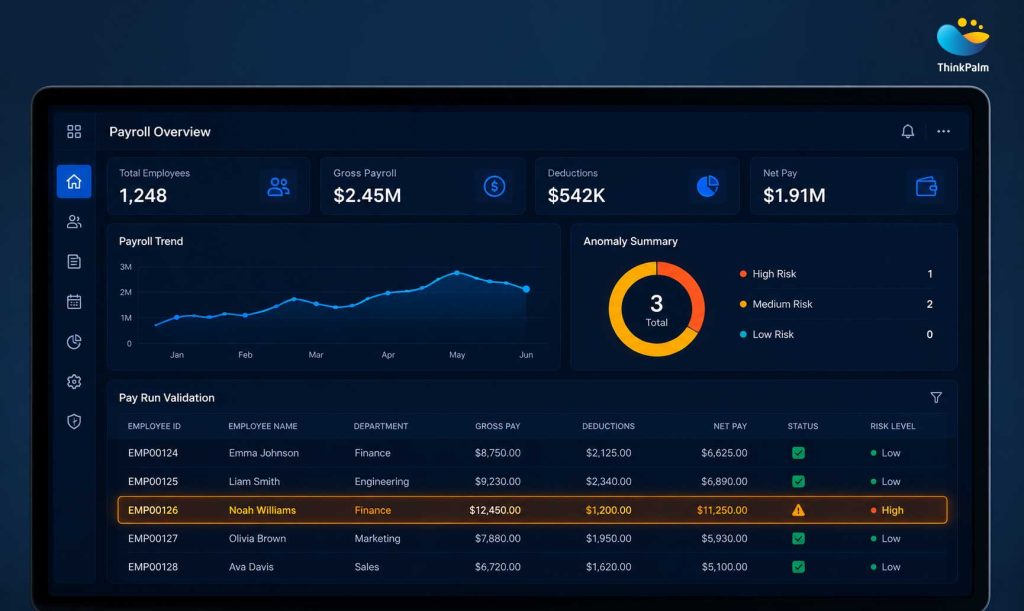
AI-Powered Payroll Dashboard for Real-Time Validation and Risk Detection
If something deviates from expected behavior, the agent generates a specific diagnosis instead of a generic warning.
For example, it can identify:
Rather than forcing payroll teams to manually review every employee record, the system produces a prioritized exceptions list ranked by severity, payroll impact, and statutory urgency.
Records that pass validation move directly into the payroll calculation workflow without manual intervention.
At ThinkPalm, we see this capability becoming one of the fastest-entry use cases for payroll platforms because it can be layered onto existing payroll engines without requiring a full platform rewrite.
In a live UK payroll deployment processing several thousand employee records per cycle, this architecture reduced post-run payroll corrections by more than 70% within the first three payroll cycles. The most significant gains came from identifying duplicate overtime imports, inactive employee records, and deduction mismatches before calculation began.
Pain point: Every exception handled identically with no prioritization by type, deadline or complexity
Every payroll cycle generates exceptions.
Some are critical. Others are routine.
But in many payroll operations, every exception enters the same queue and waits for a payroll specialist to review it manually. At small scale, that is manageable. At bureau scale, it becomes operational drag.
A payroll exception triage agent handles the sorting, prioritization, and resolution process automatically.
The workflow typically operates in three stages:
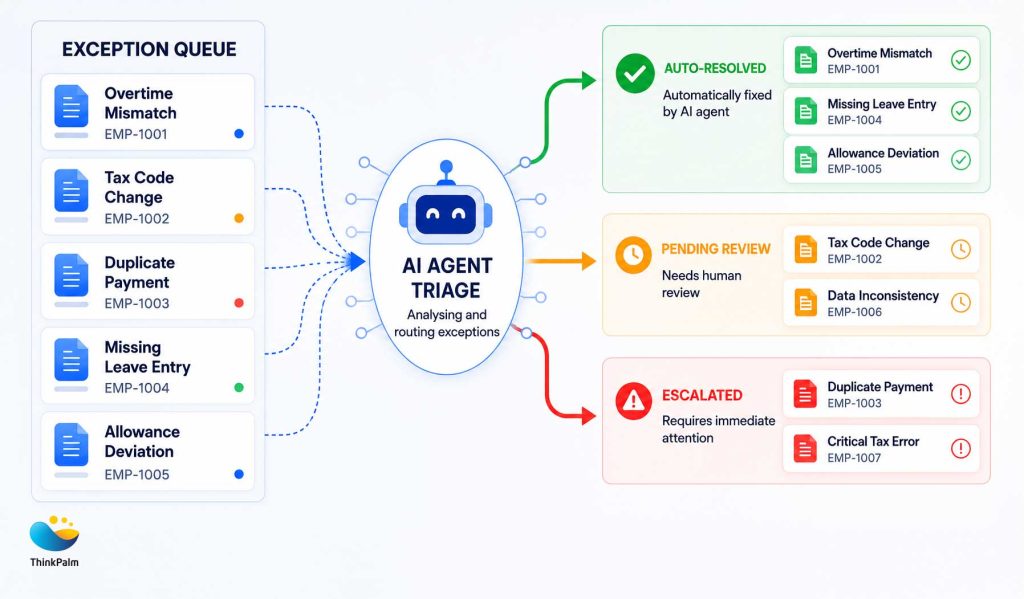
Workflow diagram showing an AI agent analyzing, resolving, and escalating critical errors.
For bureau payroll automation, this becomes even more valuable because the agent operates across multiple employer accounts simultaneously. The system continuously prioritizes the highest-risk issues across the full client portfolio rather than inside isolated queues.
Pain point: Payroll close coordination still depends on manual chasing and follow-ups
Most payroll delays do not come from payroll calculation itself.
They come from everything surrounding it.
Timesheet approvals are missing. HR has not confirmed leavers. Department managers have not submitted variable pay inputs. Payroll teams spend hours coordinating dependencies before the payroll run can even begin.
In many organizations, this coordination layer still runs through spreadsheets, reminder emails, and manual follow-ups.
A payroll close orchestration agent automates that operational layer.
Instead of waiting for payroll administrators to track every dependency manually, the agent continuously monitors workflow readiness across the entire payroll close process.
It can:
Once all required conditions are satisfied, the agent prepares a pre-validated payroll package for final approval.
That changes the role of the payroll manager significantly.
Instead of coordinating the close process manually, they review an orchestrated workflow that has already validated readiness conditions and resolved operational bottlenecks where possible.
For SME payroll environments, the impact is especially noticeable. Business owners and finance teams no longer need to manage payroll coordination manually every cycle. The platform surfaces only the decisions that genuinely require attention.
Pain point: Integration failures are discovered only after payroll errors appear downstream
Tightly integrated platforms, where HR, ERP, and payroll data all flow between connected modules, have a vulnerability that is easy to overlook. When a sync fails between two of those modules, the system does not always raise an alarm. The failure sits invisibly in the integration layer, doing nothing obvious, until something downstream reveals it. By the time any of the issues surface, the damage is already done, and the fix is reactive.
A data integrity monitoring agent addresses this by sitting continuously across the integration points between modules and validating key data in real time rather than waiting for a scheduled batch process. When an event occurs in the HR or ERP system, the agent immediately checks whether that change has propagated correctly to the payroll module.
If it has not, an alert is generated within minutes with three specific pieces of information:
This same architecture extends naturally to ERP integrations with SAP, Microsoft Dynamics, and NetSuite, all of which have well-documented APIs that make continuous payroll integration health monitoring a realistic and deployable capability.
Pain point: Regulatory changes propagated manually to client configurations, slow and inconsistent at scale
Compliance complexity grows quickly as payroll operations scale.
Multi-country payroll environments must constantly adapt to changing tax rules, pension contributions, statutory deductions, labor agreements, and reporting obligations. The challenge is not just understanding the regulation itself. It is updating every affected payroll configuration accurately and on time.
This becomes even more complex in GCC and APAC payroll environments where organizations often operate across multiple legal entities with country-specific gratuity rules, pension structures, taxation models, and labor compliance obligations. Managing those updates manually across distributed payroll operations creates significant operational risk as organizations scale regionally.
In many payroll operations, this process is still heavily manual.
A compliance specialist reviews the change, identifies affected clients or entities, updates payroll rules individually, validates the configuration, and communicates the update to stakeholders. Across dozens or hundreds of employer environments, that becomes slow, repetitive, and difficult to scale safely.
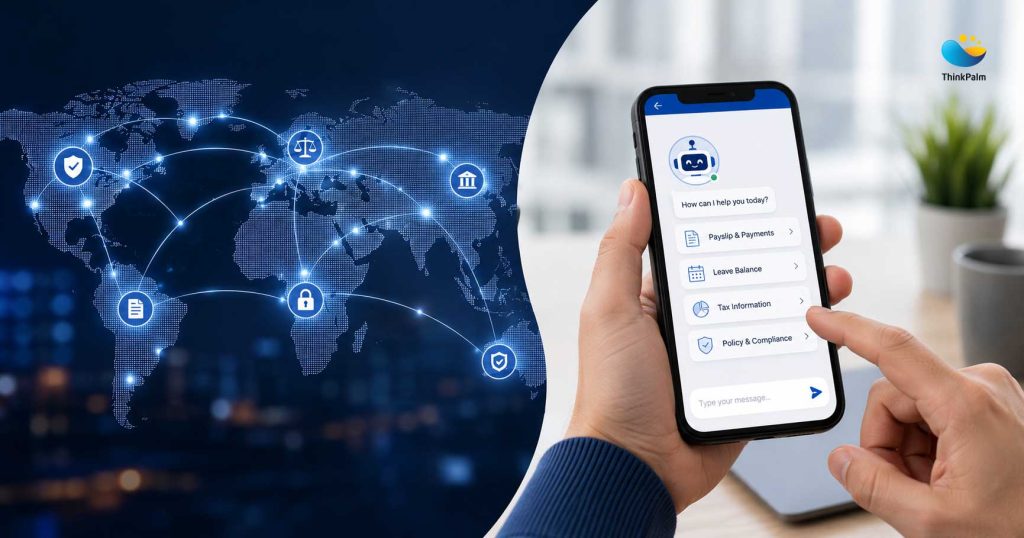
AI-Powered Payroll Support for Global Workforce Operations
A compliance propagation agent automates the operational workflow that follows regulatory validation.
The process typically works in four stages:
It is worth being clear about what this agent does and does not do. It does not replace your compliance team’s judgment about what a regulatory change means. The compliance team validates the change. The agent handles the distribution at speed and scale once validation is done.
Even with that boundary clearly defined, the time savings are significant. What previously took days of manual work across hundreds of client accounts can now be completed in hours, with a full audit trail and no risk of a client being missed.
Pain point: Payroll chatbots provide generic answers instead of employee-specific guidance
Most payroll self-service systems are still limited in practice.
Employees can download payslips, view tax documents, or read policy pages. Some platforms also include chatbots. But the experience often breaks down when employees ask detailed payroll questions tied to their own records.
For example:
Traditional chatbots usually respond with generic policy summaries because they are disconnected from live employee payroll data.
That creates frustration for employees and pushes queries back to HR advisers or payroll specialists anyway.
A RAG-based payroll self-service agent operates differently.
Before generating a response, the agent retrieves contextual payroll information relevant to the employee and the question being asked. That context may include:
The response is generated using those records as grounding context rather than relying solely on static policy documents.
That changes the quality of interaction significantly.
Instead of:
“Please contact HR for more information.”
…the employee receives:
“Your pension deduction increased this month because your salary adjustment moved you into the next contribution band effective from April 1.”
That level of specificity dramatically improves employee experience while reducing operational load on HR and payroll teams.
There is a meaningful gap between a proof-of-concept demo of an agentic AI system and a system that actually runs in a production payroll environment. The demo can look impressive. But a demo is not processing real employee data, operating under real compliance obligations, or being held accountable when something goes wrong. Getting from a working proof of concept to a production-ready system requires four things that are often underestimated at the outset.
Every decision the agent makes, every exception it resolves automatically, and every escalation it triggers needs to be logged with a timestamp, the specific data that drove the decision, and the outcome. Payroll is a compliance-critical process. There can be no black boxes.
The agent needs to know exactly what it is authorized to resolve on its own and at what point it must hand off to a human. Human-in-the-loop design is not a fallback option. It is a core design requirement for any system handling payroll at scale.
An agentic system should operate on top of the platform’s existing data layer, not run alongside it as a separate system. The goal is to make the payroll engine smarter, not to build a parallel one.
The success criteria need to be agreed upfront: error catch rate, resolution time, adviser hours saved, correction rate before and after. A pilot that generates clear evidence from its first cycle is far more valuable than one that produces output without a baseline to measure it against.
At ThinkPalm, production-ready agentic payroll systems are typically implemented as an orchestration layer integrated with the existing payroll engine rather than as a standalone replacement platform.
Our delivery approach focuses on three core principles:
Depending on the client environment, we combine orchestration frameworks, LLM-powered reasoning layers, RAG pipelines, and enterprise integration services to build AI agents that operate safely within payroll compliance constraints.
This allows organizations to introduce autonomous capabilities incrementally without disrupting existing payroll operations or calculation engines already in production.
If your biggest friction is errors being caught after the run closes, the right starting point is a pre-run anomaly detection agent. It connects to your existing data layer, requires no changes to your calculation engine, and gives you a measurable result within the first cycle. You will be able to compare your post-run correction rate before and after with minimal effort.
If your advisers or payroll specialists are spending a significant portion of their time on routine exception handling, start with an exception triage agent. Define the most frequently repeated exception types in your environment, build the auto-resolution logic for those first, and measure the time saved per cycle. The ROI becomes visible quickly and makes the case for expanding coverage to more exception types.
The principle that holds across both starting points is the same. Start narrow, measure clearly, and expand from the evidence. Agentic AI payroll platform development does not need to begin as a large transformation programme. It can begin as a four-to-six week pilot that generates a compelling proof of value and grows from there.
Agentic AI is not a future trend for payroll. It is a present capability that platforms are already deploying in production environments today.
Modern payroll platforms need intelligent systems that can detect issues early, orchestrate workflows, automate repetitive tasks, and escalate only the cases that require human judgment.
The most effective approach is to start small with one high-impact capability such as anomaly detection or exception triage, prove measurable value, and expand incrementally.
At ThinkPalm, we help payroll platforms build production-ready agentic AI capabilities, from intelligent orchestration layers and ERP-payroll integrations to AI-driven exception handling and conversational employee self-service agents, with a focus on scalable, audit-safe automation.
Our teams support the full lifecycle of agentic AI payroll platform development, including AI strategy, payroll workflow orchestration, intelligent automation, enterprise integration engineering, and production deployment.
We help organizations build:
By combining intelligent automation for HR and finance with secure enterprise integrations and human-in-the-loop governance, we help payroll providers modernize operations incrementally while delivering measurable operational outcomes at scale.
Agentic AI in payroll refers to AI systems that can monitor payroll workflows, detect anomalies, make decisions within defined boundaries, and take action automatically. Unlike traditional payroll automation, these systems actively manage operational workflows instead of only executing fixed rules.
For most payroll platforms, pre-run anomaly detection delivers the fastest ROI because it reduces payroll errors before the run closes. For bureau operations, exception triage automation also creates major time savings at scale.
A focused MVP for one capability can often be deployed within four to six weeks depending on integration complexity and API availability. Most organizations start with a limited pilot and expand gradually based on measurable outcomes.
No. Production-ready payroll AI systems are designed around human-in-the-loop workflows. The goal is to automate repetitive operational work while escalating complex or high-risk decisions to specialists.
Processes with repetitive workflows, high exception volume, and manual coordination overhead are the best starting points. Common examples include anomaly detection, exception triage, payroll close orchestration, compliance propagation, and employee self-service automation.
Standard payroll automation follows rules you set in advance. It calculates pay, applies tax codes, and generates payslips based on defined logic and, hence, is reliable but passive. It does not notice problems it was not told to look for. Agentic AI in payroll goes further. An agentic system continuously monitors data, detects anomalies, makes decisions within defined boundaries, and escalates to a human only when the situation genuinely needs judgment. It acts on its own, within the limits you define. That is the key distinction.
Midhula Jeevan is a passionate content writer with a focus on SEO and technical writing. With a love for words and a curiosity for the technical side, she blends creativity with strategy to craft content that stands out. When not writing, you could find her usually reading books, enjoying a good cup of coffee, or chasing golden sunsets.