AI for Business Process Automation: The Enterprise Leader’s Strategic Guide (2026)
Agentic AI
 Chandni Nadarajan
June 2, 2026
Chandni Nadarajan
June 2, 2026



 Chandni Nadarajan
June 2, 2026
Chandni Nadarajan
June 2, 2026
“A global enterprise believed it had already automated its operations. Dashboards were live. Approval systems were digital. Workflows moved faster than before. Yet every quarter ended the same way: delayed approvals, overloaded operations teams, executives waiting for reports, employees manually resolving exceptions across disconnected systems.”
AI is changing the way businesses run their day-to-day operations. It is now moving beyond simple, rule-based automation to systems that can learn, adapt, and help teams make smarter decisions. This blog post covers how organizations can use AI to streamline complex workflows, decide when to bring humans in the loop, and find the best ways to save time and effort. It also touches on why strong oversight, process visibility, and flexible AI systems matter as businesses develop smarter, more reliable ways to run.
Definition
AI business process automation is the use of AI technologies to help businesses run smarter. Instead of following fixed rules, these systems understand context, learn from data, and make decisions on their own — so your teams spend less time on repetitive work and more time on what actually matters.
Unlike traditional automation tools, which were largely rule-based and designed to execute predefined instructions, AI changes the game in a different way.
These automation tools proved beneficial for performing repetitive tasks but struggled with changing business conditions, unstructured data, cross-functional coordination, and the need to make contextual decisions. But with the advent of AI for Business Process Automation, there came a major shift in the way things were done.
By combining advanced tools like machine learning, NLP, and generative AI, enterprises can build workflows that do more than just execute tasks. These systems learn, adapt, and predict outcomes to directly support operational decision-making.
For example:
In many ways, intelligent process automation represents the evolution of traditional workflow automation into a more adaptive and cognitive operational model.
Modern enterprises are no longer looking to automate isolated tasks. They want to orchestrate end-to-end intelligent workflows across departments, systems, and decision layers. In short, they want systems that do not just ‘do’ things but ‘think’ through them. This evolution is commonly referred to as intelligent process automation: a combination of multiple technologies that works inside a unified operational framework, including:
Together, these technologies create workflows capable of understanding context, predicting outcomes, handling exceptions, recommending actions, and continuously optimizing processes.
Key Shift
“AI is no longer just automating execution. It is about accelerating decision-making.”
The defining difference between traditional automation and intelligent process automation
For example, in practice it looks like:
This is why enterprise AI automation is increasingly becoming a boardroom-level strategic priority rather than just an IT initiative.
For many years, companies have relied on traditional automation tools, which include robotic process automation (RPA), to improve efficiency. This is productive when processes are stable and structured. Although it reduced manual effort, companies soon discovered their limitations.
Traditional automation works well in environments where:
But when real-world situations deviate from the script, rule-based systems would either break or cause silent errors. Modern enterprise operations rarely operate under those conditions.
Today’s workflows involve fragmented data sources, changing compliance requirements, customer-specific variations, exception-heavy approvals, and real-time operational dependencies across systems. In all these cases, rule-based RPA creates bottlenecks, instead of reducing them. Organizations looking to move beyond rule-based automation often leverage AI development services to build intelligent business process automation solutions that can learn, adapt, and optimize workflows continuously.
Traditional rule-based automation largely relies on ‘if-then rules.’ Whereas AI-driven workflows operate differently. It makes probabilistic judgments and takes proactive, intelligent decisions. It can review documents, draft responses, review claims, and help in analyzing incoming requests. These were areas that traditional RPA struggled most.
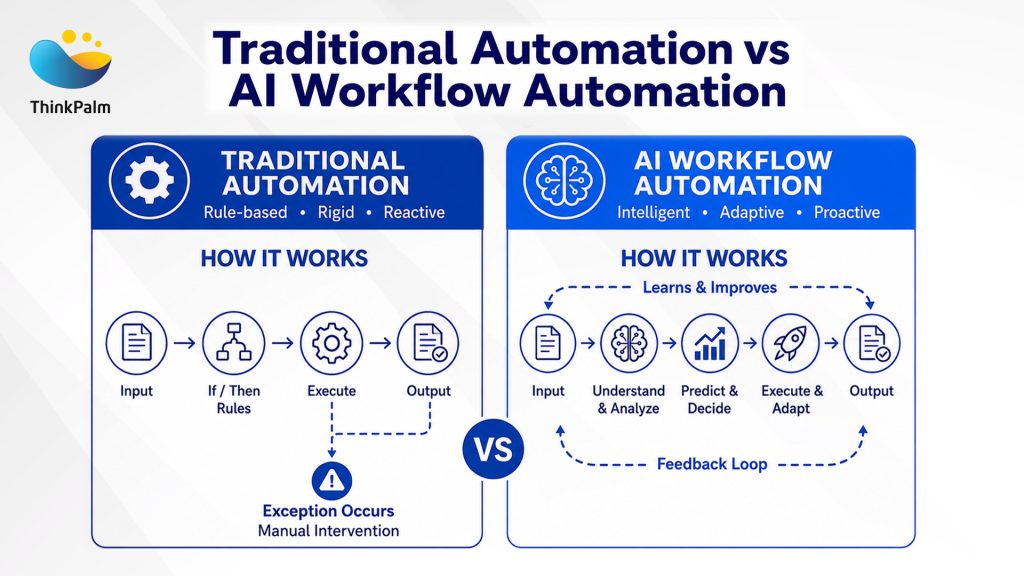
Comparing Traditional Automation and AI-Driven Workflow Intelligence
Many organizations are realizing that AI business process automation becomes significantly more effective when paired with legacy system modernization services that eliminate workflow silos and integration bottlenecks.
| Dimension | Rule-Based RPA | Intelligent Process Automation (IPA) | Agentic AI |
|---|---|---|---|
| Process type | Stable, repetitive, high-volume tasks | Variable, data-heavy, semi-structured workflows | Dynamic, cross-functional, goal-driven work |
| Logic model | Hard-coded rules and decision trees | Rules + ML models and analytics | Goal-oriented planning and adaptive policies |
| Data handling | Structured data only | Structured + semi/unstructured data | Works across structured, unstructured, and streaming data |
| Exception handling | Breaks or routes to humans | Identifies patterns and improves over time | Anticipates, experiments, and adjusts strategies |
| Adaptability | Needs frequent reconfiguration | Learns from new data; less brittle than RPA | Continuously adapts based on feedback and outcomes |
| Strategic impact | Local task-level efficiency | End-to-end process optimization | Transformation of operating models and digital decision-making |
The most important shift in AI workflow automation is the ability to improvise over time. This is something that traditional automation couldn’t do. Intelligent Process Automation and agentic AI systems can log outcomes, learn from user corrections, and feed that data back into models. This helps with refining predictions, classifications, and next-best actions without manual effort.
Static workflows may require manual redesign, whenever there are changes. Whereas using AI, you get living workflows that adjust as volumes, customer behavior, and business priorities change.
Think of it like agents that monitor their own performance, flag drift, and suggest new rules or model updates. Every interaction becomes training data that quietly makes the system smarter.
| Capability | Traditional Automation | AI Workflow Automation |
|---|---|---|
| Execution model | Rule-based execution | Context-aware execution |
| Data compatibility | Handles structured data only | Handles structured and unstructured data |
| Decision logic | Requires predefined logic | Learns from patterns and outcomes |
| Workflow behavior | Reactive workflows | Predictive and adaptive workflows |
| Exception handling | High human intervention during exceptions | AI-assisted decision-making |
| Long-term trajectory | Limited scalability in dynamic environments | Continuously improves over time |
There is a common misconception surrounding AI automation that it would replace humans as all workflows turn out to be fully autonomous.
On the contrary, most successful enterprises believe that the future of AI is not purely about replacement, but more about augmentation.
It lies in the hands of strategic leaders to decide which tasks can be fully automated, AI- assisted, and remain human-led. Hence, the end goal is not about removing humans from the loop but removing monotonous work and augmenting their tasks by adopting the ‘smart’ way.
Industry Insight
“By 2030, AI is expected to influence nearly all enterprise IT work.”
— Gartner [Source]
Let us learn different ways in which tasks can be automated and the respective approach to be adopted.
| Workflow Type | Recommended Approach |
|---|---|
| High-volume repetitive tasks | Full automation |
| Exception-heavy operational workflows | AI-assisted automation |
| High-risk compliance decisions | Human-led with AI support |
| Strategic or judgment-intensive workflows | Human augmentation |
All workflows in a business process may not be ideal for AI adoption. While implementing AI for Business Process Automation, we need to look for intelligent workflows that deliver a return on investment.
One of the most important steps in implementing AI for Business Process Automation is identifying where intelligent workflows can deliver measurable operational value.
Enterprise leaders should evaluate processes based on factors such as:
High-volume repetitive workflows often generate the fastest ROI. Volume creates the data needed to train effective AI models.
Processes with frequent variations benefit significantly from AI-assisted decision-making rather than rigid rule engines.
Workflows requiring contextual interpretation — not just rule application — are strong candidates for intelligent automation.
AI systems depend on high-quality operational data. Processes with clean, accessible data produce better AI outcomes faster.
Highly regulated workflows require stronger governance frameworks and mandatory human oversight in the automation design.
Prioritize workflows directly linked to customer experience, cost reduction, or operational resilience for the greatest business value.
Many enterprises are now using process mining technologies to uncover hidden inefficiencies and identify automation opportunities more strategically.
ThinkPalm’s enterprise AI experts help you map your workflows, identify intelligent automation candidates, and build a strategic roadmap with measurable outcomes.
Real-world applications of AI for business process automation show that intelligence is a competitive necessity, not just an advantage. Here is how different sectors are leveraging intelligent process automation to transform their operations:
Financial institutions utilize AI workflow automation to accelerate high-stakes tasks. AI-powered systems identify anomalies and prioritize risk investigations significantly faster than any manual workflow could achieve.
Manufacturers leverage enterprise AI automation to master predictive maintenance and optimize global supply chains through intelligent workflows for inventory forecasting and quality inspection.
Intelligent process automation streamlines patient onboarding and automates complex claims processing, reducing the heavy administrative burden on clinical teams so they can focus on patient care.
AI-driven workflows personalize customer journeys and optimize inventory in real time. Retailers can forecast demand changes accurately, ensuring the right products are always in the right place.
HR teams are adopting AI to automate recruitment screening, payroll exceptions, and employee onboarding, allowing personnel leaders to focus on strategic workforce planning rather than administrative coordination.
As we scale AI business process automation in our companies without proper oversight, it can create serious business and legal risks. This could take the form of problems like model drift where AI models become less accurate over time. Hidden bias in automated decisions, and “black box” systems that no one can explain or audit at all, are other risks.
In the long run, this can undermine trust and make it hard to prove compliance. If not checked well, this can lead to bad decisions into the workflow at scale.
Under the EU AI Act, certain types of AI are considered “high risks”, especially when systems make or support decisions affecting people’s rights, access to services or employment. While dealing with these high-risk use cases, companies should have strong controls: documented purpose, tested accuracy, bias management and mandatory human monitoring, rather than leaving it to completely autonomous decisions.
So, AI-powered process automation that touches areas like hiring, lending, healthcare or critical infrastructure cannot be treated as a simple IT tool. It should follow formal risk and inspection processes.
Furthermore, as per GDPR standards, AI workflow automation must remain transparent, and users should be informed how their personal data would be utilized in the workflows. Therefore, enterprises need to design their AI journeys where people can understand how their data is used and can request a human review of important automated outcomes.
If AI automation needs to be implemented safely at scale, enterprises need a clear internal governance structure, not just ad hoc approvals. There must be designated leaders responsible for each AI system, risk officers to assess impact and compliance, and internal audit teams to periodically review performance, data usage, and controls.
Clear audit protocols like what is logged, how often models are revalidated, and how issues are escalated to turn governance from a one-time checklist into an ongoing practice.
Not just with that, while choosing a suitable vendor for AI business process automation, due diligence also becomes part of governance. We need to clearly understand how they handle data protection. Questions like “Can we see and export audit logs?”, “How is training data governed?”, and “What controls exist for human-in-the-loop review?” Help ensure the platform supports, rather than undermining the organization’s governance standards.
Although the benefits of implementing AI business process automation are clear, there may be several enterprise challenges. The biggest hurdle is organizational readiness and not technology. Listed below are some common roadblocks to watch for:
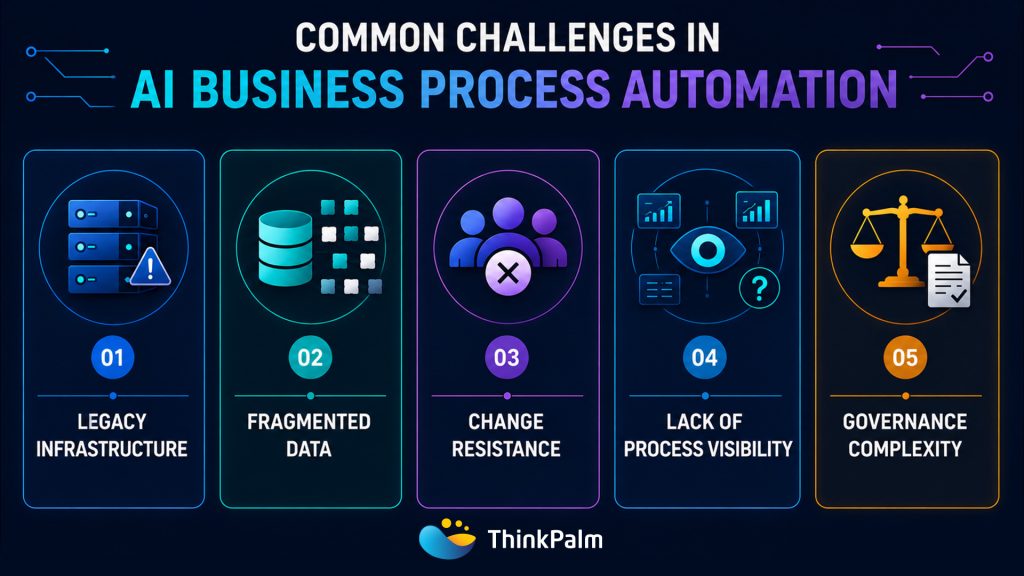
Common Challenges in AI Business Process Automation Adoption
Older systems may find it difficult to talk with modern AI. This makes integration a great challenge.
When data is scattered across different departments or silos, it reduces AI effectiveness as it wouldn’t have the full picture.
Employees often worry that AI may emerge as a threat to their jobs when it functions as an enabler and not as a replacement for them.
It is difficult to automate a process which we don’t understand. Many organizations attempt automation before mapping how it works from start to finish.
Scaling AI responsibly means ensuring there are clearly defined guard rails requiring compliance with regulations and company standards.
The future of enterprise operations is not just about faster software but moving toward increasingly autonomous and adaptive systems.
The next wave of enterprise AI automation would be about including:
Instead of merely alerting teams when a bottleneck occurs, advanced systems act independently to troubleshoot and resolve the issue before it impacts operations.
A central AI coordinator dynamically manages and synchronizes complex workflows across different teams and departments without human scheduling overhead.
Every employee gains a co-worker that understands their specific role and helps them make the right decisions in real time, drawing on organizational knowledge at scale.
The entire company — HR, IT, Finance, Operations — is connected and sharing data in real time, optimizing outputs across the whole organization simultaneously.
Rather than reacting to a crisis, enterprises predict upcoming disruptions — from supply chain delays to compliance risks — before they materialize, enabling proactive decisions.
The next generation of enterprise transformation will not be defined by automation alone. It will be defined by intelligence within workflows.
Traditional automation helped organizations improve operational efficiency, but modern enterprises now require systems capable of learning, adapting, predicting outcomes, and supporting complex decision-making. This is why AI business process automation is rapidly becoming a strategic enterprise priority.
As enterprises continue their journey toward intelligent process automation, ThinkPalm helps organizations modernize workflows, integrate AI-driven automation strategically, and build scalable systems that balance operational intelligence with human oversight.
With deep expertise across AI and IoT sectors, ThinkPalm translates complex enterprise needs into reliable digital products.
However, successful implementation requires more than deploying AI tools. Enterprises must balance automation with human judgment, establish strong governance frameworks, and prioritize workflows where intelligent automation can create measurable business value.
“The organizations that will lead in the coming decade are not those with the most automation — but those with the most intelligence embedded inside their operations.”
Chandni Nadarajan is a content writer at ThinkPalm Technologies, specializing in B2B marketing content. With a passion for turning complex ideas into clear, engaging narratives, she blends strong research and storytelling skills to make technical topics accessible. Her expertise spans technology, automation, and digital business solutions.