Bringing Organizational Knowledge into AI Test Design: RAG in TestNova
Testing as a Service (TaaS)
 Shenile A
August 18, 2026
Shenile A
August 18, 2026



 Shenile A
August 18, 2026
Shenile A
August 18, 2026
Consider the scenario where a test lead uploads a complete PRD, and within minutes, AI generates dozens of test cases. Everything seems to be going smoothly, until a senior tester asks, “Where is the account lockout rule?”
This was a tough lesson learned from a production incident last quarter. Everyone remembered it, but it was never written into the new spec. PRDs aren’t designed to capture every detail of a product’s full history. Data also lives on Jira tickets, old bug reports, and team memory. A tool that only reads the file in front of it will never see any of that. TestNova closes this gap using Retrieval-Augmented Generation (RAG).
If you want the full technical picture of how RAG works in general, we cover that in our detailed blog on what Retrieval-Augmented Generation is. Here, we will focus on what it means specifically for AI-powered software testing, and the way TestNova implements it is different from most AI testing tools on the market.
Speed was the first problem TestNova solved. Writing and maintaining test cases by hand is never an easy task keeping in mind the modern release cadence. However, when AI generation becomes possible from an uploaded PRD, Jira ticket, or Figma file, it fixes that part directly. But there were other deeper challenges.
Teams were more specific about their requirements, and it was not just about generating first drafts. They wanted drafts that already sounded like their product, which was very much aligned to internal standards, shaped by past failures, and written in the language their systems actually use.
That is a structural problem, not a prompting problem. If you need to have a complete picture, you might have to view from all sides. A PRD looks forward only. But good testing also needs to look backward and sideways. This includes questions like what broke last time, what auditors expect, how components are actually named in production, and which edge cases keep repeating across releases. That vital institutional knowledge is scattered across the organization, and no single file upload can carry all of it. The AI needs a mechanism that actively hunts for this context during the generation process.
Definition
RAG connects an AI model to a curated library of trusted documents. Before generating a response, the system retrieves the passages most relevant to the task, then generates its output using both the original input and that retrieved context. This forms a vital difference between an AI that only knows what you typed, and one that also checks its work against your library.
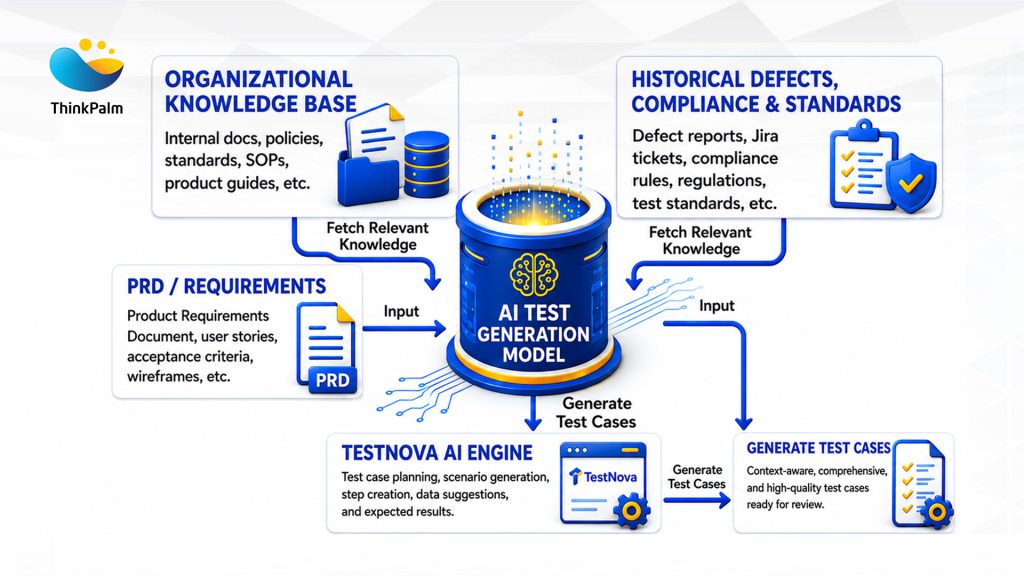
TestNova RAG: Combining PRDs and organizational knowledge into test suites.
Inside TestNova, RAG works as an optional enrichment layer inside the test design workflow, not a separate product bolted on the side. Teams can build knowledge bases containing internal documents, past bug reports, reference specs, approved URLs, regulatory standards, and other material your administrators choose to ingest. When generating tests from a PRD, a user simply toggles RAG on. During the time of test case generation, the PRD acts as the blueprint for the release, and the selected knowledge base acts as the knowledge layer. This implies that each knowledge base is tailored specifically to a particular organization and project. For example: a fintech compliance library won’t accidentally mix with an unrelated healthcare project.
TestNova retrieves the passages that relate to the requirements being processed and hands them to the model alongside the primary document. The PRD still decides what must be tested for this release. The knowledge base fills in the surrounding detail that makes each case precise instead of generic.
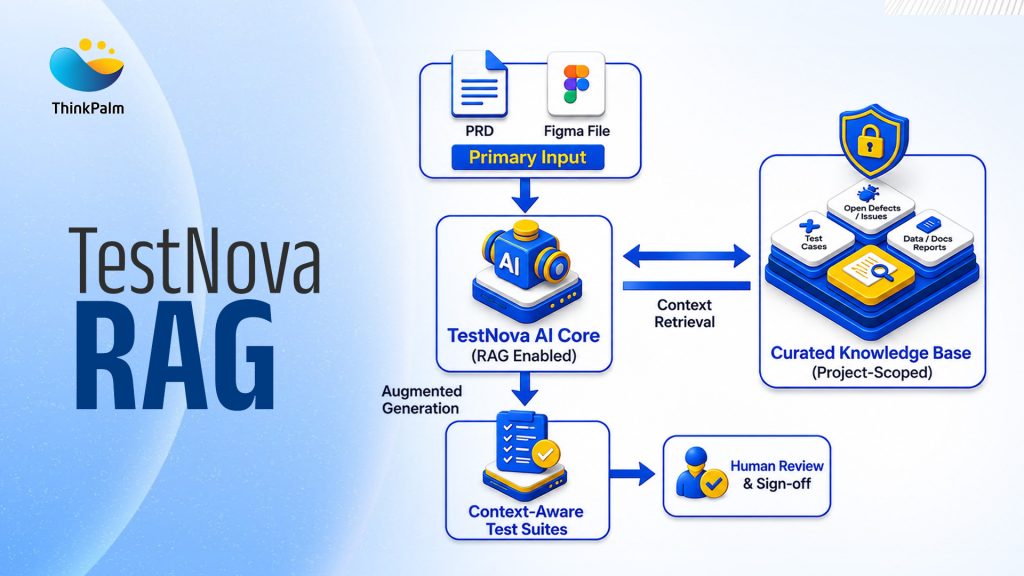
How TestNova’s RAG engine turns PRDs and organizational knowledge into review-ready test suites
Once the knowledge base is ready, teams do not have to make many changes while using RAG. TestNova does not require you to add steps or force testers to manually hunt documents before running a generation. Instead, RAG fits naturally into the existing test design process, adding relevant organizational context into your test design process exactly when and where it’s needed.
Here’s how that process works inside TestNova:
Upload a PRD, Jira ticket, Figma file, or plain text spec, the same way you always would.
Turn on RAG and select the knowledge base that matches this product or compliance scope.
TestNova produces test cases and related outputs, informed by both the spec and the retrieved context.
Cases land in test management for human sign-off, same as any other TestNova output.
Good to Know
RAG is entirely optional in TestNova. Teams can begin with PRD-based test generation and introduce knowledge bases gradually as their testing and governance practices mature.
Imagine a team preparing a test coverage for a new payments feature. The PRD describes new refund rules and a UI change. The test lead turns on RAG against a knowledge base containing the team’s API style guide, past refund defect write-ups, and the company’s payment compliance checklist.
During generation, TestNova builds validation test cases using lockout rules and audit expectations pulled straight from that corpus. This avoids generic AI guesswork. The generated steps use terminology that matches the team’s existing suites and negative paths address historical failure modes, expanding on a PRD that might only cover the happy path.
When switching to a different project like a healthcare application, the team just selects a different knowledge base with its own compliance baseline. There is no need to retrain models or rewrite complex prompts; the user simply selects the right library at generation time.
Most AI tools now leverage RAG to help a chatbot answer questions. But, TestNova uses it to shape the actual QA test suites your team ships, which is a meaningfully different bar to clear. Here is what sets it apart.
TestNova is built as a fully agentic AI test automation platform that handles planning, generation, execution, and maintenance in one place. RAG isn’t restricted to a chat window, it actively drives AI test case generation, risk-prioritized test planning, and predictive risk analysis.
Many AI platforms pull information from a single, undifferentiated pile of documents. TestNova’s knowledge base is tied to a specific organization and project, so your healthcare compliance baseline stays completely separate from your payments feature libraries.
Strict role-based access controls let administrators and test leads control what enters the knowledge layer and how it’s organized. With compliance-ready export for standards like GDPR, HIPAA, and FCA, RAG in TestNova carries the same governance rigor as the rest of the platform.
Every ingestion cycle strengthens what the next generation run can draw on. RAG works alongside TestNova’s self-healing test automation and architectural Mind Mapping techniques that connect requirements, test cases, and defects.
Generated cases can incorporate policies, recurring edge cases, and constraints documented outside the current spec, so reviewers spend less time correcting gaps the model could never have guessed from a PRD alone.
When terminology and rules live in a shared corpus, output stabilizes. New team members produce cases that read like the veterans wrote them, without weeks of tribal knowledge transfer.
RAG informs generation. It does not replace human review or sign-off. The PRD and your test management practices remain the system of record.
Pro-Tip
Start your knowledge base with the documents your team argues about most: past defect write-ups, compliance checklists, and naming conventions. Those are the sources that save the most review time once RAG is switched on.
At ThinkPalm, we built TestNova realising that simply fastening test generation wasn’t the complete solution. Using TestNova, teams can:
Pulls information on prior defects, compliance rules, and domain language automatically during generation.
Reduce those “obvious gap” fixes that often arise from generic AI outputs.
Utilize organization and project-level knowledge bases, backed by role-based access.
Easily export compliance documentation for standards like GDPR, HIPAA, and FCA whenever your team needs it.
Every ingestion cycle makes the next generation run more accurate, not just faster.
See how TestNova combines AI-powered test generation, organizational knowledge, and intelligent automation to help teams create more accurate, review-ready test cases.
Shenile A is a Software Development Engineer at ThinkPalm Technologies, specializing in software development, system design, and building scalable software solutions. He is passionate about problem-solving and architecting practical solutions to complex engineering challenges, with a current focus on AI-driven and AI-enabled software applications.