What Is ADLC? The Agent Development Lifecycle Explained
Agentic AI
 Midhula Jeevan
August 17, 2026
Midhula Jeevan
August 17, 2026



 Midhula Jeevan
August 17, 2026
Midhula Jeevan
August 17, 2026
Every enterprise software framework built over the last 40 years assumes one thing: given the same input, your code produces the same output. AI agents challenge that assumption and that changes everything about how you build, test, and ship software.
That’s the gap the Agent Development Lifecycle, or ADLC, was built to close. As AI agents move from demos into production, teams are discovering that the Software Development Lifecycle has no good answer for systems that reason, adapt, and sometimes behave differently given the exact same input.
Read on as we unpack what ADLC actually means, how it differs from SDLC, the five phases that make it up, and how teams are putting it to work today.
Definition
ADLC, short for Agent Development Lifecycle, is a structured, end-to-end methodology for designing, building, deploying, and governing enterprise AI agents. It brings common guidelines, guardrails, and specifications to agent development, so that systems stay reliable, interoperable, and easier to manage at scale, while keeping cost, risk, and operational burden in check.
A new lifecycle was needed because AI agents don’t execute fixed code paths the way traditional software does. They reason through multi-step tasks, call external tools, and decide their own execution route, which means the same input can legitimately produce different, equally valid outputs.
The term ADLC gained traction through 2024 and 2025, as enterprises moved past AI demos and began deploying autonomous agents into production, where the gaps in conventional development practice, and the cost of operating dozens of inconsistent agent builds, became impossible to ignore.
The traditional Software Development Lifecycle (SDLC) was engineered for deterministic systems. A unit test either passes or fails. A deployment either works or it doesn’t. But when an LLM reasons through a multi-step task, calls external tools, and decides its own execution path, the “Code-Build-Test” loop produces meaningless signal. A passing test suite may not fully indicate whether your agent will behave reliably in production.
This gap is where the Agent Development Lifecycle emerges as a necessity, not a preference. Consider what changes:
| Dimension | SDLC (Traditional Software) | ADLC (AI Agents) |
|---|---|---|
| Behaviour Model | Deterministic — same input, same output | Probabilistic — same input can produce different outputs |
| Testing Approach | Unit/integration tests against expected outputs | Behavioural evals against a curated test suite |
| Failure Mode | Crashes, bugs, broken logic | Hallucinations, brittle prompts, faulty reasoning chains |
| Success Metric | Passes test cases, meets specs | Reliability and consistency across real-world scenarios |
| Governance Model | Code review, version control | Intent boundaries, runtime monitoring, anomaly escalation |
For Telecom and IoT environments specifically, the stakes are higher. Agents interacting with real-time orchestration layers must handle latency variability, hardware state ambiguity, and compliance constraints that static code never faced. The “black box” problem — where neither the developer nor the auditor can trace why an agent chose a particular action — becomes a regulatory liability, not just a technical inconvenience.
Rigorous AI agent evaluation is the discipline that fills this gap, replacing pass/fail testing with behavioural scoring, trace analysis, and continuous monitoring. The sections ahead explore the terminology and methodology that enable such evaluation.
Before navigating the ADLC, every stakeholder needs a shared vocabulary, since imprecise language leads to misaligned architecture. Here’s a working glossary for CTOs, architects, and product leads before scoping an agentic system.
A multi-step reasoning loop in which an AI agent plans, executes tool calls, evaluates results, and revises its approach, going well beyond simple retrieval-augmented generation. Enterprises building multi-step AI workflows with frameworks like LangChain or AutoGen are building agentic workflows by definition.
A validation gate where domain experts review and approve agent reasoning before full autonomy is granted. HITL works best as an ongoing governance mechanism woven into the agent’s operation, not a one-time audit done before launch.
An agent’s ability to invoke external APIs, query databases, or interact with legacy systems to complete a task. This is what turns a language model into an agent capable of real-world action.
Building toward production-grade autonomy? See how we build security and governance into agentic systems from day one.
Explore Our Agentic AI CapabilitiesThe variability in AI responses where identical inputs can produce different outputs across runs. This is what invalidates traditional pass/fail testing and demands probabilistic evaluation instead.
With these four concepts clearly defined, the next phase of the ADLC becomes much easier to reason about — specifically, how teams identify which use cases are worth building as agents in the first place.
The Agentic Development Life Cycle formally begins here, at the conception phase, where teams decide whether a problem genuinely warrants autonomous, multi-step reasoning or whether a simpler pipeline will do.
Agent Viability Assessment — four criteria every CTO should apply before committing resources:
Does the task require dynamic decision-making across multiple tools, or is it a deterministic workflow? In Telecom and IoT environments, fault correlation across distributed network nodes is a genuine reasoning task; generating a status report is not.
Can the underlying model consistently call the required APIs, parse heterogeneous sensor payloads, and recover gracefully from tool failures? A rigorous feasibility study here prevents costly mid-build pivots.
Define latency thresholds, cost-per-task budgets, and acceptable error rates upfront. For enterprise AI deployments, a $0.04 cost-per-task ceiling or a 2-second response window might disqualify certain model families before architecture begins.
Map precisely what the agent is authorized to do and what it is explicitly not. Undefined boundaries produce scope creep and compliance exposure at deployment.
With viability confirmed and boundaries drawn, teams are ready to move into the architectural decisions that define how an agent actually thinks, which is exactly what Phase 2’s design and prototyping work addresses.
Effective agent design is where ADLC vs SDLC diverges most sharply. Because you’re not just architecting code, you’re architecting decision-making behaviour.
Selecting the right orchestration framework is a foundational architectural decision. Frameworks vary significantly in their approach to multi-agent coordination, state management, and tool integration. The key criteria to evaluate are:
Designing robust tool schemas for legacy enterprise APIs is equally critical. Most enterprise environments carry decade-old REST or SOAP interfaces that agents must consume. Wrapping these in strongly typed schemas with explicit input validation prevents agents from hallucinating invalid parameters. This is indeed a failure mode that SDLC testing frameworks were never designed to catch. This is also where iterative prototyping methods prove their value: short feedback loops surface schema mismatches early.
Testing an AI agent isn’t about passing assertions, it’s about proving that autonomous decision-making holds up when the environment gets unpredictable.
With design and prototyping complete, the hardest question surfaces: how do you validate behaviour you can’t fully predict? Traditional unit tests check deterministic outputs. Agents produce probabilistic, context-dependent responses where the same input can yield legitimately different, yet correct, outputs. This requires a fundamental shift toward Eval-Driven Development, where evaluation frameworks replace test suites as the primary quality gate.
Evaluations move beyond pass/fail binaries. Instead of asserting exact outputs, they measure dimensions like task completion rate, reasoning coherence, tool-call accuracy, and goal alignment across hundreds of sampled runs. Additionally, grounding evals in real-world conversation data rather than synthetic scenarios produces significantly more reliable signal.
Deploying agentic workflows into production isn’t a one-time push; it’s a continuous orchestration challenge that spans containerization, cost governance, and infrastructure placement decisions.
Getting an agent from staging to production requires a fundamentally different deployment playbook than traditional software. Four pressure points define this phase:
Package each agent as an isolated microservice using Docker or Kubernetes. This allows horizontal scaling of high-demand agents like a document-parsing agent during peak ingestion without disrupting the broader system.
At scale, unchecked LLM calls become a budget crisis fast. Implement token budgets per agent, cache repeated tool responses, and use tiered model routing like lightweight models for simple subtasks and frontier models only when necessary.
Standard pass/fail pipelines break down when agent outputs vary. Replace brittle assertions with eval-score thresholds as your deployment gate.
Latency-sensitive agents, particularly those embedded in enterprise automation workflows touching IoT hardware, benefit from edge deployment. Cloud remains the right choice for compute-intensive reasoning tasks requiring large context windows.
Cost Callout
Token spend without governance scales faster than feature value. Budget caps and model routing tiers aren’t optional; they’re core infrastructure.
Deployment is not the finish line. In the enterprise AI lifecycle, it’s where the real engineering work begins. Once agents run autonomously in production, the real work shifts to keeping behaviour reliable across changing tools, models, and data.
Observability needs to go beyond logging API calls. It means tracing the full reasoning path: the tools considered, the tools actually called, the arguments passed, and the latency at each step. A vendor-neutral standard for this has emerged in the OpenTelemetry GenAI semantic conventions, which define a common set of attributes for AI telemetry so different tracing tools can speak the same language.
Feedback loops close the gap between what an agent does and what it should do. Failed tool calls, user corrections, and human escalations are the highest-signal input for refining the system over time.
Model drift and API deprecation add risk as LLMs update and third-party APIs change. A dedicated Agent Ops function, similar to DevOps but scoped to agents, owns this: re-evaluating models, managing dependency upgrades, and tracking performance baselines across versions.
Optimization has one boundary worth naming: what an agent is allowed to optimize toward. Monitoring can quietly expand an agent’s autonomy in ways that open security gaps, which is why governance has to evolve alongside operational tuning.
Here’s the part most teams discover the hard way: getting an AI agent to a “functionally complete” state is fast. Going from functional to reliable is where most teams get stuck and where most production incidents trace back to.
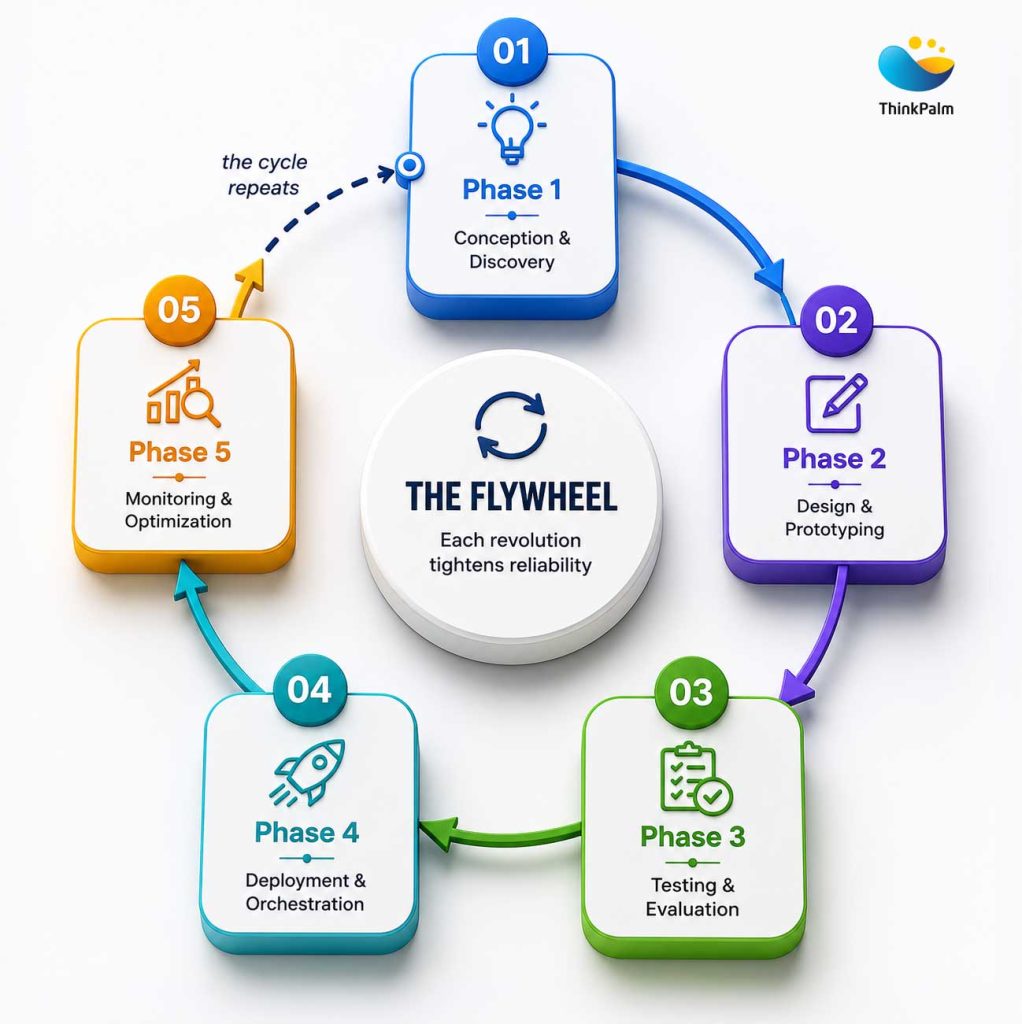
The 5-phase ADLC flywheel for continuous agentic AI development.
The Flywheel is a continuous, four-step loop:
Put the agent into a controlled or simulated environment.
Surface failure modes using evaluation benchmarks.
Update the eval suite with the newly discovered edge cases.
Experiment with the agent’s prompts, retrieval, and tool use based on what you learned.
Then it repeats.
Each revolution tightens reliability a little further. In a real sense, the eval suite functions as the agent’s control system, the mechanism that turns “it worked in the demo” into “it works, consistently, in production.”
See ADLC principles at work in a live production system. ThinkPalm helped a UX management platform trusted by Fortune 50 companies across 195 countries move from a working prototype to a governed agentic AI system that turns unstructured customer feedback into real-time, actionable insights.
Every autonomous agent you deploy is also a potential attack surface, and across the AI agent lifecycle, security can’t be bolted on after deployment. The shift from SDLC to ADLC demands a fundamental rethink of application security, because agents make runtime decisions that traditional static analysis was never designed to catch.
Security guardrails must be embedded at every phase, not treated as a compliance checkbox. Below are the critical controls engineering teams must implement:
Tool-use allowlists
Restrict each agent to a pre-approved set of tools and APIs; deny-by-default policies prevent unauthorized data access or exfiltration.
Agent-to-Agent (A2A) authentication
All inter-agent communication should use signed tokens or mutual TLS — unauthenticated message passing is a direct injection vector.
Immutable audit trails
Every autonomous decision must be logged with a timestamp, triggering context, and outcome; this is non-negotiable in regulated industries like finance or healthcare.
Scope-limited credentials
Agents should operate on least-privilege principles like time-bound, scoped API keys only.
Output validation layers
Intercept and validate agent outputs before they reach downstream systems or external APIs.
Critical Oversight
Failing to implement a hard-stop “kill switch”, which is a mechanism to immediately halt agent execution when anomalous behaviour is detected, is the single most dangerous oversight in enterprise agentic deployments. Design circuit breakers before you go live, not after.
On the other hand, overly rigid constraints can cripple agent utility. The goal is calibrated autonomy: agents operate freely within defined boundaries and escalate or halt when those boundaries are approached.
The real measure of any ADLC partnership isn’t the strategy deck — it’s the working system in production. Are you ready to move from architectural thinking to reliable agentic systems built for enterprise scale?
Explore ThinkPalm’s AI Development ServicesScaling agentic AI development beyond the proof-of-concept stage demands a structured lifecycle and not just better prompts or faster iteration cycles.
The sections above map a clear trajectory: from scoping agent goals to continuous monitoring and security hardening. The ADLC is the architectural commitment that separates prototypes from production systems.
Engineering leaders should carry these strategic imperatives forward:
Without a formalized lifecycle, agentic systems hit a reliability ceiling well before they reach meaningful business impact. The ADLC provides the governance scaffolding that autonomous agents inherently lack.
Structured AI lifecycle implementation can achieve a reduction in total cost of ownership through optimized resource allocation and reduced rework.
Enterprise-grade reliability requires deliberate human oversight checkpoints baked into the lifecycle, not bolted on after incidents occur.
Success requires shifting the engineering mindset from tuning individual model outputs to designing resilient, observable multi-agent systems at scale.
The gap between a promising agentic prototype and a production-ready system is often where enterprises stall — and the right engineering partner closes that gap faster than any framework alone.
The decades of domain depth of ThinkPalm in Telecom and IoT engineering translate directly into ADLC advantages. Complex, always-on network environments demand the same resilience, observability, and agent governance discipline that agentic workflows require at scale. That operational context — not just AI familiarity — is what separates reliable deployments from experimental ones.
Specialized testing capability is the hidden multiplier in any ADLC. ThinkPalm’s Testing-as-a-Service (TaaS) methodology applies structured validation at every lifecycle gate: behavioural testing, regression loops, and automated pipeline reliability checks that mirror how production agents actually behave under load. Skipping this rigor can result in agents that perform in staging but fail in the field.
Reducing the total cost of ownership is a consistent outcome of ThinkPalm’s full-lifecycle AI/ML engineering model. By embedding domain engineers, ML practitioners, and QA specialists into a single delivery structure, organizations avoid the fragmented handoffs that inflate time-to-value. The ADLC framework rewards this kind of integrated approach, iteration cycles compress, and technical debt stays manageable.
ADLC isn’t a rebrand of SDLC for the AI era. It’s a recognition that agents reason, adapt, and sometimes behave unpredictably, and that reality demands its own discipline: scoped conception, eval-driven testing, governed deployment, and monitoring that never really stops. Teams that treat this as optional tend to find out the hard way, usually a few weeks after launch, once the edge cases start piling up.
The organizations getting this right aren’t doing it with better prompts. They’re doing it with structure: a viability check before any code is written, an eval suite that grows sharper with every production run, and security guardrails that scale with the agent’s autonomy instead of fighting it.
Ready to build agentic systems that hold up in production, not just in the demo? Explore how bringing ADLC discipline to your next AI agent initiative can benefit your business goals.
Midhula Jeevan is a passionate content writer with a focus on SEO and technical writing. With a love for words and a curiosity for the technical side, she blends creativity with strategy to craft content that stands out. When not writing, you could find her usually reading books, enjoying a good cup of coffee, or chasing golden sunsets.