Multi-Agent Orchestration in Practice: Industry Applications & Use Cases
Agentic AI
 Midhula Jeevan
June 19, 2026
Midhula Jeevan
June 19, 2026



 Midhula Jeevan
June 19, 2026
Midhula Jeevan
June 19, 2026
Knowing what multi-agent orchestration is gets you a seat at the table. It does not tell you where to start. For enterprise leaders, the questions that actually matter are more specific:
This article answers all three, with a close look at the industries already seeing measurable multi-agent orchestration ROI.
Multi-agent orchestration is no longer just an idea for the future. It is already being used across industries to solve real business challenges.
By enabling multiple AI agents to work together, organizations can handle complex tasks more efficiently, make better decisions, and achieve results faster. In many cases, this approach delivers outcomes that standalone AI systems or traditional manual workflows simply cannot match.
In manufacturing environments, multiple AI agents can work together across quality inspection, predictive maintenance, supply chain management, and compliance monitoring. When an issue occurs, agents can identify the root cause, assess the impact, and route the right actions automatically. This reduces production delays, improves compliance, and enables faster decision-making across the factory floor.
Multi-agent systems bring speed and accuracy to payroll and workforce management processes. Agents can simultaneously handle data validation, compliance checks, payroll calculations, and reporting, significantly reducing manual effort and errors. In one deployment, ThinkPalm helped a UK-based payroll provider reduce implementation time by 50% while improving operational efficiency.
Logistics and maritime operations require constant coordination between network monitoring, fault detection, compliance management, and real-time operational data. Network performance agents, fault-detection agents, customer experience agents, and configuration agents work together to enable self-healing network operations and proactive incident management. In maritime operations, where regulatory compliance and real-time vessel data intersect constantly, orchestrated AI removes the latency that human coordination introduces.
Financial institutions manage a range of interconnected processes, from loan origination and fraud detection to regulatory reporting and customer communication. Multi-agent orchestration enables these functions to run in parallel within a governed and auditable framework. Tasks that traditionally required coordination across multiple teams can now be completed in near real time, improving both speed and accuracy.
The highest-impact multi-agent orchestration use cases share three characteristics:
If a workflow matches this profile, it is a strong candidate for orchestration, and an early indicator of where multi-agent orchestration ROI shows up fastest.
Orchestration amplifies whatever governance architecture you build into it, for better or worse. While thinking about multi-agent orchestration use cases, three risk factors demand attention before any enterprise AI orchestration goes live.
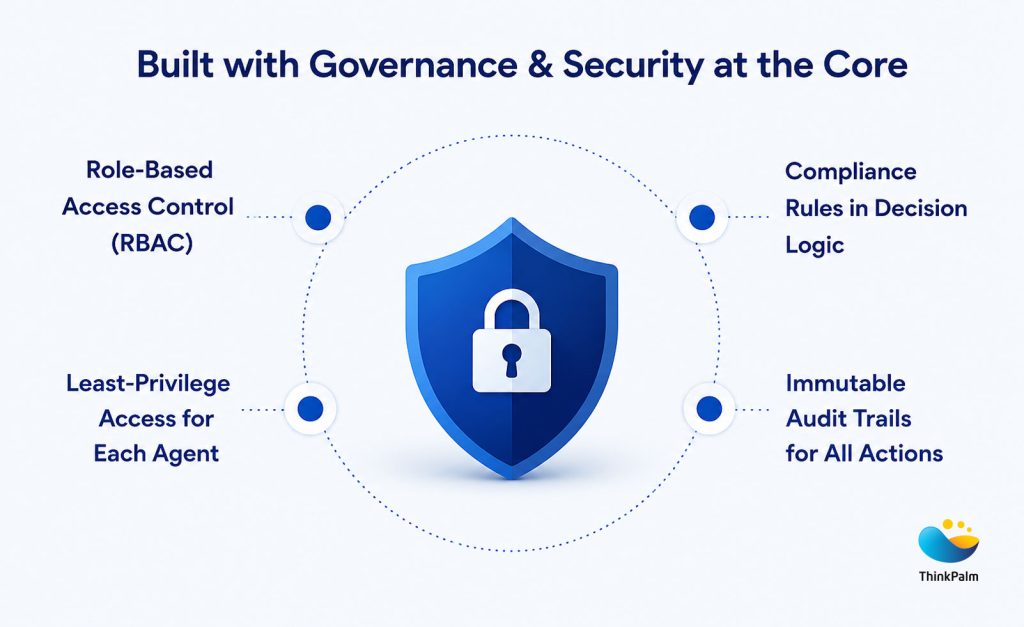
Without built-in compliance measures and role-based access control (RBAC) from the start, AI orchestration can increase risk even as it improves efficiency. To ensure secure and compliant operations, organizations should implement least-privilege access for each agent, embed compliance rules into orchestration workflows, and maintain tamper-proof audit trails that record every agent action.
Orchestration frameworks tied too tightly to a single vendor ecosystem limit future flexibility. Design for longevity and platform-agnostic architecture from the start, so the system can absorb new agents, new tools, and new compliance requirements without a costly rebuild.
Keep the scope of the workflow as small and measurable as possible before expanding. The pilot creates the proven architecture that makes subsequent deployments faster and cheaper, and it is the single biggest factor separating enterprises that see fast multi-agent orchestration ROI from those stuck in proof-of-concept purgatory.
Looking beyond orchestration? Explore our comprehensive guide to AI for Business Process Automation and see how enterprises are transforming end-to-end workflows with AI.
Most enterprises do not fail at multi-agent orchestration because the technology does not work. They fail because they skip the discipline of a phased rollout. Here is the sequence that consistently separates successful deployments from stalled ones when it comes to multi-agent orchestration use cases.
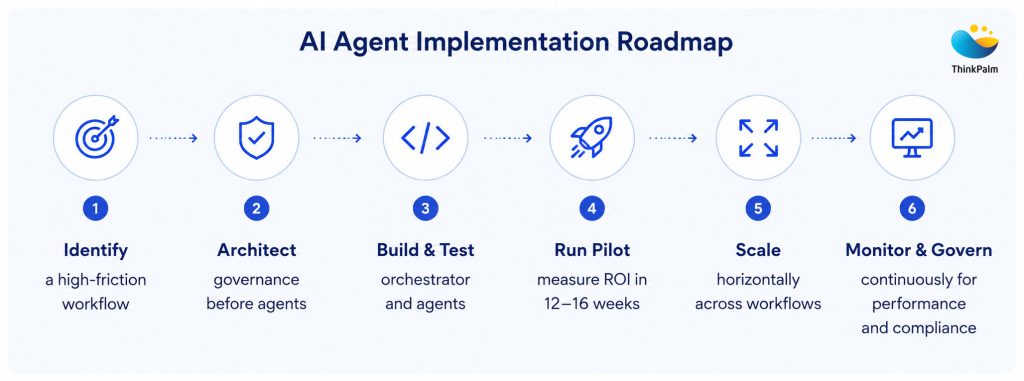
Look for a process with multiple departments, clear compliance gates, and heavy manual coordination today. Customer onboarding, procure-to-pay, and compliance reporting are common starting points because inputs, outputs, and success criteria are easy to define.
Establish role-based access controls, least-privilege access, and audit trail requirements before any agent is created. In contrast, it is much more expensive to design governance from the beginning than to retrofit it after deployment.
Validate orchestration logic against historical data and edge cases. Measure accuracy, latency, and failure modes before expanding scope.
With a disciplined pilot focused on a well-scoped workflow, enterprises typically demonstrate measurable ROI within 12 to 16 weeks. This is the proof point that earns budget for the next phase.
Use the same orchestration infrastructure on other neighboring workflows – don’t create a new platform from scratch for every use case. This is why it is important to have a platform-agnostic design.
Its deployment to production calls for the observability, alerting, and periodic review of agent behavior and how it is governed by rules.
Most orchestration discussions focus on platforms. ThinkPalm’s differentiation begins with engineering depth, 15+ years of product engineering expertise across telecom, manufacturing, maritime, logistics, fintech, and HCM, bringing the domain understanding to design agents that actually work in complex industrial realities, not just in controlled demos.
The ThinkPalm Difference
Platform vendors sell orchestration capability. ThinkPalm engineers orchestration outcomes.
Implementing multi-agent AI takes more than choosing a platform. Enterprises need a partner with AI expertise, engineering depth, domain knowledge, and governance frameworks to build reliable, scalable solutions.
ThinkPalm helps organizations turn AI experiments into production-ready systems with measurable business impact.
Secure, compliant, agentic AI with strict data governance, regulatory compliance, and enterprise-grade security. Agents are trained and tuned to your KPIs specific to that domain.
Combines requirement elicitation, code generation, QA automation, and deployment of risk agents. Up to 60% reduction in manual development efforts for clients.
Retrieval-Augmented Generation gives orchestrated agents access to your proprietary knowledge base, ensuring contextually accurate, organization-specific intelligence rather than generic outputs.
ThinkPalm designs AI models specific to your business needs and industry benchmarks, not on the off-the-shelf defaults.
For data-sovereign enterprises, complete data control without sacrificing orchestration capability, using open-source technologies and dedicated GPU infrastructure.
ISO 9001:2015 and ISO 27001:2022 certified. Security and compliance controls are design constraints, not afterthoughts, at every stage of the engagement.
Build secure, scalable, and outcome-driven multi-agent AI systems with ThinkPalm’s engineering expertise and domain knowledge. Explore our full range of capabilities.
Multi-agent orchestration is no longer an emerging concept. It is rapidly becoming the foundation for how enterprises scale AI across complex operations, workflows, and decision-making processes.
The rise of multi-agent orchestration use cases across various sectors, like manufacturing, fintech, logistics, HCM, and others, illustrates that businesses are already leveraging orchestrated AI agents to boost efficiency, speed up decision-making, and achieve better results.
With the spread of the adoption of AI, the issue now is no longer whether enterprises will utilize intelligent agents, but how effectively they can coordinate them to deliver a sustainable competitive advantage.
Move beyond AI pilots with a practical strategy for deploying coordinated AI agents across your critical business workflows.
Midhula Jeevan is a passionate content writer with a focus on SEO and technical writing. With a love for words and a curiosity for the technical side, she blends creativity with strategy to craft content that stands out. When not writing, you could find her usually reading books, enjoying a good cup of coffee, or chasing golden sunsets.