AI-Powered Predictive Maintenance: The Future of Intelligent Data Center Operations
Internet of Things (IoT)
 Athira Gopakumar
August 14, 2026
Athira Gopakumar
August 14, 2026



 Athira Gopakumar
August 14, 2026
Athira Gopakumar
August 14, 2026
Imagine a data center operations team preparing for a scheduled utility power outage. On paper, all backup systems have passed their routine inspections, and everything appears to be functioning normally. But behind the scenes, one UPS battery bank has been degrading faster than expected. The decline is subtle and too gradual for manual checks to catch.
Weeks before the scheduled outage, an AI-powered predictive maintenance system identifies unusual performance patterns and predicts an increased risk of battery failure. With these predictive insights, the operations team replaces the affected units during a planned maintenance window. This could have become a major service disruption during a critical power event.
Definition
AI-powered predictive maintenance is the use of AI, machine learning models, real-time data and continuous infrastructure monitoring to estimate the health of equipment and predict when it’s likely to fail before a breakdown happens.
Instead of servicing assets on a fixed calendar or waiting for something to break, teams can act on what the data is actually telling them.
For facilities managing mission-critical workloads, moving from reactive to predictive maintenance helps reduce operational risks and lower maintenance costs.
Industry Data
Roughly 1 in 10 operators say their most recent outage had a serious or severe impact, according to Uptime Institute’s 2026 Annual Outage Analysis. Power is one of the leading causes of impactful outages, with failures involving UPS systems, transfer switches, and generators among the dominant factors.
In a data center environment, predictive maintenance can monitor:
Fixing it when it breaks is not the strategy anymore. It’s an admission that you’re always one step behind. Reactive maintenance worked when workloads were light and outages rare. Today’s intense digital demands require a proactive approach.
Here’s what reactive maintenance quietly costs a growing data center operation:
Unplanned downtime that suddenly impacts customer-facing services.
Emergency repair premiums and rushed part sourcing.
Technician overtime and burnout from constant firefighting.
Shortened lifespan of servers, UPS units, and cooling assets.
SLA penalties and compliance exposure.
Reputational damage that outlasts the actual incident.
None of these show up as a single dramatic line item. They accumulate quietly, until a board member asks why infrastructure costs keep climbing while capacity stays flat.
Data center predictive maintenance isn’t one piece of software; it’s a pipeline. When properly deployed, AI driven predictive maintenance for data centers delivers measurable ROI across several critical operational areas. Here’s the shape it typically takes:
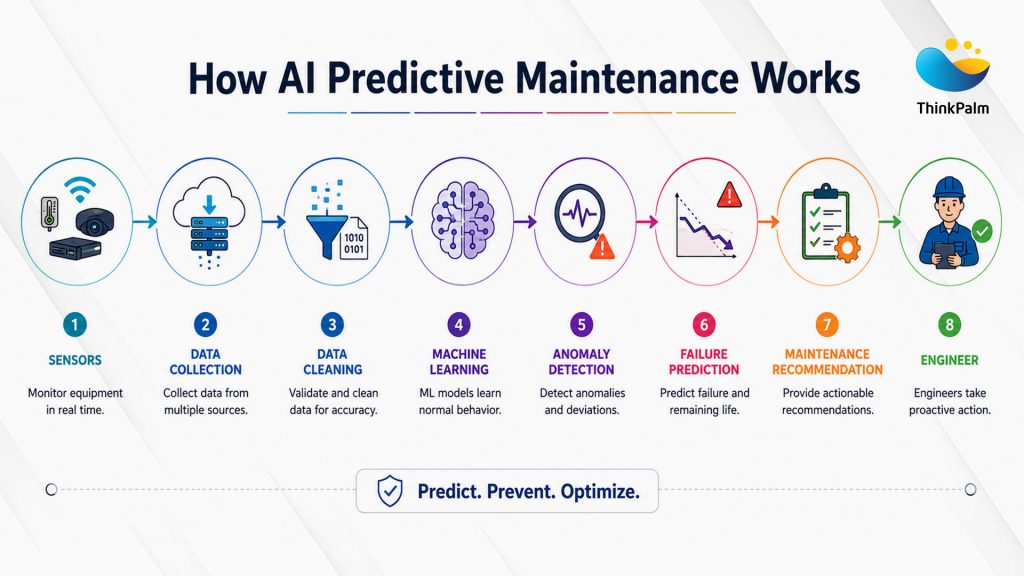
How AI-driven predictive maintenance works
Sensors and DCIM platforms constantly pull data on temperature, humidity, vibration, power draw, and battery health readings from servers, UPS systems, PDUs, cooling units, and network gear.
Readings from dozens of disconnected systems are unified into one consistent data layer. This foundational integration is where predictive projects succeed or fail.
ML models analyze historical performance to learn what “normal” looks like for each asset. This helps them flag subtle deviations, a slightly noisier fan, sudden increases in server temperature, a battery discharging faster than it should, long before a human notices.
When an anomaly is identified, the system estimates the remaining runway, forecasting the exact window, often days or weeks, before an asset fails.
Teams do not get generic warnings; instead, maintenance teams get a prioritized, specific recommendation. This tells them what’s degrading, how urgent it is, and what to do about it.
| Reactive Maintenance | Predictive Maintenance in Data Centers |
|---|---|
| Repairs occur after failure | Issues are detected before failure |
| Higher downtime risk | Improved uptime and resilience |
| Emergency-based interventions | Planned maintenance activities |
| Increased repair cost | Optimized maintenance spending |
| Limited visibility into asset health | Continuous infrastructure monitoring |
| Shorter asset life span | Extended equipment life span |
This isn’t a theoretical exercise. Applied well, AI-driven predictive maintenance for data centers shows up in very concrete places:
Identifying inefficiencies in CRAC/CRAH units and chillers before they become hot spots that threaten high-density racks.
Monitoring precise battery degradation trends so you can plan replacements during scheduled maintenance windows instead of rushing during emergencies.
Spotting failing fans, drives, and power supplies from telemetry patterns rather than waiting for support tickets to pile up.
Highlighting unusual load patterns across PDUs before they turn into serious electrical failures.
Leveraging historical data to plan when you’ll actually run out of power, cooling, or rack space, ensuring that your expansion decisions are informed by data rather than guesswork.
AI-driven predictive maintenance works on the principle of collecting data from various assets towards arriving at data-driven precision. A handful of capabilities work together to make this possible:
Learns failures from historical infrastructure data and real-time data to predict anomalies.
Provides data on key variables like temperature, humidity, and pressure, giving models the continuous, granular visibility they need.
Turns raw telemetry into ranked, actionable insight for deriving decisions.
Allows teams to simulate failures and test fixes without touching live equipment.
Pushes decision-making closer to the equipment for faster response.
Together, these are the building blocks of what the industry now calls the Intelligent Data Center, a facility that doesn’t just report its own status, but actively helps you run it better.
Pro-Tip
Start with the asset category causing you the most unplanned incidents today. A focused pilot builds internal trust faster than a facility-wide rollout.
Most data centers don’t need to build this technology from the ground up, they just need one platform that connects everything they already have. That’s exactly the gap NetvirE, ThinkPalm’s DCIM software built on an IIoT platform, is designed to fill. It doesn’t replace your existing DCIM or BMS. Instead, NetvirE sits on top of it using standard protocols like MQTT, Modbus, and SNMP. This way it turns the sensor data you already collect into a real, intelligent data center. In fact it is a practical example of AI-powered predictive maintenance for data centers in action.
Here’s how NetvirE’s sensor-to-cloud setup works, in plain terms:
Servers, UPS systems, CRAC units, PDUs, and environmental sensors constantly keep a watch on your infrastructure data which is gathered in real-time.
Industrial IoT gateways process this data close to where it’s generated, so the system can respond faster.
A cloud-native DCIM layer organizes and stores all this infrastructure data in one place, at scale.
Anomaly detection, predictive maintenance, digital twin visualization, and automated ESG reporting all come together on top of that unified data. This forms the core of AI in data center operations.
This setup is what makes ThinkPalm‘s NetvirE a genuinely intelligent data center solution. Its predictive maintenance module keeps a watch on equipment wear and tear, weeks before failure, not hours. In this manner, teams can prepare repairs on their terms instead of reacting to alarms. In production, this has translated into measurable outcomes for operators:
Of organizations have suffered a major outage caused by human error in the past three years; 85% of those stem from staff failing to follow procedures.
Google’s fleet-wide Power Usage Effectiveness (PUE) in 2025, versus the 1.54 industry average reported by the Uptime Institute.
Source: Google Data Centers
Critical failures are detected and neutralized long before they turn into costly service outages.
Eliminates emergency repair premiums and cuts down on redundant, calendar-based manual inspections.
Keeps expensive UPS units, cooling systems, and servers running within optimal operating parameters for longer.
Continuously tunes power and cooling infrastructure in real time instead of waiting for scheduled checks.
Frees technicians from constant firefighting so they can focus on high-value, planned operational tasks.
Gives leadership an accurate, real-time health dashboard across the entire facility footprint.
Maintenance activities become planned and prioritized, allowing teams to focus on high-value tasks.
Implementing AI for predictive maintenance in data centers isn’t simply a plug-and-play process. There are some predictable deployment issues which teams need to be aware of to ensure a smooth rollout. Let us delve into it:
Integration with legacy DCIM and monitoring tools should be treated as a core project workstream, not an afterthought.
Inconsistent or missing sensor data can slow down processes. Clean, unified data matters more than a complex algorithm.
Machine learning accuracy takes time, algorithms require more of your own infrastructure’s behavior to optimize predictions.
More connected sensors imply greater chances of attack surface. This makes security by design mandatory.
Engineers need to trust AI-generated recommendations before they move from legacy systems.
Working with a partner who has already navigated these issues across telecom, IoT, and data center deployments shortens the learning curve considerably.
As AI capabilities mature, the industry is also moving from simple monitoring to entirely autonomous and self-healing infrastructure environments. This means we are heading to a world of autonomy which requires minimal human supervision and predictive maintenance is really the entry point to something bigger. We envision an intelligent data center that will rely on a core stack of emerging technologies such as:
Infrastructure that adjusts itself in real time.
Systems that resolve minor issues without human intervention.
Digital twin visualization used for routine “what-if” planning, not just occasional simulations.
Generative AI assisting operations teams with diagnostics and reporting.
Sustainability-driven optimization baked into everyday decisions.
Within a few years, as these technologies merge, AI powered predictive maintenance will transform from an innovative upgrade to becoming a baseline requirement for enterprise grade operations.
The gap between data centers running on reactive maintenance and those running on AI-powered predictive maintenance is only going to widen. Every quarter you wait is another quarter of avoidable downtime risk, rising repair costs, and equipment wearing out faster than it should.
The organizations pulling ahead aren’t necessarily the ones with the biggest budgets; they’re the ones that started building real-time visibility into their infrastructure early and let the data guide their maintenance decisions from there.
Unify monitoring, predictive maintenance, and ESG reporting with NetvirE. Eliminate downtime, gain full asset visibility, and act on real-time data.
Athira Gopakumar is a Digital Marketing Specialist in the tech industry, with a strong focus on IoT marketing. She specializes in data-driven strategies, leveraging SEO, content marketing, and market research to enhance brand visibility and lead generation for IoT solutions. Passionate about the intersection of technology and marketing, she stays ahead of industry trends to drive impactful campaigns. Outside of work, she enjoys traveling to new places and dancing to unwind.