AI For Manufacturing Operations: The Bottlenecks Nobody Talks About
Agentic AI
 Midhula Jeevan
August 12, 2026
Midhula Jeevan
August 12, 2026



 Midhula Jeevan
August 12, 2026
Midhula Jeevan
August 12, 2026
Every growing manufacturing business eventually runs into the same quiet problem.
Somewhere in the middle of the operation, there’s a task that only one or two people really know how to do well. Everyone depends on them. The process runs on their judgment. And nobody notices how fragile that setup is until the day it stops being fast enough.
In manufacturing, this shows up most often in one specific place: reading customer specifications. The goal of AI for manufacturing operations is not to replace human expertise, but to work alongside it. AI can handle the repetitive, time-consuming parts of the process, while experienced teams continue making the decisions that require context, judgment, and business understanding.
Every time a customer sends in a specification, the exact requirements for what they want produced, someone has to read it, understand it, and translate it into two things: the finished product it matches, and the raw materials needed to build it.
That someone is almost always a planner with years of experience. They know the terminology, they know the shortcuts, they can look at a vague line in a spec document and know exactly what it means, because they have seen a hundred versions of it before.
This works well for a long time. It is a genuinely effective way to run a process, right up until the business starts growing faster than its planners can keep up with.
More orders come in. Specifications get more detailed. And the process that used to feel like expertise starts to feel like a constraint. Two planners might read the same document and land on slightly different interpretations. Whoever happens to be available that day ends up deciding how fast an order moves. Planner dependency like this is not really anyone’s fault. It is simply what happens when a process lives in people’s heads instead of in a system.
This is one of the most common manufacturing bottlenecks: not a lack of skill, but a lack of a repeatable process built around that skill. Reducing manual planning work is not about removing the planner. It is about removing the parts of the job that do not actually need them.
The instinctive response to a bottleneck like this is to look for a workflow tool, something that moves the specification document from one queue to another faster. But that does not actually solve the underlying problem, because the bottleneck was never about moving the document. It was about understanding it.
A generic automation tool can route a file. It cannot read a specification the way a planner does. It does not know that a particular tolerance range implies a different raw material grade, or that a certain phrase in a customer’s document means something specific to that industry. Solving this problem properly requires something closer to AI document extraction: a system that can actually parse the structure, terminology, and intent of a specification, not just shuffle it through a pipeline.
This is also where the choice of AI model matters significantly. A general-purpose model approximates. A model trained on your specific document types, terminology, and product catalog knows. This is where AI-assisted decision making becomes a genuinely different category of solution, rather than just a faster version of the same workaround.
If you are evaluating whether to use an off-the-shelf model or build something more specific to your operation, it is worth reading about custom LLM development and when fine-tuning actually pays off.
Specification mapping is one example of a much broader shift underway in AI for manufacturing operations. AI process automation in manufacturing tends to show up in a handful of recurring areas.
Instead of servicing equipment on a fixed schedule or waiting for a breakdown, AI models trained on sensor data can flag when a machine is likely to fail, often days or weeks in advance. This shifts maintenance from reactive to planned, which cuts downtime and extends equipment life.
Computer vision models can inspect products on a production line far faster and more consistently than manual inspection, catching defects that are easy for a tired human eye to miss during a long shift.
AI models that factor in historical order patterns, seasonality, and external signals can produce more accurate demand forecasts than manual spreadsheet-based planning, which reduces both stockouts and excess inventory.
AI can model supplier lead times, transportation costs, and disruption risk simultaneously, something that is difficult to do by hand once a supply chain has more than a few variables.
This is the category specification mapping falls into. Any process that depends on someone reading, interpreting, and acting on unstructured information, including contracts, compliance documents, and customer specifications, is a candidate for AI document extraction and mapping.
Want to explore how AI transforms business operations beyond software development? Read ThinkPalm’s guide to AI for business process automation.
What ties all of these together is the same underlying idea: AI in manufacturing tends to deliver the greatest operational efficiency when it is applied to the parts of a job that are repetitive and pattern-based, while leaving judgment-heavy decisions to the people who are actually equipped to make them. The goal generally is not full automation. It is scaling operations with AI by removing the repetitive load, so human expertise gets spent where it actually matters.
Specification mapping is a useful example precisely because it sits right at that boundary. It is document-heavy, pattern-based, and repetitive enough to automate, but the final decision still benefits from a planner’s judgment.
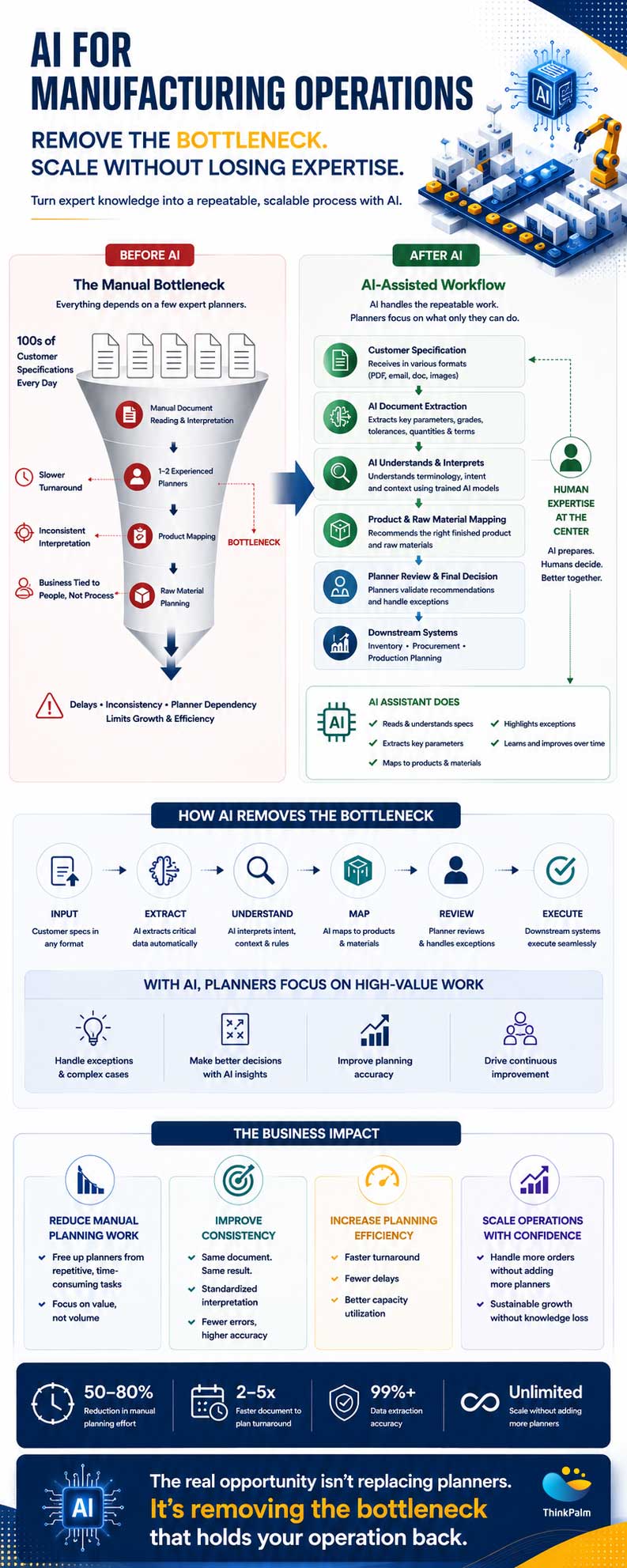
Here’s an infographic that walks through the full before-and-after picture, from the manual bottleneck to the AI-assisted workflow.
Download the InfographicIt is worth being clear about what companies facing this kind of problem usually want, because it is often misunderstood.
They do not want to replace their planners. And they do not want to automate away the judgment that made the process trustworthy in the first place. Planner expertise is valuable. The goal is not to remove it from the equation.
What they want is for the repetitive, predictable part of the job, reading the document, pulling out the requirements, matching it to a product, to happen consistently and quickly, so planners can spend their time on the parts of the job that actually need a human: the exceptions, the judgment calls, the ambiguous cases a machine still cannot reliably handle.
That distinction matters, because it changes what “success” looks like. This is not about reducing headcounts. It is about reducing manual planning work so the people doing that work can focus on the pieces that genuinely require experience.
AI decision support, at its best, is not a replacement layer. It is a preparation layer. It does the first pass. The human does the final review. This approach is also at the heart of what AI-led modernization looks like in practice for operations teams.
From document extraction pipelines to full specification mapping workflows, ThinkPalm’s AI engineers build solutions around how your business actually works.
Learn More About ThinkPalm’s AI Development ServicesBased on this pattern, here is a practical design for how an AI-assisted specification mapping system could work in a manufacturing environment. This is a proposed architecture, the kind of system ThinkPalm would design for a manufacturer facing exactly this problem.
The way AI systems like this handle complex documents draws directly on principles of knowledge representation in AI, the idea that an AI model needs to understand not just the words in a document but the relationships and meaning behind them.
Specifications would arrive the same way they always have, typically by email, so there is no new tool for the customer to learn and no new habit for the internal team to adopt either.
An AI model trained on this kind of document would extract the requirements, tolerances, and other details that matter, essentially doing the same interpretive work a planner currently does by hand. This is automating specification mapping at the extraction and interpretation level, not just the routing level.
The system would connect the specification to the correct finished good, and from there, to the raw materials required to produce it.
Instead of starting from scratch, a planner would review a system-generated mapping and adjust where needed. The system produces the first draft. The human still makes the final call. This is AI decision support working the way it should.
The output would flow straight into inventory and raw material planning, so the benefit would not stop at faster document reading. It would carry through to everything downstream that depends on that information.
This isn’t just a proposed architecture — see how ThinkPalm applied this exact approach for a real manufacturing client, moving specification mapping from a planner’s head into a system the whole team can rely on.
A solution built around AI-powered specification mapping has the potential to improve manufacturing planning in several practical ways.
First, it would reduce the manual effort currently spent interpreting and mapping customer specifications. The repetitive first-pass work that planners currently do on every order becomes a system function rather than a person-hours function.
Second, it would make specification-to-product mapping faster and more consistent, since planners would be starting from a structured baseline instead of an interpretation built from scratch each time. This directly addresses the planner dependency problem that creates inconsistency at scale.
Third, it would improve raw material planning and inventory visibility as a downstream effect of faster, more consistent specification data feeding into planning systems.
The overall impact will depend on factors such as production processes, data quality, and system integration. Organizations that adopt this approach can expect improvements in planning efficiency, consistency, and decision support as the solution is tailored to their operational environment.
Looking to explore how agentic AI solutions could work for your manufacturing operation? ThinkPalm’s agentic AI team designs systems that handle complex, multi-step workflows so your people can focus on the decisions that actually need them.
Explore ThinkPalm’s Agentic AI SolutionsThis is not really a story about specification documents specifically. It is a pattern that shows up in almost every growing company: critical knowledge sitting in a handful of people’s heads, with no way to scale it beyond how many hours those people can work in a day.
AI for manufacturing operations does not have to mean replacing the people who hold that knowledge. Often, the more effective move is encoding the repeatable part of what they know into a system, and giving them back time to focus on the parts of the job that genuinely need a human.
If there is a process in your business that only works because one or two people just know how to do it, that is usually a sign it is a good candidate for exactly this kind of solution. It is rarely a sign that those people are not valuable. It is a sign that their expertise has not yet been translated into something the rest of the business can rely on consistently.
Scaling operations with AI in manufacturing is not about removing human judgment from the equation. It is about making sure that judgment is being spent on the right problems.
For a broader look at how generative AI for enterprises is enabling this shift across industries, ThinkPalm’s complete guide for business leaders covers the strategic and practical dimensions in depth.
The bottleneck at the center of this story is common. Most growing manufacturers have at least one process that runs on the expertise of a small number of people, works well enough until it does not, and has no clear path to scaling without adding more of those same people.
AI for manufacturing operations offers a different path. Not by replacing experienced planners, but by extending their capabilities. By encoding the repeatable part of what they do into a system that is faster, more consistent, and always available, AI allows teams to spend less time on manual work and more time on decisions where human expertise creates the most value.
For operations teams thinking about where to start, specification mapping is a useful entry point because the problem is concrete, the inputs and outputs are well-defined, and the downstream benefits carry through to inventory, procurement, and production planning. AI decision support built for this kind of task does not require a rethink of the entire operation. It requires identifying the one process where planner dependency is already creating a visible constraint and building a system around that first.
The broader principle holds across manufacturing: operational efficiency AI works best when it is built around what your operation actually does, not around what a generic tool assumes you do. That is the difference between a system that earns trust and one that gets quietly abandoned.
Ready to talk through what this could look like for your operation? ThinkPalm’s AI engineering team works with manufacturers to turn process bottlenecks into repeatable, scalable systems. No generic tools. No off-the-shelf assumptions.
ThinkPalm is a product engineering and AI development company that helps manufacturing and operations teams build exactly this kind of system. From AI document extraction pipelines to full specification mapping workflows, ThinkPalm’s engineering team designs solutions around how your business actually works, not around what a generic platform can do out of the box.
Midhula Jeevan is a passionate content writer with a focus on SEO and technical writing. With a love for words and a curiosity for the technical side, she blends creativity with strategy to craft content that stands out. When not writing, you could find her usually reading books, enjoying a good cup of coffee, or chasing golden sunsets.