AI in Maritime Shipping: Top Use Cases and ROI in 2026
Agentic AI
 Midhula Jeevan
August 19, 2026
Midhula Jeevan
August 19, 2026



 Midhula Jeevan
August 19, 2026
Midhula Jeevan
August 19, 2026
Shipping carries more than 80% of world trade. However, for most of its history, the industry has relied on paper workflows, manual scheduling, and fixing things after they break.
AI in maritime shipping is changing that. In fact, the numbers make a clear case for why this is happening now.
Source: Grand View Research, Maritime AI Market Report 2024
This article covers the five highest-impact maritime AI use cases in 2026, with real statistics and a look at what makes deployments succeed. So, let’s dive in!
AI in the shipping industry has crossed a significant threshold. Specifically, in 2024, 420 organizations adopted maritime AI solutions, up from 276 in 2023. That is not experimental adoption. Rather, that is an industry in the middle of a structural shift.
The maritime AI use cases that are delivering proven ROI today fall into five categories:
AI-driven route and fuel planning across weather, currents, and port conditions
Sensor-based early warning for equipment failures before they happen at sea
AI forecasting for provisions, spare parts, and fuel by route and vessel class
Wearable-driven fatigue and wellness tracking linked to voyage performance
Fleet-level behavioral monitoring for navigation, compliance, and safety risks
Each one addresses a specific operational pain point, and more importantly, each one depends on the same underlying requirement: the AI needs to understand maritime operations, not just approximate them.
What is driving adoption right now is a combination of regulatory pressure from IMO emissions rules, the explosion of data from onboard maritime IoT sensors, and growing frustration with the cost of doing things the old way. As a result, fleet operators who have been watching from the sidelines are increasingly recognizing that the question is no longer whether to adopt AI for ship management, but how to do it without paying for a system that gets abandoned six months in.
Fuel makes up 40 to 60% of what it costs to run a vessel. Consequently, it is also where ship route optimization with AI delivers its fastest and most measurable return.
AI route optimization looks at weather, ocean currents, port congestion, cargo load, and emissions rules to find the most efficient path for each voyage. Moreover, it keeps adjusting as conditions change, not just once at departure, but throughout the journey, pulling continuous data from maritime IoT sensors onboard and external environmental feeds.
Reported by early adopters across container, bulk, and tanker fleets
There is also a CII compliance AI benefit. IMO’s Carbon Intensity Indicator (CII) rules now require every vessel to report carbon efficiency per voyage. Poor CII ratings affect charter rates, port access, and insurance premiums. As a result, AI route optimization generates this data automatically, producing auditable maritime fuel savings records with no manual logging required.
ROI Illustration
A fleet of 20 vessels saving 12% on fuel per voyage adds up to millions in annual savings, while improving the CII rating that affects commercial terms. Ultimately, the key is not just having a routing tool. It is having one that understands your specific vessels, your cargo type, and your port windows. Generic tools give generic results.
ThinkPalm builds domain-trained AI for maritime operations, from standalone vessel monitoring to end-to-end agentic workflows built around how your fleet actually operates.
A vessel breaking down at sea creates a chain of problems: safety risk, cargo delay, and serious costs. Correspondingly, to address this, predictive maintenance maritime AI is built to make this rare.
Sensors on engines, pumps, and other equipment send data to an AI model trained to recognize early signs of failure, including changes in vibration, temperature, or pressure that a human would not notice until things had already gone wrong. In other words, this is vessel performance monitoring working in real time rather than on a scheduled inspection cycle.
in AI predictive maintenance deployments across maritime fleets.
Traditional maintenance works on a calendar: replace this part every 3,000 hours. However, AI for ship management changes this. It tells you when a part is actually showing signs of wear, so you replace it before it fails, not before it was scheduled to. As a result, this directly drives fleet downtime reduction across the entire vessel operation.
This also improves parts planning. For example, when you know weeks in advance which components are likely to need attention, you stop over-ordering spares or scrambling for emergency deliveries.
ThinkPalm’s Platform
ThinkPalm’s maritime IoT platform monitors around 6,000 sensors per vessel, processing 360,000 data points per minute across engines, cargo systems, and navigation equipment. Consequently, that level of data coverage is what makes genuine early warning possible at sea.
Netvire is ThinkPalm’s IIoT platform built for real-time vessel monitoring, predictive maintenance, and fleet performance management.
Why Off-the-Shelf Models Struggle Here
A general AI model does not know what normal looks like for a specific type of marine engine running at 80% power in cold conditions. This is because off-the-shelf AI models often fail in maritime environments. They flag too many false alarms, and eventually, engineers stop trusting them.
Managing supplies on a large vessel sounds simple. However, in practice, it is one of the more complex AI applications in the maritime shipping industry. Voyages can last weeks; ports have different stock availability, consumption changes with weather and crew size, and running out of something mid-ocean is not a minor inconvenience.
AI forecasting systems draw on past consumption patterns, upcoming routes, weather forecasts, and port conditions to predict what a vessel will need and when. In essence, this is vessel inventory AI working across the full supply picture, not just fleet-wide averages.
What this looks like in practice:
The real ROI is not just efficiency. Rather, it is avoiding the expensive emergency procurement that happens when stockouts occur, while also freeing up capital tied up in excess inventory.
The same approach applies to spare parts and fuel planning; in fact, anywhere that what a vessel needs depends heavily on where it is going and how it operates.
with fatigue and stress as the leading causes.
Given these points, AI crew safety systems use wearables to track health indicators continuously, not just during a scheduled medical check, but throughout the voyage. As a result, this shifts crew health management from reactive (treat illness when it appears) to preventive (spot warning signs early) and creates a direct link between crew condition and vessel performance monitoring outcomes.
What AI crew health systems deliver:
The benefits go beyond safety. In addition, healthier crews mean fewer disruptions mid-voyage, lower medical costs, and stronger compliance with work-rest regulations, which increasingly affects crewing contracts and port state control inspections. Overall, these are among the most direct AI applications in maritime shipping industry operators can make to reduce incident rates.
Managing crew schedules and rest hours manually is one of the biggest hidden risks in maritime operations. See how AI is transforming workforce scheduling, compliance, and planning across industries.
Read: AI in Workforce Management: The Complete Guide
AI anomaly detection in maritime shipping is one of the fastest-growing areas of AI fleet management and one of the least discussed in operational planning conversations.
Traditional vessel tracking technology uses AIS, the Automatic Identification System, to report a vessel’s position. AIS tells you where a vessel is. AI anomaly detection tells you when something about that vessel’s behavior does not match what it should be doing and flags it before it becomes a problem.
What AI anomaly detection covers in practice:
For fleet management with AI, anomaly detection operates at the fleet level, not just the individual vessel level. A fleet management AI system that monitors behavioral patterns across dozens of vessels simultaneously can identify systemic issues, route safety patterns, and compliance anomalies that no manual review process could catch at scale.
There is also a sanctions compliance angle. Vessels going dark to evade tracking is a known sanctions evasion method. AI anomaly detection systems trained on historical dark vessel patterns can flag suspicious behavior with a speed and accuracy that manual AIS monitoring cannot match.
Fleet downtime reduction is a secondary but meaningful benefit. Catching navigation anomalies and mechanical warning signals early, before they result in a deviation, delay, or incident, keeps more vessels on schedule and reduces the downstream cost of disruptions.
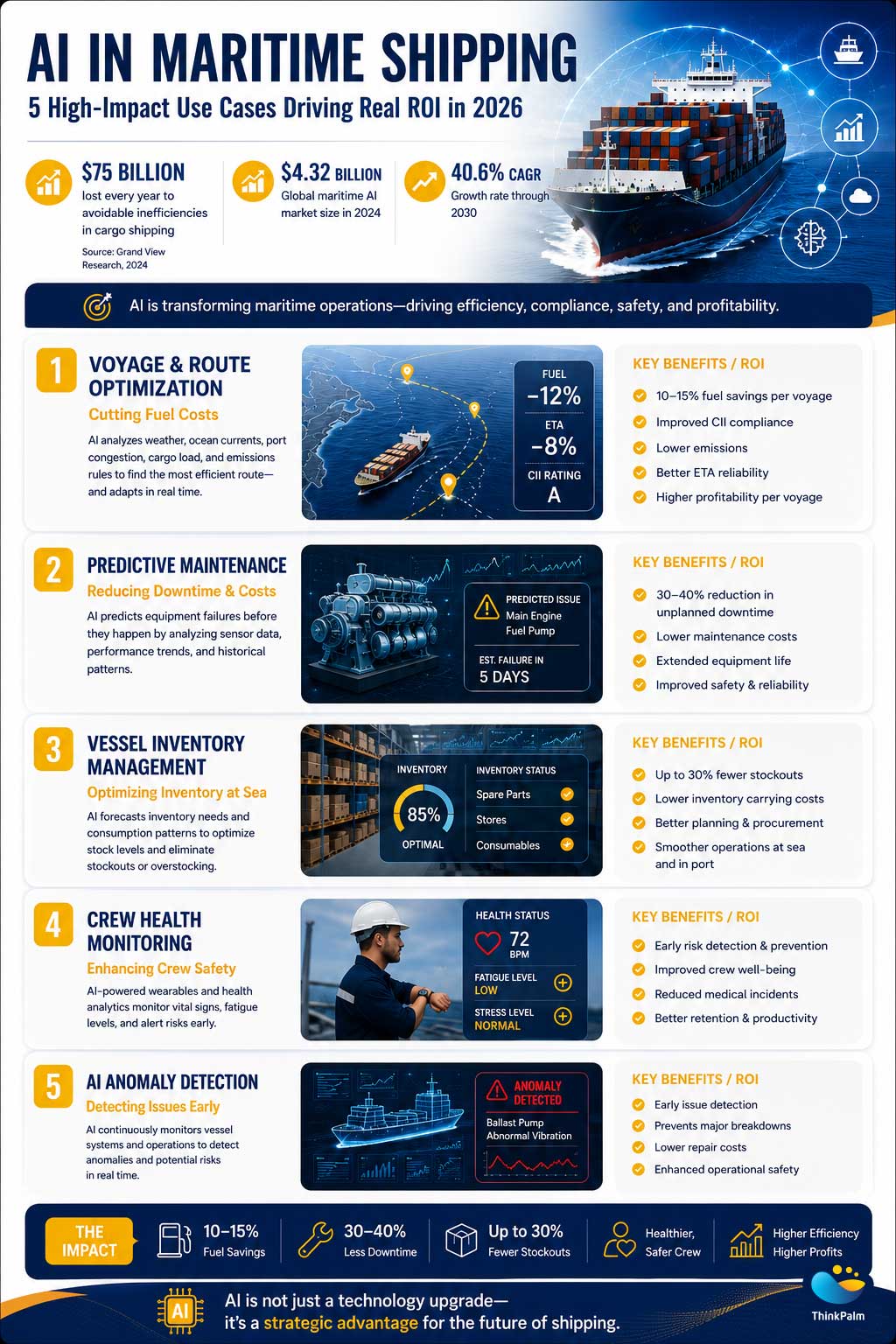
Here’s an infographic that brings all five maritime AI use cases together in one view.
Download the InfographicRoute optimization, predictive maintenance, vessel inventory, crew health, and AI anomaly detection in maritime shipping all depend on the same thing: the AI needs to actually understand maritime operations.
A general AI model does not know the difference between a ballast voyage and a laden voyage. It does not know what normal engine pressure looks like on a specific vessel class in winter. It approximates. And experienced maritime operators quickly stop trusting outputs that approximate rather than know.
This is where maritime AI use cases succeed or fail. The ROI gap between domain-trained maritime AI and generic AI is not a small one. It is the difference between a system that earns trust and one that gets quietly abandoned after six months. AI in maritime shipping only delivers its full return when it is built on data and domain knowledge that reflects how vessels, routes, and crews actually behave.
ThinkPalm is a product engineering and AI development company with a dedicated maritime AI practice. For fleet operators, shipowners, and maritime technology providers looking to move from manual operations to AI-driven workflows, ThinkPalm provides the domain expertise and engineering depth to build systems that actually work at sea.
ThinkPalm’s maritime AI capabilities include:
Onboard sensor integration, real-time data pipelines, and the maritime IoT platform that processes 360,000 data points per vessel per minute.
Domain-trained fleet management AI that covers vessel performance monitoring, route optimization, and anomaly detection across an entire fleet simultaneously.
Custom AI models trained on maritime equipment data, built to produce alerts that engineers trust and act on.
AI-driven provisioning and spare parts forecasting tailored to route, vessel class, and port availability.
End-to-end AI applications in the maritime shipping industry, from decision support tools for ship masters to fleet-level operational analytics.
Maritime shipping is not the only industry where manual operations are hitting a ceiling. See how enterprise leaders are using AI to automate complex, high-volume operations at scale.
Read our guide on AI for Business Process Automation
AI in maritime shipping has moved past the proof-of-concept stage. The five use cases covered in this article are all delivering measurable ROI in production deployments today.
The pattern across all five is consistent. Maritime AI use cases succeed when the underlying system understands the specific context in which it is operating. Domain-trained models outperform generic ones. Systems built around how a fleet actually operates outperform systems built around what a general AI platform can do out of the box.
For fleet operators and maritime businesses evaluating where to start, the entry point matters less than the architecture. Build on a foundation of real maritime data, real integration with your vessels and systems, and a governance model that keeps your teams in control of the decisions that matter. AI fleet management done right does not remove human judgment from maritime operations. It makes sure that judgment is being applied where it is actually needed.
ThinkPalm is ISO 27001:2022 certified and offers on-premise deployment for operators with data sovereignty requirements. Every system that we build is production-ready from day one, not a proof of concept that needs months of tuning before it delivers value.
Let’s build something that actually works at sea.
Midhula Jeevan is a passionate content writer with a focus on SEO and technical writing. With a love for words and a curiosity for the technical side, she blends creativity with strategy to craft content that stands out. When not writing, you could find her usually reading books, enjoying a good cup of coffee, or chasing golden sunsets.