AI Across the Maritime Enterprise: Fleet Operations, ERP, Seafarer Training and Port Management
Agentic AI
 Midhula Jeevan
September 1, 2026
Midhula Jeevan
September 1, 2026



 Midhula Jeevan
September 1, 2026
Midhula Jeevan
September 1, 2026
Say a generator starts showing signs of failure. A predictive maintenance alert catches it. But that alert is only useful if you can answer a few more questions fast. Is the vessel close to a port that has the right spare part? Is there an engineer on board who can do the repair or is that part even in stock?
If those systems don’t talk to each other, someone has to check all of this by hand. If they do talk to each other, the alert already comes with an answer: what to do next, and when.
That’s the real difference between AI on a single vessel and AI in maritime enterprise operations. One is a smart tool. The other is a connected system. This article is Part Two of ThinkPalm’s guide to AI in maritime enterprise operations. It covers four areas that connect a single vessel’s AI to the rest of the business: fleet operations, maritime ERP, seafarer training, and port operations. By the end, you’ll see how all eight areas across both parts of this guide fit into one picture.
Haven’t read Part One yet? Start with AI in Maritime Operations: Crew, Predictive Maintenance, QHSE and Voyage Intelligence for the vessel-level use cases this article builds on.
In Part One, we looked at how AI works on individual vessels, matching crew, predicting maintenance issues, spotting safety risks, and planning voyages. Here, we zoom out to the systems that connect those vessels to the rest of the business. These four areas show how AI moves from helping one ship to helping the whole fleet run better.
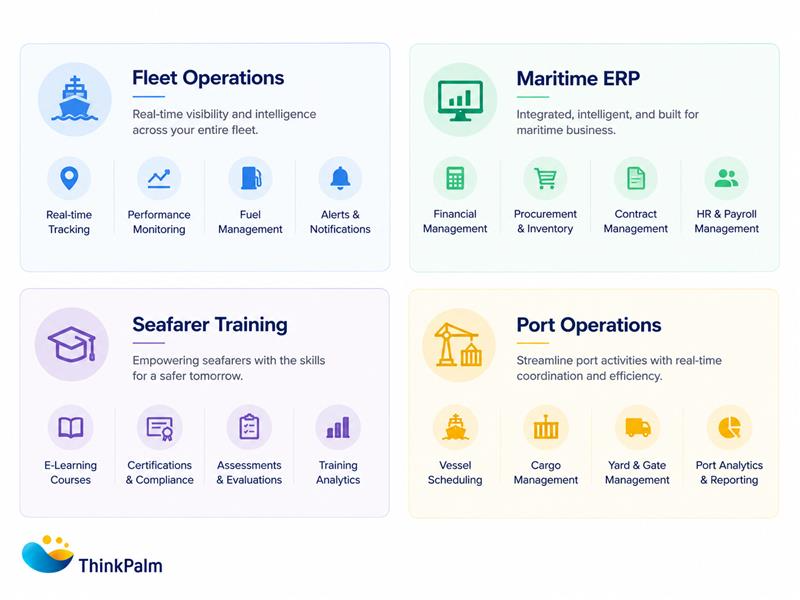
The four areas covered in this article: Fleet Operations, Maritime ERP, Seafarer Training, and Port Operations.
A single vessel’s systems can only catch that vessel’s problems. They can’t see patterns that only show up when you compare many vessels at once. Fleet-level AI can. It benchmarks sister ships against each other, watches for unusual behavior across the whole fleet, and catches issues no single vessel would reveal on its own, like a fuel-consumption problem that’s quietly affecting one whole class of ship.
Maritime ERP systems (procurement, finance, inventory, maintenance, crew, compliance) are good at recording what happened and enforcing workflow rules. They are not built to tell you what is about to happen or recommend what to do differently. AI sitting on top of ERP and operational data changes that.
The hard part here isn’t the AI. It’s your ERP data. If the data going in is messy, AI just makes the same mess happen faster.
The officer shortage means the industry cannot simply hire its way out of the skills gap — training capacity and consistency matter more than ever.
Based on a seafarer’s actual competency gaps, not a one-size-fits-all course.
Training for higher-risk scenarios that are expensive or unsafe to run in person.
Flags where a crew member needs reinforcement before certification renewal, rather than after a near-miss.
This augments instructors and simulators; it does not replace certified sea time or supervised assessment, which STCW still requires.
A port is a shared resource that many independent parties — terminal, shipping line, agent, tugs, pilots — each plan for separately, using their own guess at another party’s timing. AI predicts realistic vessel arrival times instead of relying on self-reported ETAs, optimizes berth and yard allocation as conditions change, and flags equipment or traffic anomalies before they cascade into delays.
The technology is rarely the bottleneck in port AI — coordination is. It only works when the different parties agree on shared data standards.
Fleet operations, ERP, training, and port AI are how vessel-level intelligence turns into something that works across your whole business. ThinkPalm can help you map out what that looks like for your fleet.
Explore Agentic AI Solutions →The bigger opportunity is not eight separate AI tools bolted onto eight separate workflows. It is connecting crew, vessel, voyage, maintenance, ERP, QHSE, and port data into one operational picture.
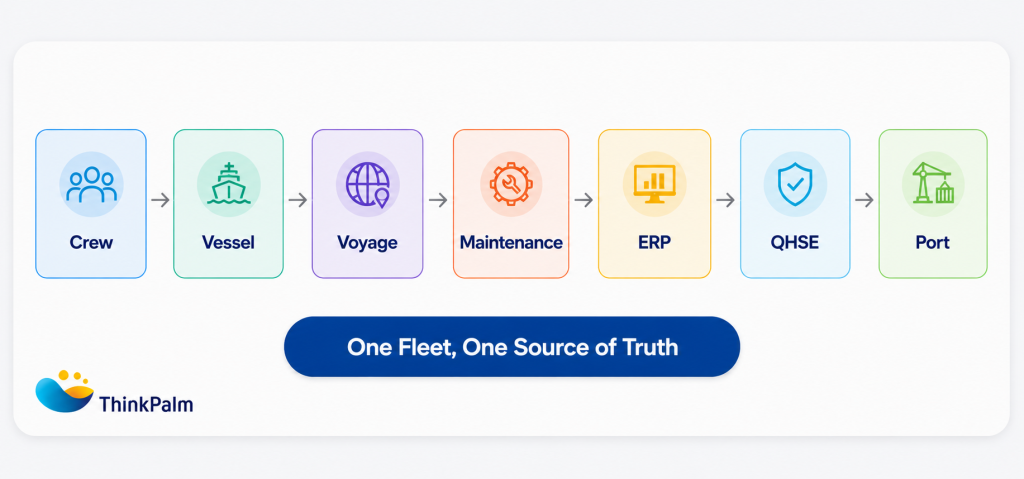
Crew, vessel, voyage, maintenance, ERP, QHSE, and port data — connected into one shared operational layer.
Here’s what that looks like in practice. A generator sends a maintenance alert. On its own, that alert means someone has to check three things by hand: is the ship near a port with the part in stock, is there a qualified engineer on board, and is the part actually available. If those three systems are connected, the alert arrives with the answer already attached: one clear recommendation instead of four separate lookups.
This doesn’t mean building one giant platform. It means building a shared layer of data that each AI tool can read from and write back to, so a decision made in one area updates the picture everywhere else automatically.
AIS behavioral history, standardized KPIs, sensor/IIoT telemetry across vessel classes.
Procurement history, financial records, inventory levels, compliance documentation.
Training records, simulator performance, competency assessment history.
Berth schedules, terminal yard data, historical port-call performance.
Integration and retrofit cost. Connecting AI to your existing systems usually costs more than the AI model itself.
Standardization gaps. Older and newer vessels don’t collect data the same way, which makes fleet-wide comparisons harder than they sound.
Cybersecurity. More connected systems means more ways in for attackers. That’s why IMO updated its Maritime Cyber Risk Management Guidelines (MSC-FAL.1/Circ.3/Rev.3) and why IACS added Unified Requirements E26/E27. The maritime cybersecurity market is expected to grow from $3.68B in 2024 to $6.55B by 2029 as a result.
Port coordination. Berth and yard AI only works if terminals, shipping lines, and agents agree to share data the same way. That’s a people problem as much as a tech one.
Regulatory uncertainty. The IMO’s non-mandatory MASS Code took effect on 1 January 2025. A mandatory version is still being worked out. If you’re building around autonomy-related AI, you’re aiming at a target that’s still moving.
Part One covered the first four steps of any AI project: find a problem worth solving, check your data, connect your systems, and run a small pilot. Here’s how to take a pilot that’s working and scale it across the fleet.
Against the specific cost identified at the start — not a generic efficiency claim.
Have engineers and masters — the people who will act on the AI’s output — sign off before wider rollout.
Once the pilot has held up for 60–90 days without a trust breakdown, extend it — the same pattern smart-port operators already use for berth and yard AI.
Already being deployed: generative AI is moving into document-heavy classification-society work — Lloyd’s Register began using generative AI built on Microsoft Azure OpenAI Service in 2025 to speed up permitting work for nuclear-powered maritime applications, an early sign of GenAI entering formal maritime workflows (Barchart/CNW).
Still emerging: early research into agentic AI for anomaly management shows systems using a domain-specific knowledge graph to reason across ship components and sensor streams, not just flag a single threshold breach (Zhuang et al., arXiv). Industry forecasts also point to AI-driven digital twins becoming a meaningful collaboration layer between owners, operators, charterers, and ports in 2026 (Global Trade Magazine).
Regulatory Note
The IMO’s non-mandatory MASS Code entered into force 1 January 2025; a mandatory SOLAS-based instrument is still in development, with sources pointing to full mandatory adoption sometime around 2028–2032. Full autonomy remains years away from broad commercial deployment — near-term progress centers on decision support for a human master, not removing the human from the loop.
AI is not replacing maritime professionals. It is removing the administrative and monitoring load that keeps them from spending time on the judgment calls that actually need a human.
Fleet operations, ERP, training, and port AI are where vessel-level AI grows into full AI in maritime enterprise capability. None of the eight areas covered across both parts of this guide work well on their own for long. The companies getting the most value are the ones connecting them into one picture, instead of running eight separate tools that don’t talk to each other.
ThinkPalm helps maritime companies build exactly this kind of connected AI: domain-trained models, IIoT data infrastructure, and enterprise systems working together, so crew, vessel, voyage, and port data all feed one operational picture instead of eight disconnected ones. This builds on the vessel-level results already covered in AI in Maritime Shipping: Top Use Cases and ROI in 2026, delivered with ISO 27001:2022-certified data handling and on-premise deployment options for companies with data sovereignty requirements.
From standalone vessel monitoring to end-to-end agentic workflows built around how your fleet actually operates.
Midhula Jeevan is a passionate content writer with a focus on SEO and technical writing. With a love for words and a curiosity for the technical side, she blends creativity with strategy to craft content that stands out. When not writing, you could find her usually reading books, enjoying a good cup of coffee, or chasing golden sunsets.