Why Do OEMs Need Wi-Fi Validation Testing Before Product Launch?
Wireless Testing
 Sujith Sukumaran
September 18, 2026
Sujith Sukumaran
September 18, 2026



 Sujith Sukumaran
September 18, 2026
Sujith Sukumaran
September 18, 2026
A Wi-Fi gateway can pass every internal QA checkpoint, ship on schedule, and still fail the moment it reaches a real home. A roaming handoff that looked clean on the lab bench turns sluggish the second there’s a second access point and a neighbor’s network in the mix. An extender that reconnected without issue in a controlled test quietly drops off the moment a customer rearranges their living room.
For product and engineering leaders, the real question isn’t whether Wi-Fi validation testing for OEMs is necessary anymore. It’s whether the validation process already in place is rigorous enough to catch these issues before the market does, or whether the business is quietly relying on customers to find them first.
Definition
Wi-Fi validation testing is the process of evaluating how a gateway, router, mesh system, or extender behaves under real-world wireless conditions. It specifically assesses roaming decisions, mesh coordination, and reconnection behavior before the product reaches the market. This Wi-Fi validation testing helps OEMs identify issues that may not appear during standard QA. It’s distinct from certification testing, which checks whether a device complies with a published standard. Validation testing checks whether the device makes good decisions in practice, under conditions a certification checklist doesn’t capture.
| Stat | What It Means | Source |
|---|---|---|
| 68% of U.S. households reported Wi-Fi issues in the past 12 months | The problem is mainstream, not a rare edge case | TechSee, 2025 |
| 72% of “whole-home” Wi-Fi package holders still reported connectivity issues | Even premium mesh setups aren’t immune | |
| 76% experience weak or unreliable Wi-Fi in specific rooms | The exact symptom of poor roaming and handoff behavior | |
| ~39% of affected households had a technician dispatched to their home | Unvalidated issues become field service costs, not just support tickets | |
| $16.5B → $26B+ projected growth of the global Wi-Fi router market, 2026 to 2031 | Mesh systems are the fastest-growing segment, meaning more surface area for roaming failures in Wi-Fi gateway and router testing | Mordor Intelligence, 2026 |
The takeaway from Wi-Fi validation testing for OEMs: this isn’t a shrinking problem. More devices are shipping into increasingly complex, multi-node home networks every year. This creates more opportunities for roaming and reconnection failures to go unnoticed until the product is already in the field.
As mesh and multi-node Wi-Fi networks get more complex, many OEMs are moving toward autonomous, next-gen test labs built to validate roaming and reconnection at scale, instead of finding out through support tickets.
Without a controlled, repeatable Wi-Fi validation environment, connectivity problems typically surface only after devices are already installed in customers’ homes. By then, the cost of fixing them has multiplied.
Each support call or truck roll from the numbers above is a cost the manufacturer or service provider absorbs indirectly, in support load, field visits, and churn risk. A missed roaming issue doesn’t stay contained to a single support ticket. It becomes a pattern across thousands of units: a spike in return rates, a wave of negative reviews that shape how the product is perceived long after the bug is patched. Engineering ends up firefighting in production instead of shipping the next release. The business absorbs the cost of expedited firmware updates, extended support cycles, and eroded trust with retail or carrier partners.
Pre-launch Wi-Fi testing moves that discovery earlier, into an environment where issues can be reproduced and diagnosed. This allows them to be resolved before they lead to costly post-launch problems. This makes Wi-Fi validation testing an important part of the product launch process.
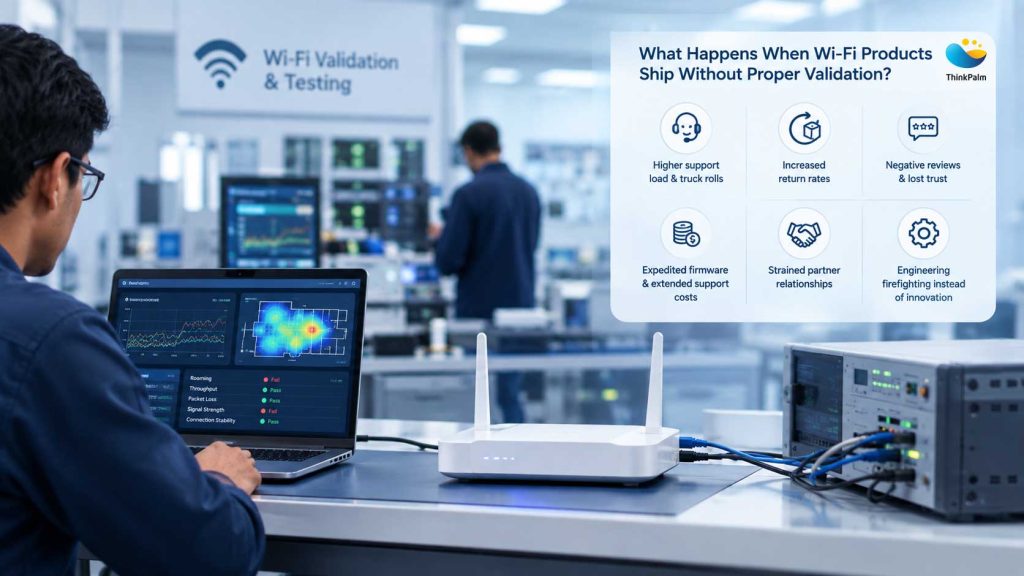
Thorough Wi-Fi validation identifies performance issues before products reach customers.
A mature Wi-Fi validation process does not simply confirm that a device connects to a network. Wi-Fi validation testing for OEMs examines the behaviors that matter in real deployments. It stress-tests the specific behaviors that tend to fail once a product leaves the lab: roaming decisions, mesh coordination, and extender reconnection under realistic, imperfect conditions.
Wi-Fi roaming testing evaluates how a device decides when and where to hand off a client connection as signal conditions change. As part of Wi-Fi validation testing, these handoffs can be assessed across repeatable scenarios. In a structured validation environment, this behavior can be tested repeatedly and consistently rather than observed anecdotally. Engineering teams can then see exactly where roaming logic makes a poor decision and why.
Mesh and extender reconnection testing focuses on what happens when a network node drops and needs to be reconnected. This is one of the most common failure points in real-world Wi-Fi deployments and one of the hardest to catch without a dedicated testing setup. It often depends on timing, interference, and network topology that can be difficult to replicate ad hoc.
Together, these testing streams give manufacturers a clear, evidence-based picture of product quality before commercial release. Wi-Fi validation testing for OEMs helps make that evidence available before launch.
At a conceptual level, a structured validation cycle generally follows these steps:
Multiple access points or mesh nodes are positioned to recreate the roaming boundaries and distances a device will realistically face in a home.
Signal strength and interference are adjusted deliberately, rather than left to chance, so failure conditions can be reproduced on demand.
Client devices are moved (physically or via simulated signal changes) across access points while engineers observe whether handoffs are timely, premature, or delayed. This Wi-Fi roaming testing helps expose inconsistent handoff behavior.
A node is dropped and monitored to see how quickly and reliably it rejoins the network, and whether the resulting topology matches expectations.
RSSI, station statistics, and topology data are recorded at each step, not just the final pass/fail outcome.
Failures are traced across the Wi-Fi driver, firmware, hostapd/supplicant, and networking layers to identify where the actual decision-making broke down.
Once a fix is applied, the same scenarios are re-run using disciplined Wi-Fi test automation to confirm the issue is resolved and no new regressions were introduced.
This is the conceptual shape of the process. The specific configurations, thresholds, and pass/fail criteria used in a given engagement are typically tailored to the product and its target chipset.
See how a purpose-built lab environment supports gateways, routers, mesh systems, and extenders across their full validation lifecycle.
Explore ThinkPalm’s Wireless Testing Services →This is where ThinkPalm’s approach differs from a standard certification pass. Most Wi-Fi Alliance authorized test labs confirm whether a device complies with published specifications. Wi-Fi testing at this level addresses conformance, while deeper validation examines how the device behaves under real-world conditions.
Wi-Fi CERTIFIED conformance, TR-398 performance benchmarks, interoperability against reference devices. That’s necessary, but it answers a narrower question than what really determines customer experience. The bigger question is whether the product makes good roaming decisions and reconnects reliably under the conditions it will actually face in a home.
ThinkPalm’s validation methodology uses proven, repeatable frameworks to assess both standalone gateway performance and full mesh and managed Wi-Fi behavior. This provides a consistent approach without requiring a new test plan for every engagement.
In a recent engagement, ThinkPalm was brought in by a manufacturer developing Wi-Fi gateways, routers, mesh systems, and extenders to validate product behavior ahead of commercial release. The goal was straightforward: catch roaming and reconnection issues in a controlled setting, before they had a chance to surface in customers’ homes.
Rather than relying on ad hoc bench checks, ThinkPalm’s team built a structured, repeatable test environment. It is designed to mirror the conditions a device would encounter in real-world deployments. This included multiple access points positioned to create realistic roaming boundaries. Controlled signal attenuation simulated distance and interference, while defined test cycles ensured consistent testing across firmware builds. The structured setup meant that when an issue appeared, it could be reproduced on demand rather than chased down after the fact.
Building a lab environment that holds up under real conditions matters just as much for next-gen hardware — see how ThinkPalm validated Wi-Fi 7 schedulers under asymmetric load conditions using the same structured, repeatable approach.
Testing focused on the scenarios most likely to cause problems in the field. On the roaming side, this meant validating how devices handled handoffs between access points. Testing covered delayed, premature, and inconsistent roaming decisions. On the extender and mesh side, the team validated reconnection behavior after a node dropped, including how quickly and reliably it rejoined the network and whether it maintained the expected topology afterward. Each scenario was run using ThinkPalm’s proven validation frameworks, with methodologies developed for Wi-Fi roaming and extender behavior testing. This ensured results were measured against consistent, repeatable criteria rather than one-off observations.
The structured approach gave the manufacturer’s engineering team clear, reproducible evidence of where roaming and reconnection behavior fell short of expectations, along with the specific conditions under which each issue occurred. That level of detail meant fixes could be targeted and verified before release, rather than diagnosed reactively from field reports after launch.
The result was a product validated for real-world Wi-Fi behavior ahead of commercial release, with issues resolved in a controlled environment instead of in customers’ homes.
See exactly how the test environment was built, which roaming and extender scenarios were validated, and what outcomes it delivered.
For a product or engineering leader building the case for structured validation, the value shows up in a few concrete places, and the industry data backs up each one:
Fewer support escalations at launch, when call center and field support costs are hardest to absorb. A product that ships with avoidable roaming or reconnection defects is adding to a support queue that’s already under strain industry-wide.
Fewer emergency firmware patches, which protects release timelines and frees engineering resources for the next product cycle.
Stronger relationships with retail and carrier partners, who measure suppliers on return rates and complaints as much as on feature sets.
A stronger brand reputation at the exact moment reviewers and early adopters are forming their first impression of the product, in a market growing fast enough that a bad launch is hard to recover share from.
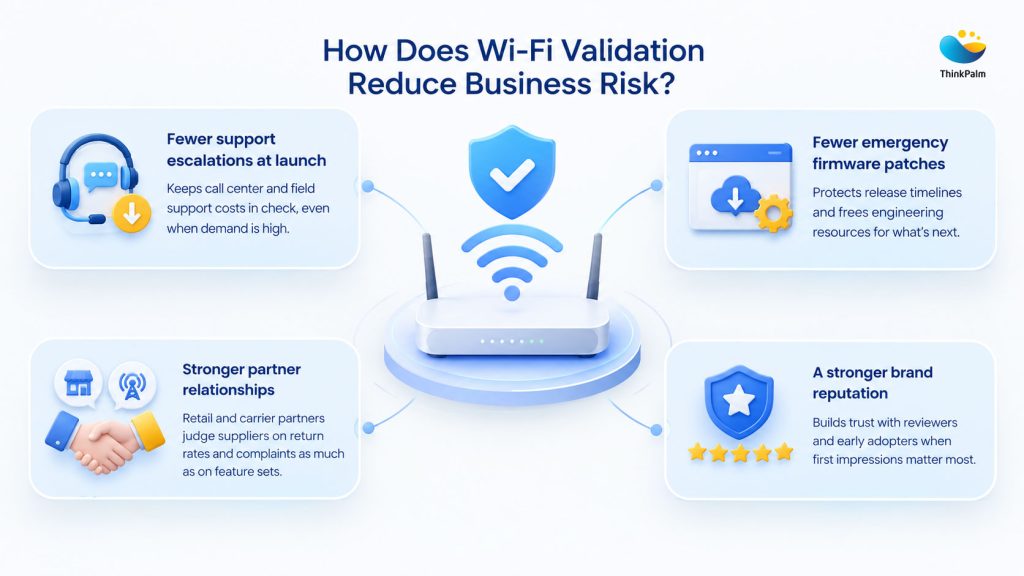
Wi-Fi validation helps reduce post-launch risks and protect product reliability.
This is the difference between a launch that goes smoothly and one that spends its first quarter reacting to problems that were preventable.
In-house QA teams are typically built to validate features and functional requirements. Wi-Fi validation is a different discipline. It requires hands-on expertise in wireless behavior, purpose-built test environments, and validation frameworks refined across many product lines and chipset generations.
It’s also a different discipline from general certification testing and from broad platform engineering. Certification labs confirm spec compliance. Full-lifecycle CPE engineering partners build the product but typically treat Wi-Fi behavioral testing as one service among many rather than a core specialization. Specialized Wi-Fi validation sits in the gap between the two: it exists specifically to answer whether the product behaves the way customers expect once it’s out of the lab.
Building that capability internally means investing in lab infrastructure, tooling, and specialized engineering expertise that may only be fully utilized during pre-launch windows. For most OEMs, it’s faster and more cost-effective to bring in a partner who already has the environment, the frameworks, and the pattern recognition in place, one that can plug directly into an existing development timeline without slowing it down.
That pattern recognition is easy to underestimate. A specialized validation partner has typically seen the same class of roaming and reconnection issues across dozens of product lines and chipset generations, which shortens diagnosis time considerably compared to a team encountering a given failure mode for the first time.
One of the most common concerns product leaders raise is timeline risk. Adding a new testing phase late in development can feel like it threatens a launch date rather than protecting it.
In practice, Wi-Fi validation is designed to run in parallel with existing development and certification work, not after it. Because the test environment and methodology are already established, a validation partner can begin as soon as stable firmware builds are available. Findings are typically shared on a rolling basis, so engineering can start addressing issues while validation of other scenarios continues, rather than waiting on a single final report at the end. This parallel structure is what lets validation strengthen a launch date instead of pushing it back.
Not all testing partners bring the same depth to Wi-Fi validation. A few signals worth evaluating a partner against:
A track record with the specific product categories in question: gateways, routers, mesh systems, or extenders.
A structured, repeatable methodology, ideally one built on a proven framework, rather than one-off testing built fresh for each engagement.
The ability to work within existing development and certification timelines.
Clear communication that translates technical findings into decisions the business can act on quickly.
The right partner doesn’t just report problems. They help a product team understand which issues matter most, why they occur, and how to resolve them before launch turns into a liability.
If your team is preparing to bring a Wi-Fi gateway, router, mesh system, or extender to market, structured validation before release can help uncover issues that may otherwise surface in the field. Wi-Fi validation testing for OEMs provides a structured way to assess real-world performance before the product reaches customers. As the numbers at the top of this article show, the margin for an unvalidated launch is thinner than it used to be.
Talk to a ThinkPalm Wi-Fi validation expert to discuss how a proven, repeatable testing framework can fit into your product timeline to see the approach in action.
Sujith Sukumaran is a Digital Marketing Analyst, where he focuses on SEO strategies and driving website growth. With a strong interest in digital marketing, he is constantly exploring new ways to enhance online visibility. Outside of work, Sujith is an avid football enthusiast.