Agentic RAG vs Standard RAG: Why Real-Time Reasoning Changes the Answer
Agentic AI
 Athira Gopakumar
September 10, 2026
Athira Gopakumar
September 10, 2026



 Athira Gopakumar
September 10, 2026
Athira Gopakumar
September 10, 2026
Imagine you ask an enterprise AI assistant a simple question, and it usually gets the answer right. But if you ask something where the assistant may have to scan through several data sources, a compliance rule, and a cost trade-off, then things start to fall apart. This is the reason why the Agentic RAG vs Standard RAG debate has moved from research discussions into the boardroom.
Retrieval-Augmented Generation (RAG) forms the core of most enterprise AI applications today by way of chatbots, internal search, copilots and more. But as organizations embed Agentic AI deeper into their decision-making workflows, this sort of extraction may not be enough. A single retrieval and responding loop may not suffice. We need an advanced system which involves planning, self-correction, and iterative reasoning for the retrieval process. This is where the role of Agentic RAG becomes important.
Standard RAG connects a large language model to an external knowledge base and generates an answer after a single retrieval pass (quick look up). Agentic RAG is more dynamic and goes further; it plans, retrieves in multiple steps, checks its own results, and only responds once it’s confident enough to generate responses. In short, standard RAG fetches and Agentic RAG reasons.
This distinction may sound minimalistic on paper. But, in practice, it’s the difference between an assistant that answers instantly but sometimes confidently wrong, and one that reasons a beat longer using an intelligent approach to get it right.
Looking for a deeper dive? Read our blog post on What Is Agentic RAG? to explore its architecture, workflow, and enterprise applications in greater detail.
A standard RAG pipeline typically operates on a four-step loop where the user submits a query; the system retrieves relevant documents; that context is added to the prompt, and the model generates a response.
query input – vector retrieval – prompt augmentation – response generation.
This linear approach is best suited for:
But its static architecture has certain limitations which are listed below:
Evaluates context only once and never re-evaluates.
No built-in verification to check for relevance or quality of output.
Weak handling of complex multi-step or ambiguous queries
One missed document can greatly affect the quality of responses
Standard RAG can handle straightforward, narrow, questions well, but the single-pass limitation would adversely affect high-stakes decision support systems. In this blog post we look at how things work, the difference, in the quality of results, and when each method belongs in your collection of tools.
An Agentic RAG system introduces one or more AI agents that have the ability to plan its own research path instead of following one fixed retrieval step. Using real-time reasoning, the system does a thorough study instead of a single lookup. Further it can:
Break a complex question into smaller sub-tasks
Run multiple, targeted searches
Evaluate retrieved information against the user intent
Prioritize more credible sources over weaker ones
Cross check conflicting evidence before responding
Refine search until confidence level meets threshold to provide an answer
Hence, Agentic RAG emerges as a meaningfully better fit for enterprise workflows where the accuracy and precision of responses outweigh in terms of critical decision-making.
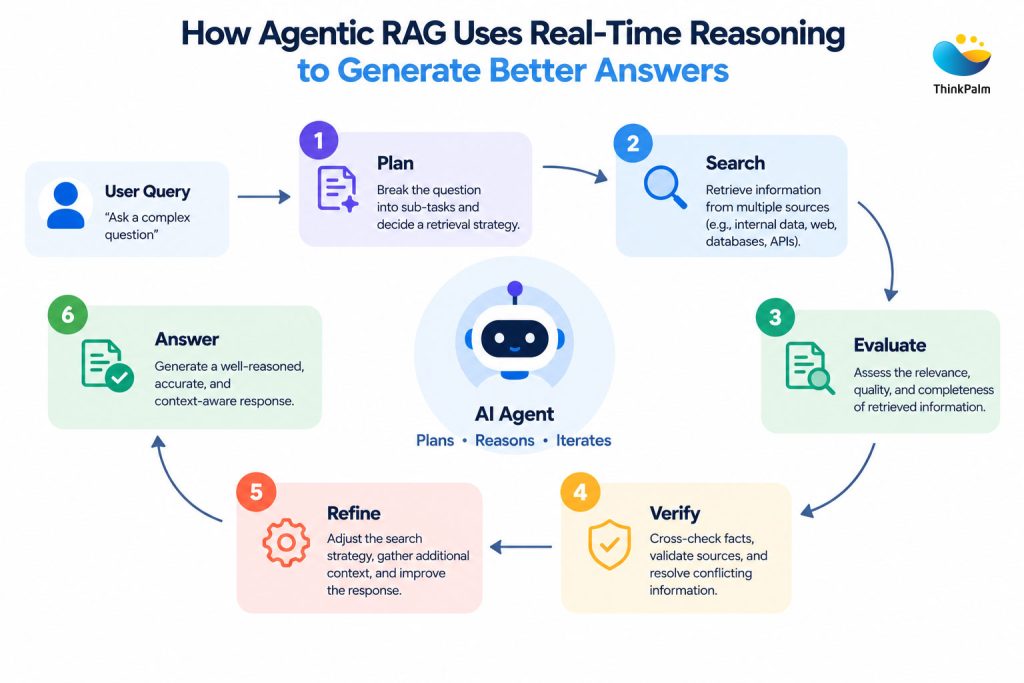
Agentic RAG workflow showing real-time reasoning from planning and search to verification, refinement, and answer generation.
| Feature | Standard RAG | Agentic RAG |
|---|---|---|
| Retrieval Approach | Single-pass (one-and-done lookup) | Multi-step & multi-layer retrieval |
| Reasoning Capability | Minimal (relies entirely on prompt context) | Real-Time Reasoning (evaluates intent dynamically) |
| Execution Planning | None | Built-in autonomous research strategy |
| Self-Correction | No | Yes |
| Tool Integration | Limited | Dynamic usage of multiple external tools & APIs |
| System Adaptability | Static & rigid | Highly dynamic & adaptive |
| Ideal Use Case | Simple Q&A, FAQs & basic document search | Complex decision-making & enterprise workflows |
Standard RAG offers a fast, cost-effective solution for basic document lookup or direct Q&A. Agentic RAG is suitable for tasks where cross-referencing information, evaluating source credibility or solving open-ended enterprise problems is needed.
Real-time reasoning is the biggest shift Agentic AI has brought to retrieval systems. Unlike the traditional way, it does not just generate answers with a single lookup. Instead of generating an answer the moment documents are retrieved, an agentic rag system keeps asking itself whether it actually has enough to answer well.
A Standard RAG system would pull a single pricing sheet and generate an answer from that isolated document.
On the contrary, an Agentic RAG system, would:
Retrieve current pricing table
Check relevant compliance and regulatory requirements
Compare healthcare-specific certifications
Calculate the infrastructure and scaling costs
Weigh security requirements
Synthesize all of it into one reasoned recommendation
So, an Agentic RAG system synthesizes these variables into a unified, highly defensible recommendation, Agentic RAG provides the rigor that regulated industries demand.
Real-time reasoning needs a rich, multi-dimensional context to function effectively. This is why multi-layer retrieval is foundational to modern Agentic RAG architectures. They do not just rely on single vector look up but orchestrate data from vector semantic search, exact keyword matching, structured database queries, API integrations, external web search and relational knowledge graphs. They cross-reference information across these diverse context layers. This helps with reducing hallucinations and verifying facts/outdated responses. Simply put, it’s like taking a second opinion before making a final diagnosis and parallel to how a human researcher would work on complex documents.
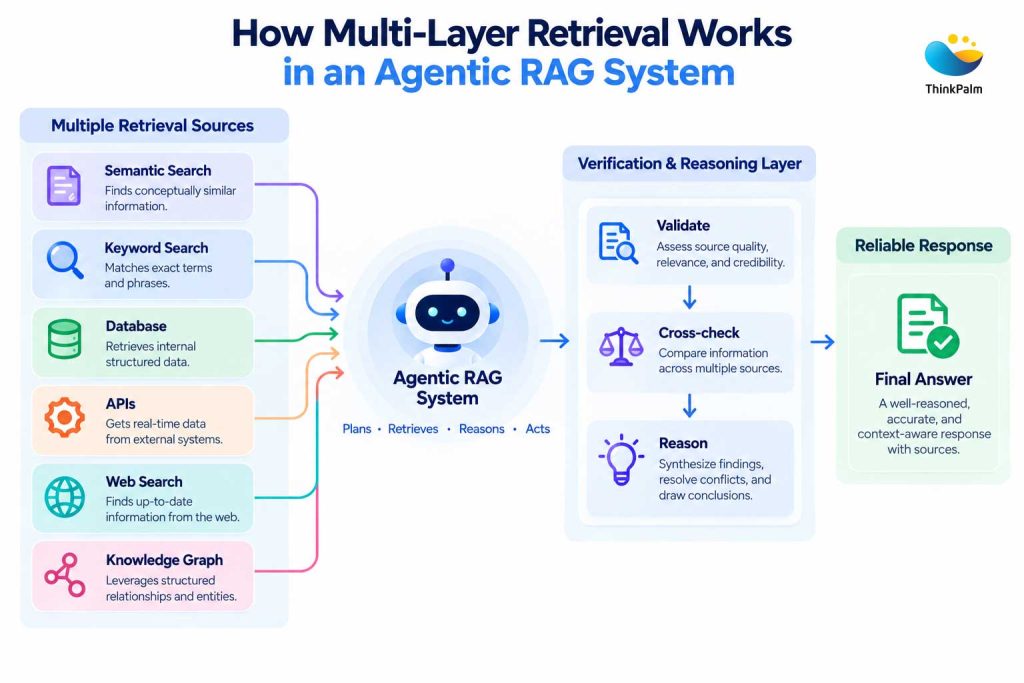
Agentic RAG system using multi-layer retrieval and verification to generate reliable responses.
If you push this idea one step further, you get a multi-agent RAG. These are nothing but specialized AI agents collaborating on different parts of the same problem instead of one generalist agent doing everything. Typical roles include:
The final output would be a combination of the responses received from every agent involved. Indeed, a collaborative effort! For finance, healthcare, legal, and engineering use cases in particular, this division of labor tends to improve both reliability and explainability. These are two things audit and compliance teams would care about a great deal.
Curious how specialized, task-driven AI agents perform in a live operational setting? Our breakdown of Agentic AI in procurement shows how multi-agent collaboration plays out in a real procure-to-pay cycle.
Agentic RAG is a better choice when it comes to making decisions involving multiple, conflicting data sources. If the task includes reasoning across several documents and not just look ups, then Agentic RAG is the best fit. Here the agent can plan actions before responding, and even the underlying information can be checked thoroughly when it comes to information carrying real business or compliance weight
On the other hand, opt for standard RAG for lean, low latency applications like customer FAQs, internal wiki search, and simple single source Q&A. While searching internal documents or citing information from trusted sources, RAG fits best.
As enterprise leaders advance their broader Agentic AI roadmaps, deploying an agentic rag system has become essential for moving beyond passive data retrieval to true autonomous decision-making.
Building FAQ systems
Searching internal documents
Answering straightforward, single-source questions
Prioritizing a lean, low-latency setup
Decisions depend on multiple, sometimes conflicting data sources
Reasoning across documents is required, not just lookup
The agent needs to plan actions before responding
Underlying information changes frequently
Accuracy carries real business or compliance weight
Organizations rolling out advanced Agentic AI initiatives are increasingly choosing Agentic RAG specifically because it supports autonomous decision-making, not just information retrieval on demand.
Discover how ThinkPalm modernized maritime procurement through an Agentic AI solution featuring autonomous reasoning, complex workflow orchestration, and real-time decision support.
Embedding an agentic rag system into enterprise-grade applications represents a major technological leap beyond traditional setups as it delivers immense benefits. Its advanced retrieval and generation capabilities within autonomous agent architectures enable dynamic, query-specific search methods that continuously audit, weigh, and verify data accuracy in real time.
Let us delve into some of the key benefits of implementing an agentic RAG system into enterprise workflows:
Provides responses after verifying several sources, hence most suitable for business-critical workflows.
Evaluates data from multiple sources to reconcile conflicting facts and outdated information.
Reduces hallucinations through continuous context verification
Employs retrieval strategies that adapt to the question and clearly understand the search intent.
Provides reasoning trails and better explainability for stakeholders and auditors.
More graceful handling of ambiguous queries
Establishes a foundation that scales with enterprise AI workflows
If quality assurance is part of your evaluation criteria before rolling out an agentic system, our blog post on AI in software testing is a useful companion read for validating these pipelines before production.
The real takeaway from the comparison between Agentic RAG vs Standard RAG isn’t about one replacing the other. It’s about giving enterprise AI the flexibility to choose based on the stakes of the question being asked. Standard RAG still has a place for fast, simple lookups. However, when a wrong answer could lead to significant consequences like a compliance failure, an inaccurate cost estimate or overlooking a potential risk then real-time reasoning, multi-layer retrieval, and multi-agent RAG are becoming the go-to options rather than just a rare choice.
Designing an Agentic RAG system that reliably reasons, retrieves across the right layers, and holds up under audit is a complex process. It takes deliberate architecture, rigorous testing, and domain expertise. At ThinkPalm, we help enterprises design, build, and validate Agentic AI systems, including Agentic RAG pipelines, tailored to their data, compliance needs, and decision-making workflows.
Build Enterprise-Ready Agentic RAG Systems
Every enterprise has different data sources, governance requirements, and decision-making workflows. Our AI specialists help organizations identify where Agentic RAG delivers the greatest value and build solutions that balance accuracy, scalability, and compliance.
Athira Gopakumar is a Digital Marketing Specialist in the tech industry, with a strong focus on IoT marketing. She specializes in data-driven strategies, leveraging SEO, content marketing, and market research to enhance brand visibility and lead generation for IoT solutions. Passionate about the intersection of technology and marketing, she stays ahead of industry trends to drive impactful campaigns. Outside of work, she enjoys traveling to new places and dancing to unwind.