 Midhula Jeevan
June 3, 2026
Midhula Jeevan
June 3, 2026
Generative AI for enterprise is no longer a technology trend for CIOs to monitor from the sidelines. It is rapidly becoming the single biggest competitive lever separating organizations that run on intelligence from those that merely run on data.
Yet a dangerous misconception persists in boardrooms worldwide: that deploying a chat interface on top of OpenAI or Google Gemini constitutes an enterprise AI strategy.
This guide is written for executives accountable for outcomes: CTOs who own the architecture, CDOs who govern the data, and COOs who need ROI, not research papers.
By the end, you will have a precise definition of generative AI for enterprise, an honest assessment of what it can and cannot do today, a clear five-step readiness framework, and a concrete way to benchmark where your organization currently stands.
What Makes This Guide Different
Most articles on generative AI for enterprise explain what the technology is. Very few address what enterprises must actually do differently to make it work at scale, in production, with real governance requirements. This guide fills that gap. ThinkPalm’s AI teams have worked across telecom, healthcare, manufacturing, and financial services, and what follows shares lessons from real deployments, not demos.
Consumer generative AI tools like ChatGPT, Gemini, and Claude are designed for individual, general-purpose use. Enterprise generative AI is a fundamentally different discipline.
At its core, enterprise generative AI refers to large language and multimodal models that are deployed within or integrated into an organization’s technology stack. These models operate on proprietary business data, are governed by enterprise security and compliance policies, and are built to deliver measurable outcomes against business KPIs, not just impressive demos.
What is Enterprise Generative AI?
Enterprise generative AI refers to large language and multimodal models deployed within an organisation’s technology stack. Unlike consumer AI tools, these models operate on proprietary business data, are governed by enterprise security and compliance policies, and are built to deliver measurable outcomes against business KPIs.
Generative AI can create content. But what happens when AI can also make decisions and take action? Understanding the difference between generative AI and agentic AI is becoming essential for enterprise leaders.
Any executive sponsoring a generative AI deployment needs a working understanding of what sits underneath it. The architecture breaks down into four distinct layers, each with its own set of decisions and risks.
Every enterprise generative AI deployment is built on four layers. Each one carries distinct decisions, costs, and risks.
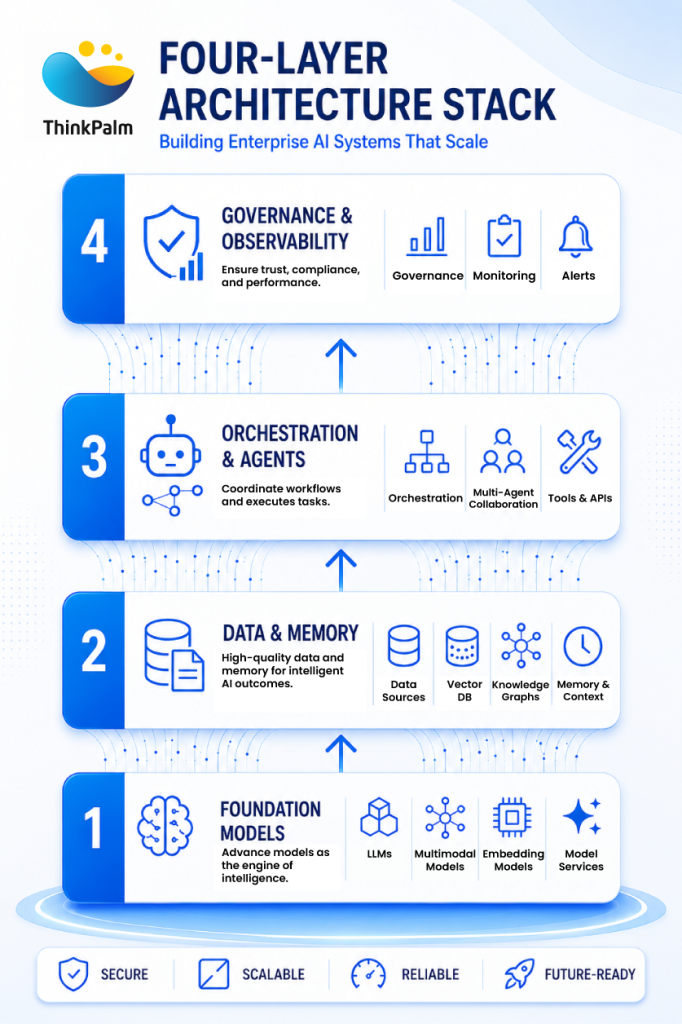
Enterprise AI architecture consists of four interconnected layers that transform models into secure, scalable business systems.
Large language models (LLMs) or multimodal models form the reasoning core of any enterprise AI system. Foundation model selection is one of the most consequential early decisions an enterprise will make. Organizations typically choose between proprietary hosted models such as GPT-4o, Claude 3.5, and Gemini 1.5 Pro, and open-weight models such as Llama 3, Mistral, and Qwen deployed in controlled environments.
The right choice depends on latency requirements, cost, data residency obligations, and domain-specific performance benchmarks. Evaluating and selecting from the leading generative AI tools for enterprise applications — whether hosted or open-weight — requires a rigorous benchmark process tied to your specific workflows.
This is where enterprise generative AI diverges most sharply from consumer tools. Retrieval-Augmented Generation (RAG) connects the LLM to live enterprise data, including documents, databases, and APIs, without embedding sensitive information directly into the model. Vector databases such as Pinecone, Weaviate, and pgvector store semantic representations of enterprise knowledge for fast, accurate retrieval.
Frameworks like LangChain, LlamaIndex, and Microsoft AutoGen enable enterprises to build multi-step AI workflows, commonly called agents, that can plan, use tools, call APIs, and make decisions autonomously. This layer is what transforms a chat tool into a business process engine.
Production enterprise AI requires hallucination detection, output filtering, bias monitoring, cost tracking, and full audit trails. This layer is consistently underestimated during proof-of-concept phases, and it is the primary reason pilots fail to scale.
Organizations evaluating enterprise AI use cases in 2026 should start with opportunities that deliver measurable business value. The strongest candidates typically involve repetitive, high-volume tasks, rely on accessible business data, and have clearly defined success metrics.
While the possibilities are extensive, certain enterprise use cases for generative AI consistently deliver faster adoption, lower implementation risk, and clearer ROI. The following areas are among the most common starting points for organizations across industries.
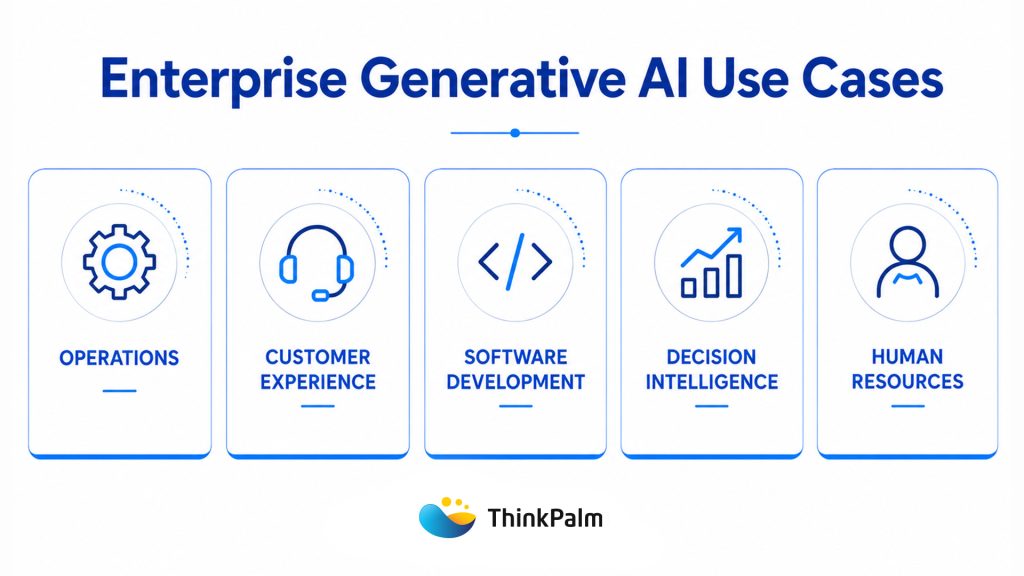
Core enterprise use cases for generative AI
Operational workflows often involve large volumes of documents, approvals, and repetitive tasks. Generative AI can help streamline these processes by reducing manual effort and improving efficiency.
Customer-facing teams are using generative AI to deliver faster, more personalized interactions while maintaining service quality at scale.
Generative AI is becoming an important productivity tool for engineering and product teams.
Business leaders are increasingly using generative AI to make information more accessible and actionable.
Human resources teams are leveraging generative AI to improve employee experiences and reduce administrative workloads.
Across enterprise deployments, the fastest returns often come from solutions that augment human expertise rather than replace it. Generative AI is most effective when it helps employees access information faster, reduce repetitive work, and make better decisions.
Organizations that begin with AI-assisted workflows typically achieve stronger adoption, lower risk, and clearer business outcomes than those that attempt end-to-end automation from the start.
Ready to build intelligent workflows with Agentic AI? Let our experts help you get started.
🚀 Start Your Agentic AI Journey →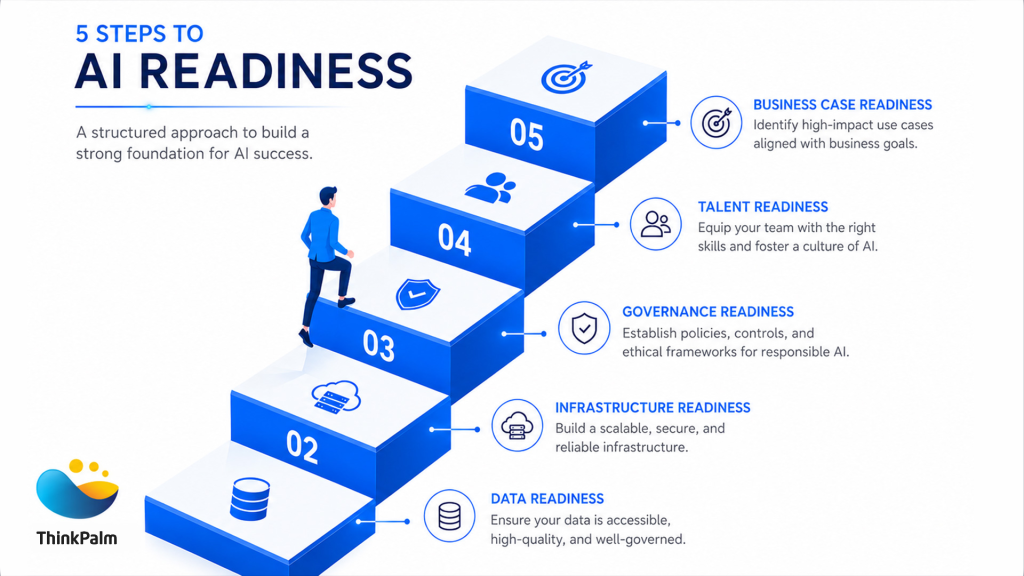
Essential readiness pillars for enterprise AI success
Many guides on generative AI for enterprise focus on the destination but overlook the journey. Successful AI adoption requires more than selecting the right model or technology platform. It depends on an organization’s readiness across multiple business and technical dimensions.
Enterprise AI readiness is not a simple yes-or-no assessment. It is a progression across five critical areas that determine whether an AI initiative can move from experimentation to production and deliver measurable business value. Before committing significant budget and resources, organizations should evaluate each of these dimensions honestly.
While generative AI adoption is accelerating, scaling from pilot projects to production remains a major challenge for most organizations. A significant majority of enterprises have only managed to move a small portion of their generative AI experiments into production, highlighting a persistent gap between experimentation and enterprise-scale deployment.
The issue is rarely about model capability. It is usually about execution, integration, and readiness across the organization. Below are some of the patterns ThinkPalm’s teams see most frequently which results in deployment failures:
Proof-of-concept environments are disconnected from production infrastructure, security reviews, and compliance approvals. Build with production in mind from day one.
A model that works well on 20 test cases often degrades significantly on 20,000 real-world inputs. Budget for ongoing model alignment and evaluation pipelines.
Enterprises that deploy LLMs on regulated or customer-facing workflows without AI hallucination mitigation strategies face serious risk. Implement retrieval grounding via RAG for enterprise workflows, set confidence thresholds, and build human-in-the-loop escalation for high-stakes outputs.
Enterprise AI succeeds when it is owned jointly by business leaders and technology teams. If your AI strategy lives only in the IT roadmap, it will optimise for technology metrics, not business outcomes.
Early commitments to a single LLM provider can become expensive liabilities as the model landscape evolves. Design your architecture with model-agnostic layers so you can swap foundation models without re-engineering your entire stack.
Discover how intelligent agents can automate workflows, coordinate tasks, and drive measurable business outcomes.
ThinkPalm is a technology-first AI development partner focused on building enterprise-grade generative AI systems, not reselling off-the-shelf platforms. Our approach is designed to help organizations move from experimentation to production with reliability, scalability, and governance built in from the start.
Our enterprise AI practice is built on three core principles: production-grade engineering, domain-aware data strategy, and governance-first architecture. These principles guide how we design, build, and deploy AI systems that can operate safely and effectively in real enterprise environments.
| AI Strategy & Readiness Assessment | Custom LLM Development & Integration | AI Governance & MLOps |
|---|---|---|
|
|
|
We bring deep engineering expertise in LangChain, LlamaIndex, Azure OpenAI Service, AWS Bedrock, Google Vertex AI, and open-weight model deployment on Kubernetes — alongside domain experience in telecom OSS/BSS, healthcare data platforms, industrial IoT, and financial services. This combination lets us move from strategy to working code in weeks, not quarters.
Generative AI for enterprise is not a question of if but when and how well. The organizations building durable AI advantage today are not those with the largest AI budgets. They are the ones that have invested early in strong data foundations, clear governance structures, and the right engineering approach to move from pilots to production.
What separates stalled initiatives from scalable success is not experimentation. It is readiness. The ability to connect AI systems to real business data, operate within enterprise constraints, and consistently deliver measurable outcomes is what defines long-term value.
For most organizations, the opportunity window is still open, but it is narrowing as competitors move from exploration to execution. The key question for CTOs, CDOs, and COOs is no longer whether to adopt generative AI, but whether the organization is prepared to deploy it in a way that is reliable, governed, and aligned with business goals.
Getting that foundation right is what turns generative AI from a set of experiments into a lasting competitive advantage.
Book a free 30-minute exploratory call with our AI strategist.
No pitch. No pressure. Just clarity on your next step.
Midhula Jeevan is a passionate content writer with a focus on SEO and technical writing. With a love for words and a curiosity for the technical side, she blends creativity with strategy to craft content that stands out. When not writing, you could find her usually reading books, enjoying a good cup of coffee, or chasing golden sunsets.
One message is all it takes to get started. Tell us what you need, and we’ll take it from there, no long forms, no waiting around.

