Wi-Fi 6/6E/7 Certification Readiness: What OEMs Should Test Before WFA Certification
Wireless Testing
 Nimmy Varghese
September 14, 2026
Nimmy Varghese
September 14, 2026



 Nimmy Varghese
September 14, 2026
Nimmy Varghese
September 14, 2026
Across our certification cycles spanning Wi-Fi 6, Wi-Fi 6E, and now Wi-Fi 7, one lesson has proven itself repeatedly: the OEMs that pass WFA certification on the first attempt are not the ones with the most advanced hardware. They are the ones with the most disciplined pre-certification process.
We learned this the hard way. OEMs that overlook Protected Management Frames (PMF) edge cases during Wi-Fi 6E submissions often face weeks of rework and costly resubmissions at the WFA ATL. That experience reshaped how we approach every certification cycle today, and it is the foundation of everything we share in this guide.
This is not a theoretical framework. It is the actual methodology our engineering teams follow before we submit a single device for formal WFA testing, and it reflects what genuine Wi-Fi certification readiness for OEMs looks like in practice.
Quick Answer
Wi-Fi certification readiness is the process of validating a device’s functionality, interoperability, security, and stability against the Wi-Fi Alliance’s test plan before submitting it to an Authorized Test Laboratory (ATL). For Wi-Fi 6, 6E, and 7, this means testing generation-specific risk areas, including OFDMA/MU-MIMO orchestration for Wi-Fi 6, 6 GHz PSC discovery for Wi-Fi 6E, and Multi-Link Operation (MLO) stability. For Wi-Fi 7, on top of a locked firmware baseline, a multi-vendor chipset interoperability matrix, and soak tests (minimum 24 hours up to 72 hours). OEMs that run this process internally consistently pass WFA certification on the first attempt.
Wi-Fi Alliance (WFA) certification is the industry’s global seal of approval for security, interoperability, and performance. Earning the Wi-Fi CERTIFIED mark tells enterprise buyers and consumers that our devices will perform reliably across diverse networks, chipsets, and vendors, not just in our own lab environment.
For our product lines, ranging from enterprise access points and consumer routers to industrial IoT wireless modules, certification guarantees three non-negotiable outcomes:
Our devices communicate flawlessly across silicon from Broadcom, Qualcomm, MediaTek, Marvell, Cypress and Intel without vendor-specific workarounds.
WPA3 Security Standard and Protected Management Frames (PMF) are validated to the letter of the standard, with zero fallback vulnerabilities.
Our firmware aligns with worldwide regulatory requirements, enabling us to ship the same certified device across multiple regions without re-engineering.
Certification failures at the ATL can delay market entry by weeks, which in fast-moving product categories may mean losing shelf position to competitors. This is why Wi-Fi certification readiness has become a core engineering discipline in its own right, not a checkbox exercise handled only in the final weeks before submission.
Wi-Fi certification is a multi-stage process that ensures a device meets Wi-Fi Alliance requirements for interoperability, performance, security, and reliability. The following steps outline the typical journey from test setup to achieving the Wi-Fi CERTIFIED™ mark.
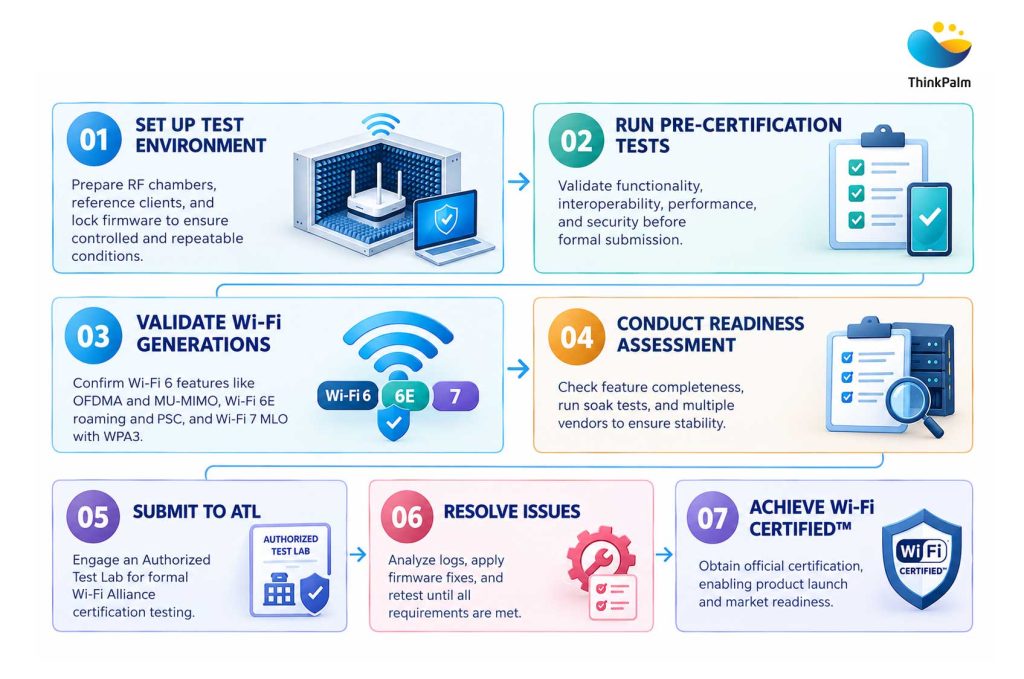
The key steps involved in preparing a Wi-Fi product for certification, from pre-certification testing to final Wi-Fi CERTIFIED™ approval.
Formal testing at an Authorized Test Laboratory (ATL) is expensive and time constrained. Our Wi-Fi Alliance (WFA) pre-certification testing program exists for one reason: we do not want to discover compliance gaps for the first time in a lab we are paying for by the hour.
A disciplined program of Wi-Fi Alliance (WFA) pre-certification testing is the backbone of Wi-Fi certification readiness. Our internal pre-certification process consistently delivers four outcomes that directly protect our business:
We catch non-compliance issues in our own lab before paying for ATL time, often finding issues that would have caused an immediate test failure.
We eliminate the painful cycle of ATL failure, engineering debug, firmware patch, and resubmission that can consume months of product calendar.
We surface interoperability gaps with third-party chipsets early, when they are cheap to fix, rather than at the point of formal testing.
We ship products that are stable and enterprise-ready from day one, not products that were rushed to certification with known rough edges.
| Technical Benefits | Business Benefits |
|---|---|
| Higher certification pass rates | Quicker product launches |
| Faster issue identification | Reduced engineering rework costs |
| Improved interoperability | Better end-user experience |
| Minimized debugging effort | Competitive market advantage |
| Stronger compliance with standards | Lower risk of certification delays |
Finding a compliance issue for the first time during formal testing can mean costly rework and delays. Pre-certification testing helps catch these issues earlier. Learn more about how pre-certification testing can identify Wi-Fi compliance issues before certification.
While the fundamentals of WFA testing stay the same across generations, each standard introduces its own certification risk profile. Use this table to scope your pre-certification test plan by generation before drilling into the details below.
| Requirement | Wi-Fi 6 (802.11ax) | Wi-Fi 6E | Wi-Fi 7 (802.11be) |
|---|---|---|---|
| Frequency bands | 2.4 GHz, 5 GHz | 2.4 GHz, 5 GHz, 6 GHz | 2.4 GHz, 5 GHz, 6 GHz |
| Signature capability | OFDMA, MU-MIMO, 1024-QAM, TWT | 6 GHz spectrum access, PSC discovery | MLO, 320 MHz channels, 4096-QAM |
| Mandatory security | WPA3 required for new certifications; PMF strongly recommended | WPA3 + PMF mandatory on 6 GHz: no fallback allowed | WPA3 mandatory; synchronized key management across all MLO links |
| Highest-risk certification area | OFDMA/MU-MIMO orchestration across max spatial streams | PSC/non-PSC discovery and multi-band roaming | MLO link establishment, teardown, and failover stability |
| Backward compatibility check | Wi-Fi 4 (802.11n) and Wi-Fi 5 (802.11ac) clients | Legacy clients on 2.4/5 GHz while 6 GHz is active | Wi-Fi 5 and Wi-Fi 6 clients under MLO-scheduled load |
Once the business case is clear, the next step is to establish a controlled and repeatable test environment. Before our engineers write a single test case, we set up the lab conditions that make pre-certification results meaningful. Running pre-certification tests in an uncontrolled RF environment produces unreliable results that do not reflect ATL conditions.
To achieve a controlled, repeatable, and efficient test environment, we have developed an in-house Test Scheduler application capable of integrating with vendors’ proprietary automation scripts. This enables us to quickly build a simple, flexible, and convenient automated testing environment, significantly reducing setup effort while improving test execution consistency and efficiency.
We conduct all performance and interoperability testing in a shielded RF enclosure or anechoic chamber to eliminate ambient interference from neighboring Wi-Fi networks, supported by a robust automation framework to ensure consistent, repeatable, and reliable test results.
For range and attenuation testing, we use a programmable RF attenuator to simulate real-world signal degradation in a repeatable, measurable way.
Our interoperability matrix includes at least one device from Broadcom, Qualcomm, MediaTek, Marvell, Cypress and Intel chipset families across each Wi-Fi generation being certified.
We include both current-generation and legacy clients to validate backward compatibility. A Wi-Fi 7 AP that drops Wi-Fi 5 clients will fail interoperability testing.
We lock the firmware version before beginning formal pre-certification testing. Any driver or firmware change after lock requires a delta assessment before testing continues.
Last-minute firmware patches introduced during an ATL test cycle have invalidated our results before. We now enforce a hard firmware freeze at least two weeks before ATL submission.
Want to see how pre-compliance testing can help validate a Wi-Fi access point before formal certification? Explore how ThinkPalm helped an OEM assess Wi-Fi access point performance through RvR testing.
With the environment locked down, validation should branch into the features and failure modes that are unique to each Wi-Fi generation. While the fundamentals stay the same, Wi-Fi 6, 6E, and 7 each introduce certification risks that OEM teams should test deliberately before formal lab submission.
Wi-Fi 6 (IEEE 802.11ax) introduced major improvements in efficiency, capacity, and overall network performance. Before pursuing WFA certification, OEMs should validate the following areas:
Wi-Fi 6E extends Wi-Fi 6 into the 6 GHz band, adding both opportunity and complexity. As a result, OEMs must account for additional validation requirements before certification.
PMF (802.11w) protects management frames, such as deauthentication and disassociation, from spoofing, preventing an attacker from forcibly disconnecting a client. It’s optional on legacy Wi-Fi 4/5 networks, but WFA makes it mandatory for Wi-Fi 6 certifications, WPA3, and any device operating on the 6 GHz band. In our experience, incomplete PMF implementation is the single most common reason WPA3-certified devices still fail interoperability testing, because edge-case handling during deauthentication attacks is rarely exercised in day-to-day functional testing.
Extensively test Preferred Scanning Channels (PSC) and non-PSC discovery methods. For a deeper understanding of this process, learn how Wi-Fi devices discover networks on the 6 GHz band.
Wi-Fi 7 (IEEE 802.11be) brings a new level of performance and architectural complexity, making thorough pre-certification validation essential before formal testing begins. Pre-certification testing should focus on dynamic, real-time link coordination.
This is the highest-risk area for Wi-Fi 7. Teams must stress-test link establishment/teardown, dynamic traffic distribution across links, link switching latency, and rapid recovery during sudden link failures. Testing MLO performance in Wi-Fi 7 is essential for validating stability across these scenarios.
Validate the integrity of 320 MHz channels, 4096-QAM modulation, and Multi-RU (Resource Unit) scheduling under high attenuation and interference.
Because MLO authenticates across multiple radios simultaneously, teams must validate that WPA3 handshakes and key management remain perfectly synchronized across all active links. Additionally, robust Protected Management Frame (PMF) handling during simulated deauthentication attacks must be strictly verified.
Connect legacy Wi-Fi 5 and Wi-Fi 6 clients to Wi-Fi 7 access points. Confirm that legacy devices confined to the 5 GHz band maintain expected airtime and throughput without being starved by the AP’s MLO scheduling decisions for Wi-Fi 7 clients.
These five test categories serve as the cross-cutting automation framework behind all generation-specific validation. Regardless of whether a device targets Wi-Fi 6, 6E, or 7, a credible pre-certification program should cover each of the following areas systematically.
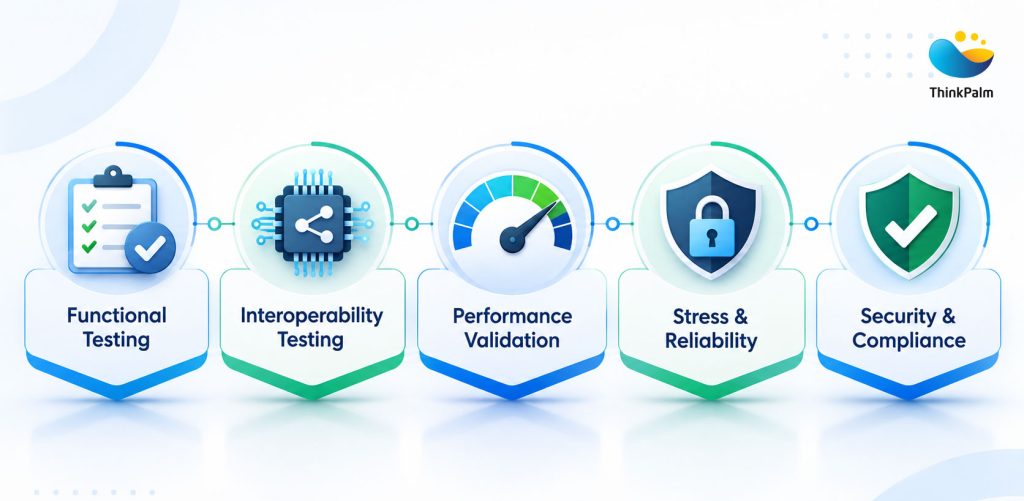
Core testing areas that help validate Wi-Fi products for functionality, interoperability, performance, reliability, security, and compliance.
From interoperability and performance to security, stability, and pre-compliance validation, the right testing strategy can help uncover certification risks before they reach the ATL.
Explore ThinkPalm’s Wireless Testing ServicesEven with a solid test plan, many devices still fail certification due to overlooked edge cases. Here are the most common pitfalls OEMs should anticipate and address:
Incomplete PMF Implementation: Incorrect handling of robust management frames during deauthentication attacks.
6 GHz Scanning Anomalies: Client implementations fail to scan PSC channels correctly, or APs misconfigure reduced neighbor reports (RNR).
MLO State Machine Instabilities: Desynchronization between the Access Point Multi-Link Device (AP MLD) and Non-AP MLD during rapid link drops.
Regulatory Mismatches: Incorrect Channel Availability Check (CAC) behavior or transmit power limit violations across varying regional profiles.
Skipped or Shortened Soak Testing: Memory leaks and driver crashes that only surface after 24+ hours of sustained traffic like unicast TCP/UDP, streaming video, and ping sequences which goes undetected.
The relationship between an OEM and its Authorized Test Laboratory (ATL) should not be purely transactional. OEMs must engage in the lab before they are ready to submit, not just when handing over a device, to save significant time and cost.
Most ATLs offer informal pre-screening consultations in which their engineers review the OEM’s test plan and flag areas likely to cause issues based on experience with similar devices. OEMs should leverage this service for every new Wi-Fi generation they certify. The cost is a fraction of a failed formal submission.
OEMs must initiate early ATL engagement in the following scenarios:
Leveraging ATL test sequencing guidance is critical for navigating complex Wi-Fi 7 MLO certification.
When the device uses a chipset pairing, the ATL has not tested before, interoperability surprises are more common.
When target-market regulations have recently changed, the ATL is often the fastest source of current information.
When internal pre-certification testing surfaces with anomalies that cannot be explained, an ATL engineer’s perspective on unusual failure modes is invaluable.
Early ATL engagement transforms certification from a reactive process into a proactive collaboration, helping OEMs minimize risk, reduce cost, and accelerate time to market.
Passing certification is not the end of the compliance story. Our firmware update cycle, chipset revision process, and product variant management all have the potential to affect certification status if they are not managed carefully after launch.
What triggers a delta certification or full re-certification for us:
We maintain a certification change log that tracks every firmware release against the certification baseline. This prevents the scenario where a cumulative series of individually small changes collectively places the device outside its certified configuration without anyone noticing.
To bring all these recommendations together, OEM teams should confirm the following items before submitting a product for formal certification:
All target Wi-Fi Alliance (WFA) test-plan features are fully implemented and verified in the firmware.
WPA3 Security standards and PMF completely validated with zero fallback vulnerabilities.
The device has successfully connected and passed basic traffic tests against at least three distinct vendor chipsets.
Roaming triggers, band-steering thresholds, and link-failover mechanisms behave predictably.
Device maintained stability under traffic load by executing soak tests (minimum 24 hours up to 72 hours).
Sniffer profiles (Over-the-Air traces) and internal driver debug logs are easily exportable for rapid troubleshooting if an issue arises at the lab.
For modern OEMs, Wi-Fi Alliance certification is more than a compliance milestone. It is a strategic differentiator. When Wi-Fi certification readiness is embedded into the development lifecycle, certification shifts from a late-stage checkpoint into a repeatable advantage.
By validating the above mentioned five test categories early, OEMs can significantly improve certification success rates, reduce development costs, and accelerate product launches. In today’s competitive wireless market, pre-certification readiness is the fastest path to Wi-Fi CERTIFIED™ success.
Planning your next Wi-Fi 6, 6E, or 7 certification cycle? Let’s talk through your pre-certification test plan before it reaches the ATL.
Nimmy Varghese is a Wi-Fi Test Engineer focused on Wi-Fi standards validation and certification testing. Her work involves validating wireless features, interoperability, protocol compliance, end-to-end connectivity, and optimizing test workflows for next-generation Wi-Fi devices.