Enterprise MCP Server: Connecting AI Agents to Enterprise Systems
Agentic AI
 Athira Gopakumar
September 7, 2026
Athira Gopakumar
September 7, 2026



 Athira Gopakumar
September 7, 2026
Athira Gopakumar
September 7, 2026
Artificial intelligence is moving beyond chatbots. Today’s AI agents can automate workflows, retrieve business data, execute tasks, and collaborate across applications. But there is one major challenge: enterprise systems were not built to communicate directly with AI.
Every CRM, ERP, database, document repository, and internal application has its own APIs, authentication methods, and data formats. Building custom integrations for every AI application quickly becomes expensive, difficult to maintain, and hard to scale.
This is where an Enterprise MCP Server changes the game. Built on the Model Context Protocol, an Enterprise MCP Server provides a standardized, secure layer that connects AI agents to enterprise systems. Instead of creating dozens of point-to-point integrations, organizations can expose business tools and data through a common protocol that every MCP enabled AI agent can understand.
Quick Answer
An Enterprise MCP Server is a standardized, secure connector built on the Model Context Protocol (MCP) that lets AI agents access enterprise systems such as CRMs, ERPs, databases, and internal APIs through a single common interface. Instead of building a custom integration for every AI application and every backend system, organizations expose their tools and data once, through an Enterprise MCP Server, and every MCP-enabled AI agent can use them.
The Model Context Protocol (MCP) is an open-source standard, originally developed by Anthropic, that defines a common way for AI applications to connect to external systems, tools, and data sources. It is often described as the “USB C for AI,” a single, standardized connector that any AI model can use to plug into any compatible system, instead of every AI vendor and every enterprise system needing its own custom integration.
MCP uses a client server architecture made up of three parts, covered in detail in the next section: the host, the client, and the server. Communication happens through structured, discoverable interfaces, so an AI model can learn what a system is capable of at runtime, rather than needing that knowledge hardcoded in advance.
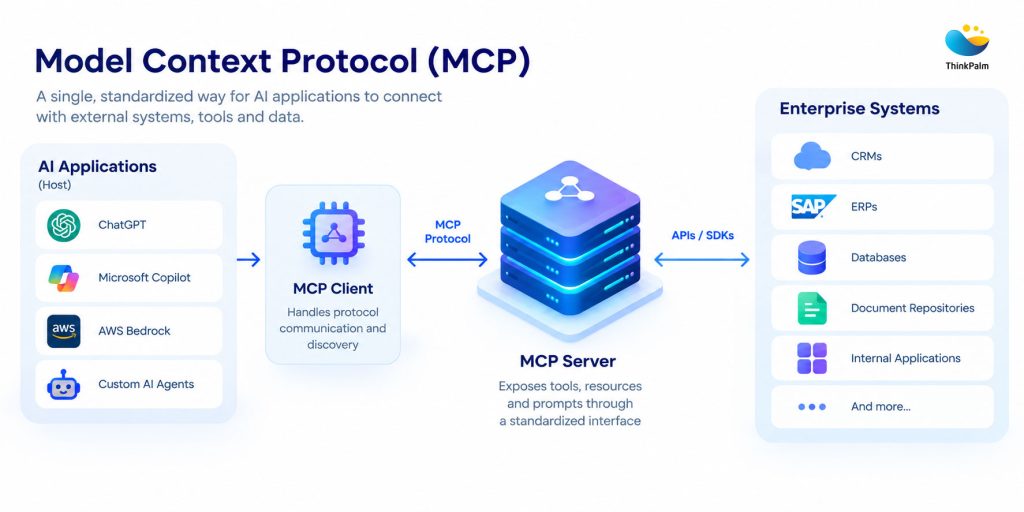
MCP provides a standardized bridge between AI applications and enterprise systems.
Adoption has scaled quickly since MCP’s release in late 2024:
An MCP server is a service that implements the Model Context Protocol, enabling AI applications to securely interact with external tools, APIs, databases, and enterprise software.
Think of it as a universal translator between AI models and business systems. Instead of teaching every AI application how to communicate with Salesforce, SAP, ServiceNow, GitHub, or internal databases individually, the MCP server exposes these capabilities using a standardized interface. The result is faster development, lower maintenance costs, and better interoperability across AI applications.
Technically, an MCP server exposes three types of capabilities:
| Primitive | What It Is | Example |
|---|---|---|
| Tools | Executable actions the agent can invoke | Create a Jira ticket, update a Salesforce record |
| Resources | Data the agent can read | A document, a database table, a support ticket |
| Prompts | Reusable instruction templates | A standardized “summarize this incident” prompt |
MCP servers can run locally, as a subprocess for a single user with zero network overhead, or remotely over HTTP, deployed centrally so many users and agents can connect to it with load balancing and network level authentication. Enterprises deploying at scale need the latter.
Organizations adopting AI often discover that the biggest challenge is not building intelligent models. It is integrating them into existing business systems.
Without a standardized integration layer, enterprises face:
An Enterprise MCP Server eliminates these issues by creating a single, governed access layer between AI agents and enterprise applications. Rather than connecting every AI model directly to backend systems, enterprises expose approved tools and resources once and allow multiple AI agents to consume them securely.
This is what solves the integration math problem underneath most enterprise AI integration projects: instead of building a separate connector for every combination of AI model and enterprise system, you build one MCP server per system, and any compliant AI client can use it. This same logic underpins broader AI for business process automation strategies, where the integration layer, not the model, is usually the bottleneck. Demand for this is accelerating.
Source: Gartner
An MCP architecture typically consists of three components.
The host is the AI application where users interact with an assistant or autonomous agent.
The client manages communication between the AI application and one or more MCP servers.
Connects to enterprise resources such as CRM platforms, ERP systems, HR applications, knowledge bases, databases, internal APIs, and cloud services.
It authenticates requests, validates permissions, invokes tools, retrieves resources, and returns structured responses that AI models can understand. This architecture decouples AI applications from backend systems, making integrations easier to manage and scale, and it is the technical foundation of most MCP enterprise integration deployments today.
In practice, if an agent needs Salesforce, PostgreSQL, and GitHub access, the host runs three MCP clients, one for each server. Each client discovers what its server can do at runtime, invokes tools or reads resources as needed, and every call passes through that server’s authentication and authorization layer before it touches the real system.
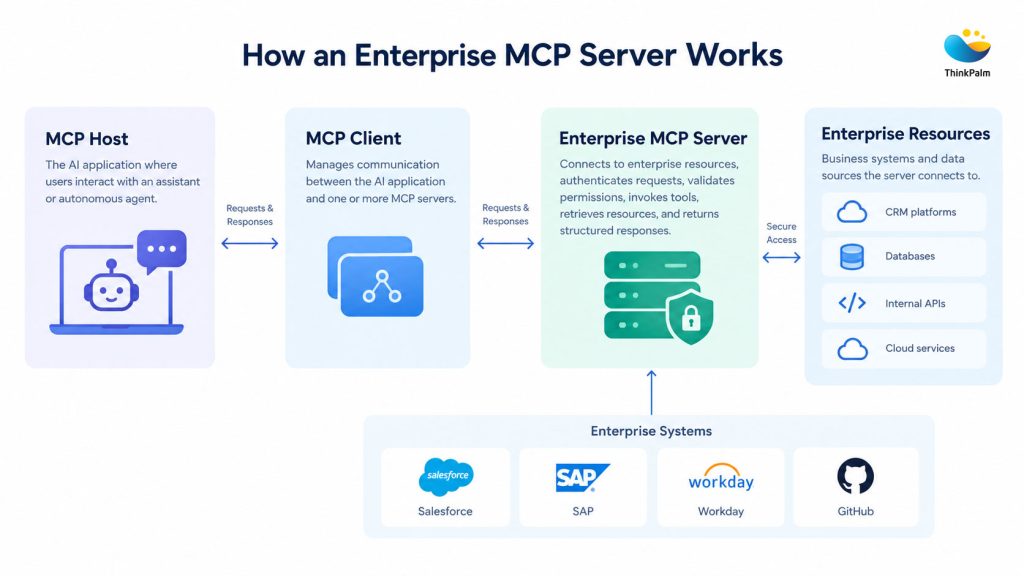
How AI agents connect securely with enterprise systems through MCP.
Most enterprises do not build every connector from scratch. Managed MCP platforms provide prebuilt connectors to hundreds of common enterprise systems, including Salesforce, SAP, Workday, and SQL databases, cutting integration timelines significantly. Several vendors report 60 to 70 percent time savings compared with building point to point integrations manually.
Successfully connecting AI agents to enterprise systems starts with the right architecture. Our experts help enterprises design secure MCP servers, scope integration priorities, and deploy AI agents that work safely inside your existing CRM, ERP, and internal systems.
Explore Our Agentic AI Development Services & SolutionsOnce an Enterprise MCP Server is in place, the payoff shows up well beyond the initial integration. It changes how AI agents are deployed, secured, and scaled across the organization, and it changes how quickly new AI initiatives can move from idea to production.
Here are the core benefits enterprises see once MCP becomes part of their integration strategy.
Every new AI initiative no longer requires custom APIs or middleware. AI agents can discover and use enterprise capabilities through a common protocol, which is the core value behind AI agent integration at scale.
Enterprise deployments require more than connectivity. They need governance. An Enterprise MCP Server enables centralized authentication, role based access control (RBAC), audit logging, and policy enforcement before an AI agent accesses business data.
Development teams can reuse existing MCP integrations across multiple AI applications instead of rebuilding connectors every time a new project begins.
As organizations deploy dozens of AI agents, maintaining hundreds of integrations becomes unsustainable. An Enterprise MCP Server provides a scalable integration model where backend changes happen once, without affecting every AI application.
Because MCP is an open standard, organizations can adopt different AI models while continuing to use the same enterprise integrations.
Looking to scale governance across multiple AI agents? Explore our guide to multi-agent orchestration use cases, including practical approaches to governance, access controls, and phased rollout.
AI agents retrieve customer history, create tickets, summarize conversations, and recommend solutions.
Sales assistants access CRM data, generate opportunity insights, update records, and schedule follow ups.
AI agents monitor infrastructure, retrieve logs, automate incident management, and trigger operational workflows.
HR assistants answer policy questions, retrieve employee documents, schedule interviews, and automate onboarding.
Finance teams use AI agents to retrieve reports, validate invoices, analyze spending, and automate approvals.
AI assistants interact with GitHub, GitLab, or Jenkins to manage CI/CD pipelines, review pull requests, or analyze build logs.
Agents access company wikis, intranets, and document repositories to answer questions grounded in internal knowledge, supporting retrieval augmented generation (RAG) use cases.
The common thread across all of these: MCP turns enterprise AI agents from passive, chat only assistants into systems that can take real action inside the tools a business already runs.
ThinkPalm built a procurement AI agent for a global ship management group running typed MCP tools against existing ERP and vessel management systems across a fleet of over 700 vessels.
Traditional API integrations connect one application to another. Every new AI solution often requires additional custom development.
An Enterprise MCP Server changes this model by creating a reusable integration layer.
This architecture significantly reduces integration complexity while improving consistency and governance.
MCP is a specification, not a built in security shield. It provides the framework to build securely, but it does not guarantee that any given server has done so.
2026 Security Audit Finding
Roughly 25% of public MCP servers ran with no authentication at all, and 53% relied on long lived static API keys rather than short lived, scoped credentials, a real concern as the public server registry has grown more than sevenfold in just over a year.
A properly secured Enterprise MCP Server should implement:
For enterprises, this usually means pairing MCP servers with a dedicated identity layer rather than building OAuth infrastructure from scratch, since several identity providers now ship purpose built MCP authentication support covering the protocol’s specific requirements.
Many organizations focus only on deploying MCP servers. The real success lies in operating them securely and at scale. Follow these best practices:
These practices improve reliability while reducing operational risk in enterprise AI deployments.
Although MCP simplifies enterprise AI integration, organizations should plan for:
Legacy applications without modern APIs
Identity and access management
Governance across multiple AI agents
Performance monitoring
Tool versioning
Compliance requirements
A still evolving standard, since MCP’s authorization spec has already gone through multiple revisions since 2024
Addressing these early ensures AI initiatives remain secure and maintainable as adoption grows.
The next generation of AI will not be defined by larger language models alone. It will be defined by how effectively those models interact with enterprise systems.
An Enterprise MCP Server enables organizations to move beyond isolated AI assistants and build connected AI ecosystems where multiple agents collaborate across business applications securely and efficiently. As AI adoption grows, enterprises will increasingly require standardized protocols, centralized governance, and scalable integration layers. MCP provides that foundation.
As enterprises move from AI experimentation to production deployments, integration becomes the defining factor for success. An Enterprise MCP Server provides the secure, standardized bridge that connects AI agents with enterprise applications, enabling scalable AI agent integration without the burden of maintaining countless custom APIs.
Organizations that adopt model context protocol servers can accelerate enterprise AI integration, improve governance, reduce operational complexity, and future proof their AI infrastructure. Rather than serving as just another middleware component, the Enterprise MCP Server becomes the foundation for building connected, intelligent, and enterprise ready AI ecosystems.
Whether you are running your first enterprise MCP pilot or looking to scale AI agent integrations across your organization, ThinkPalm has the engineering depth to help you move forward with confidence.
Athira Gopakumar is a Digital Marketing Specialist in the tech industry, with a strong focus on IoT marketing. She specializes in data-driven strategies, leveraging SEO, content marketing, and market research to enhance brand visibility and lead generation for IoT solutions. Passionate about the intersection of technology and marketing, she stays ahead of industry trends to drive impactful campaigns. Outside of work, she enjoys traveling to new places and dancing to unwind.