Wi-Fi 7 Beyond Speed: Understanding Multi-Link Operation and How Fast Can It Connect?
Wireless Testing
 Praveen K
June 30, 2026
Praveen K
June 30, 2026



 Praveen K
June 30, 2026
Praveen K
June 30, 2026
Wi-Fi 7 (IEEE 802.11be) represents a generational leap in wireless networking, not just in raw throughput, but in how devices fundamentally connect to access points. Central to this evolution is Multi-Link Operation (MLO), a feature that increases capacity by simultaneously sending and receiving data across different frequency bands and channels (2.4 GHz, 5 GHz, and 6 GHz).
While Wi-Fi 6 introduced significant improvements in spectral efficiency, Wi-Fi 7 extends that foundation by enabling true coordinated multi-band connectivity, fundamentally changing how quickly and reliably a device can establish a usable connection.
But speed on paper and speed in the real world are two different things. In this MLO access point connection performance comparison, we put three leading Wi-Fi 7 access points to the test, measuring exactly how fast each one completes the full connection workflow under identical, controlled conditions.
Before diving into the benchmarks, it is important to understand what Multi-Link Operation actually does and why it marks such a significant departure from legacy Wi-Fi behavior.
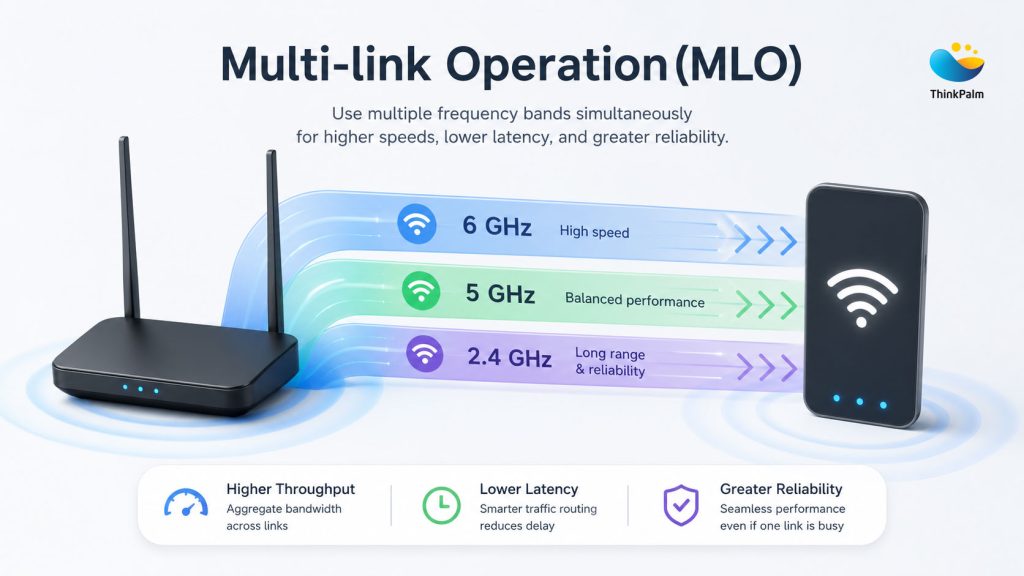
Smarter Wi-Fi Through Multi-Link Operation
In traditional Wi-Fi deployments, a client device connects to an access point on a single band and a single channel at any given time. Wi-Fi 7’s Multi-Link Operation (MLO) transforms this entirely. MLO allows a device and an access point to simultaneously establish and use multiple radio links across different frequency bands, meaning a single logical connection can span 2.4 GHz, 5 GHz, and 6 GHz links concurrently.
This multi-band architecture is defined under the IEEE 802.11be standard and introduces a new layer of complexity into the connection workflow. Devices no longer associate over a single channel. Instead, they negotiate, discover, and bind multiple links concurrently, which is why understanding Wi-Fi 7 MLO connection performance is critical for real-world deployment decisions.
MLO introduces significant advantages for a wide range of use cases. Key enhancements include:
Throughput gains in Wi-Fi 7 are not just about multi-band aggregation. OFDMA and multi-RU allocation in Wi-Fi 7 take spectrum efficiency further by enabling smarter, more granular resource distribution across clients.
With the introduction of Multi-Link Operation (MLO) in Wi-Fi 7, connection behavior has become significantly more complex compared to legacy Wi-Fi. Where a traditional association involved a single band negotiation, MLO requires coordinated multi-band link discovery, simultaneous authentication, and primary link selection, all before a device can pass its first byte of useful traffic.
This added complexity makes connection time a critical performance metric. The time it takes to establish a usable MLO connection directly impacts:
Getting connected quickly matters. What happens after the connection is established matters just as much. How Wi-Fi 7 handles simultaneous real-time traffic under congestion is just as critical for applications like VoIP and video conferencing that cannot tolerate latency spikes.
Different vendors implement MLO and connection workflows differently. This is where a structured Wi-Fi 7 access point vendor performance comparison becomes highly informative. Because MLO is a new and complex standard, each vendor’s firmware makes different decisions about how to handle:
This validation helps identify performance differences across access points, understand vendor-specific optimizations, detect delays in scanning, association or link setup, and benchmark real-world MLO connection performance across leading hardware.
All tests were conducted in a controlled open-air environment using the following hardware and software configuration:
| Component | Configuration |
|---|---|
| Access Points (AP) subjected to experimentation | Brand A, Brand B, Brand C |
| Station (STA or Client) | Intel BE201 Wi-Fi 7 Windows (MLO Enabled) |
| Sniffer Device | Intel BE201 Wi-Fi 7 Linux – 2 Nos |
| Configuration of APs | MLO Enabled with WPA3 SAE security, Channel 1 (20 MHz) & Channel 36 (160 MHz) |
| Frequency Bands | 2.4 GHz and 5 GHz |
| Sniffer Capturing Tool | Wireshark v4.2.2 (GUI) |
| Environment | Open Air |
Two dedicated monitor-mode Intel BE201 sniffers captured traffic in parallel on both MLO links, ensuring complete visibility into the connection workflow across both the 2.4 GHz and 5 GHz bands.
The infrastructure behind this kind of testing goes beyond standard off-the-shelf setups. For a closer look at what modern wireless test labs look like today and how they differ from legacy approaches.
Packet captures were collected simultaneously on both MLO links using dedicated monitor-mode Intel BE201 sniffers. Connection establishment time was measured from the first Probe Response frame through completion of EAPOL Message 4. By and large, this approach provides a consistent reference point across all tested access points while capturing the complete WPA3-SAE authentication workflow.
Furthermore, the measured window intentionally covers the full pre-association and authentication workflow, including scanning completion, probe handling, MLO link discovery across both 2.4 GHz and 5 GHz, primary link selection, association initiation, and the complete WPA3-SAE EAPOL handshake. This ensures that any vendor-specific delays, whether in band scanning, link negotiation, or authentication initiation, are fully captured in the measurement.
The time difference between Probe response and Eapol Msg 4 can be calculated by referring to the individual Fig 1a, Fig 1b, and Fig 1c, respectively.
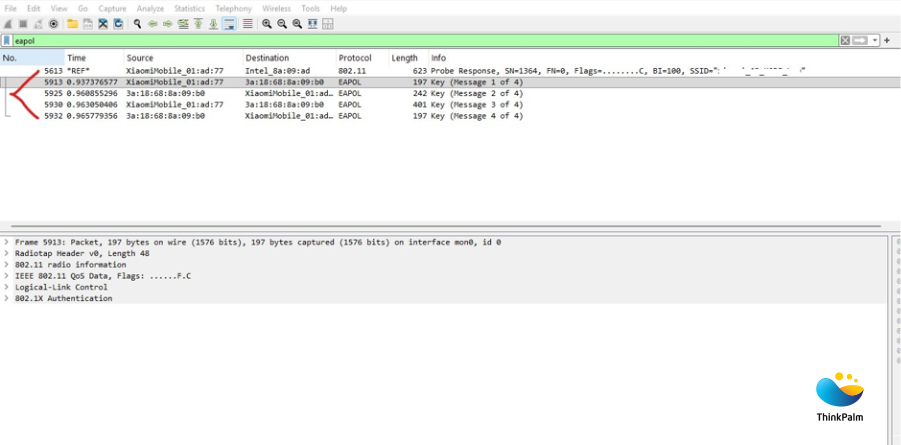
Fig. (1a) Time difference between Probe response and Eapol Msg 4 of AP Brand A
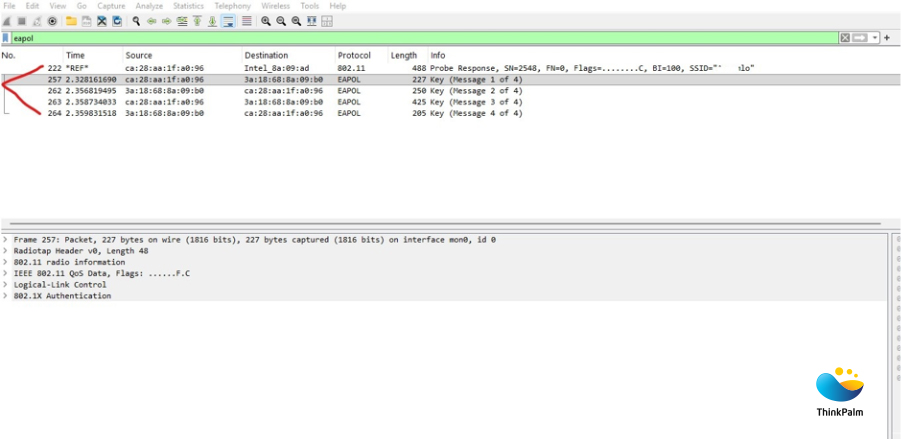
Fig. (1b) Time difference between Probe response and Eapol Msg 4 of AP Brand B
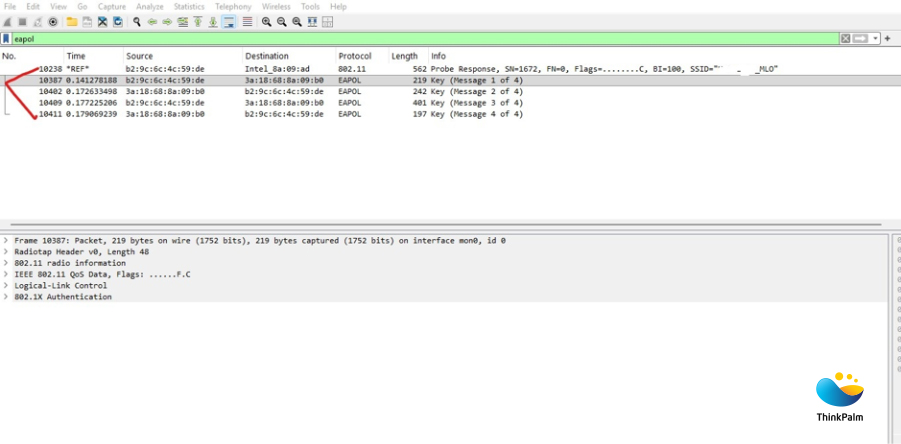
Fig. (1c) Time difference between Probe response and Eapol Msg 4 of AP Brand C
The measured connection time for each access point encompasses the full connection lifecycle:
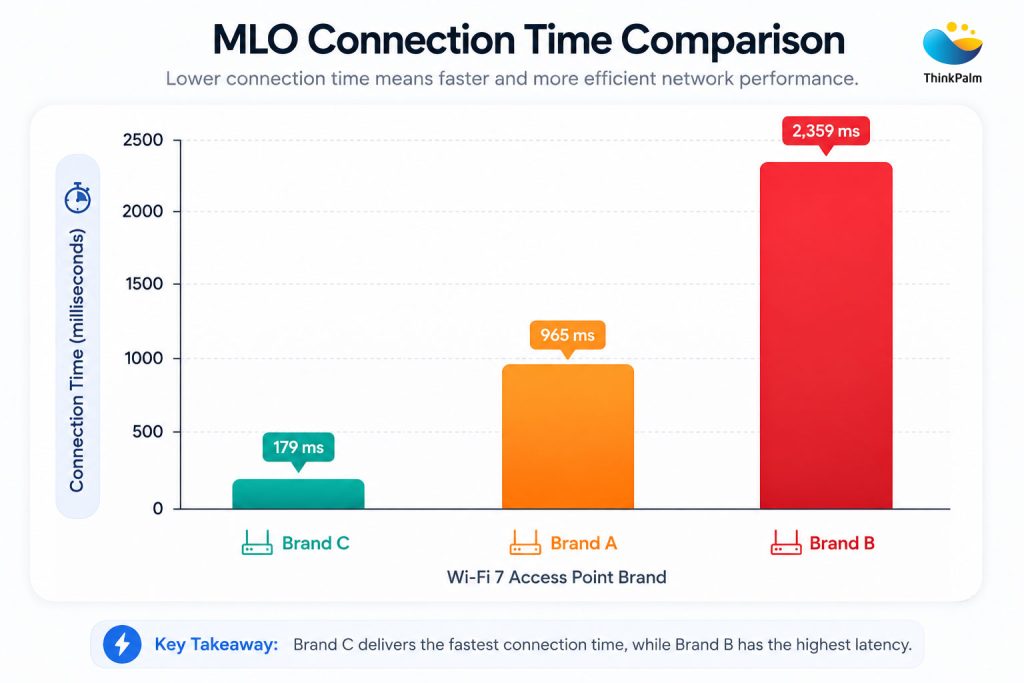
The results reveal a striking difference in how each vendor handles the MLO connection workflow:
| Access Point | Connection Time (milliseconds) | Speed of Connection Time |
|---|---|---|
| Brand A | 965 | Medium |
| Brand B | 2359 | Slowest |
| Brand C | 179 | Fastest |
MLO Reduces Connection Delays for Instant Connectivity
Notably, the 802.11be MLO pre-association scanning delay, not WPA3-SAE authentication speed, is the primary driver of these differences. Brand C’s superior result is driven by efficient concurrent band scanning and link negotiation, while Brand B’s poor performance appears rooted in sequential link scanning and frequent protocol timeouts.
Verdict: Highly optimized, production-ready MLO stack.
Reason: Brand C achieves the lowest connection time through its optimized Asynchronous Concurrent Multi-Link Negotiation, which eliminates sequential link binding delays, combined with its highly efficient Parallelized Active Probing Mechanics, which ensure rapid client-to-AP band mapping under heavy network loads without triggering protocol timeouts. Recommended for enterprise environments, high-density deployments, and any use case with strict latency SLAs.
Verdict: Acceptable for general use but exhibits moderate pre-association friction.
Reason: Brand A exhibits moderate pre-association friction due to conservative association trigger timings. However, its connection time baseline remains acceptable for environments that do not require aggressive roaming or millisecond-level latency guarantees. Suitable for small-to-medium office deployments with predictable client behavior.
Verdict: Unacceptable latency for dynamic or roaming environments.
Reason: Brand B introduces a severe performance bottleneck driven by inefficient Sequential Link Scanning and frequent Protocol Timeouts. These cause unacceptable latency spikes during active client roaming and make Brand B unsuitable for enterprise-grade or high-density Wi-Fi 7 deployments where fast MLO access point connection performance is a hard requirement.
MLO connection performance is only the starting point. Understanding how EMLSR (one of the MLO connection modes) works within the MLO framework reveals the deeper protocol mechanics that determine how efficiently a Wi-Fi 7 device maintains and switches between its active links.
This analysis demonstrates that MLO connection performance depends primarily on pre-association mechanics and multi-link coordination, not WPA3-SAE authentication speed.
Evidently, this is a critical finding for network engineers and enterprise IT teams evaluating Wi-Fi 7 hardware: the authentication phase is broadly consistent across vendors. However, the real differentiator lies in how efficiently each access point handles the steps that come before it.
The operational variances observed in this test are driven by three core vendor bottlenecks:
How quickly the client and access point identify available bands across all supported frequencies.
The delay introduced before the AP initiates the connection handshake, which is a significant source of latency variation across vendors.
Whether multi-band negotiation happens concurrently (fast) or sequentially (slow), reflecting how mature the vendor’s multi-link operation link selection behavior implementation is.
This validation is vital for evaluating real-world Wi-Fi 7 deployments, selecting optimal AP hardware for your environment, and isolating pre-association delays to drive better vendor firmware optimization. For network architects, IT procurement teams, and wireless engineers, connection time benchmarks like this provide actionable intelligence that throughput tests alone cannot deliver.
We, at ThinkPalm, offer Wi-Fi pre-compliance testing services by working with chipset manufacturers, OEMs, Wi-Fi service providers, and enterprises. Additionally, our team operates dedicated lab infrastructure, including RF chambers, variable attenuators, and Candela Wi-Fi AX and TR-398 automation suites.
Testing capabilities span Wi-Fi performance, security, functionality, interference, stability, and pre-compliance validation. This includes protocol-level analysis across Wi-Fi 7 (802.11be), Wi-Fi 6E, and legacy standards, with specific expertise in MLO, MU-MIMO, OFDMA, WPA3-SAE, and band steering validation. Packet-level capture and analysis using Wireshark and monitor-mode sniffers forms a core part of the team’s methodology, as demonstrated in the connection time measurements above.
Praveen K is a skilled and passionate Senior Test Lead at ThinkPalm with extensive experience in testing Wi-Fi and Bluetooth SoCs. He’s curious, adaptable, and always eager to explore new tools and techniques to stay ahead in the dynamic field of wireless technology.