Enterprise Agentic AI: A Practical Guide for Business Leaders in 2026
Agentic AI
 Athira Gopakumar
July 29, 2026
Athira Gopakumar
July 29, 2026



 Athira Gopakumar
July 29, 2026
Athira Gopakumar
July 29, 2026
Artificial intelligence is evolving beyond chatbots and copilots. Agentic AI for enterprise is no longer a vision of the future, but a current capability that many organizations are embracing to streamline intricate processes, enhance decision-making, and propel digital transformation.
Unlike traditional AI applications, which are more focused on content generation or recommendations, Agentic AI systems can plan, reason, take action, and interact with other systems to execute business goals with only a small amount of human interaction. As AI continues to power business automation, enterprise Agentic AI plays a pivotal role in unlocking the next generation of intelligent business automation, enabling tasks to be executed independently.
But even with all the buzz, there is a lot of uncertainty when it comes to what exactly constitutes Agentic AI. What many people call “AI agents” is often just a sophisticated chatbot or workflow automation tool with some degree of autonomy. It is important to grasp the difference because it is crucial for organizations to get the most from this technology.
In this guide, you will discover what Agentic AI for enterprise actually means, how it’s different from existing enterprise AI systems, where it provides the highest business value, and the critical factors for effective adoption, governance, and scale of enterprise AI agents.
Definition
Enterprise Agentic AI is autonomous AI systems that can plan, reason, make decisions, and take action within enterprise settings with minimal human interaction in order to accomplish specific business tasks.
Unlike traditional automation systems that rely on predefined rules and workflows, enterprise AI agents can:
Interpret business goals and operational context.
Break complex objectives into executable tasks.
Interact with enterprise applications, APIs, and data sources.
Adapt to changing conditions and evolving priorities.
Learn from outcomes, feedback, and past interactions to improve performance.
These capabilities of Agentic AI systems in business are more adaptive and resilient than traditional automation, allowing businesses to create smart workflows that continuously optimize processes, improve business outcomes, and operational efficiency.
Common enterprise use cases include AI agents that handle IT incidents, manage procurement processes, analyze financial data, manage customer service processes end-to-end, and coordinate actions across more than one enterprise system without constant human supervision.
The initial wave of enterprise AI has been primarily about productivity-boosting assistants and AI copilots that helped employees in their work. The next wave focused on autonomy, where enterprise AI agents can autonomously plan, execute, and optimize complex business workflows with limited human involvement. Learn how AI is transforming intelligent workflows in our guide to AI business process automation.
Today’s organizations are under increasing pressure to:
Agentic AI in the enterprise solves this by allowing intelligent systems to independently perform multi-step workflows, make contextual decisions, interact with enterprise applications, and coordinate actions, as necessary, across business functions.
From IT operations and customer service to finance and supply chain management, Agentic AI for enterprise is helping organizations move beyond task automation toward outcome-driven automation. Instead of simply automating repetitive tasks, enterprise AI automation powered by autonomous agents enables businesses to achieve measurable outcomes with greater speed, accuracy, and scalability.
A regular AI tool generates a response. An enterprise AI agent gets something done.
While these three technologies (Agentic AI, Generative AI, and Traditional Automation) are frequently grouped together, they have different functions.
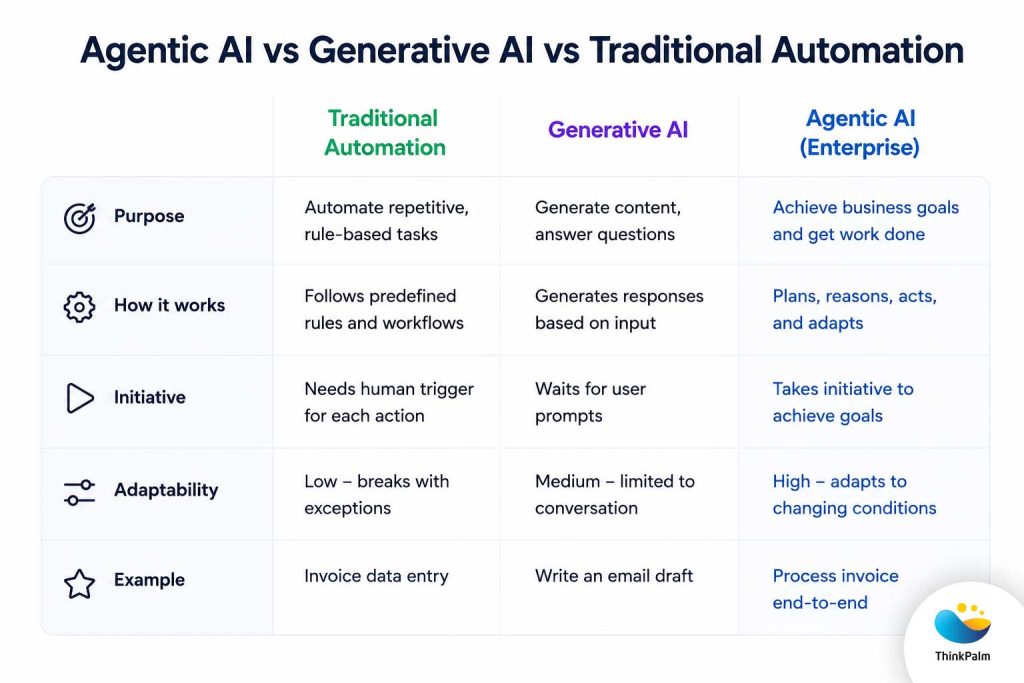
Understanding the key differences between traditional automation, generative AI, and Agentic AI
Here is how the three categories differ:
Traditional automation follows rules. It is fast and reliable for predictable tasks, but it has no flexibility when something unexpected happens.
Generative AI creates content and answers questions. It is useful, but it waits for you to ask it something and does not take action inside your systems.
Agentic AI for enterprise does both and goes further. It understands a business goal, builds a plan, uses your tools and systems to carry that plan out, and adjusts when things do not go as expected.
Most enterprise Agentic AI systems rely on a Large Language Model (LLM) as the reasoning engine at their core. When integrated with links to your business data, workflow capabilities, and governance guardrails, it can take care of work that once required specific human judgement and time.
Still evaluating enterprise AI approaches? Understanding when to use generative AI versus autonomous AI agents is essential for building the right AI strategy.
Typically, enterprise Agentic AI architectures integrate several AI technologies to facilitate autonomous decision-making, workflow orchestration, and intelligent execution. They usually consist of five key steps, although they can differ depending on the specific implementation.
The desired result is defined by business users, for example, by resolving a ticket or processing an invoice, or by creating a compliance report. In contrast to preprogrammed instructions, enterprise AI agents are tasked with an objective and then figure out how to achieve it.
AI agent reads the objective, determines dependencies, assesses the resources available, and creates an execution plan. The agent can divide large business objectives into smaller tasks that can be done and adjust actions as conditions evolve.
Agents access the desired data from enterprise applications, databases, knowledge bases, and business systems via APIs, connectors, and retrieval mechanisms. Accurate, up-to-date data is crucial, and the quality of the decisions depends on the quality of the underlying data.
Agents interact with enterprise software, business applications, external tools, and even other enterprise AI agents to perform tasks. Agentic AI for enterprise is unique in its capacity to act across various systems, whereas traditional AI assistants act as mere data generators or recommenders.
To understand how foundational AI capabilities have evolved to make this possible, read our guide on generative AI for enterprises.
Feedback loops, performance, and human oversight allow for continuous monitoring, evaluation, and refinement of outcomes. As the system learns and evolves over time, it becomes more adaptive, reliable, and efficient in decision-making and execution, enhancing enterprise AI automation.
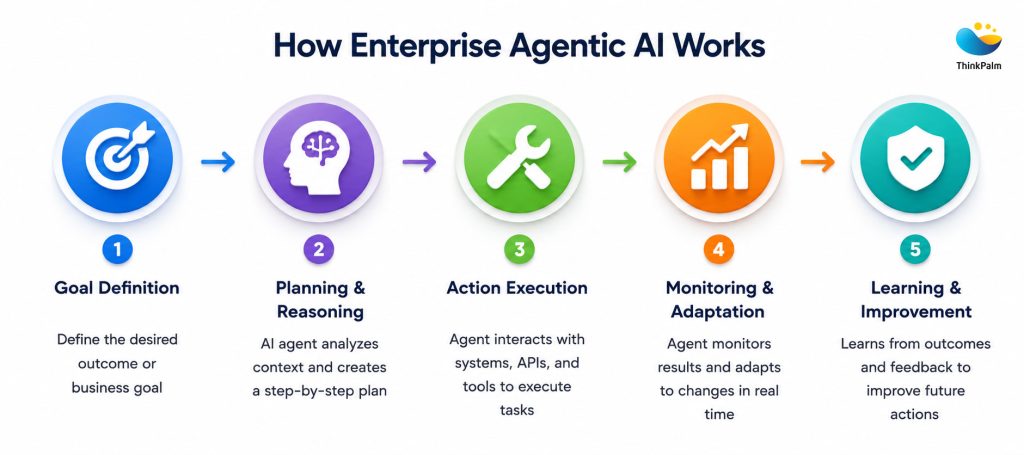
How enterprise Agentic AI transforms goals into intelligent actions
Together, these features allow enterprise AI agents to drive automation of complex business processes, yet keep context, flexibility, and consistency with business goals.
Looking to automate more complex workflows? Multiple AI agents can collaborate across departments to orchestrate end-to-end business processes. See how organizations are putting this into practice in our guide to multi-agent orchestration use cases.
Adopting Agentic AI for enterprise is not just about streamlining automation; it’s about transforming into intelligent, outcome-focused operations. With enterprise AI agents, organizations can streamline operations, make faster decisions, and scale enterprise AI automation functions.
Enterprise AI agents eliminate repetitive, multi-step workflows, save manual effort, lessen bottlenecks, and ensure consistency and efficiency.
Autonomous agents can process enterprise data in real time, allowing organizations to quickly adapt to shifting enterprise conditions and new opportunities.
Employees are freed from repetitive tasks to concentrate on strategic initiatives, innovation, and customer interaction through the power of AI agents.
Unlike rule-based automation, autonomous agents can adjust more to evolving business needs and increase in size throughout various departments, thus having more flexibility.
Agentic AI systems in business enable faster responses, personalized interactions, and consistent service delivery, helping organizations enhance customer satisfaction and loyalty.
Enterprise AI agents are delivering real results across several key functions.
Agents provide proactive system monitoring, proactively identify incidents, proactively determine the root cause, and initiate remediation before a human is even aware of a problem. IT moves from firefighting to reliability management.
Enterprise AI agents handle inquiries, resolve common issues, update records, and escalate to humans only when needed. Gartner predicts that by 2029, Agentic AI will resolve 80% of common customer service issues without human intervention, reducing operational costs by 30%.
Agents automate invoice processing, payment matching, fraud detection, and financial reporting. Organizations are seeing processing time cut by up to 70% while accuracy and compliance improve.
Agents track inventory, coordinate suppliers, optimize logistics, manage onboarding, monitor training completion, and review job applications, allowing people to focus on more value-added tasks.
These examples illustrate how Agentic AI systems in business are transforming enterprise operations.
Agentic AI for enterprise is more than just a new technology. It’s setting the stage for autonomous and intelligent systems in your organization. No matter how sophisticated an enterprise AI agent is, it can only be valuable when they have access to proper data, system integration, processes, and governance model in place.
If you’re thinking about investing in AI automation for your enterprise, evaluate your organization’s readiness in these five key areas first.
Ask: Does your enterprise data meet the criteria of being accurate, accessible, and well-governed?
Why it matters: Enterprise AI agents need to process trustworthy data to deliver meaningful outcomes, execute workflows, and make decisions. Inconsistencies in data quality, silos, or mismanagement of data can have a tremendous effect on the trustworthiness of autonomous decision-making.
Ask: Is it possible for your enterprise applications to communicate with each other in a secure manner?
Why it matters: Agentic AI systems in business rely on smooth integration with ERP, CRM, HR, finance, and other enterprise software. APIs, connectors, and secure data access allow agents to access data, initiate actions, and manage processes in different systems.
Ask: Do you have policies that guarantee security, responsibility, and compliance with AI?
Why it matters: Governance should define access controls, human oversight, audit trails, regulatory compliance, and risk management. Solid governance is essential to scale enterprise Agentic AI without compromising transparency and accountability.
Ask: Are your business processes standardized, documented, and measurable?
Why it matters: Workflows are best described in the case of autonomous agents. Standardized processes minimize ambiguity, ensure that the process is done in the same way, and make it easier to measure business outcomes.
Ask: Are your employees prepared to work alongside AI agents?
Why it matters: With organizations increasingly using enterprise AI agents, job roles shift from automation to oversight, verification, and fine-tuning of AI-driven processes. As crucial as investing in technology is, investing in change management and AI literacy is.
These five factors are critical for organizations to be well-positioned to implement Agentic AI for enterprise successfully. They don’t view AI as a technology project but as a data, governance, integrations, and maturity transformation project that is designed to support enterprise AI automation at scale, securely, and with measurable business value.
Successfully implementing Agentic AI for enterprise starts with understanding your organization’s readiness. Our experts help enterprises identify high-impact use cases, assess AI maturity, design secure architectures, and build scalable enterprise AI automation solutions tailored to business goals.
The benefits are real, but so are the risks. Most of them are not covered in most of the guides.
Agent Sprawl. As individual teams deploy their own agents independently, organizations accumulate uncontrolled autonomous systems with no central oversight. This creates security gaps, compliance risks, and redundant costs. Treat enterprise AI agents as enterprise infrastructure, not departmental tools.
Machine Identity Blind Spots. Every AI agent needs credentials to access your systems. As agentic deployments grow, unmanaged digital identities become a serious security vulnerability. Apply the same access controls and monitoring to agents that you apply to human users.
Data and Reliability Risks. The top barriers leaders report are reliability and hallucinations, followed by security and accuracy. Agents grounded in verified, real-time enterprise data produce far better results than those working from stale or incomplete information.
Strong governance is not a barrier to Agentic AI value. It is what makes that value sustainable.
Key governance principles:
A practical starting roadmap:
Step 1
Start with repetitive, high-volume workflows such as IT support or invoice processing.
Step 2
Test in a controlled environment, measure outcomes, and validate performance.
Step 3
Ensure agents have secure access to accurate, up-to-date enterprise data.
Step 4
Define human oversight, access controls, and compliance policies.
Step 5
Expand successful deployments across business functions with centralized governance.
Knowing where to start with enterprise Agentic AI can be the hardest part. ThinkPalm is a product engineering and software development company with close to two decades of experience helping enterprises, telecom companies, and technology product organizations build AI solutions that work in production.
ThinkPalm’s Agentic AI capabilities include custom AI development, autonomous agent design and deployment, enterprise application integration, test automation, and IoT and data platform services.
The future of Agentic AI in the enterprise will be driven by greater autonomy, intelligent collaboration, and enterprise-wide automation. As the technology matures, organizations can expect advancements in:
Multiple AI agents working together across functions and departments.
End-to-end business process orchestration with minimal human intervention.
Workflows designed from the ground up around autonomous AI execution.
Enterprise AI agents purpose-built for specific industries and use cases.
More mature governance and compliance frameworks for autonomous systems.
As these capabilities evolve, Agentic AI for enterprise will transition from pilot projects to a core driver of enterprise AI automation. Organizations that invest early in scalable architectures, robust governance, and workforce readiness will be best positioned to unlock long-term business value and competitive advantage.
Still evaluating enterprise AI approaches? Enterprise AI agents deliver even greater value when they collaborate to solve complex business problems. Discover how multiple AI agents can coordinate tasks, share context, and automate end-to-end workflows across your organization.
Agentic AI for enterprise is already changing how organizations operate. The businesses seeing the best results started with a clear problem, picked a use case with measurable outcomes, fixed their data foundations, and built governance before they scaled.
Enterprise AI agents give your organization the ability to work faster, scale smarter, and free your people up for the work that actually needs them. Watch out for agent-washing. Demand proof. Build governance early. Manage machine identities carefully.
The organizations that move thoughtfully but decisively in 2026 will be the ones setting the pace for years to come.
Athira Gopakumar is a Digital Marketing Specialist in the tech industry, with a strong focus on IoT marketing. She specializes in data-driven strategies, leveraging SEO, content marketing, and market research to enhance brand visibility and lead generation for IoT solutions. Passionate about the intersection of technology and marketing, she stays ahead of industry trends to drive impactful campaigns. Outside of work, she enjoys traveling to new places and dancing to unwind.