How Autonomous Logistics Agents Are Transforming Supply Chain Decisions
Agentic AI
 Chandni Nadarajan
August 7, 2026
Chandni Nadarajan
August 7, 2026



 Chandni Nadarajan
August 7, 2026
Chandni Nadarajan
August 7, 2026
Imagine a logistics operation that never sleeps. At 3:00 AM, inventory levels fall below a predefined threshold. By 3:02 AM, a reorder is placed. At 3:05 AM, a delayed shipment is reprioritized, and by 3:07 AM, affected customers receive updated delivery estimates.
No one logged into a dashboard. No one drafted an email. No one approved the next step.
Instead, a network of autonomous logistics agents quietly handled the routine decisions in the background, leaving people to focus on disputes, negotiations, and the exceptions that truly need human expertise.
For logistics teams facing increasing order volumes and shrinking operational bandwidth, that future may be closer than they think.
Every logistics operation depends on a set of daily micro decisions which consist of questions like what to reorder, which shipment gets priority today, whether a delivery is at risk, and how to answer a supplier’s status query. Although it looks simple at the surface level, these tasks still route through people. For instance, planners track inventory, managers sign off, and coordinators will have to type manual replies.
That setup works fine at low volume. But it breaks down as the network grows. As routes, vendors, and time zones multiply, human processing becomes the primary constraint. The true delay isn’t fleet capacity or software; it is the queue waiting for human review.
AI in logistics decision-making is critical because manual bottlenecks trigger three distinct issues:
Execution Delays: Clear operational choices sit idle in review backlogs.
Communication Friction: Lack of AI supplier communication automation slows down response times.
Coverage Gaps: Supply chain disruptions happen 24/7, but manual oversight stops when shifts end.
Supply Chain Reality
As of 2024, only 60% of supply chain organizations had comprehensive
visibility into their tier-one suppliers, up from 50% the year before.
That means a large share of logistics teams are still making decisions on
partial data even at the first tier, before you even count second- and
third-tier suppliers.
Definition
Autonomous logistics agents are AI systems that continuously monitor operational data, inventory levels, shipment status, and delivery SLAs and act directly on that data within rules the business sets. They do not simply display it on a dashboard for someone to review later. They place the reorder, reprioritize the shipment, or send the notification themselves, and only escalate to a person when a decision genuinely falls outside their defined scope.
Traditional logistics workflow automation AI undertakes tasks only along a fixed path and still relies on human intervention for decision-making. On the other hand, autonomous AI agents change this paradigm by making judgements based on preset operational guidelines. They handle routine tasks end-to-end and involve humans only when something falls outside them.
To understand why autonomous logistics agents are a suitable choice beyond workflow automation, it helps to first understand what Agentic AI is and how enterprises are beginning to use AI systems that can make decisions, execute tasks, and collaborate with humans.
Key Principle
A workflow automation tool doesn’t solve decision bottlenecks; it just pushed them down the line. What logistics operations actually need is a system that can make operational decisions within clearly defined limits. Autonomous logistics agents are capable of making real-time inventory decisioning AI choices within set boundaries escalating to human teams only when complex exceptions arise.
The solution ThinkPalm proposed to a logistics client was built around two connected systems, not one. The first handles the operational decision while the other manages the communication it triggers. Agentic AI in logistics handles routine execution end-to-end, while human teams step in only for high-friction cases like disputes, negotiations, and SLA monitoring AI escalations.
The shift toward autonomous operations is moving at a faster pace across enterprise software and supply chain networks. Recent industry projections highlight how fast agentic AI is moving from early adoption to a core business standard:
These autonomous logistics agents continuously monitor inventory, shipment status, and delivery of SLAs continuously. They act directly within the rules the business sets rather than simply flagging alerts for manual review.
Every autonomous decision would have a follow-up dialogue in the form of a confirmation of ETA (estimated time of arrival) update, a delay notice, or resolving a billing dispute. This layer is designed to manage that communication across email, chat, and supplier portals, which is where AI supplier communication automation does most of its work. It does its work by:
In this manner, an LLM supplier communication genuinely earns its place. A language model that can read a supplier’s contract terms and shipment history can draft a suitable reply closer to what a trained logistics coordinator would write. Hence this turns out to be professional correspondence as opposed to a basic form letter.
ThinkPalm’s team can help you evaluate your current logistics workflows, identify high-value automation opportunities, and design a governed, on-premise-capable multi-agent system tailored to your operations.
Explore ThinkPalm’s AI Development ServicesDeploying autonomous AI agents in supply chain workflows transforms daily operations. However, the phrase “the AI decides” tends to raise curiosity from operations leaders: decides based on what, exactly? In a well-designed system, real-time inventory decisioning AI watches the same signals that a skilled planner would. It monitors current stock levels, reorder points, supplier lead times, in-transit inventory, and demand trends. Its key highlight is that this happens continuously and not during a scheduled review.
When those signals hit a specified threshold, the business has defined; the agent acts: it places the reorder, adjusts a shipment priority, or reroutes things if there’s a delay. But every action is logged clearly with the reasoning behind it. Therefore, a supply chain manager can audit what happened without having to reverse-engineer the decision after the fact. This audit trail is what separates a genuinely autonomous system from a black box that quietly changes things, and it often plays a crucial role in whether an operations team feels comfortable handing over the reins to the system.
A logistics leader may not agree to a system that runs unsupervised on every decision, and a well-designed solution won’t demand it. AI exception handling logistics is the part of the system that identifies when a situation has moved outside its pre-set boundaries rules and re-routes it to a person before acting.
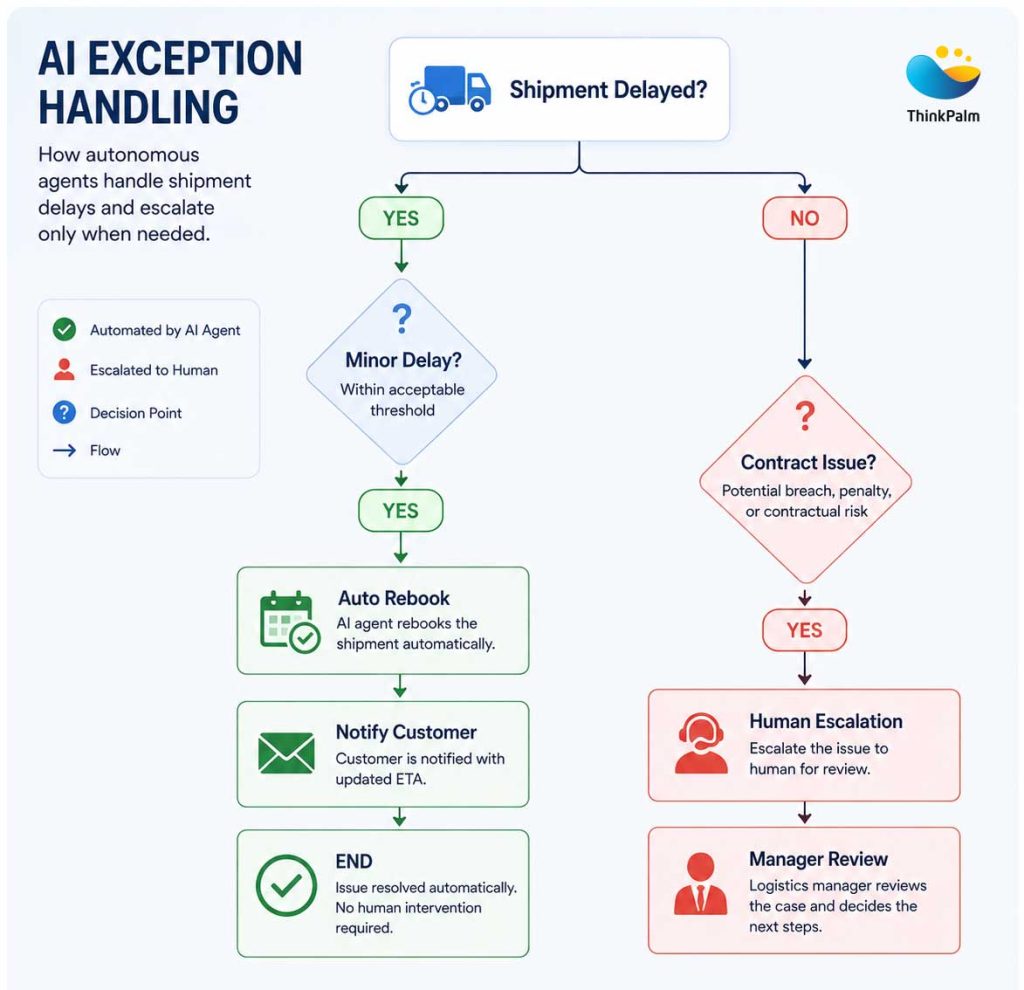
AI exception handling workflow for shipment delays and human escalation.
When a delivery window is missed, it often gets sorted out automatically with a quick rebooking and a notification. But if there’s a dispute over damaged goods, a contract renegotiation, or a supplier threatening to walk away from an SLA, such cases would be escalated immediately. These are sensitive areas that call for human judgment, relationship context, and authority the agent isn’t given. SLA monitoring AI plays a supporting role here too. This tracks the correlation of commitments vs actual performance in real time, so breaches get caught early on rather than showing up a week later when it might be too late to do anything about it. At the same time, there’s still time to act, rather than surfacing in a report a week later.
Pro-Tip
Escalation rules matter more than the automation itself. Before scoping an autonomous agent, get specific: which decision is your team genuinely comfortable handing over, and which should always land on a person’s desk? Start conservative, and it’s far easier to widen an agent’s authority later than to walk back to a system that already made a call it shouldn’t have.
While deploying autonomous AI agents in the supply chain, these are the outcomes a well-designed system is built to deliver. These are some of the anticipated benefits based on solution design, not a guarantee that every logistics operation will see identical results in their day-to-day decisioning.
Routine inventory, routing, and dispatch tasks can be executed automatically without much human intervention.
AI in logistics decision-making enables instant task execution instead of holding orders in queue for manual reviews.
Automated systems can operate around the clock to manage off-hours delays, inquiries, and exceptions, unlike systems that need constant human supervision.
Uses LLM supplier communication tools to maintain swift, context-aware messaging with partners and customers.
Identifies operational bottlenecks early, minimizing SLA penalties and accelerating dispute resolution.
Every automated choice includes a clear audit trail showing what action was taken and why.
Autonomous logistics agents aren’t the right starting point for every team. They deliver their highest value when your business meets a few specific conditions.
When the decision volume is high enough, which makes manual review as the actual bottleneck, not just an occasional inconvenience.
Most decisions follow patterns that can be captured in rules or learned from historical data. Additionally, it needs to be supervised manually with a clear, bounded set of exceptions.
Communication volume with suppliers and customers creates real response-time pressure on the team.
You require a transparent audit trail that clearly explains every automated choice.
If the above set of conditions apply to your operation, the next step isn’t buying a tool off the shelf; it’s identifying which specific decisions are safe to automate first.
Most routine logistics decisions already have an obvious answer sitting in the data, the constraint is a person being available to act on it.
Autonomous logistics agents make judgment calls within defined rules; standard workflow automation just moves tasks along a fixed path and still waits on a person to decide.
Every autonomous decision creates a conversation. AI supplier communication automation, backed by LLM supplier communication, keeps that conversation fast and consistent without losing context.
AI exception handling and SLA monitoring decide what the agent should never touch, get this list right before scoping anything else.
A system that shows what it decided and why is the difference between oversight and blind trust.
At ThinkPalm, we help enterprises build AI solutions that align with their operational workflows, industry requirements, and business objectives. Our experience spans logistics, manufacturing, fintech, and HR technology, with a focus on developing secure, scalable AI systems that can integrate with existing enterprise environments, including cloud and on-premises deployments.
For organizations exploring autonomous operations, our approach centers on understanding how work gets done today. We help identify repetitive, time-sensitive processes, defining where AI can add value, and ensuring that people remain involved where judgment, compliance, or exceptions are required. This could be beneficial whenever complex exceptions or SLA monitoring AI breaches occur.
Whether it’s enabling intelligent decision-making, improving operational visibility, or integrating AI into existing business processes, the goal remains the same i.e. helping enterprises adopt AI in a practical, and business-focused manner.
The most efficient logistics operations aren’t necessarily the ones with most people watching dashboards. They’re the ones that have drawn up a clear line between the decisions a system can safely make on its own, and the ones that require human judgement. That’s the principle behind autonomous logistics agents: operating within pre-approved boundaries, using clear escalation paths, and providing full visibility, so agentic AI in logistics remains secure and auditable.
The same thinking holds wherever decisions are high-volume, rule-heavy, and time-sensitive not just in logistics. The real question isn’t whether AI in logistics decision-making adds value. It’s which decisions are safe to hand over, and which ones still belong to a person.
Discover how ThinkPalm helps enterprises adopt AI for smarter, more efficient logistics operations.
Chandni Nadarajan is a content writer at ThinkPalm Technologies, specializing in B2B marketing content. With a passion for turning complex ideas into clear, engaging narratives, she blends strong research and storytelling skills to make technical topics accessible. Her expertise spans technology, automation, and digital business solutions.