The Hidden Side of Wi-Fi 7: How EMLSR Makes Multi-Link Operation Smarter
Wireless Testing
 Praveen K
July 8, 2026
Praveen K
July 8, 2026



 Praveen K
July 8, 2026
Praveen K
July 8, 2026
Wi-Fi 7, defined under the IEEE 802.11be standard, does not prescribe a single implementation model for Multi-Link Operation. Instead, it defines five distinct MLO connection modes, each making different trade-offs between performance, power consumption, and hardware complexity. Understanding these modes is essential for anyone evaluating Wi-Fi 7 hardware for real-world deployment.
In this article, we focus on one of the most practically significant of these modes: Enhanced Multi-Link Single Radio (EMLSR). Using packet-level analysis of Beacon and Association frames, we verify how EMLSR capability is advertised, negotiated, and confirmed between a Wi-Fi 7 access point and client.
Before diving into EMLSR specifically, it helps to understand what drove this investigation. In a recent comparison of MLO connection time across three Wi-Fi 7 access points, we found that pre-association mechanics, not authentication speed, were the primary differentiator between vendors.
A common misconception about Wi-Fi 7 is that Multi-Link Operation (MLO) is a single, uniform feature that works the same way across all devices. In practice, 802.11be MLO defines five distinct operational modes, and each AP vendor can choose to support any one or more of them. The mode in use directly determines how the device manages its radio resources, how it switches between bands, and how efficiently it handles simultaneous traffic flows.
| MLO Mode | Radios Required | Attributes |
|---|---|---|
| Multi-Link Single Radio (MLSR) | 1 | Only one link is operational at a time while others are in power save mode. |
| Enhanced Multi-Link Single Radio (EMLSR) | 1 | MLSR with link monitoring and Channel Access on multiple bands. E.g., STA with 2×2 radios listens to each band in 1 x 1 mode. |
| Simultaneous Tx and Rx (STR) | >= 2 | Simultaneous Tx, Rx, or Tx+Rx on multiple links without any synchronization. |
| Non-Simultaneous Tx and Rx (NSTR) | >= 2 | Simultaneous Tx or Rx on multiple links with radio synchronization to end the transmissions at the same time. |
| Enhanced Multi-Link Multi-Radio (EMLMR) | >= 2 | MLMR (STR) with enhanced capability to dynamically adjust spatial multiplexing support on each link. |
Each mode represents a different engineering trade-off. STR delivers maximum throughput but demands complex, costly multi-radio hardware. NSTR reduces interference sensitivity but limits simultaneous transmission. EMLSR and EMLMR offer middle-ground approaches that bring meaningful multi-band benefits without the full hardware overhead of STR. AP coordination modes unlock advanced enterprise scenarios but require tightly integrated infrastructure.
Because each vendor can choose which modes to implement, real-world Wi-Fi 7 interoperability depends heavily on whether the AP and client can negotiate a mutually supported mode during association. This is precisely what our validation set out to confirm.
Among the five modes, Enhanced Multi-Link Single Radio (EMLSR) occupies a particularly interesting position. Unlike STR, which requires multiple simultaneous active radio chains, EMLSR allows a device to monitor multiple frequency bands while maintaining only one active transmit and receive path at a given time. This means the device can be responsive across bands without the cost and power penalty of running multiple radios simultaneously.
This architecture works through a dynamic channel access mechanism. During the Enhanced Distribution Channel Access (EDCA) procedure, both the AP and the STA have the flexibility to explore multiple bands and select the most suitable one for the current transmission. The radio can switch between bands rapidly, allowing the device to take advantage of whichever band offers the best conditions at any given moment.
Compared to the basic single-radio option (MLSR), EMLSR does not compromise on band switching agility, giving it a meaningful performance advantage over simpler single-radio implementations.
Relative to EMLMR, it sacrifices some peak throughput in exchange for lower power draw and hardware simplicity, making it well suited to a wide range of client devices including laptops, mobile devices, and IoT endpoints. For device manufacturers targeting cost-sensitive or battery-constrained products, EMLSR represents a compelling path to EMLSR-based MLO interoperability with Wi-Fi 7 networks without requiring a full multi-radio implementation.
Getting connected is only the first step. How Wi-Fi 7 handles real-time traffic under congestion is equally critical, especially for applications like VoIP and video conferencing that cannot tolerate latency spikes.
EMLSR (Enhanced Multi-Link Single Radio) introduces a set of meaningful advantages that make it relevant across a wide range of deployment scenarios:
A single radio chain is sufficient for EMLSR operation, significantly lowering the design complexity and bill of materials for client devices compared to STR implementations.
Because only one radio path is active at a time, EMLSR draws considerably less power than simultaneous multi-radio modes, making it suitable for mobile and battery-powered devices.
Despite operating on a single radio, EMLSR can monitor and switch between 2.4 GHz and 5 GHz (and, where 6 GHz is supported) dynamically, accessing the least congested band when needed.
The ability to monitor multiple bands simultaneously allows EMLSR devices to identify better link options and transition more smoothly than single-band legacy devices.
Multi-band awareness provides a degree of link resilience. If conditions deteriorate on the active band, the device can switch rapidly without losing the connection context established during association.
The following hardware and software configuration was used to validate EMLSR capability advertisement and negotiation:
| Component | Configuration |
|---|---|
| STA (Station or Client) | Intel BE201 Wi-Fi 7 Windows (MLO Enabled) |
| Sniffer Device | Intel BE201 Wi-Fi 7 Linux – 2 Nos |
| Configuration of APs | MLO Enabled with WPA3 SAE security, Channel 1 (40 MHz) & Channel 36 (160 MHz) |
| Frequency Bands | 2.4 GHz and 5 GHz |
| Sniffer Capturing Tool | Wireshark v4.2.2 (GUI) |
| Environment | Open Air |
Two dedicated monitor-mode Intel BE201 sniffers captured traffic simultaneously across both the 2.4 GHz and 5 GHz links. This dual-sniffer setup ensured complete visibility into both the Beacon frames transmitted by the AP and the Association Request frames sent by the client, enabling precise frame-level analysis of how EMLSR capability was communicated and agreed upon during the connection workflow.
The infrastructure behind this kind of testing goes beyond standard off-the-shelf setups. For a closer look at what modern wireless test labs look like today and how they differ from legacy approaches.
The validation approach focused on Beacon and Association frames as the primary evidence source for EMLSR (Enhanced Multi-Link Single Radio) capability. These two frame types are where an access point and client formally communicate their MLO capabilities and reach agreement on how the connection will operate.
Beacon frames transmitted by the AP were examined for the presence and content of Multi-Link Elements (MLE), including advertised EMLSR capability, supported link information, and MLD MAC addressing. Association Request frames from the client were then cross-referenced to confirm that the STA correctly acknowledged and negotiated the EMLSR parameters offered by the AP.
This approach enabled verification of five key interoperability indicators:
The Beacon frame is the AP’s primary broadcast mechanism for advertising its capabilities to nearby clients. In a Wi-Fi 7 deployment with EMLSR support, the Beacon frame carries a Multi-Link Element (MLE) that contains critical information: the MLD MAC address that identifies the AP as a multi-link device, the EML Capabilities field that signals EMLSR support, and the set of links available for multi-link operation.
Analysis of the captured Beacon frames (Fig 2a) confirmed that the AP correctly advertised its EMLSR interoperability parameters, including the MLD MAC address, EML Capabilities field with EMLSR enabled, and the available 2.4 GHz and 5 GHz links. Importantly, the AP advertised the same MLO SSID across both bands, confirming proper multi-link beacon operation.
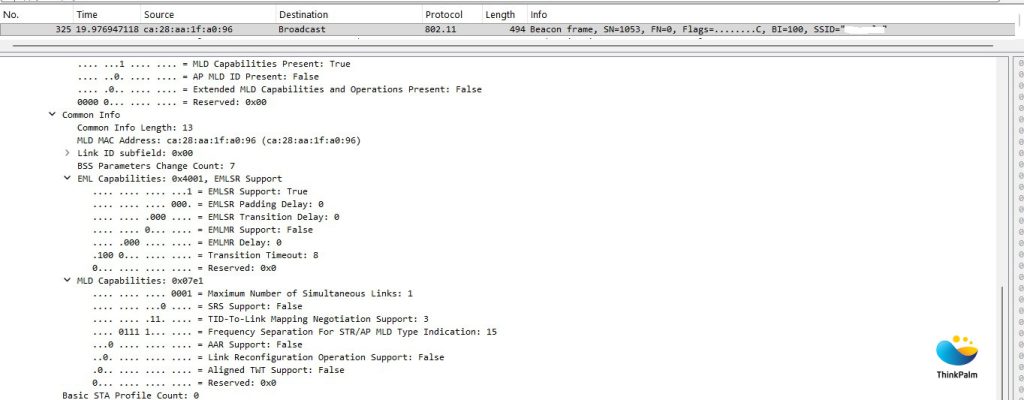
Fig 2a: Beacon Advertisement Showing EMLSR Capability
The Association Request frame is where the client responds to the AP’s capability advertisement and initiates the formal negotiation of connection parameters. In an 802.11be MLO connection, this frame must include the client’s own Multi-Link Element, signaling which bands it wishes to associate on and which MLO mode it is requesting to operate in.
Analysis of the captured Association Request frames (Fig 2b) confirmed that the Intel BE201 client correctly included the required MLO fields, requested EMLSR-based operation, and specified its preferred primary link. The EMLSR Support field was set correctly, the MLD MAC address was consistent with the Beacon advertisement, and the client indicated the 5 GHz link as the preferred operational link, consistent with the AP’s link coordination behavior.
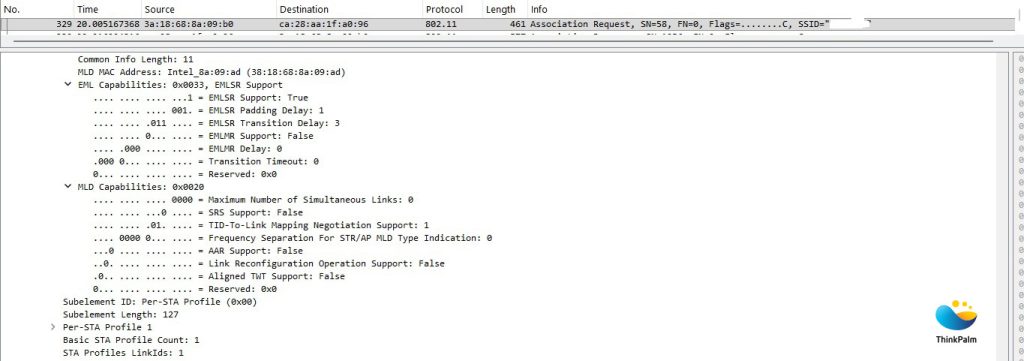
Fig 2b: Association Request Demonstrating EMLSR Negotiation
The combined analysis of Beacon and Association frames produced a clear, evidence-backed picture of how Enhanced Multi-Link Single Radio capability is established between a Wi-Fi 7 AP and client. The packet captures confirm the following:
Both the AP and the STA are correctly advertised and negotiated with EMLSR capability through the EML Capabilities field in the Multi-Link Element.
The captures confirm that the connection operates exclusively in single-radio EMLSR mode. Simultaneous multi-radio operation was neither advertised nor negotiated.
The AP uses a consistent MLD MAC address across both bands, confirming proper multi-link device addressing as required by the 802.11be specification.
The Association Request and subsequent frames confirm that AP and STA reached successful agreement on EMLSR parameters, including supported links and operational mode.
Based on observed link behavior, the 5 GHz band serves as the primary active link, with link coordination and scheduling controlled by the AP. This is consistent with typical EMLSR behavior where the higher-frequency band with better throughput characteristics is preferred for active transmission.
ThinkPalm is a Wi-Fi pre-compliance testing service provider with dedicated lab infrastructure and deep expertise in 802.11be protocol validation.
Having validated how EMLSR operates at the protocol level, it is worth placing it in context against the other available 802.11be MLO modes. The comparison reveals why Enhanced Multi-Link Single Radio has emerged as a particularly practical choice for a broad range of Wi-Fi 7 deployment scenarios.
The most obvious alternative to EMLSR is a true multi-radio implementation, where the device maintains simultaneous active connections across multiple bands. While MLMR delivers higher peak throughput, it requires multiple independent radio chains, significantly increasing hardware cost, design complexity, and power to draw. For client devices where battery life and cost matter, EMLSR provides access to the core benefits of multi-link operation at a fraction of the implementation overhead.
At the other end of the spectrum, the basic single-radio MLO option (MLSR) connects across multiple bands but without the dynamic band-switching agility that EMLSR provides. EMLSR retains the ability to switch between bands rapidly during EDCA procedures, achieving better overall system performance than MLSR without adding hardware complexity. This makes EMLSR strictly superior to MLSR for most practical use cases.
The net result is that EMLSR occupies the most practical position in the MLO mode spectrum for the majority of client devices. It delivers genuine multi-link single radio multi-band agility, meaningful performance improvements over single-band legacy Wi-Fi, and a realistic implementation path for device manufacturers without the cost and complexity of full multi-radio architectures.
Wi-Fi 7 also introduces significant advances in how spectrum is allocated across clients. See how OFDMA and Multi-RU allocation in Wi-Fi 7 perform in real over-the-air conditions.
This validation confirms that a Wi-Fi 7 AP and client can successfully establish a standard IEEE 802.11be Multi-Link Operation connection using EMLSR-based operation. The Beacon and Association Request frames contain all the required elements: Multi-Link Element (MLE), MLD MAC Address, EML Capabilities, and Enhanced Multi-Link Single Radio Support fields, verifying complete MLO capability advertisement and negotiation between the AP and STA.
The captures further confirm that EMLSR Support is enabled; STR and EMLMR simultaneous multi-link operation is not supported, and the connection correctly operates in single-radio EMLSR mode. The 5 GHz link serves as the primary operational link, with link coordination managed by the AP, consistent with expected EMLSR-based MLO interoperability behavior.
From a deployment perspective, EMLSR represents a meaningful and practical step forward in Wi-Fi 7 adoption. It’s a combination of multi-band awareness, single-radio simplicity, and fast band-switching agility. This makes it well suited to most client device categories entering the market today.
Studies like this are part of how ThinkPalm continues to bridge the gap between wireless standards and real-world network deployments. For network architects and IT teams evaluating Wi-Fi 7 deployment readiness, understanding which MLO modes are supported and how they are negotiated is as important as benchmarking raw throughput or connection speed.
Connect with our team to discuss your Wi-Fi 7 testing and validation requirements.
Praveen K is a skilled and passionate Senior Test Lead at ThinkPalm with extensive experience in testing Wi-Fi and Bluetooth SoCs. He’s curious, adaptable, and always eager to explore new tools and techniques to stay ahead in the dynamic field of wireless technology.