Self-Healing Test Automation Benefits, Challenges & Best Practices Guide
Testing as a Service (TaaS)
 Chandni Nadarajan
July 30, 2026
Chandni Nadarajan
July 30, 2026



 Chandni Nadarajan
July 30, 2026
Chandni Nadarajan
July 30, 2026
For many engineering leaders, the biggest obstacle to scaling automation isn’t writing new tests but supporting the old ones. As applications change, even minor UI tweaks can trigger hundreds of false test failures. This consumes valuable engineering hours without focusing on improving software quality.
Self-healing test automation benefits deal with this exact challenge. By reducing repetitive maintenance and focusing on test script resilience, it delivers major productivity gains. However, it isn’t a silver bullet. To get a real return on your investment, you need to know exactly what this technology can and cannot do.
This blog discusses self-healing test automation benefits and how it can genuinely save teams time and reduce maintenance headaches, but only when it’s set up right. This guide breaks down:
If you’re new to the concept, our complete guide to self-healing test automation covers the mechanics in depth. Here, we’re focused purely on what it’s worth.
The role of self-healing automation is to reduce test maintenance time, minimize flaky failures, and fasten release cycles. On many occasions, QA engineers seem to spend the majority of their time chasing broken locators as opposed to improving product quality. This robs them of time to build new test cases.
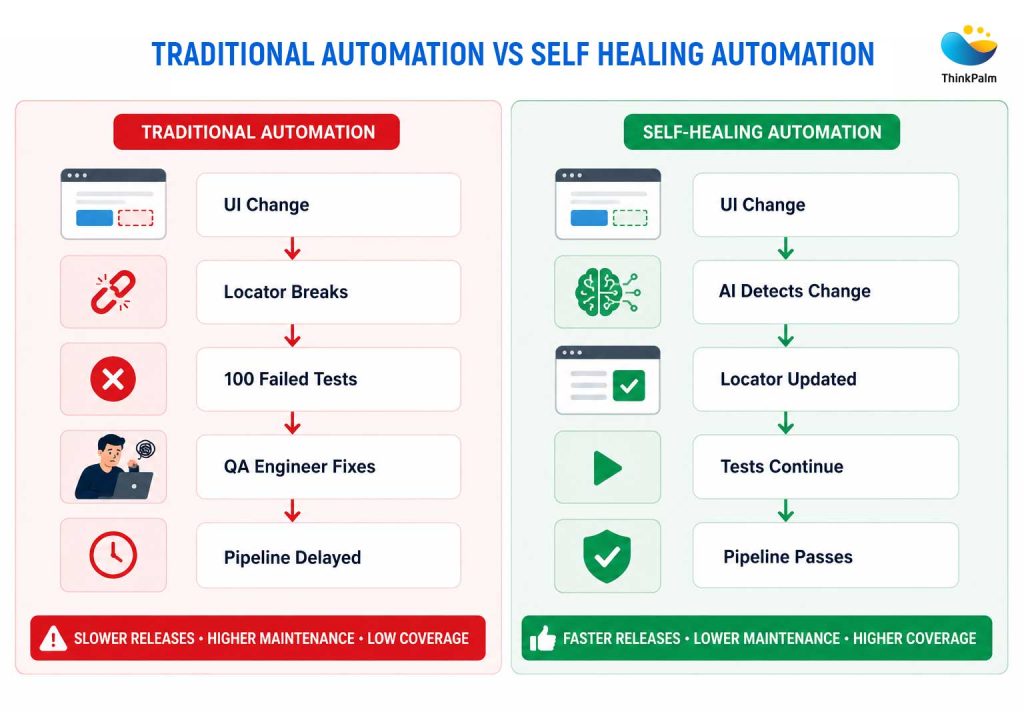
Traditional vs. self-healing test automation workflow after a UI change.
The hours spent manually updating broken element locators are reduced. Here, the system detects the UI change and updates itself in seconds during the test run, freeing engineers’ time to focus on building new features.
A broken test that would otherwise block a CI/CD pipeline would heal and re-run without anyone needing to open a laptop to fix a minor layout change.
This is a quieter benefit but an important one. When locator failures are constant, teams often just skip the flaky test to keep pipelines green, which quietly destroys your test coverage. By automatically fixing the root cause of the flakiness, you preserve your actual test coverage.
AI classification separates a genuine UI update from an actual application bug, so engineers stop chasing phantom defects.
Self-healing absorbs minor rendering differences between browsers. This means there is no hassle of creating and keeping up with separate test versions for each browser.
Your delivery pipelines remain functional and stable despite frequent, daily UI adjustments. Instead of halting critical releases over minor, cosmetic interface changes, the automated systems adapt seamlessly.
The process is entirely transparent. Every modification is fully documented, capturing the previous locator, the replacement locator, the system’s confidence score, and a clear visual comparison. This ensures you maintain a genuine audit trail, avoiding the ambiguity of a black-box operation.
Automated healing prevents the accumulation of technical debt and scripts update themselves over time instead of slowly rotting between refactors.
Self-healing significantly improves test script resilience by addressing one of the most common causes of UI automation failures: brittle locators that break after routine interface changes. Instead of requiring engineers to manually update test scripts whenever an element’s attributes or position change, self-healing mechanisms intelligently identify equivalent elements and continue execution.
Beyond the maintenance-time reduction, teams also report meaningfully better CI/CD pipeline success rates once locator flakiness stops masking the failures that actually matter. Independent third-party research backs this up:
Return on investment (ROI) for organizations investing in AI-driven, AI-enhanced automated testing solutions.
Source: Forrester Consulting
Net present value (NPV) delivered to a composite organization over three years.
Source: Forrester Consulting
If you look at self-healing test automation benefits in terms of speed, it appears promising. But the true mark of a mature QA strategy is knowing where the technology’s capabilities end. Solving one category of problem that is element identification failures is all it does. This implies it cannot ‘think’, and teams that understand this tight scope deploy it far more effectively than those who treat it as a substitute for human intuition.
Therefore, you cannot expect an algorithm to take over your testing pipeline from start to finish completely, and your AI test maintenance ROI will suffer. It is essential to keep your automation strategy grounded; you must recognize what falls entirely outside its capabilities. Let us delve into some of the areas where self-healing automation works and those it cannot fix.
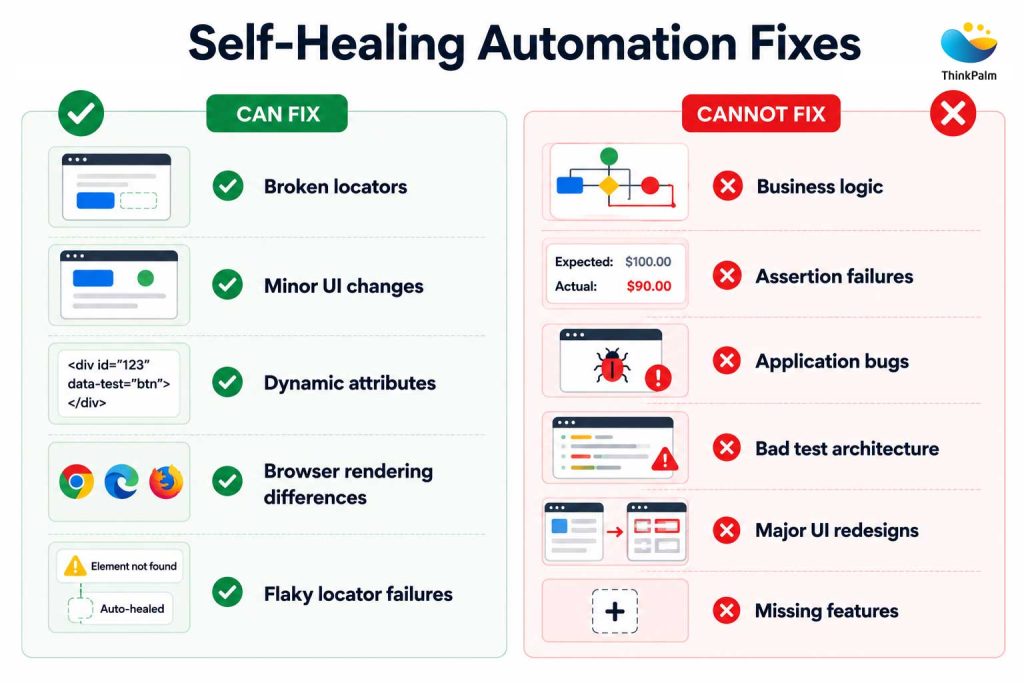
What self- healing automation can and cannot fix
Genuine application bugs — If the application is behaving incorrectly, the test must fail. Self-healing is not designed to prevent software defects, and it should never do so.
Logic and assertion failures — This technology is not for verifying business logic. It cannot detect missing functionality, wrong data, or incorrect value assertions.
Complete UI redesigns — When there are major changes to user flows while redesigning UI, auto remediation is impossible. In such situations, it requires human review, and the tests need to be entirely rewritten from scratch, rather than attempting a simple heal.
Poor test architecture — Even with self-healing technology, test suites that suffer from poor test architecture are still a major problem. If your automation relies on order-dependent tests (Test B only works if Test A ran first) or shared state between tests (Tests reuse the same login session or database data), they will remain extremely fragile. Self-healing fixes broken locators, not bad design.
Key Risk
Silent Test Drift: When a test gets healed over and over again without anyone checking in on it manually, this test can drift so far from its original purpose. It then stops verifying the actual requirement. In a worst-case scenario, the “healed” test could end up checking a different part of the page entirely making the test pass even though the application is truly broken. Hence, set a recurring schedule to check the self-healing reports and see what was healed. Also, set confidence thresholds that match the risk level of the test being conducted.
Beyond drift, you need to set rules for self-healing automation, so the rules aren’t too loose; otherwise, the system will apply incorrect heals, masking real problems. On the other hand, if they are too strict, the system will trigger unnecessary failures that limit your AI test maintenance ROI by forcing humans to waste time investigating things the tool could have fixed.
The model has learning limitations too. Self-healing models work well depending on their training data. These systems generally perform much better against mature, stable applications than against software that is being drastically rewritten every single day. Teams who refuse to accept self-healing automation can be shown in an audit log. This report proves exactly what the system fixed and highlights the immediate flaky test reduction it provided.
A successful rollout depends on following four key strategic practices:
The way you build your tests directly affects how well the AI can repair them later. Hence, you need to treat your tests like code that must remain maintainable.
Use semantic locators: Use meaningful identifiers such as ARIA roles, visible text content, and data-testid attributes instead of relying on an element’s position on the page.
Assign data-testid attributes: Every interactive element must have a unique data-testid attribute. Use such attributes for important buttons, forms, and interactive elements wherever possible. These would act as the most reliable reference points for automated recovery.
Avoid hardcoded positional references: Avoid fragile locators based on positions, such as “the third item in a list,” as even minor interface changes can cause them to fail.
Self-healing tools make decisions based on how confident they are that they have identified the correct replacement element. If you set the right confidence thresholds, this helps balance automation with accuracy.
Start strict, then relax: When you first deploy the tool, use a high confidence threshold. Allow the system to auto-apply any fixes only after it becomes certain. You may then gradually relax as you gain trust in the accuracy of the tool.
Keep stricter thresholds for critical flows: When it comes to business-critical workflows such as user authentication, payment processing, and account management, keep the threshold extremely high.
Mandate review for sensitive actions: It is always advisable to keep a human in the review for actions such as form submission or other critical actions like deleting records and data updates.
Self-healing automation can reduce maintenance effort, but it should not operate without visibility. True autonomous QA benefits cannot be achieved by eliminating human judgment. Manual reviews ensure that automated recoveries remain accurate and continue to validate the intended application behavior.
Regular Log Reviews: Healing logs should be reviewed regularly at least once a week, to maintain test suites actively. This keeps teams informed about the changes the system makes and be aware of the silent test drift.
Set up healing alerts: Configure your monitoring system to alert you if the frequency of self-healing spikes unexpectedly. This helps identify potential issues earlier rather than surfacing during release delays or production incidents.
Organizations that combine automation with regular review are better positioned to prevent test drift and maintain long-term confidence in their automated testing strategy.
Investigate elements that require repeated healing. Frequent recoveries may indicate unstable UI components, poor locator design, or underlying application changes that need attention.
Self-healing events provide valuable information about application and test stability. When tracked alongside standard test results, they can help teams identify emerging issues before they impact release quality.
Show Heals on CI Dashboards: Teams should be able to see both test outcomes and recovery events in a single view, not hidden in separate logs.
Monitor healing rates over time as an early indicator of UI instability, frequent application changes, or declining test suite health.
Use healing trends to identify areas that require improvement, such as components that would benefit from stronger locator strategies or better data-testid coverage.
Definition
A confidence score is the self-healing engine’s certainty rating, usually expressed as a percentage, that a proposed replacement locator matches the element the original test intended to interact with. It’s calculated from how many of the element’s captured traits (label, ARIA role, position, visual hash, surrounding context) still match after a UI change.
At ThinkPalm, we’ve seen teams struggle with self-healing automation when it’s rolled out without proper guardrails. But we have also seen teams getting AI test maintenance ROI when it’s done right.
With our AI-driven TestNova platform and our Testing as a Service approach, we empower organizations to:
Self-healing automation is a powerful tool to make your testing faster and more reliable. We have explored its value in terms of cutting maintenance time and stopping your deployment pipelines from breaking over tiny changes.
But we need to understand its real worth in terms of fixing element identification issues, not fixing broken software or poor test design. The most important choice you will make is setting the “confidence thresholds” right for your specific needs. Also, never ignore the healing log, it is your visual proof and best diagnostic tool. To conclude, self-healing test automation benefits reach their highest level, and you truly begin to achieve autonomous QA benefits, when you combine this smart technology with solid test design and regular human review.
Understanding the benefits and best practices is the first step. The next is putting them into practice. If you’re planning a rollout, our How to Implement Self-Healing Test Automation: 8-Step Guide provides a step-by-step framework to help you introduce self-healing automation with confidence.
ThinkPalm’s Testing as a Service experts prevent self-healing test automation from drifting. Combine intelligent technology with strategic oversight to ensure your maintenance savings genuinely scale.
Chandni Nadarajan is a content writer at ThinkPalm Technologies, specializing in B2B marketing content. With a passion for turning complex ideas into clear, engaging narratives, she blends strong research and storytelling skills to make technical topics accessible. Her expertise spans technology, automation, and digital business solutions.