Agentic AI vs Traditional Automation: Why RPA Alone No Longer Works
Agentic AI
 Athira Gopakumar
August 4, 2026
Athira Gopakumar
August 4, 2026



 Athira Gopakumar
August 4, 2026
Athira Gopakumar
August 4, 2026
Imagine two employees. The first follows every instruction perfectly but freezes the moment something unexpected happens. The second understands the objective, adapts when conditions change, asks for help only when necessary, and still completes the task.
Which one would you trust to run your business? This is exactly the difference between traditional automation and agentic AI.
Today’s data consists of unstructured scanned contracts, support emails, and messy chat messages. Additionally, regulations keep shifting, and customers often expect answers that give them a personalized feeling and not scripted anymore. The problematic situation doesn’t end there. The workflows seem to be scattered across a dozen disconnected systems rather than a single streamlined database.
When processes get stuck under these conditions, it does not mean your existing systems fail. It just means that “automating a task” and “achieving a business outcome” have quietly become two entirely different challenges.
Therefore, it becomes essential for enterprises dealing with unpredictable data and constantly evolving workflows to rely on intelligent AI agents. This is no longer just an upgrade, it is the only way to achieve true end-to-end automation.
Traditional approaches lack the flexibility to handle today’s complex environments.
To bridge this gap, businesses are moving toward agentic automation, shifting from rigid scripts to goal-driven AI-powered automation.
Definition
Traditional automation, follows a fixed, pre-defined set of rules, in the form of custom scripts, backend integrations, or tools like Robotic Process Automation (RPA). It was built to eliminate repetitive manual work. If you give it a consistent input, then it would perform the same steps flawlessly, at scale, without getting tired or making a typo.
That’s genuinely useful. This is where RPA became a standard line item in digital transformation budgets over the last decade. A well-built RPA bot can:
However, there’s a catch. The RPA has no way to interpret intent or think on its own feet. A renamed field, an unusual customer request, or a hard-to-read PDF can affect the entire process.
Therefore, these tasks are again handed over to a human for execution. Surprisingly, this is the exact manual work automation was supposed to remove.
Agentic AI refers to AI systems built around autonomous AI agents that can understand a goal, reason through available information, decide what to do, and act, usually without being told at each step. Hence, Agentic AI makes a fundamental shift in how software operates.
of public organizations will deploy AI agents for routine decision-making by 2028.
Source: Gartner
In the case of RPA, it needs to be told exactly what to do. Whereas Agentic AI needs to be told what to achieve. For example, if you are to give an agentic system the instruction of fulfilling a goal “resolve this customer’s billing dispute,” then it can pull the customer’s history, check the relevant policy, draft a resolution, and only escalate the case if it’s genuinely unsure. That’s a different way of working altogether. In short, you give Agentic AI the goal, it would figure out the path on its own.
This is what makes intelligent AI agents different from a chatbot, or a script as they don’t need the path spelled out. They work out what’s needed, adjust when the first approach doesn’t deliver the desired output, and loop in a human only when the decision truly calls for one.
Pro Tip
If a workflow needs a human to make a judgment call more than once a week, that’s your first candidate for Agentic AI—not your tenth RPA bot.
Here’s where the two approaches genuinely differ, and where enterprise leaders most often get the comparison wrong.
| Dimension | Traditional Automation (RPA) | Agentic AI |
|---|---|---|
| Operating Logic | Follows explicit, pre-defined rules. | Goal-oriented; plans its own steps. |
| Data It Can Handle | Structured, consistent inputs. | Structured and unstructured data (emails, PDFs, chat, images). |
| Handling Exceptions | Stops and escalates to a human. | Reasons through exceptions and adapts. |
| Decision-Making | None; executes exactly as scripted. | Makes contextual, judgment-based decisions. |
| Maintenance | Breaks when interfaces or business rules change. | Adapts to new information without requiring a full rebuild. |
| Best Fit | High-volume, repetitive, standardized tasks. | Multi-step, judgment-heavy, exception-prone workflows. |
If you closely observe the differences, neither column is “better” on its own. In fact, they’re built for different jobs. The real question isn’t whether to choose an Agentic AI or RPA. But which parts of this workflow need speed, and which parts need judgment?
There are several limitations for traditional rule-based tools as enterprise workflows evolve. When evaluating agentic AI vs traditional automation, we have realized that standard scripting cannot keep up with four major operational shifts. Let us examine four shifts in how enterprises operate now.
Modern workflows span cloud platforms, SaaS tools, and APIs that change frequently. In a traditional setup, every minor update becomes a new point of failure for a static bot. Agentic automation adapts to these changes automatically.
Most enterprise data now lives in contracts, tickets, emails, and scanned documents. Rule-based automation simply cannot interpret these inputs, whereas AI-powered automation excels at processing complex, unstructured information.
Incomplete forms and unusual requests have become everyday occurrences that stop rigid automation. Autonomous AI agents can reason through ambiguity, adapt to changing conditions, and continue the workflow.
Customers expect personalized interactions. Traditional workflows can route requests to the appropriate queue, but intelligent AI agents understand context, recognize customer intent, and help resolve the underlying issue.
Well, this does not mean that RPA has failed. It simply means RPA was never meant to carry out the whole automation strategy alone. As a result, the enterprises feeling the most friction today are usually the ones that treated it as a one-time fix. But the solution lies in upgrading to Agentic AI.
For example: A telecom back-office team automated their SIM activation process years ago using RPA. It worked well for a long time. But a regulatory change introduced an identity verification step that involved inconsistent document formats. And the bot couldn’t interpret the new documents. So, every activation fell into a manual queue for human review. This is a typical use case for Agentic AI: same workflow, but a judgement call the old bot was never built to make.
By deploying Agentic AI automation, the system can use autonomous AI agents to read, understand, and process the new verification formats seamlessly, keeping the workflow moving without human intervention.
A traditional bot executes commands, whereas an AI agent behaves more like a digital case worker. It can understand requests in plain language, pull information from multiple systems, evaluate its options, take an approved action, and learn from the results to do better next time.
Take the instance of customer support. Instead of just sending a ticket to a queue, an AI agent can interpret the customer’s tone, check their purchase and support history, spot whether this is a repeat issue, draft a personalized reply, schedule a technician if needed, and save escalation for the cases that genuinely deserve it. This implies that a full workflow can be managed end- to- end, by Agentic AI, not even one task being ticked off a list.
This shift from task automation to owning the whole workflow by AI Agents is the core reason for agentic automation to show up in transformation roadmaps across industries.
Discover how ThinkPalm helps enterprises automate complex workflows, modernize legacy systems, and improve operational efficiency with intelligent AI agents.
Explore Agentic AI SolutionsAI-powered automation earns its ROI where the challenge lies in decision-making, not just data entry. Here’s where Agentic AI’s return shows up most:
AI agents resolve customer queries faster by understanding intent and retrieving relevant context from knowledge bases instead of simply routing tickets between teams.
Invoice validation, fraud detection, and reconciliation become more accurate while reducing the need for manual reviews and improving financial efficiency.
Instead of allowing broken locators to fail automated tests, the system reasons through UI changes and heals scripts automatically, as demonstrated by ThinkPalm’s self-healing automation within TestNova.
AI-driven automation continuously monitors asset performance, identifies anomalies early, and supports predictive maintenance, helping organizations reduce downtime and improve operational reliability.
Intelligent AI agents monitor infrastructure, diagnose incidents, recommend resolutions, and automate routine remediation without waiting for issues to move through a ticket queue.
AI-powered automation predicts disruptions, optimizes inventory, and adapts logistics using real-time operating conditions instead of relying on static reorder rules.
Overall, the real value of AI-powered automation comes from the agent making decisions, and not from executing a task faster.
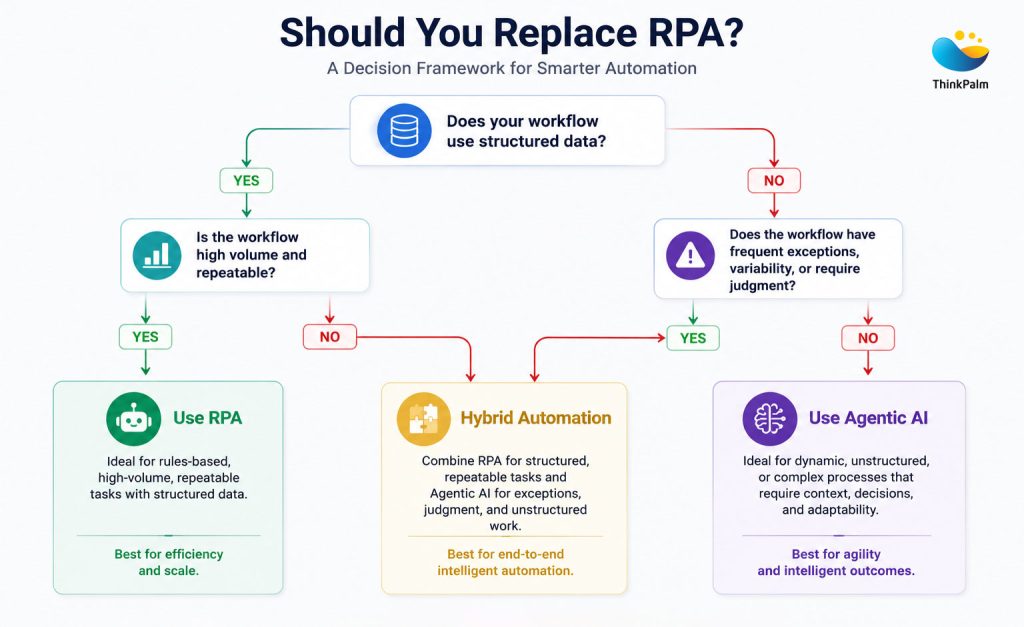
Should You Replace RPA? A Decision Framework for Agentic AI Automation
The short answer would be ‘no’, and treating this as a replacement decision is the most common mistake in automation strategy conversations today. RPA and Agentic AI exist to solve different problems.
Now, let us use this quick framework to decide where each belongs:
Combine both in hybrid workflows. Let AI agents decide what should happen, and hand off the repetitive execution to RPA bots. AI agents determine the path; RPA executes the steps quickly and accurately.
Once you have decided to roll out agentic automation, it doesn’t mean you should completely replace what already works. A phased approach minimizes disruption, at the same time AI-powered automation would deliver value early on:
🚀 Pro Tip
Start with one process. Choose one with a clear, measurable exception rate. Prove the ROI first, then scale confidently across the organization.
Traditional automation continues to excel at repetitive, structured, high-volume tasks. Agentic AI complements these strengths rather than replacing them.
Agentic AI is goal-oriented. It reasons, makes decisions, and adapts to changing situations instead of simply following predefined rules.
Unstructured data, frequent exceptions, and dynamic, multi-system workflows quickly expose the limitations of rule-based automation.
AI agents make intelligent decisions while RPA executes repetitive tasks. Together, they deliver broader automation capabilities than either technology can achieve alone.
Begin with your highest-exception process, establish governance guardrails, measure outcomes, and expand adoption as business value and ROI become evident.
At ThinkPalm, we build Agentic AI into your enterprise workflows without asking you to replace what’s already working. Our Agentic AI and SDLC services enable teams to:
Whether you want to fix one problematic workflow or update your 2026 roadmap, we at ThinkPalm provide smart solutions needed to turn complex operations into major business advantages.
The debate around Agentic AI vs Traditional Automation isn’t about picking a winner. RPA still does what it’s always done well: fast, accurate, repetitive execution. Agentic AI picks up where RPA has to stop, reading context, handling exceptions, and making calls a script never could.
The enterprises pulling ahead in 2026 aren’t the ones that ripped out their RPA investment. They’re the ones that layered intelligence on top of it, one high-exception workflow at a time.
Get a free workflow assessment from ThinkPalm’s Agentic AI team and discover which business processes are ready for intelligent automation and which are better suited to traditional RPA.
Talk to an Agentic AI ExpertAthira Gopakumar is a Digital Marketing Specialist in the tech industry, with a strong focus on IoT marketing. She specializes in data-driven strategies, leveraging SEO, content marketing, and market research to enhance brand visibility and lead generation for IoT solutions. Passionate about the intersection of technology and marketing, she stays ahead of industry trends to drive impactful campaigns. Outside of work, she enjoys traveling to new places and dancing to unwind.