Spanning Tree vs EVPN: How Layer-2 Networks Evolved Beyond STP
Networking
 Anju P Chandran
July 13, 2026
Anju P Chandran
July 13, 2026



 Anju P Chandran
July 13, 2026
Anju P Chandran
July 13, 2026
EVPN vs Spanning Tree is one of the most important topics in modern network design. Modern enterprises depend heavily on reliable and high-performing networks to support business-critical applications, cloud services, and digital operations. Even brief network disruptions can impact productivity, customer experience, and revenue. As organizations continue to expand their digital infrastructure, network architectures must evolve to deliver greater scalability, resilience, and operational efficiency.
Traditional Ethernet networks introduced redundant links to improve availability and eliminate single points of failure. While redundancy enhanced reliability, it also created the possibility of Layer-2 loops. These loops could generate broadcast storms, duplicate traffic, and MAC address instability, leading to network outages and degraded performance. To address these challenges, the Spanning Tree Protocol (STP) became the industry-standard mechanism for Layer 2 loop prevention and stable Layer-2 communication.
Although STP served enterprise networks effectively for many years, modern networking requirements have changed significantly. The adoption of virtualization, cloud computing, and large-scale data centers has increased the demand for higher bandwidth utilization, faster convergence, and scalable network designs. As a result, technologies such as Ethernet VPN (EVPN) and VXLAN have emerged as modern alternatives that overcome many of the limitations associated with traditional Layer-2 architectures.
This article breaks down how each technology works, where they differ, and how Layer 2 network design evolution led the industry from STP to EVPN.
Spanning Tree Protocol (STP) is a Layer 2 network protocol developed to prevent Layer-2 loops in Ethernet networks. In environments where multiple switches are interconnected through redundant links, frames can circulate indefinitely, consuming bandwidth and creating instability. STP addresses this challenge by creating a loop-free logical topology while preserving physical redundancy.
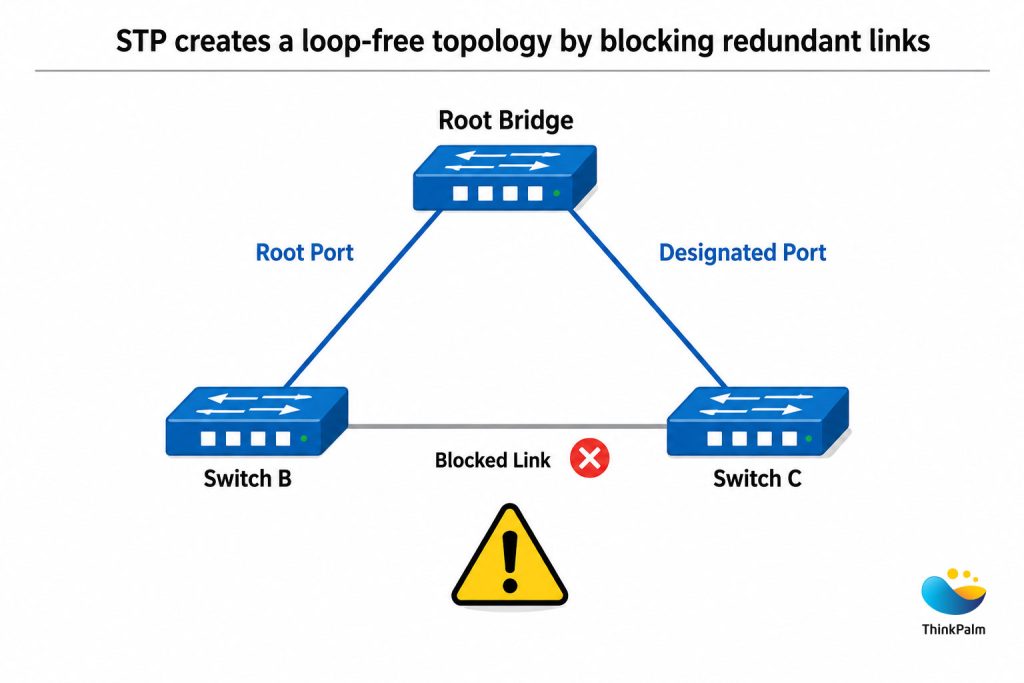
STP Creates a Loop-Free Topology by Blocking Redundant Links
To achieve this, STP elects a root bridge that serves as the central reference point for the network. Each switch calculates the best path toward the root bridge, and redundant paths that could potentially create loops are placed into a blocking state. This ensures that only one active forwarding path exists between network segments at any given time.
From an operational perspective, STP provides predictable and stable network behavior. It prevents Layer-2 loops and enables communication to continue even when physical redundancy exists. However, the protocol achieves stability by sacrificing efficient utilization of available network resources.
Rapid Spanning Tree Protocol (RSTP) is a later version of STP that improves recovery times. While classic STP could take up to 50 seconds to recover from a failure, RSTP brings that down to a few seconds in most cases. Both versions share the same core design though: some links must always remain blocked, and only one forwarding path is active at a time.
As enterprise networks become larger and more dynamic, several limitations of STP become increasingly evident.
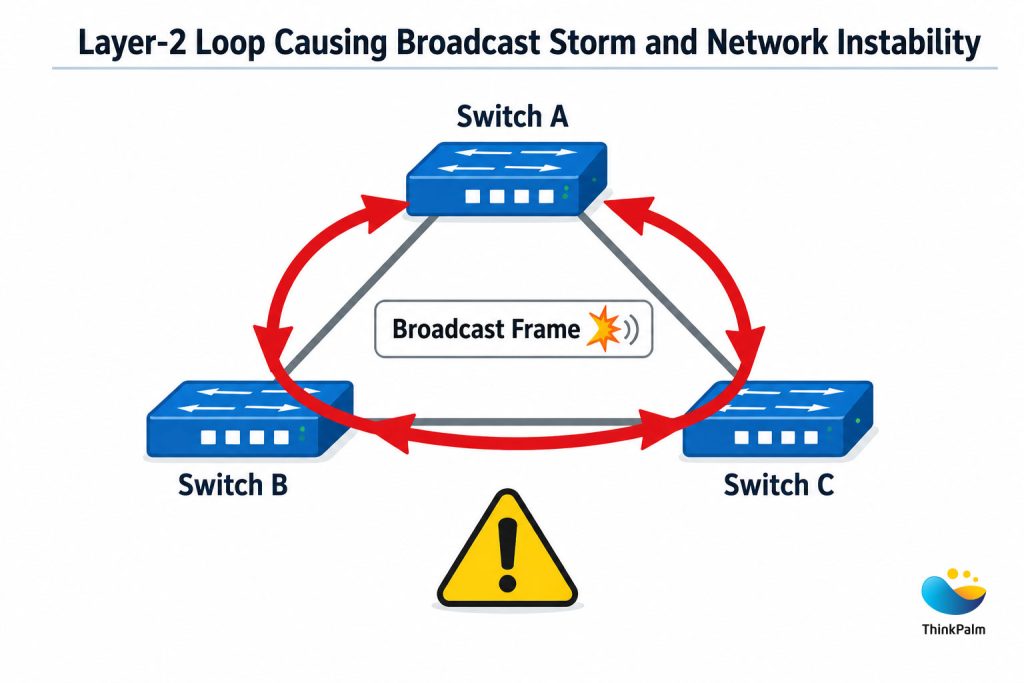
Layer-2 Loop Causing Broadcast Storm and Network Instability
Inefficient bandwidth utilization. Because STP blocks redundant links to maintain a loop-free topology, a portion of the network infrastructure remains idle during normal operation. Organizations may invest in high-capacity links that are available only as backup paths, resulting in underutilized resources and reduced return on investment.
Inability to distribute traffic across multiple paths. Since only one forwarding path remains active, traffic congestion and bottlenecks can develop in environments with high data volumes, particularly within data centers where east-west traffic dominates.
Slow network convergence. When a link or switch failure occurs, STP must recalculate the topology before traffic can resume normal forwarding. Although modern variants such as RSTP have improved recovery times, convergence delays can still affect latency-sensitive applications and critical business services.
Limited scalability. As Layer-2 domains continue to grow, scalability becomes a challenge. Larger broadcast domains increase operational complexity and raise the risk of widespread service disruptions.
These limitations have driven the industry toward more efficient and scalable networking models. The EVPN vs Spanning Tree conversation grew directly from these gaps, as network engineers needed a protocol that could use all available links, recover faster, and grow without hitting a ceiling.
Network architectures have evolved significantly to meet changing business and application requirements. Early Ethernet networks primarily handled north-south traffic, where users accessed centralized servers and applications. VLANs introduced segmentation and improved network organization, but they did not fully address scalability and efficiency concerns.
The rise of virtualization and cloud computing dramatically changed traffic patterns. Modern data centers generate large volumes of east-west traffic as virtual machines, containers, storage platforms, and distributed applications communicate with one another. Traditional network designs were not optimized for these communication patterns.
To address these challenges, organizations adopted leaf-spine architectures alongside modern technologies such as Segment Routing (SR) to improve scalability and traffic engineering.
Unlike traditional hierarchical designs, leaf-spine topologies provide predictable latency and multiple equal-cost forwarding paths between endpoints. At the same time, overlay technologies such as VXLAN emerged to extend Layer-2 connectivity across Layer-3 networks by encapsulating Ethernet frames within IP packets.
Together, these innovations laid the foundation for EVPN, which introduces a scalable control plane capable of intelligently managing Layer-2 and Layer-3 reachability information. Layer 2 network design evolution had reached a point where a smarter control plane was no longer optional. It was necessary.
EVPN, or Ethernet VPN, is a modern control-plane technology that uses Border Gateway Protocol (BGP) to distribute Layer-2 and Layer-3 reachability information throughout the network. Similar to LISP (Locator/ID Separation Protocol), EVPN uses a control-plane-driven approach to make networks more scalable and efficient. Unlike traditional Ethernet networks that depend heavily on flooding and data-plane learning, EVPN proactively shares endpoint information between network devices.
When deployed with VXLAN, EVPN creates a highly scalable and efficient architecture. VXLAN provides the data-plane mechanism for transporting Layer-2 traffic across an IP network, while EVPN acts as the control plane responsible for distributing reachability information and maintaining forwarding intelligence.
By replacing traditional flood-and-learn behavior with an advertise-and-learn model, EVPN significantly reduces unnecessary traffic and improves network efficiency. Endpoints can be located quickly without excessive flooding, resulting in improved scalability, better bandwidth utilization, and more predictable performance.
Replaces flood-and-learn with advertise-and-learn, dramatically reducing unnecessary traffic.
A centralised BGP control plane makes managing large-scale environments more consistent and predictable.
Natively supports isolated network segments for different customers or business units.
Provides a robust base for future growth across modern data center and cloud environments.
A key component of VXLAN-based networks is the VXLAN Tunnel Endpoint (VTEP). A VTEP acts as the entry and exit point of a VXLAN tunnel, connecting traditional Ethernet networks to the VXLAN overlay.
When traffic enters the VXLAN network, the source VTEP encapsulates the Ethernet frame inside a VXLAN packet and forwards it across the IP underlay network. The destination VTEP then removes the VXLAN header and delivers the original Ethernet frame to the target endpoint.
In modern data centers, leaf switches commonly function as VTEPs. They are responsible not only for encapsulating and decapsulating traffic but also for learning endpoint information and participating in EVPN route exchanges.
Because VTEPs exchange endpoint information through EVPN, the network can build a distributed database of MAC addresses, IP addresses, VXLAN segments, and forwarding paths. This intelligence enables direct communication between endpoints without relying on excessive flooding.
As EVPN fabrics scale, consistent provisioning and telemetry become increasingly important. Learn how gNMI and gRPC simplify network automation and operational management.
One of the most significant advantages of EVPN is its ability to proactively distribute endpoint reachability information throughout the network. Understanding how EVPN works makes it clear why it is such a major step forward from traditional Layer-2 approaches.
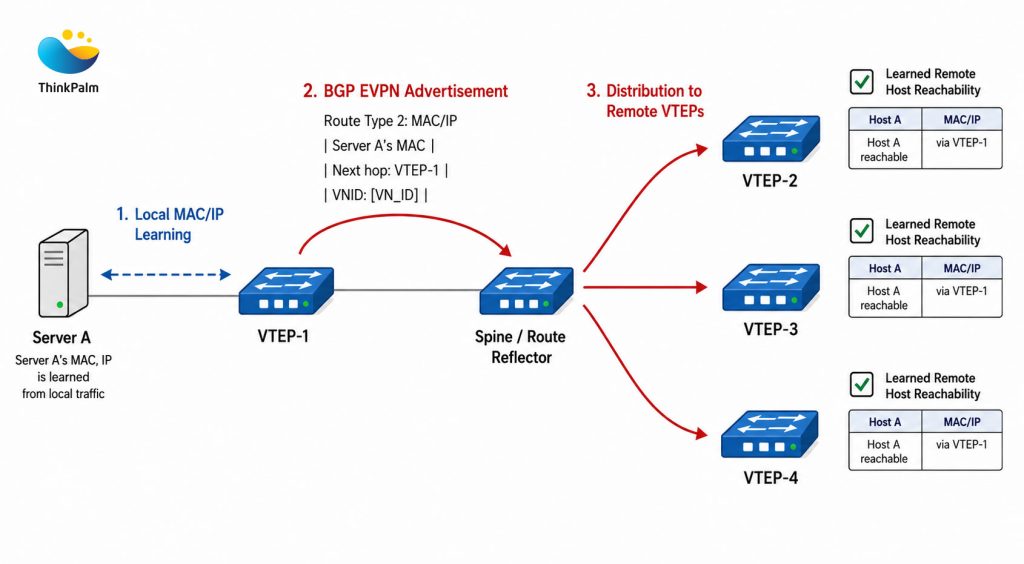
EVPN learning workflow where VTEPs learn local endpoints and advertise MAC/IP reachability information using BGP EVPN routes.
Traditional Ethernet networks rely on flood-and-learn behavior. When a switch does not know the destination MAC address, it floods traffic throughout the network until the destination is discovered. While this approach is acceptable in small environments, it becomes inefficient as network size increases.
EVPN introduces a more intelligent mechanism. The process works in five steps.
When an endpoint connects to a VTEP and generates traffic, the VTEP learns the endpoint’s MAC address, IP address, and associated VXLAN segment through local data-plane learning.
After learning the endpoint information, the VTEP creates a BGP EVPN route advertisement and distributes it to other VTEPs in the fabric. This advertisement effectively informs the network where the endpoint resides and how it can be reached.
Using BGP, the advertisement travels to every other VTEP in the network. Each VTEP receives the information and stores it in its local forwarding database.
When a server sends traffic to another endpoint, the source VTEP consults its EVPN database and determines the destination VTEP responsible for the target endpoint. The traffic is then encapsulated into VXLAN and sent directly across the IP fabric.
The destination VTEP decapsulates the packet and forwards it to the intended device.
The following information is commonly included in EVPN route advertisements:
| Information | Purpose |
|---|---|
| MAC Address | Identifies the endpoint device |
| IP Address | Provides Layer-3 reachability information |
| VNI (VXLAN Network Identifier) | Identifies the VXLAN segment |
| Next-Hop VTEP IP | Indicates where traffic should be forwarded |
| Route Type | Defines the purpose of the EVPN advertisement |
| Ethernet Segment Information | Supports multi-homing and redundancy |
How It Works
In simple terms, EVPN follows a “learn locally, advertise globally” model. Endpoint information is learned once by the local VTEP and then distributed throughout the network using BGP. This approach dramatically reduces broadcast traffic, minimizes unknown unicast flooding, and improves scalability.
Understanding how packets are processed after they enter the host is just as important as understanding how they’re forwarded across the network. Explore how Linux kernel packet processing impacts networking performance.
The EVPN vs Spanning Tree comparison comes down to a fundamental shift in network design philosophy. Instead of blocking redundant links to prevent loops, EVPN enables all available paths to remain active simultaneously.
This is achieved through Equal-Cost Multi-Path (ECMP) forwarding, which distributes traffic across multiple paths while maintaining efficient load balancing and resilience. Because all links remain active, organizations can fully utilize their network infrastructure rather than leaving redundant paths idle.
STP blocks redundant links and permits only one active forwarding path. EVPN uses its control-plane intelligence to maintain an accurate, loop-free forwarding database without needing to block any links. All links can remain active and forward traffic at the same time.
With STP, any link placed in a blocking state is essentially wasted during normal operation. With EVPN, all links stay active and carry traffic. Organizations get full use of every link they have installed.
STP forces all traffic between two points to follow a single path. EVPN supports ECMP forwarding, which spreads traffic across multiple paths simultaneously. This improves throughput, reduces bottlenecks, and makes better use of available network capacity.
When a link or switch fails under STP, the protocol must recalculate the topology before traffic resumes. EVPN leverages its control-plane intelligence to rapidly update forwarding information, resulting in significantly faster convergence compared to traditional Layer-2 protocols and minimizing disruption to business-critical applications.
EVPN supports all-active multi-homing, allowing devices to connect to multiple switches without requiring standby links. STP allows a device to connect to multiple switches, but only one of those connections is active at a time.
STP networks become harder to manage as they grow. Large broadcast domains generate heavy flooding traffic and increase the risk that a single problem will affect the entire network. EVPN reduces flooding dramatically and scales to support large, multi-tenant environments with many thousands of endpoints.
The table below summarizes the EVPN vs Spanning Tree differences side by side.
| Feature | STP | EVPN |
|---|---|---|
| Redundant Links | Blocked | Active |
| Bandwidth Utilization | Partial | Full |
| Traffic Distribution | Single Path | ECMP Multi-Path |
| Convergence Speed | Slower | Fast |
| Scalability | Limited | High |
| Multi-Homing Support | Limited | All-Active |
| Unknown Traffic Handling | Flooding | Control-Plane Learning |
| Data Center Suitability | Moderate | Excellent |
Choosing between STP and EVPN depends on the size of the network, the type of traffic it carries, and the infrastructure it needs to support.
It is also worth noting that STP and EVPN can coexist during a migration. Organizations moving from a traditional STP-based design to an EVPN fabric do not have to make the switch all at once. STP can remain in place on access-layer or legacy portions of the network while EVPN handles the core fabric, allowing a gradual and controlled transition.
Deploying modern network architectures also requires comprehensive validation. Discover why L2/L3 protocol testing is evolving to support AI-driven, cloud-native, and next-generation networking environments.
Understanding EVPN vs Spanning Tree is one thing. Putting the right architecture in place for your organization is another. That is where ThinkPalm comes in.
With close to two decades of experience working with telecom companies, enterprises, and technology vendors, ThinkPalm helps organizations move away from legacy network architectures and build infrastructure that is scalable, efficient, and ready for the future.
ThinkPalm’s networking capabilities include:
Helps enterprises virtualize traditional hardware-based network functions, reducing costs and improving agility across carrier-grade and enterprise environments.
Designs and builds adaptive, secure, and highly customizable SD-WAN frameworks that optimize business connectivity and reduce dependence on expensive hardware.
Leverages virtualization and open software to help organizations create and manage virtual networks more efficiently.
From building containerized NFV infrastructures to maintaining production-level deployments, ThinkPalm supports the full lifecycle of network virtualization.
Helps organizations manage traffic growth and maintain quality of service across complex environments including 5G and IoT networks.
ThinkPalm’s OpenStack experts provide end-to-end support for moving network operations into the cloud, with a focus on minimizing migration costs and disruption.
The EVPN vs Spanning Tree comparison reflects the broader transformation of enterprise networking. While STP played a critical role in providing stable Layer-2 communication and preventing network loops, its limitations become increasingly apparent in modern environments characterized by virtualization, cloud adoption, and large-scale data center deployments.
EVPN addresses these challenges by introducing an intelligent control plane that proactively distributes endpoint information, reduces flooding, enables active-active forwarding, and supports highly scalable architectures. When combined with VXLAN, EVPN provides a robust foundation for modern networks that demand high availability, efficient bandwidth utilization, and rapid convergence.
For organizations planning future-ready infrastructure, EVPN vs Spanning Tree is not just a technical comparison. It is a strategic decision. EVPN represents more than a protocol upgrade. It is a strategic investment that enables scalable growth, improved operational efficiency, and the network agility required to support next-generation applications and services.
Whether you are evaluating a move from STP to EVPN, planning a leaf-spine data center fabric, or looking to virtualize your network functions at scale, ThinkPalm has the engineering depth and industry experience to guide the process from design through deployment.
Connect with our networking experts to discuss your infrastructure goals.
Anju P Chandran is a Senior Software Engineer with 6 years of experience in Layer 2 and Layer 3 networking protocol development using the C programming language. Her expertise includes feature development and enhancement, troubleshooting and resolving complex networking issues in switches and routers, and developing efficient solutions for networking systems.