Agentic AI in Procurement: How It’s Transforming the Procure-to-Pay Cycle
Agentic AI
 Midhula Jeevan
July 22, 2026
Midhula Jeevan
July 22, 2026



 Midhula Jeevan
July 22, 2026
Midhula Jeevan
July 22, 2026
It’s the 24th of the month, and someone on finance is staring at an invoice that doesn’t match the purchase order. Again! They pull up the ERP in one tab, an email thread in another, and a spreadsheet in between, trying to figure out who approved what. Multiply that by a few hundred invoices a month, and you start to understand why procurement teams often describe their jobs as putting out fires rather than doing procurement.
Recent years have seen significant advances in procurement automation. Digitizing the forms. Adding an approval bot. Automating the data entry. Each step genuinely helped. But most of it automated single tasks rather than the whole problem, so the person doing the work didn’t disappear. The automation just moved them to wherever it stopped.
That’s the picture in which Agentic AI in procurement came. Instead of following a fixed script or waiting for someone to ask a question, an AI agent can look at a problem, figure out what’s going on, take action across a few different systems, and only tap a human on the shoulder when something genuinely needs a judgment call.
This piece looks at where that shift is happening fastest: procure-to-pay, or P2P, the part of procurement where requisitions become purchase orders; purchase orders become deliveries, and deliveries eventually turn into paid invoices. It’s a good place to see agentic AI in procure-to-pay, because it’s where autonomy meets the daily mechanics of buying and paying.
Unlike traditional automation, which follows fixed rules, or generative AI, which responds only when prompted, agentic AI plans a sequence of steps, uses tools and data on its own, and adapts when something doesn’t go as expected. In procure-to-pay, this typically means agents that process purchase orders, resolve invoice mismatches, onboard suppliers, and monitor vendor performance with minimal oversight. Whether you call it procure to pay AI or procure to pay agentic AI, the idea is the same: software that carries a task through to completion instead of just flagging it.
Agent-based procurement doesn’t just follow instructions. It works toward a goal, the way a capable new hire would after a few months on the job.
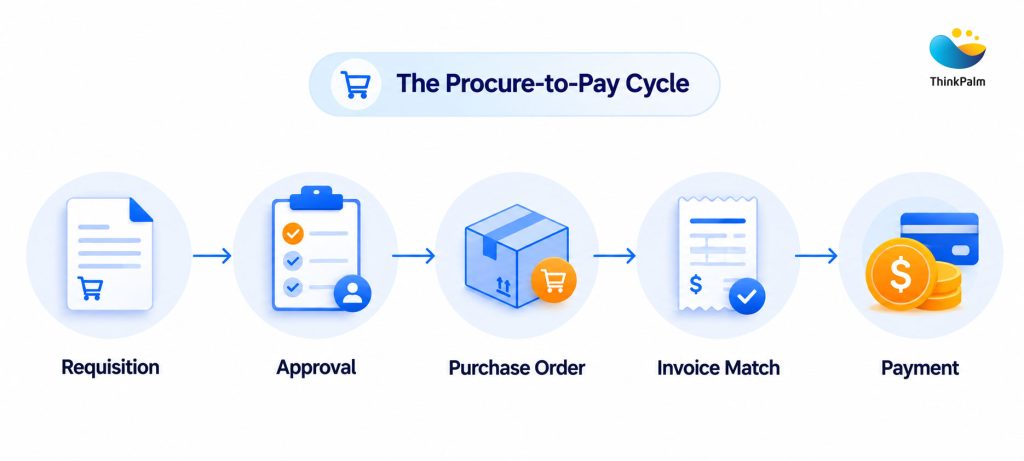
Procure-to-pay (P2P), also called procurement to pay, is the process a business follows from the moment it decides to buy something through to the moment the supplier actually gets paid. Understanding the procurement to pay meaning starts with breaking down the procurement to pay process itself, which typically runs through five stages: a requisition gets created and approved, a purchase order goes out, the goods or services are received, the invoice is checked against the PO and receipt (commonly called a three-way match), and finally payment is processed.
The need is identified, a request is raised, and relevant stakeholders sign off against budget and policy.
A formal PO is issued to the supplier confirming the terms, quantity, pricing, and delivery expectations.
Delivery is confirmed and a goods receipt is recorded against the original purchase order.
The invoice is checked against the PO and the goods receipt to confirm accuracy before payment is approved.
The supplier is paid in accordance with agreed terms, closing the procure-to-pay cycle.
Run smoothly, this gives a business one reliable source of truth for what it’s buying and whether it has paid for it. Run poorly, you get duplicate orders that surface only after payment, ignored purchasing policies, and hours lost untangling invoices that refuse to reconcile.
Agentic AI for P2P tends to show up in a few clear places in the workflow.
An agent validates a request against budget and policy and routes it immediately, instead of letting it sit in a queue.
Agents generate POs, catch pricing that doesn’t match the contract, and flag duplicate orders before anyone buys the same thing twice.
An onboarding agent reaches out to a new vendor, requests the right documents, validates what comes back, and moves things forward without anyone chasing paperwork over email.
Low-risk requests move straight through, and only the ones that genuinely need a second opinion get escalated.
This is where the three-way match headache lives, and where agents prove their value fastest by investigating discrepancies and resolving or escalating with context attached.
Agents watch delivery times, quality, and pricing against contract terms, catching a slipping supplier relationship before it becomes a real problem.
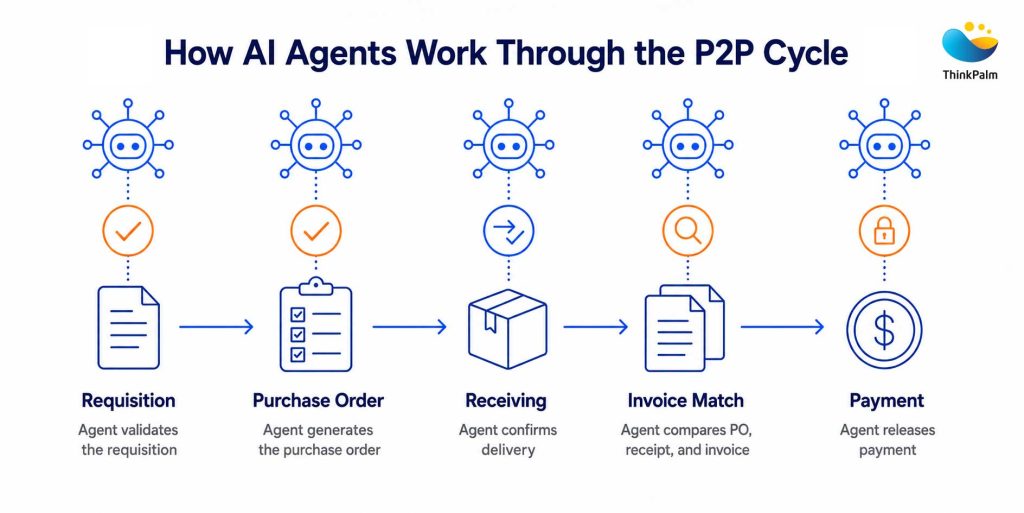
An autonomous P2P procurement agent doesn’t just raise a flag and walk away. It investigates, pulls context from connected systems, and either resolves the issue or hands it off with enough information for a human to decide in seconds.
Still working out where agentic AI ends and generative AI begins? Read Agentic AI vs Generative AI in Business Operations for a closer breakdown.
Ask anyone who works in procurement to describe a bad week, and you’ll hear some version of the same six problems.
Request intake chaos: Requests show up scattered across email and chat; half of them missing the information someone needs to actually act on them.
Approval bottlenecks: Too many handoffs, unclear rules about who signs off on what, and no automatic follow-up when something stalls. Cycle times stretch, and by the time anyone notices, a pile of “urgent” exceptions has built up waiting on someone’s attention.
Policy and budget compliance gaps: Off-contract buying, purchases coded to the wrong cost center, approval paths that vary depending on who happens to be handling the request.
Supplier onboarding drag: Collecting documents and validating a new vendor is still mostly manual, slow, and difficult to track, which delays purchasing before it’s even started.
Invoice friction: Mismatches and exceptions across the PO, receipt, and invoice mean rework, late payments, and vendor relationships that get strained over something that should be routine.
Low visibility: Leaders often can’t see where work is actually stuck, what the real cycle time looks like, or how workload is distributed across teams, not without someone building a spreadsheet to find out.
None of these are new problems. What’s changed is that procurement to pay solutions built on agentic AI can catch and resolve them continuously, in the moment, instead of surfacing a month later in a report nobody has time to read.
If these challenges sound familiar, it may be worth evaluating what a purpose-built agent could handle for your team.
The strongest AI for procurement solutions tend to deliver value in a few consistent, tangible ways. Here’s what that actually looks like in practice.
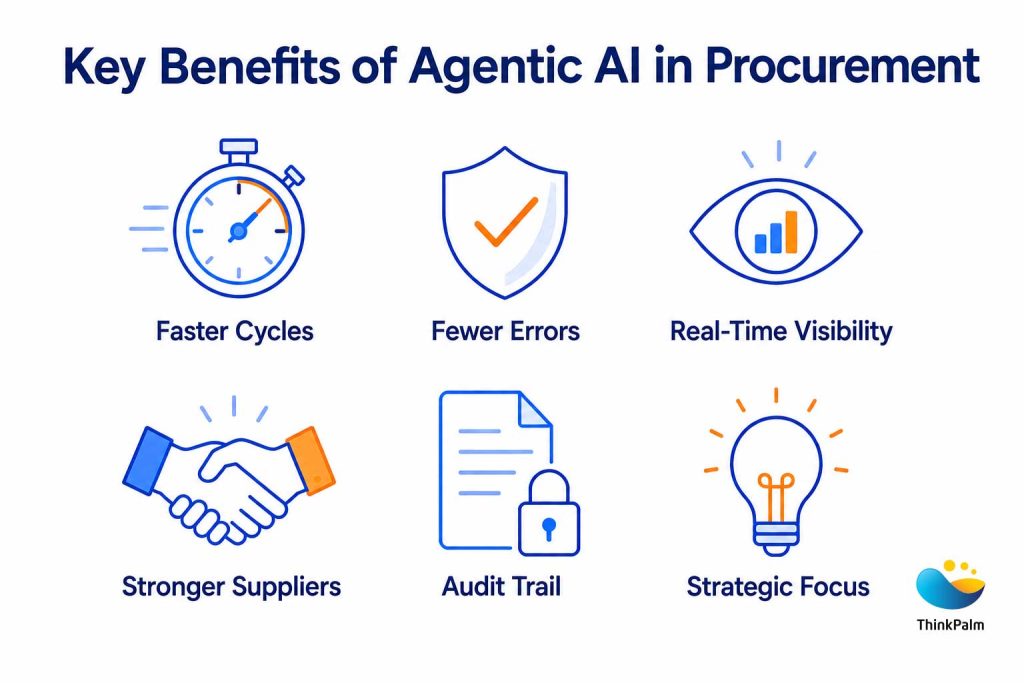
Requisitions, approvals, and invoice processing move as fast as the agent can reason through them, not as fast as someone can get to their inbox. With clear approval rules applied consistently, purchasing speeds up, and the pile of “urgent” exceptions that used to build up while people waited on signatures mostly stop forming in the first place.
An agent checks a three-way match the same careful way every single time. Tying the request, PO, receiving record, and invoice together catches overbilling, duplicate charges, and missed credits before they turn into a dispute, instead of surfacing weeks later during a reconciliation.
Instead of a static report pulled together once a month, teams get a living view of spending and budget across categories, locations, and suppliers, the kind of visibility that used to take a dedicated spreadsheet and a few hours to reconstruct.
Faster, more accurate payments and consistent onboarding, with the same required documents collected the same way every time, remove a lot of the friction that quietly damages trust with vendors over time. Suppliers notice when they’re paid on time and treated consistently.
Every approval is logged automatically: who approved what, when, and against which policy. Across many stakeholders and locations, that record is what turns an audit from a weeks-long scramble into a quick lookup.
As routine decisions shift to agents, procurement people get their time back for negotiation, category strategy, and the relationship building no agent is going to do for them.
This is really what AI powered procurement management comes down to: less time on the mechanics of buying, more time on decisions that move the needle.
AI for procurement rarely works in isolation. Its value comes from how well it connects to everything already running underneath the business, which is why integration tends to decide whether a pilot scales or quietly dies.
An agent is only as sharp as the data it can see. If your ERP, contract repository, and supplier portals hold inconsistent records, the agent inherits that mess and reasons badly on top of it. Cleaning up data quality is often more valuable than adding another integration.
Rather than connecting agents to a dozen disconnected databases, stronger implementations build a unified data spine that agents and generative AI tools can both draw from. This is also what makes persistent memory possible, letting an agent recall context from a prior interaction instead of starting from zero.
Many procurement agents pair an LLM for reasoning with retrieval systems that pull the right contract clause or policy document at the right moment. The reasoning is only as good as what gets retrieved.
Whether you’re layering agents onto an existing platform or building custom ones, integration depth with your ERP and procurement platforms usually matters more than any capability on a features list.
As agent systems scale, retrieval quality becomes the real bottleneck, not the model. See what retrieval augmented generation is and how it actually works.
Gartner has predicted that more than 40% of agentic AI projects will fail by 2027, largely because the systems underneath them weren’t built to support this level of reasoning. The technology usually isn’t the problem. The rollout is.
Document how requisitions, approvals, and invoices actually move today, not how the org chart says they should. Workflow mapping surfaces the real bottlenecks to target.
Pick one painful area, invoice exception handling is a common starting point, and prove it works before expanding.
Define escalation logic, approval thresholds, and audit-ready logs before agents go live. This is also where sourcing frameworks and supplier scoring models get codified, so agents apply them consistently.
Agents improve when decisions are reviewed and corrected over time, turning a decent pilot into a reliable one.
Some teams use an AI agent builder or agentic AI solutions to assemble and orchestrate agents internally, while others buy purpose-built ones. Either way, agent orchestration deserves as much scrutiny as any individual agent’s capabilities.
Once a pilot shows results, extend the approach into the next stage, including negotiation strategies and tail spend management, rather than starting over.
Done this way, procurement to pay agentic automation becomes a capability you build up in stages, not a single big-bang deployment that either works perfectly or not at all.
Autonomy raises stakes in governance. Data privacy and IP leakage matter because procurement data often includes sensitive pricing and contract terms, so any agent with broad access needs clear boundaries on what it can see and share. Role-based access controls keep agents inside the same limits as the humans they support.
Audit trails and compliance monitoring make every decision explainable, so when a payment gets questioned months later, someone can see exactly why it was approved. And a responsible AI framework ties governance mechanisms, data governance, policy enforcement, and risk management into one consistent standard, rather than a distinct set of rules just for agents.
As routine decisions move to agents, procurement increasingly becomes a hybrid workforce, humans and agents working the same workflows, with human-in-the-loop oversight focused on decisions that need judgment. Team structures shift accordingly, with fewer people on manual data entry and exception chasing, and more on supplier strategy, scenario planning, and continuous procurement optimization.
New skills are emerging too. Prompt engineering and knowing how to guide and correct an agent are becoming part of the procurement skill set, not just an IT concern. Some organizations are building small internal teams for sourcing task automation and workflow orchestration across the function, rather than treating each agent as a one-off project.
Change management matters more here than in most tech rollouts, since trust has to be earned. People need to see an agent’s decisions before they’ll rely on them, which is why closed-loop feedback and audit trails matter for adoption as much as compliance.
A single agent handling one task is straightforward. Getting several to coordinate on the same workflow is where most implementations struggle. Learn how multi-agent orchestration works and how it solves this.
Retail procurement carries its own version of these challenges, usually at higher volume and with less room for error around timing. Seasonal demand forecasting lets agents adjust purchasing recommendations in real time heading into a peak season. SKU-level replenishment triggers reorders automatically based on live inventory and sales velocity across stores. Vendor compliance monitoring keeps pricing and delivery terms in check across a fragmented supplier base, and tail-spend consolidation catches when different stores are buying the same category from different suppliers at different prices.
For a retail P2P setup specifically, the wins tend to show up as:
Retail has actually lagged other industries in AI adoption within procurement. Ironclad’s 2025 State of AI in Procurement Report, a survey of 800 procurement professionals, found retail adoption sitting around 65%, well behind sectors like technology at 89%. That gap is a real opportunity for retailers moving on this now.
Agentic AI in procurement isn’t about replacing procurement people. It’s about clearing out the repetitive work that’s kept them from doing the parts of the job that actually need a human, fewer late nights untangling invoices, faster approvals, real visibility into spend, and supplier relationships that aren’t strained by avoidable friction.
While this piece has focused on retail, the same case holds anywhere purchasing runs at volume. P2P is especially valuable in industries with lots of suppliers, frequent purchases, approvals, and invoice traffic, think manufacturing, healthcare, hospitality, construction, financial services, and education. It helps most wherever teams need tighter spend control, faster cycle times, and fewer invoice and compliance issues across multiple locations or cost centers, which is really just a description of most procurement teams once they get past a certain size.
From invoice exception handling to supplier onboarding and approval routing, ThinkPalm helps procurement teams design, govern, and scale agentic AI across the procure-to-pay workflow.
Midhula Jeevan is a passionate content writer with a focus on SEO and technical writing. With a love for words and a curiosity for the technical side, she blends creativity with strategy to craft content that stands out. When not writing, you could find her usually reading books, enjoying a good cup of coffee, or chasing golden sunsets.