LISP Protocol in Networking: A Complete Guide to Locator/ID Separation Protocol
Networking
 Athira P V
June 16, 2026
Athira P V
June 16, 2026



 Athira P V
June 16, 2026
Athira P V
June 16, 2026
The way networks assign and use IP addresses has not changed much since the early days of the internet. A single IP address still does two jobs at once: it identifies a device and tells the network where that device lives. For decades, this worked well enough. Today, with workloads shifting between data centers, cloud environments, and branch offices at speed, that tight coupling is becoming a serious bottleneck.
The Locator/ID Separation Protocol (LISP Protocol) was built to solve this problem. By separating the identity of an endpoint from its physical location in the network, LISP Protocol in Networking introduces a more scalable, flexible, and mobility-ready architecture for modern enterprises.
At a Glance
Traditional IP addressing ties device identity and network location to a single address, creating problems with mobility, scalability, and cloud flexibility. The Locator/ID Separation Protocol (LISP Protocol) solves this by separating the two into distinct namespaces, allowing endpoints to move freely without disrupting sessions or bloating the routing table.
This guide covers how LISP Protocol works, its role in SD-Access, how it compares to BGP EVPN, and where it fits best in enterprise networks.
IP addressing is the system that assigns a unique numerical label to every device connected to a network, allowing data to be routed from one point to another. Each IP address serves as both an identifier for the device and an indicator of its location within the network topology.
In the IPv4 model, these addresses are 32-bit numbers, offering roughly 4.3 billion unique combinations. IPv6 expanded that space significantly with 128-bit addresses, but the underlying architecture still ties identity to location, and that design assumption is increasingly difficult to manage at enterprise scale.
The dual-role problem creates several compounding challenges:
The explosive growth of connected devices has consumed available IPv4 addresses. IPv6 solves the space problem but not routing scalability.
The global BGP routing table now carries over 900,000 prefixes. Each entry consumes memory and CPU, slowing convergence.
A device that moves to a new network typically requires a new IP address, breaking active sessions and disrupting applications.
Multi-ISP organizations must manage complex BGP policies for redundancy and traffic engineering — failures are hard to recover from gracefully.
Workloads moving between data centers and cloud environments often force renumbering, adding operational risk and potential outages.
Curious how the broader protocol stack is evolving beyond IP? Read our breakdown of QUIC Protocol and how HTTP/3 is replacing TCP for faster, more secure web performance.
The Locator/ID Separation Protocol is a network architecture and tunnelling protocol that solves the identity-location coupling problem in traditional IP addressing by introducing two separate namespaces.
Rather than asking a single IP address to do two jobs, LISP Protocol in Networking splits the functions cleanly:
The stable identity of a host or workload. An EID stays the same regardless of where the endpoint physically connects to the network.
The address representing the current location of a device within the network topology, used for routing traffic across the underlay infrastructure.
A mapping system sits between these two namespaces, dynamically resolving EIDs to RLOCs in a process similar to how DNS resolves hostnames to IP addresses. When a device sends traffic, the network looks up the destination EID, finds the corresponding RLOC, and forwards the encapsulated packet to the right place.
The Locator/ID Separation Protocol was originally developed by Cisco and has since been standardized by the IETF as RFC 6830, with updates published under RFC 9300. It is not a proprietary technology locked to a single vendor, though its most prominent enterprise deployment today is within Cisco’s SD-Access fabric.
By decoupling identity from location, the LISP Protocol in Networking enables endpoints to move freely across the network without changing their address, without breaking sessions, and without forcing the global routing table to carry the full weight of every endpoint prefix.
The EID RLOC separation is the foundational concept behind the Locator/ID Separation Protocol, and understanding it clearly makes everything else about LISP Protocol easier to follow.
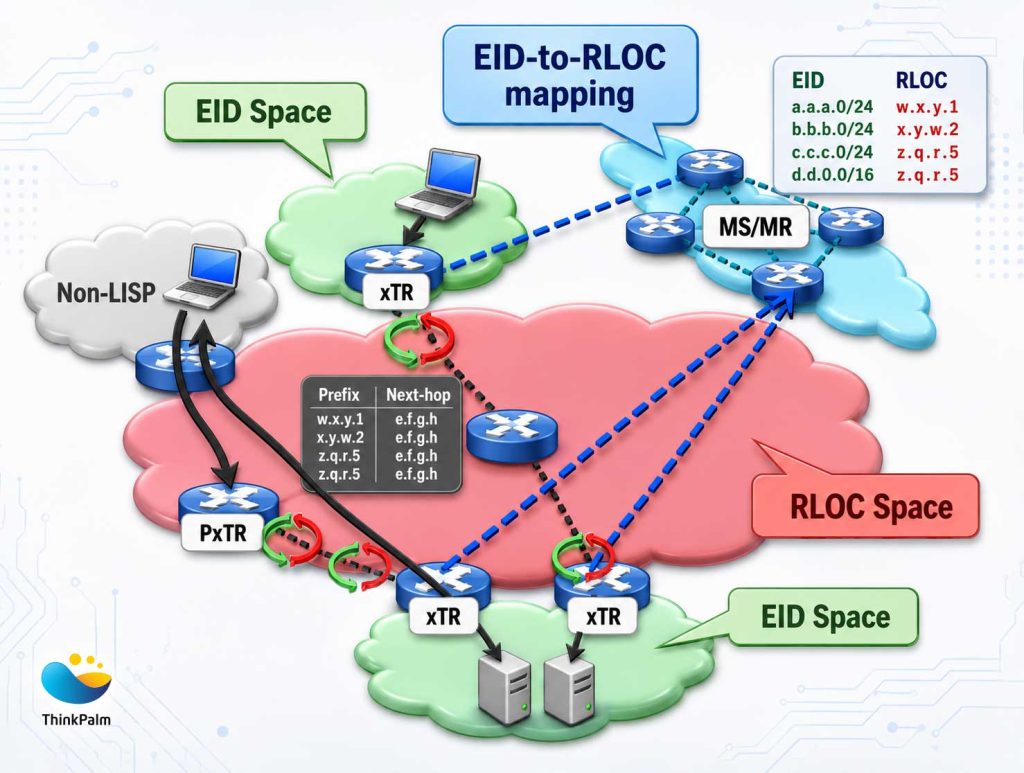
How LISP separates EID space from RLOC space using xTRs and the mapping system.
An EID is the address assigned to an endpoint, such as a server, workstation, virtual machine, or IoT device. It is a stable identifier that belongs to the endpoint itself, not to the network attachment point. When a device moves from one location to another, its EID does not change. Active sessions remain intact because the identity of the endpoint is preserved.
Think of an EID like a person’s name. It identifies who they are, regardless of where they happen to be standing.
An RLOC is the address assigned to the router or tunnel endpoint that connects a site to the network. It tells the routing infrastructure where a particular EID is currently reachable. If a device moves from one site to another, the RLOC changes to reflect the new attachment point, but the EID stays the same.
Using the same analogy, an RLOC is like a postal address. It tells the delivery system where to send something right now, and it can change when the person moves.
| Attribute | EID | RLOC |
|---|---|---|
| What it identifies | The endpoint or workload | The network attachment point |
| Changes when the device moves? | No | Yes |
| Used for | Identity and policy | Routing and forwarding |
| Where it lives | Inside the LISP site | In the transit/underlay network |
| Analogous to | A person’s name | A postal address |
This EID RLOC separation is what allows the Locator/ID Separation Protocol to support seamless mobility, simplified multihoming, and scalable routing without requiring any changes to the endpoint or application.
The LISP Protocol in Networking is built around a set of functional components that together implement the map-and-encapsulate model. Rather than listing them as a flat glossary, it helps to group them by role.
These components handle the actual encapsulation and decapsulation of traffic as it crosses the LISP overlay network architecture.
These components allow LISP-enabled sites to communicate with traditional non-LISP networks, which is essential during phased deployments.
These components form the intelligence layer of the LISP Protocol, maintaining the database that maps EIDs to RLOCs.
Together, these components implement a pull-based overlay network architecture where mapping information is only fetched when needed, rather than distributed proactively across all routers.
Understanding the LISP Protocol packet flow reveals why it is well-suited to dynamic, high-mobility environments and how it contributes to IP routing table optimization at scale.
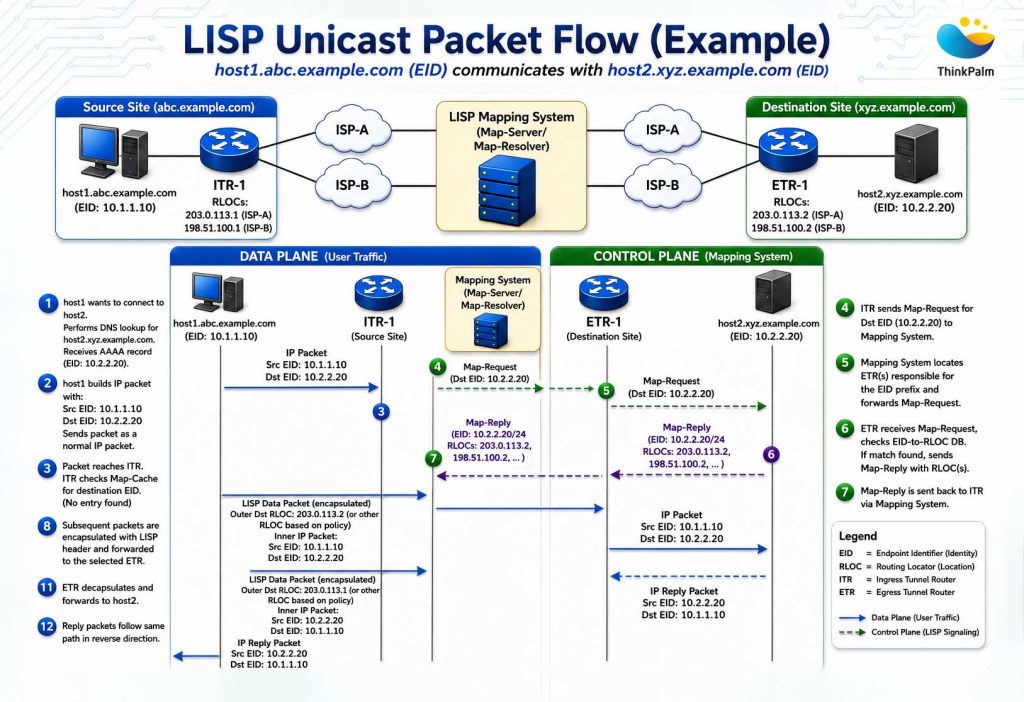
Step-by-step packet flow of a LISP unicast communication between two hosts.
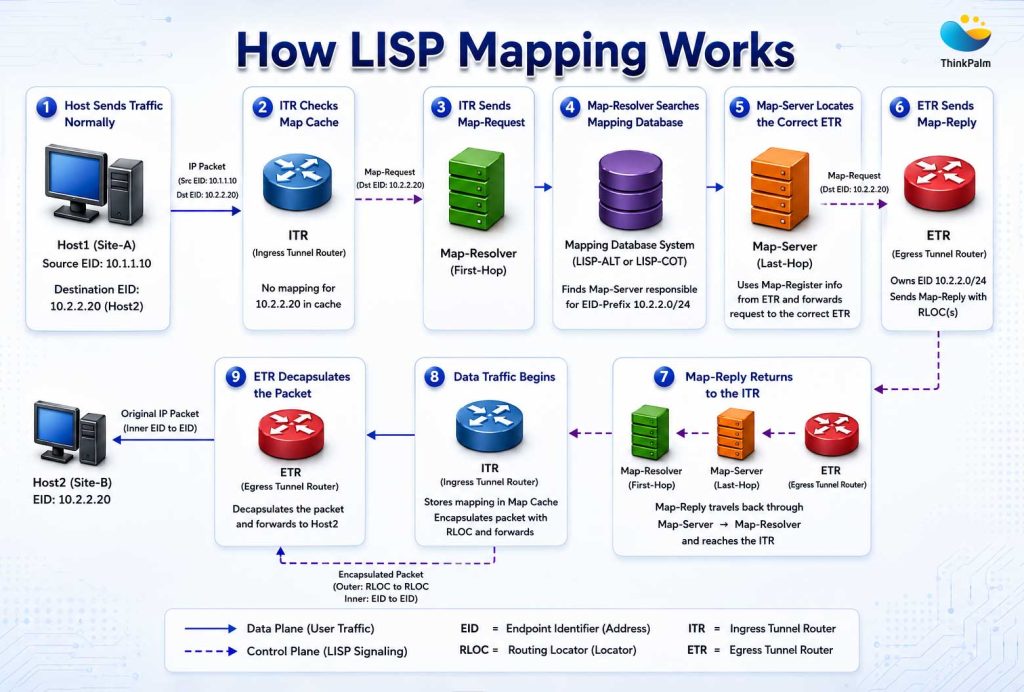
The nine-step process behind how LISP mapping resolves an EID to its RLOC.
The map cache is an important efficiency mechanism that competitors frequently overlook. Once a mapping is learned, subsequent packets to the same destination EID are forwarded immediately without triggering another lookup. Only the first packet to a new destination incurs the map resolution delay, which is typically measured in milliseconds.
This pull-based model also contributes directly to IP routing table optimization. Because only RLOCs are advertised into the global routing infrastructure, the number of prefixes in the routing table is dramatically smaller than in a traditional flat IP network. EID prefixes stay off the global table entirely, reducing memory consumption, CPU load, and convergence time across the overlay network architecture.
Both the Locator/ID Separation Protocol and BGP EVPN (Ethernet Virtual Private Network) solve similar problems: how to build scalable, flexible overlay networks that support endpoint mobility and multi-tenancy. However, they approach the problem differently, and each is better suited to specific environments.
Ethernet Virtual Private Network is a control plane technology that uses BGP to distribute endpoint reachability and MAC/IP binding information across a network fabric. It is widely used in data center environments, where it is commonly paired with VXLAN for the data plane. EVPN is supported by a broad range of vendors including Cisco, Juniper, Arista, and HPE Aruba.
The most important distinction between LISP Protocol and BGP EVPN is how they handle endpoint information distribution.
Mapping information is only fetched when a traffic flow is initiated. Efficient in large, high-churn environments — devices only learn about what they need.
MAC and IP reachability is distributed proactively to all devices via BGP updates. Every switch knows about every endpoint — simpler forwarding but higher control plane volume.
As enterprise networks evolve, so do the security requirements around connectivity. Post-Quantum TLS with ML-KEM is already shaping how enterprises think about encryption and quantum-safe connectivity for the long term.
The growing adoption of LISP Protocol in Networking across enterprise environments is driven by a concrete set of operational and architectural advantages over traditional IP addressing models.
LISP reduces global routing table growth by advertising only RLOCs into the routing infrastructure. This lowers:
As a result, networks become more stable, efficient, and easier to scale.
LISP enables true network mobility and roaming by allowing devices to retain their EID even when their physical location changes.
Devices can move between:
without interrupting active sessions.
This capability is especially useful for:
LISP supports multiple RLOCs for a single EID, enabling:
without complex BGP tuning.
Modern enterprises increasingly operate across:
LISP allows workloads to move freely while maintaining consistent addressing.
LISP also integrates naturally with SD-WAN overlay networking by supporting:
Traffic paths can be optimized using:
This improves WAN utilization and application performance.
LISP functionality is handled within the network infrastructure. Applications and end devices do not require modification.
LISP supports incremental deployment and interoperability with traditional IP networks.
LISP enables flexible overlay-based VPN provisioning and identity-based segmentation without heavy dependence on MPLS-VPN architectures.
Identity-based networking improves:
across enterprise environments.
| Feature / Capability | Traditional IP Networking | Locator/ID Separation Protocol |
|---|---|---|
| Addressing Model | Identity and location combined | Identity and location separated |
| Routing Scalability | Large routing tables | Reduced routing overhead |
| Mobility Support | Session disruption during movement | Seamless mobility |
| Multihoming | Complex BGP configurations | Simplified multihoming |
| Cloud Mobility | Requires renumbering | Stable EIDs across environments |
| SD-WAN Integration | Limited flexibility | Ideal for overlay networking |
| Traffic Engineering | Complex and policy-heavy | Dynamic and simplified |
| Network Segmentation | VLAN-based | Identity-based |
| Scalability | Limited for modern dynamic networks | Highly scalable and cloud-ready |
Deploying a modern network fabric like SD-Access requires rigorous validation before going live. Building next-gen test labs that move from legacy to autonomous network testing is becoming a critical step for enterprise network teams.
The architectural advantages of the Locator/ID Separation Protocol translate into measurable operational benefits across several common enterprise scenarios.
This is where LISP in SD-Access has the deepest footprint. Large university campuses, corporate headquarters, and hospital networks use LISP Protocol to support user mobility across hundreds of access switches and wireless APs. When a user moves from one building to another, the network automatically updates the endpoint registration without interrupting the session or requiring a new IP address.
Organizations running workloads across AWS, Azure, and private data centers benefit from the stable EID model. Workloads can migrate between cloud environments without renumbering, and consistent overlay network architecture policies follow the workload regardless of where it runs.
Large IoT environments, such as manufacturing floors, smart buildings, and logistics networks, involve thousands of devices that connect, disconnect, and move regularly. The Locator/ID Separation Protocol provides scalable addressing and mobility management without bloating the routing table with individual device prefixes.
LISP Protocol integrates naturally with SD-WAN overlay architectures for distributed enterprise WAN deployments. Branch offices can be connected to the fabric with minimal configuration, and traffic engineering is handled dynamically through RLOC priorities and weighting rather than static policy.
Hospitals and large healthcare facilities are strong use cases for LISP Protocol in Networking. Medical devices and staff terminals move between wards and floors continuously. Maintaining session continuity without renumbering or disrupting clinical applications is a direct operational benefit of the EID-based mobility model.
VPN technology is also undergoing its own architectural shift. Wireguard VPN represents a cryptographic leap that is making traditional VPN approaches look increasingly outdated.
The Locator/ID Separation Protocol represents a meaningful evolution in how enterprise networks handle IP addressing. By separating endpoint identity from routing location, LISP Protocol in Networking removes the most persistent constraints in traditional IP architecture: routing table bloat, session disruption during mobility, and rigid cloud boundaries.
It is not a universal replacement for every networking model, but for large, dynamic enterprise campuses, high-mobility IoT deployments, and Cisco-centric SD-Access environments, it delivers a scalable, identity-driven foundation that traditional IP addressing cannot match.
At ThinkPalm, we help enterprises design and deploy modern network architectures built on technologies like LISP Protocol in Networking, ensuring your infrastructure is ready for the demands of cloud, mobility, and Zero Trust environments.
Athira P V is a Senior Software Engineer with over 6 years of experience in the telecommunications industry. She specializes in Layer 2 and Layer 3 networking protocol development, with expertise in carrier-grade networking solutions and telecom software. Throughout her career, she has contributed to protocol implementation, feature development, troubleshooting, and performance optimization for networking products.