Predictive Maintenance AI: How Fleets Are Breaking Free of the Reactive Repair Cycle
Industrial Internet of things (IIoT)
 Chandni Nadarajan
July 16, 2026
Chandni Nadarajan
July 16, 2026



 Chandni Nadarajan
July 16, 2026
Chandni Nadarajan
July 16, 2026
Imagine if your fleet could tell you a vehicle’s engine would fail next Tuesday. Or your warehouse equipment could warn you that a critical motor had only two weeks of healthy operation left. Maintenance would no longer revolve around emergencies or fixed schedules. Repairs could be planned, downtime minimized, and budgets can be forecasted based on real-time equipment health. While that may sound futuristic, it’s precisely what predictive maintenance AI is designed to enable.
In this blog post, we discuss how predictive maintenance AI enables teams to get a real-time picture of equipment health, turning maintenance into something they plan for, not something that attacks them mid-shift.
Definition
Predictive maintenance AI uses Industrial IoT, machine learning, and data analytics to continuously assess asset health and predict when maintenance is likely to be needed.
For a lot of logistics and fleet operations, maintenance is often reactive. So, the equipment gets serviced on a fixed calendar or repaired once it breaks, and budgets are set the same way people budget for surprises, because that’s exactly what breakdowns are.
Instead of waiting for a failure or guessing at service intervals, AI-driven predictive maintenance performs maintenance based on actual asset conditions. Thus, it helps reduce unexpected breakdowns, extends asset life, and optimizes maintenance costs.
In most cases, reactive and calendar-based servicing survive in logistics and manufacturing not because operators are careless. They’ve survived because the alternative true predictive capability needs three things; most fleets were never equipped with sensor data, a way to interpret it, and a system that turns that interpretation into action.
Without that infrastructure, the same problems show up everywhere which are listed below:
Downtime lands without warning — A failure can pull a vehicle or asset out of service mid-route, disrupting schedules, deliveries, and revenue.
Servicing follows the calendar, not actual usage — Assets are often serviced too early, increasing maintenance costs, or too late, after damage has already occurred.
No centralized view across sites — When assets are spread across locations, maintenance teams lack a unified fleet health dashboard to identify healthy, degrading, or high-risk equipment.
Maintenance budgets rely on guesswork — Without an MLOps-powered maintenance model and accurate remaining useful life (RUL) estimation, budgeting for repairs becomes reactive instead of data-driven.
Let’s look at how these two contrasting strategies directly impact your fleet’s daily efficiency and bottom line:
| Feature / Metric | Reactive Maintenance | Predictive Maintenance AI |
|---|---|---|
| Core Approach | Fixing assets only after a physical breakdown occurs. | Continuously monitoring real-time telemetry to prevent failures before they happen. |
| Downtime Impact | High, unpredictable, and highly disruptive to daily delivery schedules. | Minimal and controlled; repairs are strategically scheduled during off-peak windows. |
| Operational Cost | High due to emergency repair rates, expedited shipping for parts, and secondary asset damage. | Optimized; targets only the components that need servicing, reducing wasted labor and parts. |
| Asset Lifespan | Shortened due to cumulative wear and tear and catastrophic system failures. | Maximized by catching and mitigating minor wear (such as overheating or micro-vibrations) early. |
| Data & Technology | None; relies on manual, calendar-based scheduling or visual inspections. | High; utilizes IIoT sensors, machine learning models, and real-time data streaming. |
| Planning & Budgeting | Unplanned emergency spending based on guesswork. | Data-driven forecasting powered by precise Remaining Useful Life (RUL) estimations. |
At its core, AI-driven predictive maintenance is all about math and timing. Here it takes real-time sensor data like vibration, temperature, load etc. and uses anomaly detection maintenance to catch the early warning signs of trouble long before a machine breaks down.
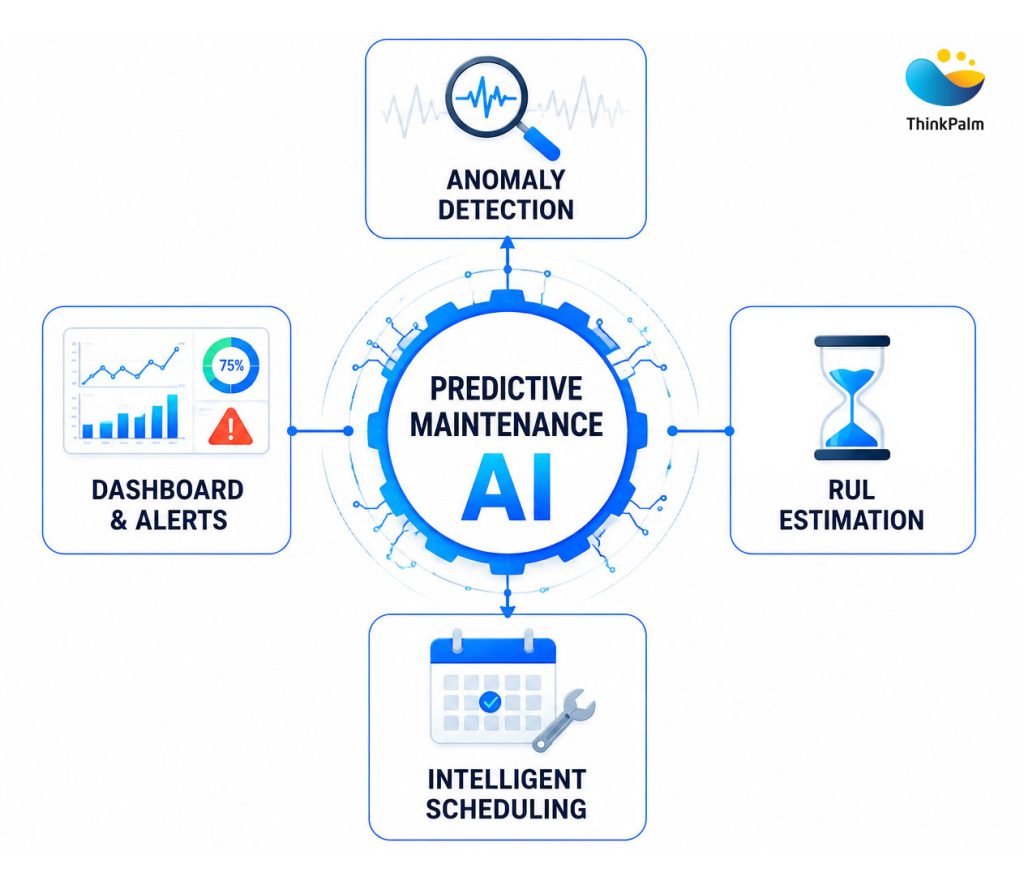
Core capabilities of predictive maintenance AI
To work in the real world, a solid, predictive maintenance AI solution must be built around four key capabilities:
Detects unusual equipment behavior and identifies early warning signs before failures occur, giving maintenance teams the first indication that an asset may require attention.
Estimates how much operational life remains in critical components, allowing maintenance to be scheduled before failures occur. Prognostics and Health Management (PHM) research widely uses this approach to support proactive maintenance decisions.
Plans maintenance during low-demand operating windows so servicing can be completed with minimal disruption to day-to-day operations.
Consolidates equipment health, maintenance alerts, and operational insights into a centralized fleet health dashboard, enabling maintenance teams to monitor assets across every location from a single interface.
Picture a logistics operator running a distributed fleet of transport vehicles and warehouse equipment across several facilities. Right now, they are stuck in that classic method of maintenance which consists of fixed-interval servicing and reactive repairs. But there is no systematic way to see equipment’s health before something fails.
The proposed fix is an IoT predictive maintenance solution that:
At the end of the day, the goal isn’t a report generated after something breaks. It’s about using AI-driven predictive maintenance that keeps operations data-driven and ahead of failure from the very start.
A dependable predictive maintenance AI works on a few practical building blocks:
Pairing time-series forecasting with pattern-recognition machine learning gives you a dual advantage. Your AI-driven predictive maintenance system delivers two things: interpretability, so maintenance teams understand why a prediction was made, and the accuracy needed to catch failure patterns early.
Gain real-time visibility into fleet and equipment health, reduce unplanned downtime, and enable AI-powered predictive maintenance with the NetvirE Industrial IoT platform.
Explore NetvirE Industrial IoT PlatformWhen you think of bringing a solid IoT predictive maintenance solution to the table, it’s all about making your life easier and your operations more predictable. As a proposed solution, these are the target outcomes the system is designed to hit:
In short, your team gets several advantages if we are to compare a reactive vs predictive maintenance approach.
A full predictive AI build isn’t the right call for every maintenance operation. It tends to be worth the investment when:
Organizations are most likely to benefit when they face one or more of these challenges:
To sum up, we can say that reactive maintenance isn’t a failure of effort. It’s just because the equipment can’t tell you how it’s doing. When you upgrade with predictive maintenance AI, it closes that gap significantly. It can turn raw sensor data into early warning, and this can in turn transform your daily operations into a true condition-based maintenance AI workflow. In this manner, you can move away from the pitfalls of reactive vs predictive maintenance approaches and start building around actual condition instead of guesswork.
Whether you’re managing fleets, warehouse equipment, or industrial assets, ThinkPalm’s AI engineering team builds predictive maintenance solutions that enable real-time monitoring, remaining useful life (RUL) estimation, and intelligent maintenance planning for greater operational reliability.
Chandni Nadarajan is a content writer at ThinkPalm Technologies, specializing in B2B marketing content. With a passion for turning complex ideas into clear, engaging narratives, she blends strong research and storytelling skills to make technical topics accessible. Her expertise spans technology, automation, and digital business solutions.