What Is Segment Routing? Benefits, SRv6, and the Future of Modern Networking
Networking
 Samebenezer M
May 27, 2026
Samebenezer M
May 27, 2026



 Samebenezer M
May 27, 2026
Samebenezer M
May 27, 2026
To understand Segment Routing, let’s imagine a delivery driver who must deliver a parcel. In traditional networking, the driver needs to stop at every intersection to ask for directions. This process slows down everything. Unlike the new system where the driver is fully equipped with a GPS system. Similarly, with Segment Routing, the driver is handed over a ‘smart list’ of instructions before they even start the journey. They know exactly which bridge to cross and which tunnel to take without ever stopping to ask for help. This is what we see with source routing i.e. putting the intelligence in the packet, not the path.
In Summary
In our fast-paced digital world, networks need to handle data quickly, efficiently, and with precision. But traditional routing methods often rely on each router making independent decisions, which can introduce delays and complexity. Segment Routing is a routing approach that allows the sender to define the complete path a data packet should take through the network using a list of instructions called segments. This approach simplifies network operations, improves traffic control, and enables faster, more scalable routing.
In this blog, we shall explore how Segment Routing becomes a key technology enabler for modern networks.
Segment Routing (SR) is an advanced network routing technique designed to simplify and enhance traffic engineering in modern networks.
It reduces dependency on complex signaling protocols like MPLS LDP or RSVP-TE by using source-based routing. Segment Routing uses Interior Gateway Protocols (IGPs) such as OSPF or IS-IS for distributing SIDs.
To put it simply, here the sender defines the path that a packet should take through the network. The packet is assigned a sequence of instructions called Segment Identifiers (SIDs). The packet header contains an ordered list of SIDs. Each node processes the next SID in the list to determine where to forward the packet. This is called source routing.
With the growth of cloud computing, 5G, IoT devices, video streaming, and distributed enterprise applications, there is more traffic than ever. Well, things were difficult in traditional networking approaches as they had to rely on multiple protocols and complex configurations to manage traffic paths.
Segment Routing solves this challenge by using a source routing approach. Here the source router defines the complete path a packet should take across the network. Therefore, the first router can plan the entire journey by avoiding congestion and reaching its destination using intelligent SDN/NFV and network virtualization solutions for modern enterprises. Consequently, this makes network operations much easier and improves performance.
In the traditional set up, where Multiprotocol Label Switching (MPLS) networks were used for running traffic, technologies like LDP and RSVP-TE are commonly used to establish and maintain traffic paths. However, this seemed difficult as it was like managing a busy airport with outdated tools.
But, in the modern era, which requires high-speed networks, managing these protocols became increasingly complex. Segment Routing reduces dependency on protocols such as LDP and RSVP-TE. Instead, it uses the “languages” that routers already speak (like OSPF or IS-IS) to share path information.
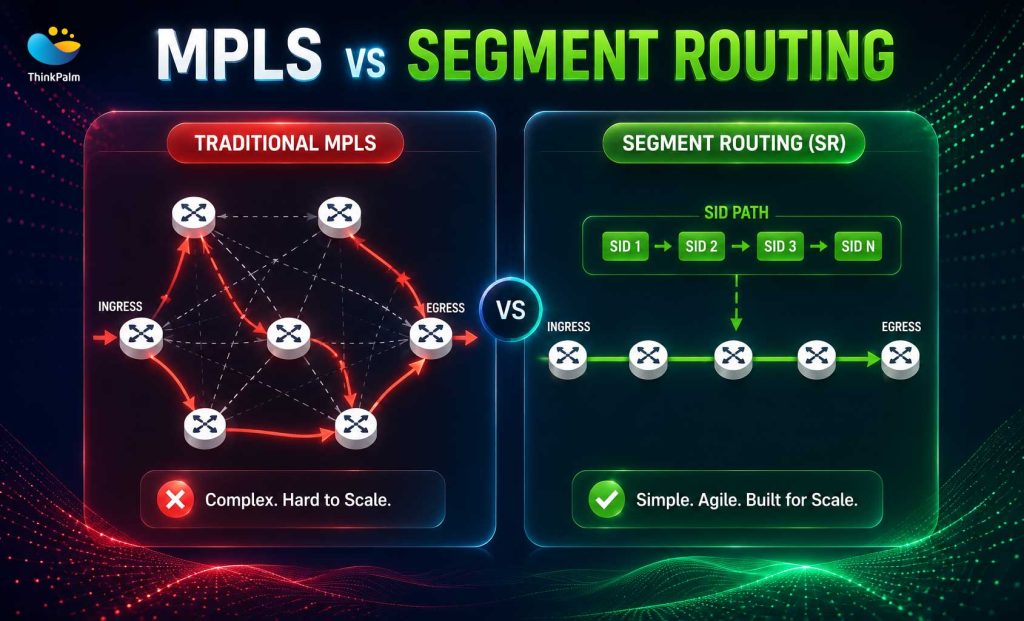
Traditional MPLS and Segment Routing (SR) architecture comparison.
Although MPLS networks supported traffic engineering, they required manual tunnel configuration and struggled to scale up as per needs. Therefore, it could not adapt to changing network conditions. Whereas Segment Routing displays greater capability in improving traffic engineering. It can react instantly to changing network conditions, bypass any sort of congestion, and even take the fastest routes.
For example, in the case of video conferencing, online banking, or cloud services data is sent through less congested routes to ensure better user experience and reliability with segment routing.
As millions of devices become connected, across distributed environments, scalability challenges begin to crop up. Traditional methods may not be sufficient to deal with the sheer volume of data. This is where SRv6 over IPv6 changes the game.
By using IPv6 addresses as instructions (SIDs), SRv6 can grow without limits. Hence, this becomes the ‘go-to’ choice for organizations building large-scale cloud environments, 5G infrastructure, edge computing, and future-ready digital services. Also, when it comes to modernizing infrastructure, it is a preferred choice for enterprises and telecom providers.
In short, Segment Routing is becoming a key technology for building simpler, more scalable, and highly efficient networks.
Need to optimize performance across distributed network environments?
Explore how
cloud-native SD-WAN for application performance optimization
helps enterprises improve scalability, visibility, and application experience across cloud and edge networks.
The diagram below shows how Segment Routing (SR) guides traffic across a predefined network path using Segment Identifiers (SIDs). Instead of relying on multiple signaling protocols, the ingress router defines the complete path the packet should follow through the network.
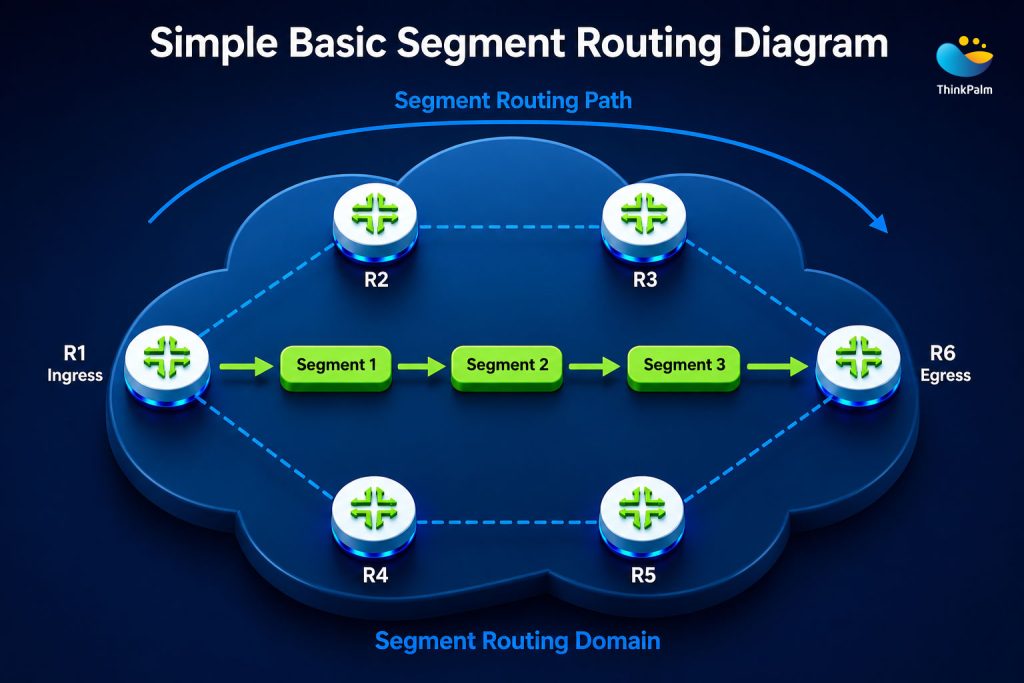
Segment Routing path defined by a sequence of Segment Identifiers (SIDs)
To understand how data moves, it is important to understand three core concepts:
An SR Domain is a group of routers that participate in segment routing. They understand the SR instructions. In this network, each router takes the role of ingress, transit, or egress nodes.
An SR Path is the predefined route that traffic follows from the source router to the destination router. This path is created using a sequence of SIDs just like breadcrumbs.
A Segment is a single instruction telling the packet where to go next.
These are like the “turns” on your GPS. There are two main types you’ll see most often:
There are different types of Segment Routing that modern companies and service providers use. However, their choice of routing style is based on how big their network is and what kind of equipment they already own. There are two main ways to do this: SR-MPLS and SRv6.
Both the routers convey directions using the ‘smart’ way. But they use different ‘languages’ to write those directions. SR-MPLS uses standard MPLS “labels” as its instructions. Hence, companies do not have to purchase new hardware to get the benefits of modern routing.
Additionally, SR-MPLS can handle everything using existing tools the router already has. Hence, the network runs much smoother.
For example: A phone company can switch to SR-MPLS to make their network faster and more modern without having to replace their expensive existing routers.
Planning to modernize legacy MPLS infrastructure? Explore how ThinkPalm helps enterprises simplify complex WAN environments using SD-WAN, SDN/NFV, and intelligent network automation solutions.
SRv6 is a more advanced version that uses IPv6 addresses (the language of the modern internet) instead of labels. This version is built for the massive scale of the cloud, 5G, and “smart” devices.
Because IPv6 has an almost infinite amount of space for instructions, SRv6 can handle much larger and more complex networks than anything we’ve used before. It is provided with intelligent routing capabilities that tells you exactly how and where data travels.
For example: A 5G provider can use SRv6 to instantly balance traffic between millions of smartphones, smart cars, and city sensors all at once.
Segment Routing with IPv6 (SRv6) has transitioned to a global standard for some of the most demanding networks in the world, like AI data centers, 5G infrastructure, and multi-cloud architectures. Let’s take a deep dive into the key advances making SRv6 the preferred choice for modern networks.
One early criticism of SRv6 was packet bloat, and the packet headers were becoming too large because every routing instruction (called a Segment ID, or SID) used a full 128-bit IPv6 address.
The solution? Compression. Technologies like uSID (micro-SID) and NEXT-C-SID let you zip multiple routing instructions into a single IPv6 address block. This helps reduce the header size.
The result is lower bandwidth consumption, faster forwarding, and better performance on the high-speed silicon chips inside modern routers. For hyperscale data centers and AI infrastructures, where every byte matters. This is a major advantage.
For AI training, financial trading systems, or AR/VR applications, even a few hundred milliseconds of downtime are unacceptable. SRv6 now utilizes TI-LFA (Topology-Independent Loop-Free Alternate). This is a mechanism that pre-calculates backup paths before a failure even happens.
For example: If a fibre line is cut, traffic switches to the backup path in under 50 milliseconds. This can take place without ‘microloops’ where traffic gets stuck in circles during the switch.
In the past, if you wanted one path for low-latency gaming and another for high-capacity file transfers, you often had to build two separate networks. As the needs vary with each application, it was operationally difficult and expensive to serve all needs.
Flexible Algorithm (Flex-Algo) changes that. It lets network operators carve one physical network into multiple “logical slices” inside the same physical infrastructure, each with its own routing rules based on delay, bandwidth, security policy, or even energy efficiency.
In 2026, Flex-Algo is heavily used for 5G transport slicing, isolating AI workloads, and connecting enterprise branches with guaranteed SLAs all on shared hardware.
Traditional MPLS networks were built for simple ‘client to server’ traffic. But AI clusters generate massive traffic.
SRv6 is increasingly integrated with Kubernetes and SDN controllers. Therefore, this allows the network to sense congestion in an AI cluster and reroute traffic in real-time. This keeps GPUs at 100% efficiency and prevents “hotspots” that slow down large-scale model training.
You can’t manage what you can’t see. SRv6 now operates with in-band telemetry (IOAM) and streaming analytics platforms, giving operators a real-time view of exactly where every packet is going, how long it’s taking, and where congestion is building.
This predictive operation helps anticipate congestion and reroute traffic before slowing down. Detecting anomalies much ahead helps engineers troubleshoot rather than hours of guesswork.
| Feature | MPLS | Segment Routing (SR) |
| Label Distribution | Uses LDP, RSVP-TE for label distribution. | Uses IGP extensions; labels (SIDs) are pre-assigned. |
| Traffic Engineering | Requires explicit LSPs, can use RSVP-TE. | Source routing via label stack; no need for signalling for each path change. |
| Complexity & Scalability | Can be complex; more state information to manage. | Simpler with less state to manage, better scalability. |
| Path Computation | Centralized or distributed, often involves a PCE. | Decentralized; computed at ingress node using pre-defined SIDs. |
| Flexibility/Use Cases | Versatile for VPNs, QoS, TE; but can be resource intensive. | Similar capabilities with less overhead, ideal for rapid path changes. |
Modern networks need to handle immense data from cloud applications, 5G services, and other ‘smart’ devices without much complication. Segment Routing (SR) helps organizations simplify network operations while improving scalability, performance, and reliability.
Listed below are some of the main reasons that make modern enterprise and telecom networks switch to segment routing.
MPLS Segment Routing offers a simplified architecture where it does not have to rely on multiple protocols unlike traditional Multiprotocol Label Switching (MPLS) environments This reduces operational complexity and enables easier traffic management.
Example:
A multinational enterprise simplified its WAN infrastructure by adopting segment routing, reducing configuration complexity and enabling faster network recovery during outages.
As organizations expand their networks, managing multiple paths becomes challenging. However, Segment Routing fixes this using simple Segment Identifiers (SIDs) to define paths. Therefore, networks can expand massively without overwhelming routers.
Example:
A retail chain expanding across multiple locations used Segment Routing to support network growth without adding operational overhead.
This is one of the biggest advantages of source routing, i.e. to gain better control over traffic flow. Here network teams can direct applications through optimized paths based on bandwidth, latency, or congestion levels. Hence, this improves overall user experience.
Example:
A video streaming provider used Segment Routing to steer high-priority traffic onto a less crowded ‘road.’ This helped ensure smoother streaming performance during peak traffic periods.
Segment Routing uses fast reroute technology such as TI-LFA and improves network resilience. This helps redirect traffic to a backup path in case of failures.
Example:
When a network link failed due to a cable outage, a bank used Segmented Routing to reroute traffic without customers noticing a lag in their banking application.
Segment Routing proves beneficial with its simple network design and even reduces the need for multiple protocols. Consequently, this helps organizations with lower maintenance costs while improving network efficiency.
Example:
An enterprise slashed its network management costs significantly after implementing segment routing, as IT teams spent less time on manual set ups and troubleshooting.
Modern implementations like SRv6 use modern internet language like IPv6 as segment identifiers. Hence, this is built to support greater scalability, flexibility, and automation for next-generation networks.
Example:
A telecom provider adopted SRv6 to support 5G services and connected devices, enabling better traffic management for millions of new device connections.
While Segment Routing (SR) offers several advantages such as simplified network operations, better traffic engineering, and improved scalability, organizations may still need to be aware of the various hurdles they might face before modernizing.
This helps enterprises and telecom providers to plan ahead before modernizing their networks using MPLS Segment Routing or SRv6.
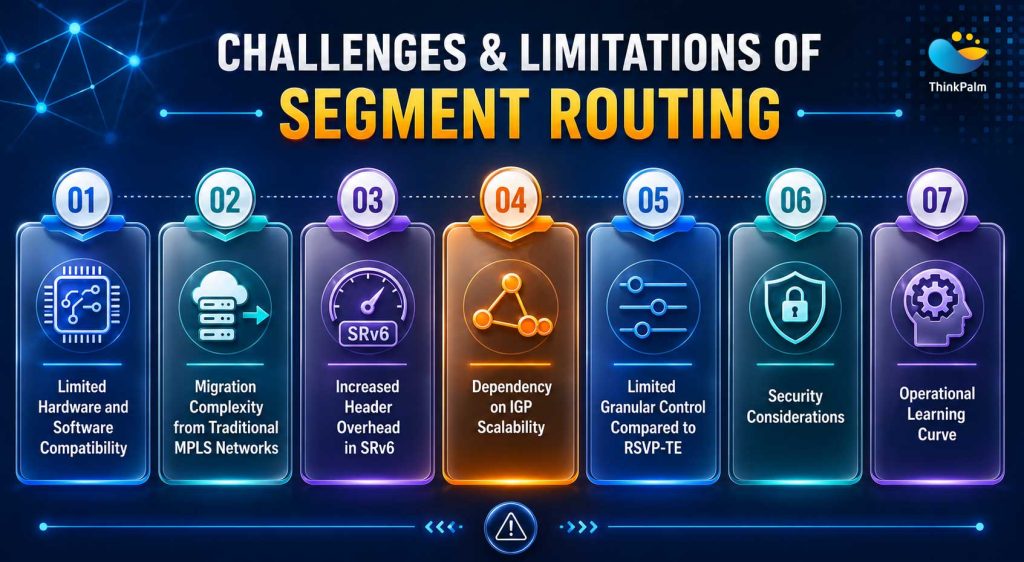
Segment Routing Challenges in Modern Networks
All legacy routers and networking devices may not speak the language of segment routing. In such cases, organizations may need software upgrades or new hardware to enable SR capabilities. This is especially applicable for advanced deployments like SRv6.
Many enterprises still rely heavily on traditional Multiprotocol Label Switching (MPLS) environments. This makes use of protocols such as LDP and RSVP-TE. When a company chooses to migrate to MPLS segment routing, this might need careful planning to ensure compatibility, avoid service disruptions, and maintain network stability during the transition. Similar modernization initiatives can also be seen with automation of SD-WAN environments that help enterprises simplify network management and improve operational efficiency.
In SRv6, Segment Identifiers are represented using 128-bit IPv6 addresses. While this improves scalability and flexibility, it can also increase packet header size and consume additional bandwidth in certain environments.
Segment Routing relies on Interior Gateway Protocols (IGPs) such as OSPF and IS-IS to distribute routing information. In very large networks with frequent updates, managing and scaling these protocols efficiently can become challenging.
Although Segment Routing improves Traffic Engineering, some organizations may still prefer RSVP-TE for highly granular bandwidth reservation and explicit path control in specialized environments.
Because the entry router holds the master plan for the data’s entire journey, companies must implement strict security controls to prevent hackers from unauthorized SID manipulation or misuse of routing instructions.
Adopting Segment Routing often requires network teams to learn new architectures, routing concepts, and deployment models, particularly when implementing advanced technologies like SRv6.
With expertise in telecom, SDN/NFV, IoT, and cloud-native networking, ThinkPalm helps enterprises and telecom providers build scalable and future-ready network infrastructures. Its capabilities include SD-WAN, network virtualization, protocol development, network automation, and intelligent connectivity solutions.
ThinkPalm’s experience in software-defined networking and virtualized network environments aligns closely with modern segment routing, Traffic Engineering, and SRv6-based architectures. Through solutions like Netvire and advanced SDN/NFV services, ThinkPalm enables organizations to simplify traditional Multiprotocol Label Switching (MPLS) environments, improve network efficiency, and accelerate digital transformation.
By combining product engineering with next-generation networking expertise, ThinkPalm helps businesses modernize their infrastructure for cloud, 5G, edge, and intelligent network operations.
Traditional Multiprotocol Label Switching (MPLS) networks rely on additional protocols like LDP and RSVP-TE for traffic management. Segment Routing simplifies this by using source routing and predefined Segment Identifiers (SIDs), reducing operational complexity.
SRv6 is an advanced form of Segment Routing that uses IPv6 addresses as Segment Identifiers instead of MPLS labels. It offers greater scalability, automation, and flexibility for cloud, 5G, and edge networks.
Segment Routing helps simplify network operations, improve traffic engineering, reduce protocol complexity, enhance scalability, and enable faster network recovery during failures.
Industries such as telecom, cloud service providers, banking, media streaming, healthcare, and large enterprises benefit from Segment Routing due to its scalability, reliability, and intelligent traffic management capabilities.
SRv6 supports large-scale and dynamic environments by using IPv6-based routing instructions. This makes it ideal for managing traffic across cloud infrastructure, IoT ecosystems, edge computing, and 5G networks.

Samebenezer M is a Systems Engineer at ThinkPalm Technologies with experience in virtualization, Linux administration, and DLP security engineering. He contributes to DLP solutions involving multi-platform agents, policy enforcement, and secure communication systems. Passionate about enterprise security and infrastructure technologies, he enjoys watching sunrises and spending his free time playing cricket and PC games.