Custom LLM vs Off-the-Shelf: When Fine-Tuning Actually Pays Off
Agentic AI
 Midhula Jeevan
June 24, 2026
Midhula Jeevan
June 24, 2026



 Midhula Jeevan
June 24, 2026
Midhula Jeevan
June 24, 2026
If you’re exploring AI for your business, you’ve probably run into two very different opinions. One side says: just use a ready-made AI model like ChatGPT or Claude — it’s fast, cheap, and good enough. The other side says: you need a custom-trained model built around your own data, or it’ll never really “get” your business.
Custom LLM development for business means changing or training a large language model, so it understands your company’s data, words, and workflows. It is different from using a general AI model like ChatGPT or Claude as is. Some businesses fine-tune a model on their own data.
Both sides have a point. The right answer depends on what you’re trying to do.
This guide walks through, in plain terms, when it actually makes sense to invest in a custom AI model for your business. It also covers when you are better off sticking with a ready-made model.
Today’s general AI models are already very good at a lot of things. This includes tools like ChatGPT, Claude, and Gemini. If you give one of these models access to your documents, it can often get you most of the way to something useful. This setup is called retrieval-augmented generation, or RAG. RAG simply means the AI looks up your documents before it answers. This can take days, not months, to set up.
A ready-made model with RAG tends to work well when:
For many AI projects, such as internal helpdesks, customer support assistants, and document summarizers, this is the right starting point. It often stays the right answer for the long term too.
Want a broader view of where generative AI fits across the enterprise, beyond just RAG? Our guide to Generative AI for Enterprises breaks down the full landscape of use cases, deployment models, and business value so you can see how this piece fits the bigger picture.
There are a few situations where general models start to fall short. This is usually when the conversation turns toward a custom AI model for business.
Industries like maritime, telecom, manufacturing, and finance have their own terms and ways of thinking. A general model has not seen much of this specialized language. You can explain things to it, but it will not always handle tricky edge cases well. A domain-specific language model is trained on real examples from your industry. It handles these cases more reliably.
A general model might get things right most of the time. But “most of the time” becomes a real problem once you are running thousands of documents, tickets, or transactions through it. Small mistakes add up fast. In regulated industries, this can create real AI compliance risk.
Ready-made models usually charge based on how much text you send them. If you feed in a lot of background information every time, which RAG setups often need, AI implementation cost and response times can climb quickly. A model that already understands your domain needs less explaining. This usually means it runs faster and costs less.
ThinkPalm’s Agentic AI Solutions help you go beyond a single fine-tuned model. We build AI agents across your existing tools, so the right model is just one part of a workflow that actually gets the job done end to end.
LLM “fine-tuning” for business gets mentioned a lot, but it is not all-or-nothing. AI model customization sits on a spectrum. Off-the-shelf sits on one end, and a fully custom model sits on the other. The right point on that spectrum depends on your situation.
| Option | What It Means | Good Fit For | Typical Timeline |
|---|---|---|---|
| Off-the-shelf model plus RAG | Use a general AI model as is, and feed it your documents when it needs an answer | General tasks, data that changes often, getting started fast | Days to a few weeks |
| Light fine-tuning | Small tweaks to a general model so it matches your tone, format, or basic terms | Style and format changes, mild domain adjustment | A few weeks |
| Full fine-tuning | Retrain the model on your own proprietary data so it deeply understands your domain | Specialized industries, high-volume repetitive tasks | Multiple months |
| Fine-tuning plus RAG together | A domain-specific LLM with live lookups for current information | Most real-world enterprise LLM development projects, since it offers the best of both | Multiple months, ongoing |
Most businesses that go custom end up in that last row. They use a model that understands their world, plus the ability to look up current information. This combination is becoming the standard shape of enterprise AI development services, not a rare extra.
If speed matters most right now, a ready-made model with RAG can be running in days or weeks, and it usually costs the least to start. Light fine-tuning takes a few more weeks and costs more, but it stays manageable for most budgets.
Full fine-tuning, especially combined with RAG, is a multi-month project. It costs the most upfront, but it often becomes cheaper to run per task once it is built, especially at high volume. The right starting point depends on how soon you need results and how much budget you have for testing.
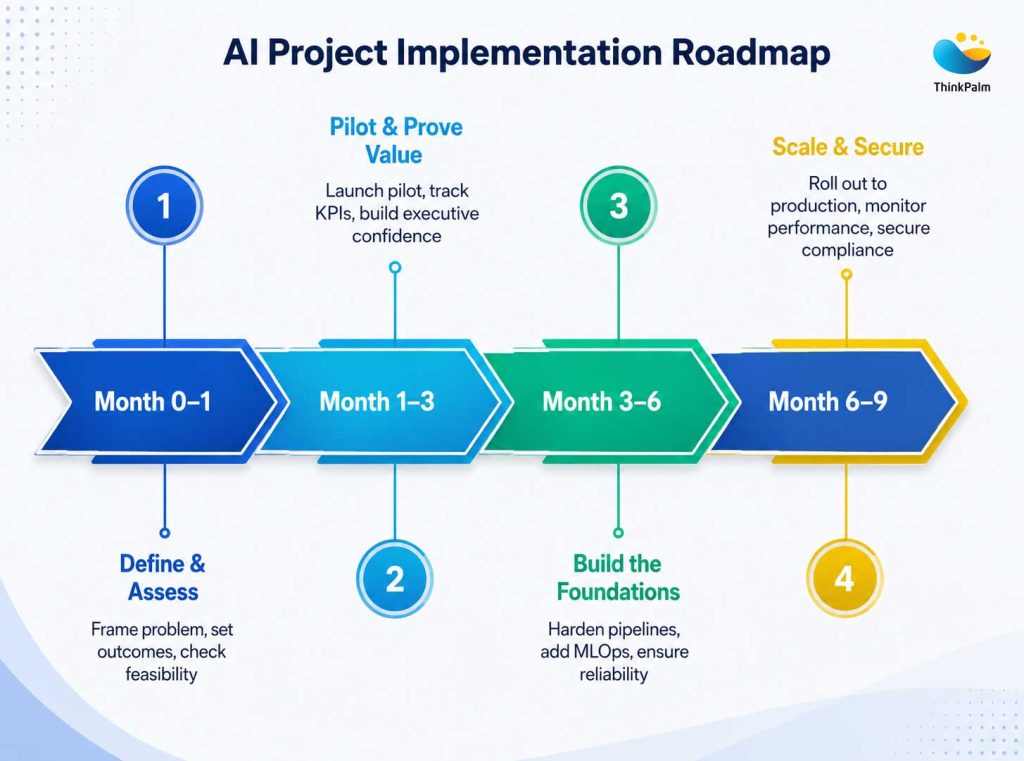
AI project implementation roadmap from planning to production
Instead of asking “should we fine-tune a model,” it is more useful to ask this: when the AI gets something wrong, what does that actually cost us? And how often is that happening right now?
If you are using AI to draft a first version of an email that a person reviews before sending, a mistake costs almost nothing. A ready-made model is probably the right call, and likely will be forever.
But think about other cases. Maybe your AI is flagging faults in telecom networks. Maybe it is checking financial documents for compliance issues. Maybe it is writing quality reports on a factory floor. In these cases, a wrong answer can mean downtime, compliance headaches, or rework.
This is where custom LLM development for business starts to pay for itself. It is not because a custom model is “smarter.” It is because model accuracy and hallucination control matter more in exactly these situations.
Trying to map out where the cost of AI mistakes is highest across your own operations? Our AI for Business Process Automation guide walks through how enterprise leaders identify high-stakes workflows and build a strategic roadmap around them.
A few signs usually point toward going custom being worth the investment.
On the flip side, it is usually too early to go custom in a few cases. Maybe you are still testing whether the idea is useful. Maybe you do not yet have enough good-quality data. Maybe a ready-made model already does a solid job on your task. Or maybe your processes change so often that a custom build would need constant retraining.
In any of these cases, a ready-made model plus a good lookup setup is the smarter choice. It is often the permanent one too.
The lowest-risk approach we see work again and again looks like this:
So you can test the idea and start collecting real usage data.
Where people override its answers, or where it’s inconsistent.
If a custom model is worth it — instead of guessing upfront.
Before jumping to a full custom build.
So it’s both knowledgeable about your business and up to date.
This way, you avoid the most expensive mistake we see — spending months building a custom model before knowing if it’s actually needed.
That staged approach is not just a framework we recommend. It is how every engagement at ThinkPalm actually starts. We look at your data, your processes, and the systems you already use. We do this before writing a single line of model code.
As part of our AI Development Services, our team figures out what you need. That could be a ready-made model with a lookup setup, a custom AI model for business, or, most often, a mix of both.
This is also where our work in generative AI development and multi-agent orchestration comes in. Many business workflows are not just one AI call. They are a series of steps across different systems. The “custom or not” decision can look different for each step. Our AI integration with existing systems capability connects whatever setup makes sense to the tools you already use. It does not sit off to the side as its own thing.
As a custom AI development company, our job is not to talk you into the fanciest setup. It is to build the one that fits your data, your volume, and how much a mistake would actually cost you. For many clients, that means starting simple. For others, it means custom LLM development for business from day one. This is especially true in maritime, manufacturing, and fintech, where industry language and reliability really matter.
The right choice isn’t always between a ready-made model and a fully custom one. If you’re evaluating AI for your business, ThinkPalm’s AI specialists can help you assess the options, identify the most practical approach, and build a roadmap aligned with your goals.
Midhula Jeevan is a passionate content writer with a focus on SEO and technical writing. With a love for words and a curiosity for the technical side, she blends creativity with strategy to craft content that stands out. When not writing, you could find her usually reading books, enjoying a good cup of coffee, or chasing golden sunsets.