How to Achieve Legacy System Modernization with AI: A Step-by-Step Guide
Agentic AI
 Chandni Nadarajan
May 13, 2026
Chandni Nadarajan
May 13, 2026



 Chandni Nadarajan
May 13, 2026
Chandni Nadarajan
May 13, 2026
Ever wondered about a situation when it’s month-end, and your core system starts lagging. Reports that should take minutes now take hours. Every small update seems to affect the entire workflow, leading teams to manual fixes just to keep things running. While competitors are using AI to automate processes, predict issues, and speed up workflows, the challenge is how to modernize your legacy system without starting from scratch. The answer lies in legacy system modernization.
In Summary
Legacy system modernization helps enterprises upgrade outdated systems to improve scalability, security, operational efficiency, and integration with modern technologies. Instead of replacing everything from scratch, businesses can use AI-led modernization to automate workflows, enhance decision-making, reduce technical debt, and accelerate digital transformation.
In this blog, we shall examine legacy system modernization, its relevance, the key steps involved in modernizing, the challenges in its implementation, and the future of AI in Legacy Modernization.
Legacy system modernization is the process of updating existing systems or replacing outdated ones, such as architecture, infrastructure, or software systems, to align with existing industrial standards. This would make the business systems more scalable, cost-effective, and secure.
According to a study by Gartner “Only 48% of digital initiatives meet their targets,” highlighting why enterprises are turning to AI-led modernization to improve success rates.
Modernizing legacy systems is not about switching platforms. But it aims at delivering enhanced user experience through the power of modern technologies like cloud computing, data analytics, and artificial intelligence. However, many companies find it difficult to transition due to several bottlenecks. Their existing systems, current tech stacks, monolithic architectures, and messy code limits modern integration. So, what can be done to improve this situation? As we read further, we will learn more about it.
We are living in a world which is technologically advanced. But many businesses are still using systems that were created long ago. Modernizing these systems would prepare companies to adapt to evolving business trends, with improved user experience.
If we carefully assess the return on investment (ROI), the results are striking making teams prepare for modernization efforts. These benefits are mostly in terms of reduced maintenance costs and improved operational efficiency.
Companies often need to upgrade their old systems as they may not work well with new technologies. For instance, legacy applications often struggle to support growing traffic and performance demands. This makes it difficult for businesses to cope with new advancements. When companies upgrade significantly, they can use tools like cloud applications, APIs, third-party platforms and AI-powered automation. Therefore, companies can unlock new opportunities for innovation and growth.
Modernizing also helps in reducing technical debt. This implies removing old and complicated code that slows down technology. Also, legacy systems increase the cost of maintenance. This leaves room for modern cyber threats and security risks.
Now a days, it is difficult to obtain these specialized skills required to support legacy technologies. AI-led Modernization makes things simpler where repetitive tasks can be automated. Eventually, this frees up resources for new ideas and growth.
The legacy systems were not designed for an AI-driven, cloud-first future. Hence, in the present scenario, it may turn out to be slow and outdated. Listed below are some challenges associated with modernizing legacy applications.
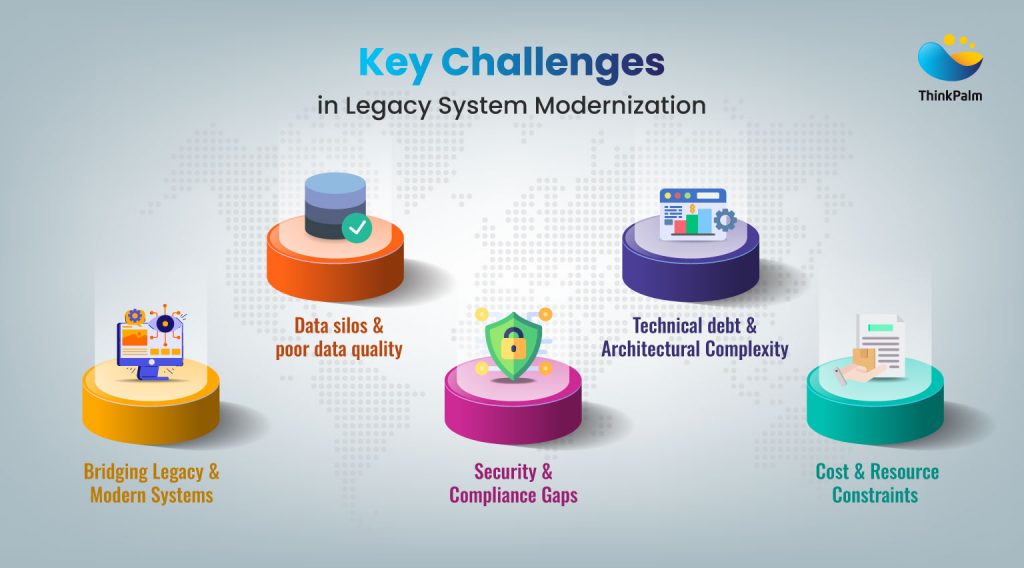
Key challenges in legacy system modernization
Legacy systems are often filled with critical data. But it’s usually trapped in varied formats messy and unstructured patterns. Hence, moving this data to modern platforms would be challenging. The rigid architecture and high maintenance costs make it difficult for transitioning. If not handled well, it might result in loss of data, inconsistencies, and cause integration issues with modern systems.
Technical debt is the consequence of implementing several short cuts or quick fixes during the developmental phases. With the passage of time, this debt accumulates and turns into high maintenance costs, reduces operational efficiency, and hinders innovations. Legacy code complexity increases due to lack of documentation or code written in obsolete programming languages or frameworks. This makes it difficult to transition.
Struggling with outdated architecture? Learn how to select a future-proof foundation in our blog post: Choosing the Right Backend Framework for AI-Powered Software.
Legacy systems are often difficult to communicate with modern, cloud-native applications. This “bridge” between generations creates integration with new systems difficult. If the transition does not happen well, this can cause data loss, security issues, and operational downtime.
Legacy systems often lack present-day security and privacy standards. This can expose businesses to threats like data breaches, malware, or ransomware. Modernization becomes challenging for companies as it involves updating protocols, enabling encryption to safeguard sensitive data, and aligning with current compliance requirements.
Legacy modernization often requires significant investment, as it includes the cost of new hardware, cloud subscriptions, and extensive employee retraining. Without an adequate strategy, companies would find themselves paying for two environments simultaneously-the old and the new. Hence, this greatly increases operational overhead and resource strain. Therefore, the best practice would be to focus on high-impact applications for migration first and then move down to others.
There are several steps to undertake while preparing companies for AI led modernization. Let us examine some of the key steps to follow while integrating AI into legacy systems.
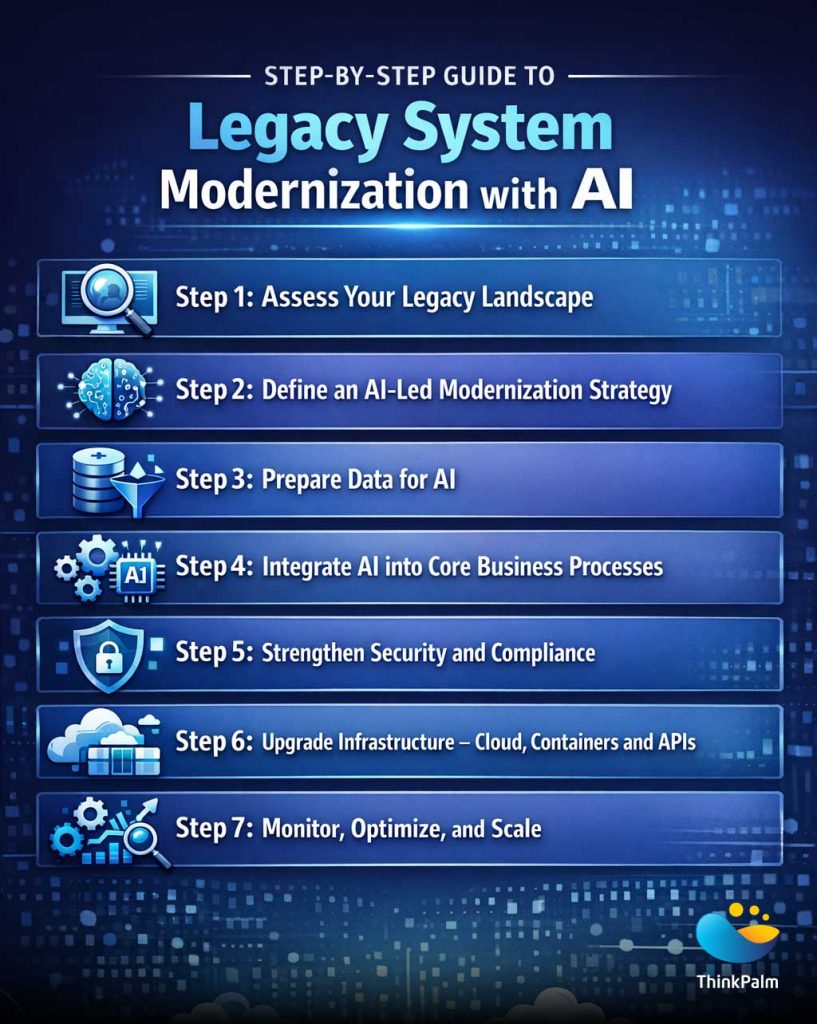
Legacy system modernization with AI
Before you prepare your company for modernization, you need a clear map to assess the current state of technology. This provides an opportunity to identify performance issues, dependencies, limitations, and integration challenges.
This will help companies identify the core areas that demand attention and separate them from systems that can wait. Moreover, companies can formulate a plan for identifying how compatible AI-led modernization approach would be with legacy systems.
After assessing your legacy systems, choose an AI-led Modernization strategy that would help in defining your business goals. You can categorize your legacy stem using the ‘6R’ modernization strategy mentioned below:
Data forms the core of every AI project. It is important to organize all unstructured data into structured formats, fill out missing info, or update the docs. Before you prepare for migration, it is better to keep all your data in one place, preferably in a cloud or some secure system. When data is cleaner and more organized, AI can produce better outcomes.
Your existing infrastructure can be upgraded using AI capabilities such as agentic AI automation. This does not mean everything needs to change all of a sudden. Moreover, you can focus on certain areas which are monotonous requiring agentic AI automation and machine learning capabilities for a future-ready system.
Want to learn how a UK-based payroll and HR solutions provider partnered with ThinkPalm for legacy system modernization in their legacy payroll system ? By embedding AI into the software development lifecycle, ThinkPalm enabled 50% faster implementation, improved compliance, and reduced operational costs.
Businesses who follow outdated systems are at risk due to emerging cases of data breaches and cyber-attacks in today’s digital landscape. AI helps in upgrading security and ensuring compliance. They play a vital role in detecting anomalies, predicting risks, and taking necessary corrective actions. Moreover, they can automate compliance reporting even with regulatory changes.
A successful AI strategy is based on the strong foundation it sits on. Traditional systems rely on physical servers. But this often lacks the flexibility, scalability, and speed required to support AI-powered automation and real-time processing. Hence, modern infrastructure is needed to support legacy modernization.
Using AI-enabled digital transformation in organizations can create a flexible and scalable foundation without affecting existing operations.
Modernization is a continuous and ongoing journey. After you have implemented your AI Modernization strategy, organizations must actively monitor systems, optimize performance, and scale AI capabilities alongside your business.
To understand how AI improves operational efficiency and streamlines workflows in legacy environments, explore our detailed guide on AI Workflow Optimization.
The application of AI in several sectors is reaping benefits as it can optimize operations and elevate customer experiences. Let us now explore some real-world applications of AI-powered automation highlighting the transformative power of legacy modernization.
By implementing AI-powered automation, traditional banking systems, which require several days of manual labor, can now be completed in minutes with greater accuracy. Embedding AI into legacy core systems helped to speed up processes like loan approvals and fraud detection.
Example: A leading global bank, HSBC enhanced its legacy anti-money laundering systems with AI. This helped in improving detection accuracy by 2–4x while reducing false alerts by over 60%. Hence, this enabled faster identification of financial crime.
Leveraging AI-driven insights onto existing systems helps enable predictive maintenance and optimization of production workflows. This reduces operational costs and minimizes disruptions.
Example: TechnoFab, an automotive parts manufacturer, modernized their legacy systems by leveraging AI-powered predictive maintenance. This helped them with anomaly detection, reducing downtime, and eliminating false alarms. They integrated AI, IoT sensors, and machine learning into its legacy ERP.
The application of AI-driven inventory management entails usage of predictive models to forecast demand and detect stock issues. This implies optimizing inventory based on regional demand and stocking inventory delivering better shopping experience.
Example: Global retailers like Walmart and Target are using AI to modernize legacy inventory systems. This helps with enabling real-time demand forecasting and proactive stock replenishment. The result? Retailers can prevent stockouts, optimize inventory placement, and ensure better product availability across stores.
Implementing AI in legacy modernization provides innumerable benefits. Businesses have realized the necessity of upgrading their outdated systems.
By integrating AI into enterprise modernization efforts, companies can achieve certain long-term benefits.
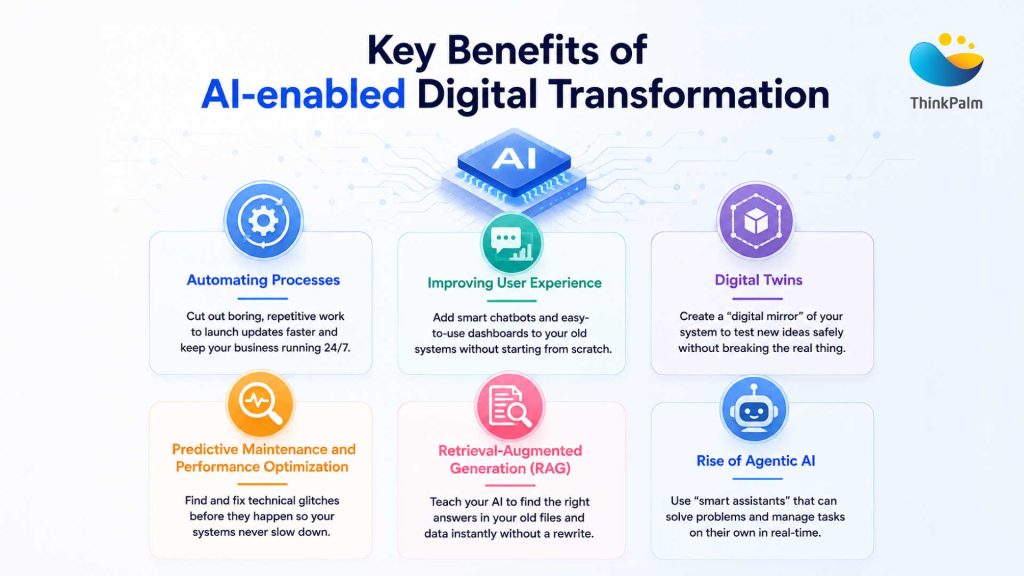
Benefits of AI-enabled digital transformation
Let us examine some of the key benefits of leveraging AI for legacy system modernization.
The benefits become even clearer when examining real-world examples of AI-led legacy modernization in banking, healthcare, manufacturing, and government sectors, where organizations have successfully modernized critical systems without disrupting operations.
Modernizing legacy systems is more than a technical upgrade. Moreover, it aims at making a strategic shift towards an AI-first approach. This is where ThinkPalm brings deep expertise where we help in bridging the gap between legacy systems and intelligent, adaptive systems.
We aim at leveraging agentic AI solutions to modernize legacy systems across the entire software lifecycle. Our approach to AI legacy modernization focuses on transforming existing systems without disrupting core operations. By embedding intelligent automation and machine learning, organizations can migrate, optimize, and enhance legacy applications while ensuring scalability and future readiness.
Modernizing legacy systems is not a one-time task. Instead of considering these legacy systems as a technical burden, it is important to identify untapped opportunities waiting to be transformed.
However, businesses can provide value to the existing systems with the right modernization approaches and drive meaningful innovation without starting from scratch. This helps companies move from rigid, outdated infrastructures to intelligent, adaptive ecosystems that support growth, agility, and long-term success.
AI-led modernization means using artificial intelligence capabilities to upgrade legacy systems and workflows by automating processes, enhancing system efficiency, and enabling smarter decision-making. It transforms outdated systems into intelligent, scalable platforms without requiring a complete system rebuild.
Enterprises can identify AI modernization opportunities by analyzing legacy systems, mapping business workflows, and identifying repetitive, data-heavy, or manual processes that can benefit from AI powered automation. They should also evaluate technical debt, performance gaps, and high-impact areas where AI can improve efficiency, reduce costs, and enhance decision-making.
Manual modernization often faces bottlenecks such as slow data migration, complex legacy code analysis, high operational costs, and time-consuming testing processes. AI solves these challenges by automating code analysis, accelerating data migration, improving testing accuracy, and enabling faster, more efficient legacy system modernization.
Organizations can start an AI-led modernization initiative by assessing their legacy systems, identifying high-impact use cases, and defining a clear AI and enterprise modernization roadmap.
Chandni Nadarajan is a content writer at ThinkPalm Technologies, specializing in B2B marketing content. With a passion for turning complex ideas into clear, engaging narratives, she blends strong research and storytelling skills to make technical topics accessible. Her expertise spans technology, automation, and digital business solutions.