What Is AI Mind Mapping? Benefits, Techniques, and Applications for Modern AI Teams
Testing as a Service (TaaS)
 Tharun Sudharsan
June 5, 2026
Tharun Sudharsan
June 5, 2026



 Tharun Sudharsan
June 5, 2026
Tharun Sudharsan
June 5, 2026
Imagine you’re about to design a complex multi-agent system. You open your notebook, write “AI Architecture” at the top, and immediately feel paralyzed. You need to find space for agents, tools, data flows, fallback logic, APIs, and decision trees, all fighting for space in your head. Sounds familiar?
The truth is that your brain doesn’t think in straight lines. It thinks in webs, clusters of connected ideas that branch, loop, and associate. Still, we consistently force this sort of complex thinking into rigid lists and linear documents. This is completely against our natural cognition. The role of AI mind mapping becomes a strategic advantage here.
This blog explores the most effective mind mapping techniques, shows where they deliver the highest ROI, and details how modern, AI-powered mind mapping tools are taking system design to a new level.
This is very much different from traditional outlines or bullet lists. Moreover, mind maps are radial and non-linear. This makes it a best fit while working with complex, multi-layered problems. A well-built mind map typically contains:
The concept of mind mapping is not new. It dates to a centuries-old practice in which Porphyry of Tyros used visual diagrams to map Aristotle’s ideas in the 3rd century AD.
However, it was psychologist Tony Buzan who popularized the modern format in the 1970s. His argument stated that linear note-taking fundamentally conflicts with how the brain processes information.
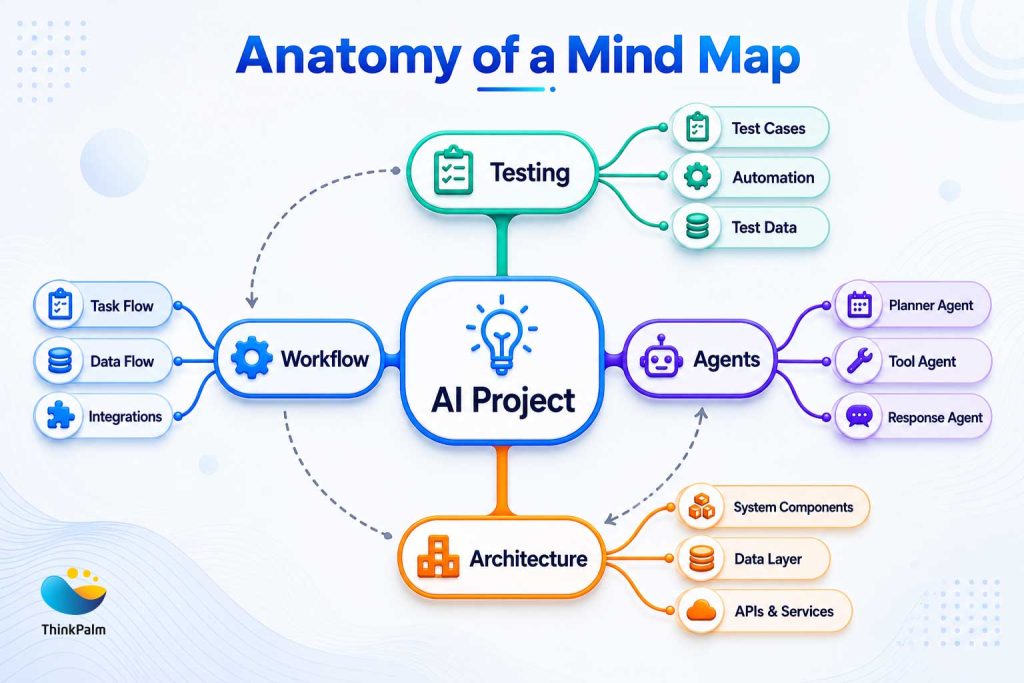
Anatomy of a Mind Map
Visual thinking is now deeply ingrained in engineering workflows, not as a matter of aesthetics, but grounded in cognitive science. It is believed that visual thinking produces better outcomes than text-alone approaches.
Research suggests that visual information is remembered more effectively than text alone. John Medina’s Brain Rules notes that retention can increase from about 10% to 65% when relevant visuals accompany information.
Mind maps also engage both hemispheres of the brain simultaneously.
As both hemispheres are activated simultaneously, it provides a holistic understanding that linear text documents cannot simply replicate.
This method proves beneficial for teams working on AI system architecture. It provides you with the opportunity to visualize the entire agent ecosystem, including its inputs, outputs, decision branches, and tool integrations, on a single canvas.
Hence, you make better architectural decisions. Otherwise, those same elements would be buried deep inside a specification document.
All mind maps do not serve the same purpose. It is vital to match the right structure depending on the problem you need to solve. Moreover, this is one of the core mind mapping techniques that separates casual users from skilled practitioners.
Depending on the project lifecycle, modern mind mapping tools may be selected, and technical teams can deploy five distinct visual formats as per different project stages:
| Workflow Type | Recommended Approach |
|---|---|
| Spider Map | Brainstorming |
| Concept Map | AI Architecture |
| Flowchart Map | Workflow Planning |
| Tree Map | System Breakdown |
| Multi-Radial | Architecture Comparison |
The classic radial design, a layout in which one central idea branches out in all directions.
Open brainstorming, early-stage ideation, and broad visual thinking before committing to a direction.
This is more structured than a spider map. Concept maps use labeled arrows to show how different parts connect. This format is particularly useful for concept mapping AI system architecture, as it shows directional relationships between components.
Concept mapping AI system architecture, visualizing component relationships, and documenting dependencies between agents, tools, and data flows.
Example: A data team building a RAG pipeline used a concept map to trace how queries move into the vector database. Visualizing in this manner helped them pinpoint certain gaps as they had forgotten a critical re-ranking step. This led to poor results.
This is a hybrid style that combines mind mapping with process flows.
Workflow planning, sprint mapping, and designing sequential logic, including the decision trees inside AI agent systems.
A top-down hierarchical structure that breaks down vast, complex systems into subsystems, modules, and agents.
Breaking large systems into components like organizational charts, product feature lists or building a comprehensive mind map for software testing to track what needs to be verified.
This framework links multiple central nodes together.
Comparing architectural approaches side by side in a single visual space.
Modern AI system architecture is deeply complex, involving multiple agents, tools, data pipelines, fallback mechanisms, and integration points, that work together. Trying to organize all of this, while keeping the larger picture in mind and visualizing holistically before a single line of code is written, can be challenging.
Mindmaps provide a visual way to plan and organize things when building a multi-agent system, and they help to:
“Building AI agent pipelines or planning a multi-model architecture? A mind map session reduces implementation challenges and minimizes costly rework later in the project.”
Workflow planning with mind maps also prevents a common failure mode in AI development by providing a complete view of the system. While designing each agent in isolation, it allows you to visualize redundant agents, missing connections, and circular dependencies that would be missing in written documentation.
Platforms like LangGraph and CrewAI have adopted visual, graph-based interfaces for exactly this reason. Hence, teams can plan, manage, and orchestrate complex AI workflows more effectively.
Want to see how enterprise leaders scale these architectures into automated operations? Read our blog post to learn how organizations successfully drive efficiency using intelligent workflow design for AI business process automation and scalable enterprise automation approaches.
One of the most underutilized use cases of visual thinking is mind map in software testing. As software ecosystems grow more complex, traditional, text-heavy test case files often miss certain edge cases and fail to show your overall testing coverage.
Mind map for software testing solves this by mapping the entire test scope in a structured way:
Example: A QA team testing an AI-powered recommendation engine used a mind map in testing to map 140 test scenarios across six test categories. The visual immediately revealed that they had completely forgotten to include negative testing for “cold-start” users (new accounts with zero history). This gap had been entirely overlooked when they were using spreadsheets.
Want to see how AI transforms software testing in practice? Explore our AI powered Test Automation Platform to learn how an enterprise network management provider significantly reduced test case generation effort using AI-powered software testing and intelligent quality engineering approaches.
Mind map testing is especially powerful in agile environments, where verification plans need to change quickly. Updating a branch during mind map testing takes seconds, whereas modifying a rigid, formal document forces your team into slow reformatting and review cycles.
| Testing Approach | Mind Map Testing | Spreadsheet-Based Testing |
|---|---|---|
| Coverage Visibility | Full scope visible at once | Requires scrolling/filtering |
| Gap Identification | Gaps visible spatially | Easy to overlook in rows |
| Update Speed | Instant branch edits | Requires formatting changes |
| Team Collaboration | Shared visual context | Interpretation varies |
| Agile Compatibility | High as maps evolve naturally | Medium as documents lag sprints |
Artificial intelligence is transforming the way teams create and use mind maps. Although this was largely considered a manual activity, AI-powered mapping platforms have completely changed how teams generate and organize ideas.
Tools like MindMeister AI and Taskade now generate a full mind map from a single text prompt.
For example, you can type “design a customer onboarding AI agent workflow” and instantly receive a structured visual map, creating a fast-starting point for your next workflow planning session.
AI assistants embedded in mapping tools look at your current nodes and suggest related branches you might have missed. This acts as a safety net during complex concept mapping. There may be critical components that the human brain might overlook under tight deadlines.
You can speak your thoughts aloud during a design session, and AI transcribes and organizes them into a branching visual layout in real time. This entirely removes the friction of stopping your brainstorming to type documentation manually.
Instead of static files, AI now builds living knowledge bases that automatically update as your project evolves. This is valuable for teams managing complex, evolving AI system architecture to get an up-to-date view.
Let us delve into some of the advantages of mind mapping that help teams work more effectively, especially when managing complex projects and systems.
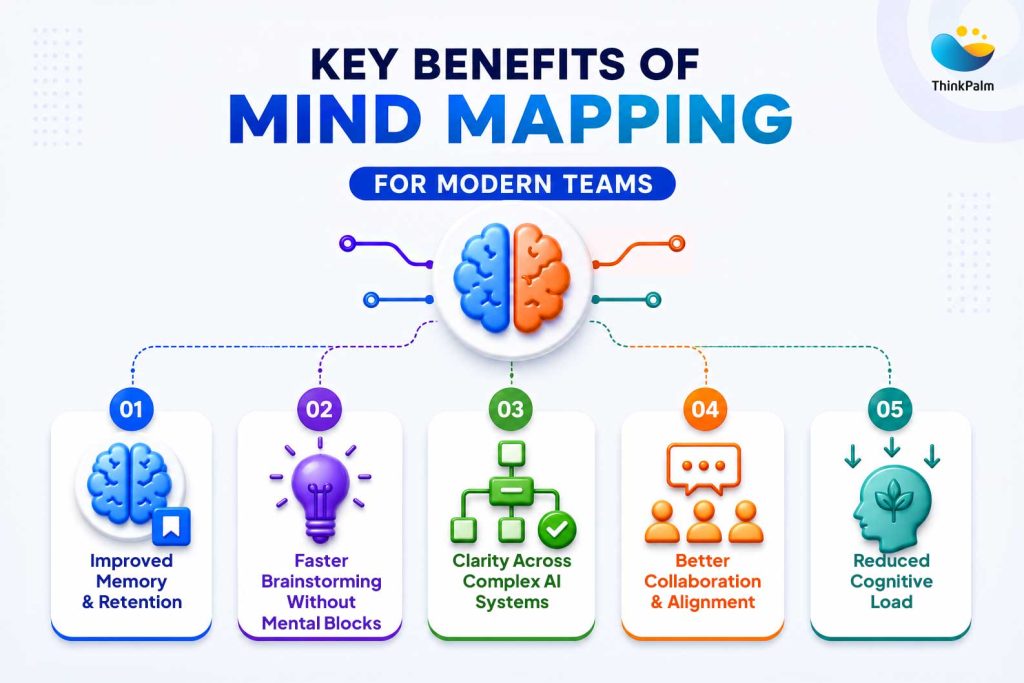
Key Benefits of Mind Mapping
Visual structures are encoded more durably than text lists. Research shows that students who use mind maps score 10–15% higher on recall tests than traditional note-takers (Farrand, Hussain & Hennessy, 2002).
The same principle applies in professional settings: a mind map of a system design is easier to recall and reason than a written spec.
The non-linear, judgment-free nature of mind mapping removes the friction that stalls linear thinking. Ideas get captured first and organized later, which is why experienced practitioners advise “start ugly, finish clean” as one of their core mind mapping techniques.
A mind map of an AI agent pipeline lets architects see the entire system of agents, tools, data flows, and decision trees in a single view. This clarity prevents tunnel vision and identifies architectural issues before they become expensive.
A shared visual map aligns cross-functional teams much faster than a text document. As the same structure is visible to all, it makes discussions more productive, improves communication, and helps teams reach decisions faster.
Mind maps simplify complex information by presenting it in an easy-to-follow visual structure. This allows teams to focus on problem-solving and decision-making instead of trying to keep every detail in mind.
AI mind mapping bridges natural human cognition and the structured demands of AI system design.
Concept mapping and flowchart-style maps are especially powerful for agent workflow design and AI architecture.
Mind map in software testing reveals coverage gaps and accelerates agile test planning in ways spreadsheets cannot.
Modern mind mapping tools now use AI to generate, suggest, and evolve maps automatically.
Visual thinking is no longer a soft skill in complex AI development environments; it is a competitive differentiator.
Start with one topic you’re currently working on, a system design, a test plan, a product feature, and spend 15 minutes mapping it visually. The connections you discover will likely surprise you.
If you are ready to take your quality assurance further, it is essential to pair these visual mapping structures with modern software testing practices that leverage AI in software testing to achieve maximum coverage and system reliability.
At ThinkPalm, we help enterprise teams simplify the complexity of modern AI ecosystems through structured visual thinking, robust workflow planning, and advanced AI quality engineering. We believe that successful AI mind mapping begins with a crystal-clear understanding of how agents, data flows, and verification strategies connect across your entire platform.
Using our AI test automation platform, we help organizations:
In 2026, with the role of AI increasingly reshaping our workflows, building systems, and processing information, the role of visual thinking has accelerated further.
In fact, it has emerged as a critical tool for engineers, architects, and product teams. Whether you’re mapping a software testing plan, designing an agent pipeline, or planning a product sprint, AI mind mapping can transform how you think and build.
By making it easier to grasp relationships, dependencies, and testing requirements, mind maps empower teams to create smarter, more dependable AI solutions with greater assurance.
Blueprints are a great start, but scaling multi-agent pipelines into production requires robust engineering. At ThinkPalm, we transform your visual workflows into reliable, flawlessly tested enterprise applications. To optimize your AI quality engineering and accelerate production delivery.
Schedule a Consultation with Us TodayTharun Sudharsan is a Software Engineer with expertise in Python development and automation. He is currently part of the team developing an AI-powered testing platform focused on enhancing software quality through intelligent automation and advanced testing capabilities. Outside of work, he enjoys playing and watching cricket and staying updated with emerging technologies.