Agentic AI vs Generative AI in Business Operations: What’s the Difference in 2026?
Agentic AI
 Athira Gopakumar
April 27, 2026
Athira Gopakumar
April 27, 2026



 Athira Gopakumar
April 27, 2026
Athira Gopakumar
April 27, 2026
Artificial intelligence in business is moving faster than ever. Not long ago, AI tools were helping teams write emails, generate code, and summarize reports. Today, AI is starting to do much more. It can plan steps, make decisions, and even take action on its own. In 2026, the conversation is no longer just about productivity. It is about autonomy and accountability.
This is where the debate around Agentic AI vs Generative AI begins. Generative AI is great at creating content and ideas. Agentic AI goes a step further by working toward goals and completing tasks with less human involvement. For business leaders shaping their digital strategy, understanding this difference is becoming essential. Read on as we break down how these two technologies differ and what they mean for your business.
What You’ll Learn in This Blog
In this blog, we will cover:
While both Agentic AI and Generative AI fall under the broader field of artificial intelligence, they are built for different purposes.
At a high level, the difference between Agentic AI vs Generative AI comes down to creation versus action. Generative AI produces content in response to prompts. Agentic AI goes further by making decisions and executing tasks to achieve a goal. One reacts. The other plans and acts.
The further development of artificial intelligence is Agentic AI. It focuses on doing rather than just generating responses. Agentic AI helps achieve goals, schedule actions, interact with enterprise systems, and perform tasks on an end-to-end basis. It is not intended to create content but aim at accomplishing goals and fulfilling tasks with a minimum of supervision.
An agentic AI system is capable of breaking a bigger goal into smaller steps, planning a course of action, making decisions during it, and acting. It is able to communicate with other systems, adapt to emerging circumstances, and keep working towards the predetermined result.
In contrast to generative AI, which responds to prompts, Agentic AI is a proactive one. It does not wait till all instructions are given. When a goal is assigned, it is able to identify the means to accomplish it. Such purposeful/directional action is what differentiates Agentic AI in the more general discussion of Agentic AI vs Generative AI.
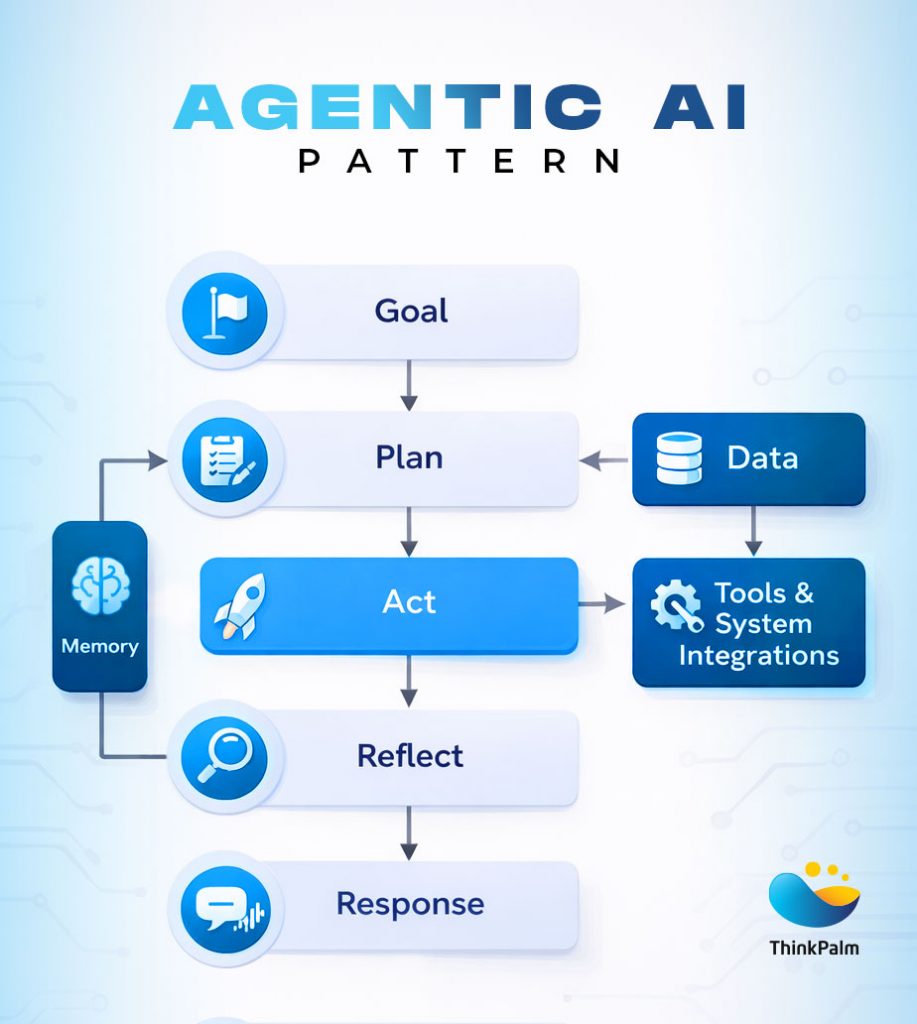
On a fundamental level, Generative AI revolves around ‘creation’. It creates text, images, code, or insights in reaction to human input. They produce content following the pattern acquired from a large volume of data. The system usually analyzes a prompt by the user and produces a response to the demand corresponding to the request.
Generative AI, in the simplest terms, is responsive in nature. It receives an instruction, processes it, and gives an output. An example is the tools such as ChatGPT that can write emails, summarize documents, or create ideas within a few seconds.
Generative AI is also strength-giving as it enhances speed and creativity. However, it requires the intervention of a human being to initiate and direct the work. It cannot make decisions on its own about what to do next unless directed. It is more of content creation rather than independent action.
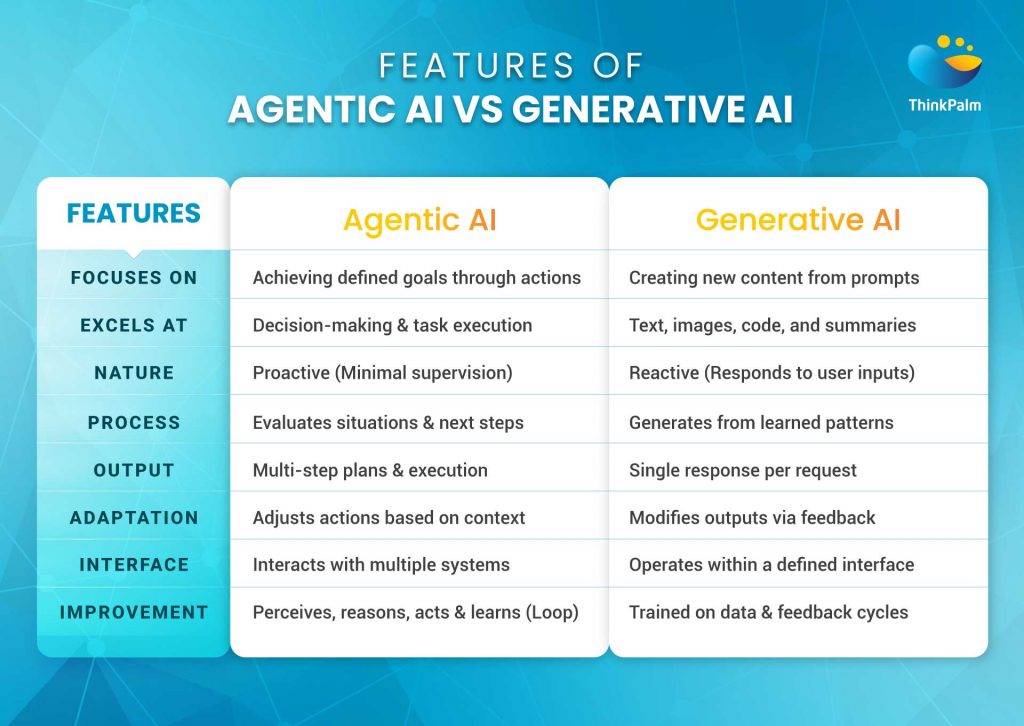
Although Agentic AI and Generative AI are categorized under the same umbrella of AI, the capabilities of each are aimed to serve two completely different purposes. Understanding those features can be helpful to explain their fit into the enterprise strategy.
Below is a side-by-side comparison of the core features of Agentic AI vs Generative AI:
Speed and productivity are the primary purposes of generative AI in business operations. It also generates content (emails, reports, marketing copy, code, and summaries) in response to user prompting. Marketing, development, and analytics teams have been relying on it to cut down on the manual work and speed up their entire workflow.
Nevertheless, generative AI is responsive. It waits for instructions, produces an output, and stops there. It does not set plans, make decisions on its own, or be accountable for achievements. In the vast majority of instances, humans are quite in charge and apply it as an intelligent helper and not as an autonomous system.
The transition to agentic AI in business operations implies the change of assistive AI into autonomous. These systems are goal-oriented digital agents that are capable of planning, decision-making, and executing multi-step workflows with minimum human intervention.
In comparison to generative tools, Agentic AI is proactive. It is able to integrate with enterprise systems like the CRM, ERP, and other operational systems and make actual moves, not merely create responses. It follows through, adjusts to evolving circumstances, and strives towards a set goal.
In plain language, while Generative AI assists with a task, Agentic AI is formulated to arrange and accomplish the tasks.
To develop the appropriate AI strategy, it is important to understand the difference between generative AI and agentic AI. The two technologies share many similarities since they both have advanced machine learning models; however, the purpose, autonomy, and impact on business are quite different.
On a higher level, the discussion on the topic of Agentic AI vs Generative AI is reduced to this: one creates, the other performs.
Here is a side-by-side comparison:
| Feature | Agentic AI | Generative AI |
| Primary Purpose | Executes tasks and achieves defined business outcomes | Creates content such as text, images, code, and summaries |
| Operational Role | Functions as a digital worker or autonomous agent | Acts as a creative or analytical assistant |
| Trigger Mechanism | Initiates actions based on goals and system events | Responds to human prompts |
| Level of Autonomy | High: Plans and executes multi-step workflows independently | Low: Requires human input at every step |
| Decision-Making | Makes decisions within predefined rules and constraints | Suggests outputs but does not decide |
| State Awareness | Stateful: Maintains context and tracks progress over time | Stateless: Focused on the current prompt |
| Workflow Ownership | AI agent owns the end-to-end workflow | Human owns the process |
| System Integration | Deep integration with CRMs, ERPs, APIs, and legacy systems | Limited, often standalone (chat-based) |
| Adaptability | Adapts strategy dynamically when conditions change | Requires new prompts when conditions change |
| Risk Profile | Operational risks (transactions, system changes) | Content risks (hallucinations, bias, copyright) |
| Governance Needs | Strong governance, audit trails, and human-in-the-loop controls | Output validation and usage guidelines |
| Business Impact | Transforms and automates entire business processes | Improves individual productivity |
The effect of Agentic AI vs Generative AI on the business activity transcends technology. It alters the way things are done in the workplace, the way decisions are made, and the manner in which risk is handled.
The whole business process can be reformed by agentic AI. As an illustration, an AI agent can scan inventory quantities, identify shortages, reach out to suppliers via system interconnections, and update internal databases by default. In the present instance, AI is not simply helping in the workflow. It is running it.
Generative AI enhances the productivity of individuals on tasks. A marketer is able to generate various versions of emails in a few seconds, and an analyst can generate quick summaries. Nonetheless, approvals, performance, and subsequent activities are still handled by human beings. The workflow, however, remains human-led.
The other distinction between Agentic AI and Generative AI is flexibility.
Agentic AI is stateful and goal-driven. It monitors the progress and alters its strategy as the circumstance varies. In case of a supply chain delay, it will be able to reroute the shipments, redefine schedules, and inform the parties, and still pursue the initial goal.
Generative AI is concerned with the request being made at present. When situations evolve, it needs an additional stimulus from a human being to react. It is not an independent monitoring and adjustment of ongoing processes.
The risk profiles of Generative AI and Agentic AI are also not similar.
There is an operational risk that is brought about by agentic AI. Due to the ability to execute across systems, a poorly configured agent may cause undesirable transactions or alterations in the system. This necessitates good governance, audit trail, and human controls.
Generative AI has content-related risks to a considerable extent. These are incorrect output, bias, or copyright. Though these are not entirely irrelevant, they are usually restricted to the information generated and not the operational effect.
Although the two technologies provide value, they differ in terms of how they are used depending on their autonomy and responsibility levels.
The agentic AI is used where the objective of the business is to ensure that it has systems to act and to be able to govern workflows with little or no intervention.
Automating internal processes like procurement approvals, ticket resolutions, or inventory reordering without manual triggers.
Keeping track of the stock, tracking shortages, connecting with suppliers via system integrations, and automatically updating records.
Real-time control of delivery routes and schedules on the basis of the traffic conditions, the shipment priority, or disruptions.
Keep track of market data and automatically make investment reallocation within predetermined risk parameters.
Making it possible to detect system failures and initiate corrective scripts and escalating only when human intervention is necessary.
In such situations, Agentic AI can be viewed as a digital operator. It does not simply come up with recommendations. It makes decisions in stipulated regulations.
Generative AI is popular to stimulate personal productivity and creativity within a group.
In such situations, Generative AI serves as an intelligent assistant. However, humans still remain the one who makes the approvals, implementation, and results.
By 2026, businesses will not be deciding between Agentic AI vs Generative AI. They will be combining them.
The hybrid model is where Agentic AI controls the workflow and executes it, and Generative AI assists in the creation of the content when necessary. As an example, an AI agent can work on a customer case full-scale and, with the help of a generative model, compose the final response.
This approach blends autonomy with creativity, allowing businesses to scale operations without losing flexibility.
It is essential to understand that there is a distinction between Agentic AI and Generative AI to make smart investment decisions. They both play a different role, and selecting one type and using it in another might not produce as much impact as possible.
Agentic AI is best suited for automating repeatable, outcome-driven processes where autonomy and execution matter. The generative AI can be best utilized to assist knowledge workers in enhancing speed, creativity, and efficiency.
Organizations that align the right AI model to the right operational need will not only improve productivity but also gain a measurable competitive advantage.
In 2026, the conversation around Agentic AI vs Generative AI is no longer about choosing one over the other. It is about using each where it delivers the most value. Generative AI accelerates creativity and knowledge work. Agentic AI introduces autonomy and execution into core business processes.
Together, they create the foundation for intelligent, scalable operations.
At ThinkPalm, we go a step further by building Agentic AI solutions tailored for the Software Development Life Cycle. From autonomous code reviews and test case generation to intelligent defect tracking and workflow orchestration, we help engineering teams move from AI-assisted development to AI-driven SDLC execution. This ensures faster releases, stronger governance, and measurable impact across the development lifecycle.
Neither Generative AI nor Agentic AI is inherently better – they serve different purposes. Generative AI excels at content creation, while Agentic AI focuses on autonomous, goal-driven execution, often using generative AI as part of its workflows. Many advanced systems combine both for optimal results.
Enterprises use Generative AI to support teams with content creation, analysis, and insights across customer support, supply chain, marketing, and IT. Agentic AI is used to autonomously run workflows in these functions by executing actions, coordinating systems, and driving outcomes with minimal human intervention.
Yes, Agentic AI can significantly accelerate digital transformation for small and medium-sized enterprises (SMEs) by shifting from passive, insight-driven AI to autonomous, action-oriented systems. Acting as a digital colleague, agentic AI can plan, collaborate, and execute complex workflows independently, reducing manual effort while improving speed, efficiency, and scalability.
After implementing Agentic AI, businesses should track ROI using metrics such as task completion rates, time to resolution, agent autonomy levels, human override rates, cost savings, and user satisfaction. These KPIs measure both operational efficiency and the real business value delivered by agentic systems.
Generative AI creates content based on prompts, such as text, images, or code. Agentic AI goes further by making decisions and taking actions to achieve a goal. In short, generative AI produces outputs, while agentic AI actively works toward outcomes.
Athira Gopakumar is a Digital Marketing Specialist in the tech industry, with a strong focus on IoT marketing. She specializes in data-driven strategies, leveraging SEO, content marketing, and market research to enhance brand visibility and lead generation for IoT solutions. Passionate about the intersection of technology and marketing, she stays ahead of industry trends to drive impactful campaigns. Outside of work, she enjoys traveling to new places and dancing to unwind.