What is a Data Center Digital Twin? How it Works, Key Benefits & Why it Matters in 2026
Industrial Internet of things (IIoT)
 Athira Gopakumar
July 10, 2026
Athira Gopakumar
July 10, 2026



 Athira Gopakumar
July 10, 2026
Athira Gopakumar
July 10, 2026
Imagine a large enterprise data center supporting thousands of business-critical applications. On a busy Monday morning, you notice that a cooling unit begins operating below optimal levels. The issue wasn’t severe enough to trigger an immediate alarm. However, over the next few hours, temperatures start rising across several high-density racks. By the time operations teams track down the root cause, system performance has already dropped, emergency repairs are underway, and the company is facing costly downtime.
Now what if the team had a virtual replica of the entire facility that would constantly track real-world conditions, analyze sensor data, and catch potential failures before they occur? That’s what a data center digital twin is capable of.
DEFINITION
Data Center digital twin is a virtual model of your actual data center that stays updated in real time. It gathers live data from IoT sensors, DCIM platforms, building management systems, and your IT infrastructure. Hence this reflects exactly what’s happening across your servers, cooling units, power systems, racks, and environmental conditions. With this comprehensive picture, you can simulate changes, predict potential failures, and optimize your entire operation for better efficiency.
Simply put, a digital twin can transform reactive operations into proactive and predictive management.
Organizations experienced a major outage caused by human error within the past three years.
Source: Uptime Institute
A digital twin isn’t a single piece of software you install and switch on. In fact, it’s a stack of connected capabilities that work together. Here’s how each layer fits in:
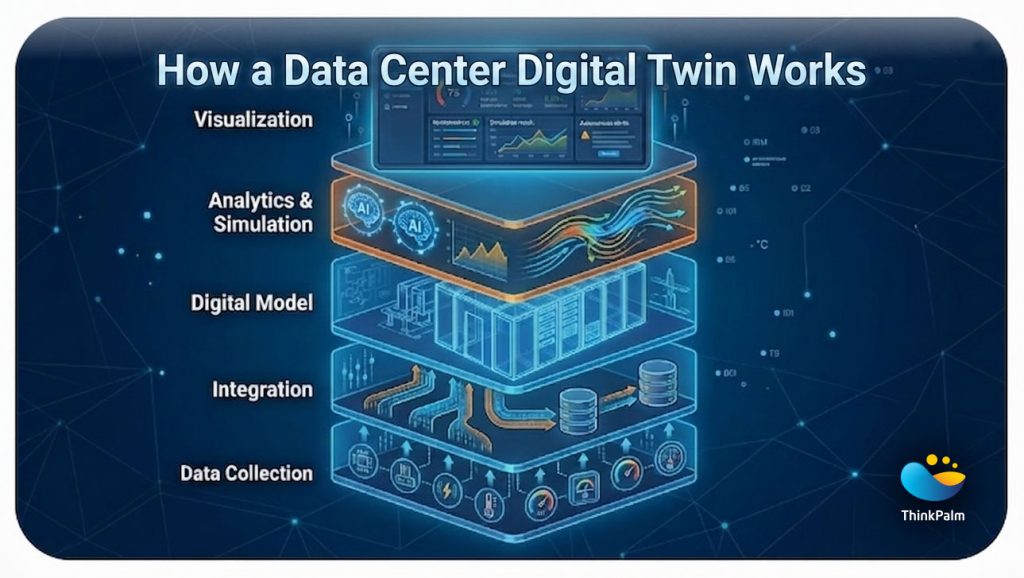
The five-layer technology stack that powers a predictive Data Center Digital Twin.
Everything begins with data collection. Sensors and monitoring tools capture information from servers, storage systems, cooling equipment, UPS units, power distribution systems, environmental sensors, network devices, and building management systems. IIoT remote monitoring solutions provide the real-time operational data that forms the foundation of a digital twin. Think of this layer as the nervous system of the entire solution.
Next the collected data is integrated with your existing DCIM platform, Building Management System (BMS), asset databases, and IT service management tools. Instead of replacing your current infrastructure, a digital twin builds on top of it by connecting every operational data source into a unified ecosystem.
This layer creates a virtual 3D representation of your physical data center, including racks, cooling systems, electrical infrastructure, cable paths, and environmental zones. Teams can navigate the facility digitally to monitor operations, investigate issues, and evaluate planned changes before implementing them.
AI and simulation engines continuously analyze historical and real-time operational data to predict equipment failures, model airflow and thermal behavior, run “what-if” scenarios, and forecast future capacity requirements. This is the layer that transforms operations from reactive monitoring into proactive optimization.
A unified dashboard consolidates live monitoring data, asset insights, analytics, and simulation results into a single operational view. As digital twin platforms evolve, this layer increasingly supports autonomous operations, allowing AI to recommend and even apply operational adjustments with minimal human intervention.
There are several trends that are driving towards data center digital twin adoption:
Organizations need greater visibility into power consumption and cooling efficiency to reduce operational expenses.
Running compute-intensive AI applications demands significantly more processing power, making infrastructure planning and optimization increasingly complex.
Packing more computing power into smaller spaces creates greater thermal and electrical challenges, requiring continuous monitoring and simulation.
Stricter environmental requirements demand data-driven energy management strategies that help demonstrate measurable reductions in carbon emissions.
As infrastructure expands across distributed edge locations, centralized visibility becomes essential for maintaining operational control.
Modern businesses cannot afford service disruptions, making early risk detection, predictive maintenance, and proactive operations essential.
Traditional data center management relies on siloed tools and manual processes. But a digital twin changes this by creating a single source of truth across IT and facilities teams.
As organizations deploy high-density GPUs and liquid cooling environments, digital twins provide the real-time insights needed to manage today’s highly sophisticated infrastructure.
The technology is genuinely interesting, but what matters is how it helps people run the facility. Here are the six outcomes that come up repeatedly when operators talk about why they adopted a digital twin:
When unexpected equipment failures occur, it can disrupt operations and violate service agreements. Meanwhile a data center digital twin continuously analyzes data from servers, power systems, cooling equipment, and environmental sensors to catch the very first warning signs of trouble.
This data center predictive maintenance enables teams to:
Key benefit:
For mission-critical environments, preventing just a single outage can instantly save your organization massive amounts of money.
A digital twin provides real-time visibility into power usage, cooling performance, and environmental conditions, helping operators identify inefficiencies across the facility.
Key benefits:
By testing changes virtually before implementation, teams can make smarter energy management decisions with less risk.
As workloads expand and infrastructure evolves, planning future capacity becomes increasingly complex. A digital twin provides a clear view of the available physical space, power and cooling you have left.
Key benefits:
With better visibility into available resources, teams can make more informed expansion decisions.
Modifying your power, cooling, or IT infrastructure can introduce operational risks. By contrast a digital twin takes the danger away by letting you run “what-if” simulations in a safe virtual environment first before you touch any live environment.
Key benefits:
You can find the bottlenecks digitally, keeping your actual production environment completely safe from accidental downtime.
Sustainability is becoming a key priority for data center operators. Digital twins capture the exact data points you need to track your environmental impact and hit your green milestones.
Key benefits:
By combining operational data with analytics, organizations can make measurable progress toward their sustainability goals while improving overall efficiency.
The rise of AI-powered data centers is changing how companies monitor, manage, and optimize their infrastructure. By combining AI with digital twin technology, operators gain better visibility into the health, performance, and efficiency of their data center environments.
AI-powered digital twins can:
Teams do not have to wait for panic alerts to interfere. Instead, they can make smart, proactive decisions using live data and predictive insights.
These days data centers are getting more complicated, and basic tracking will not be sufficient. Hence, AI-powered digital twins are transforming simple monitoring into intelligent operational platforms. As a result, this helps organizations improve uptime, optimize resources, and manage infrastructure with greater confidence.
Traditional monitoring tools only tell you what is happening by tracking data center health and sending alerts. But a digital twin goes a step further. By combining real-time data with AI and simulations, it explains why issues happen, predicts what will happen next, and lets you test changes safely. Ultimately, digital twins upgrade traditional monitoring to allow for smarter planning, predictive maintenance, and better decision-making in complex environments.
| Capability | Traditional Monitoring | Data Center Digital Twin |
|---|---|---|
| Real-time visibility | Partial | Comprehensive |
| Visualization | Dashboards only | Interactive 3D model |
| Predictive analytics | Limited | Advanced |
| Scenario simulation | No | Yes |
| Capacity forecasting | Manual | Automated |
| Root cause analysis | Reactive | Proactive |
Digital twins deliver real value, but the implementation path isn’t always smooth sailing. Let us examine some of the common road-blocks operators face and how to plan around them:
The upfront investment for the platform, new sensors, and system integration can be significant. Reduce risk by implementing the project in phases, beginning with high-value use cases that clearly demonstrate ROI before expanding across the data center.
Legacy data centers often have incomplete asset inventories and missing sensor information. Organizing and validating operational data before deployment creates a more accurate and reliable digital twin.
Connecting DCIM platforms, Building Management Systems (BMS), and IT infrastructure from multiple vendors requires careful API integration. Treat system integration as a dedicated workstream rather than an afterthought.
Older facilities may lack the sensor density required for accurate real-time modeling. Include targeted sensor upgrades as part of the overall implementation roadmap.
A digital twin consolidates real-time operational data, making it a valuable target for cyber threats. Design security architecture from the outset with robust access controls, encryption, and network segmentation.
Operations teams need training and confidence to trust AI-driven recommendations. Pair technical implementation with comprehensive user training and change management to maximize long-term adoption.
You don’t have to model your entire facility on day one. The digital twin projects that tend to go well start focused on one critical zone, one pressing problem and expand from there. Here’s the path most successful implementations follow:
Begin with your current setup. Review the sensors already in place, what your DCIM system captures, and where data gaps exist. The quality of your data is crucial for creating an accurate digital twin, and this step often reveals cleanup tasks that should be completed before moving forward.
Do not build a digital twin just for the sake of having one. Instead, start with a specific business problem, such as unplanned downtime, cooling inefficiency, or poor capacity visibility. That problem should shape your scope and make the business case easier to justify.
Combine your DCIM, building management platforms, IoT sensors, and asset databases into a single unified data layer. This is where many teams face major roadblocks, so it is important to fix data connections before investing in expensive AI or simulation software.
Create a detailed virtual representation of your physical assets, power chains, cooling systems, and environmental zones. Instead of mapping the entire facility immediately, focus on the section that matters most to your initial problem.
Add AI tools to detect unusual behavior, predict equipment failures, and run what-if scenarios. In fact, this is where the digital twin evolves from a simple dashboard into an intelligent assistant that supports proactive decision-making.
Expand only after you have measurable proof that the model works. Once you see outcomes such as fewer incidents, lower PUE, or faster change cycles, extend the digital twin to additional zones or facilities while tracking metrics that clearly show ROI.
Modern digital twin solutions for data centers do not replace DCIM solutions. Instead, a data center digital twin acts as an upgrade. Most organizations already use data center infrastructure management platforms to manage assets, power, space, and environmental data.
A digital twin enhances DCIM by adding:
By teaming up your DCIM with a digital twin, you create a more intelligent approach to data center management.
If you need to have a successful data center digital twin implementation, the success depends entirely on the quality of the live operational data feeding it. However, many of the projects fail as data is trapped inside several disconnected monitoring systems. This makes real-time visibility impossible.
ThinkPalm’s NetvirE fixes this by establishing a Sensor-to-Cloud architecture. Using Industrial IoT (IIoT) edge gateways, it pulls fragmented data streams from across your entire infrastructure into a single, reliable data layer.
Therefore, organizations adopting digital twin technology for data centers, building this unified visibility is the perfect first step delivering massive stand-alone value even before simulation tools are added.
While traditional data center infrastructure management (DCIM) tools are passive record systems, NetvirE layers advanced AI analytics and Agentic AI on top of your data foundation. This shifts your operations from reactive firefighting to autonomous, predictive optimization, delivering clear business outcomes. Hence, companies that move from monitoring to digital twin solutions for data centers will be better positioned to build smarter, and future-ready data centers.
Talk to our IIoT team first. Our engineers can assess your current infrastructure readiness and recommend the right starting point before you commit to platform or vendor decisions.
Athira Gopakumar is a Digital Marketing Specialist in the tech industry, with a strong focus on IoT marketing. She specializes in data-driven strategies, leveraging SEO, content marketing, and market research to enhance brand visibility and lead generation for IoT solutions. Passionate about the intersection of technology and marketing, she stays ahead of industry trends to drive impactful campaigns. Outside of work, she enjoys traveling to new places and dancing to unwind.