IIoT for Data Centers: How Industrial IoT Is Replacing Legacy DCIM Tools
Industrial Internet of things (IIoT)
 Athira Gopakumar
June 26, 2026
Athira Gopakumar
June 26, 2026



 Athira Gopakumar
June 26, 2026
Athira Gopakumar
June 26, 2026
Imagine a busy Friday afternoon at a Tier III data center. A cooling unit starts behaving erratically. Surprisingly, no alarm has gone off yet, and the threshold hasn’t been crossed. But something wrong was noticed even after the routine system check.
In a legacy DCIM environment, that “something” stays completely invisible until it becomes a crisis. By the time a traditional alarm finally triggers, a server rack gets overheated and a critical client SLA is broken.
Now let us reimagine that same Friday with IIoT for data centers in place. The moment that cooling unit starts drawing anomalous current, connected sensors flag the deviation. An AI model trained on normal operational baselines identifies it as early-stage compressor degradation. The team then schedules a repair for the following Saturday. The client never notices anything. This is the exact operational gap that pushes enterprise teams to move away from legacy tracking towards IIoT-powered infrastructure management.
In Summary
IIoT for data centers deploy interconnected sensors, edge gateways, and AI analytics to turn raw infrastructure data into real-time operational intelligence. Unlike legacy DCIM tools, which monitor and record, IIoT platforms predict, automate and optimize. This post explores how IIoT enhances data center infrastructure monitoring, predictive maintenance, asset management, and sustainability tracking compared to traditional DCIM systems.
For years, DCIM platforms originally succeeded by providing a single pane of glass for power, cooling, space, and connectivity. They earned their place by transforming scattered spreadsheets and isolated dashboards into a much more manageable system.
For a long time, this basic layer of data center asset management was sufficient.
However, modern infrastructure looks nothing like the environments that those legacy tools were built to handle. In fact, today’s facilities operate under the intense pressure from high-density AI computing, hybrid workloads, edge deployments, and distributed multi-site portfolios.
They’re expected to deliver near-zero downtime while simultaneously proving ESG compliance, managing energy costs, and scaling on demand.
The latest Uptime Institute Annual Outage Analysis 2025 reports that outages are becoming less frequent but increasingly expensive, with a significant share of outages costing over $100,000 and some exceeding $1 million. The report emphasizes that operators must actively manage emerging risks through improved monitoring and operational practices.
By design, legacy DCIM platforms are passive record systems. They track what you have, not what’s about to fail. The most common pain points include:
Reactive-only alerting — Thresholds trigger after the damage is already underway.
Siloed visibility — IT and facilities data live in separate systems, creating blind spots.
Manual reporting — ESG and capacity data require hours of spreadsheet work.
No rack-level telemetry — Server and asset degradation goes undetected until it’s a crisis.
Poor multi-site support — Each facility has its own dashboard with no unified view.
Hence, the result is what operations teams know as data center reactive maintenance. This is a firefighting mode where teams respond to failures rather than prevent them. The old systems of record were built for a simpler era. However, today’s hyper-complex facilities demand an active, intelligent system.
Definition
IIoT for Data Centers refers to the use of interconnected sensors, edge gateways, controllers, and analytics platforms that continuously collect, transmit, and interpret operational data from connected infrastructure assets. By transforming real-time telemetry into actionable insights, IIoT enables proactive monitoring, predictive maintenance, and intelligent decision-making across data center environments.
For example: where a traditional DCIM system asks, “what is the current reading on this server?” These data centers operate completely differently. It asks a much smarter question: “what does three weeks of vibration data on this UPS tell us about where it’s headed?”
The architecture works in distinct layers. Physical sensors attached to servers, cooling units power distribution units (PDUs), batteries, and environmental monitoring points stream data continuously to edge gateways. Those gateways preprocess telemetry close to the source, filtering noise, compressing signals, and reducing latency.
The processed data then flows to a cloud-native platform where AI analytics engines apply anomaly detection, predictive models, and capacity forecasting. The output isn’t just a dashboard; it’s a series of actionable recommendations, automated responses, and proactive maintenance schedules.
ThinkPalm’s NetvirE platform operates exactly on this architecture. It connects data center assets at the sensor layer, processes telemetry through industrial IoT edge gateways, and delivers AI-driven insights through a unified management dashboard, giving operators visibility they simply cannot get from a conventional DCIM tool.
One of the reasons IIoT for data centers is so effective is due to its capability to monitor. Here, instead of manual inspection, modern sensor ecosystems capture the signals that help in safeguarding uptime and maximizing efficiency:
When combined, these devices create a real-time sensor network that produces tens of thousands of data points every minute. In a smart data center management framework, the magic happens when the AI model spots anomalies and doesn’t just sit within a single, isolated temperature or power spike variation.
In fact, it can spot those hidden patterns before a human operator could. This helps bypass data center reactive maintenance entirely and executing precise data center infrastructure monitoring saving millions.
If there’s one area where the difference between legacy DCIM and IIoT is immediately obvious, it’s data center infrastructure monitoring.
Traditional monitoring relies on a basic polling model. Here, the system checks a sensor value at set intervals, compares it against a predefined threshold, and fires an alert if the value exceeds the limit. However, by the time an alert fires, the problem has already passed the point where it could have been caught quietly.
Instead, IIoT for data centers replaces this outdated process with a continuous, correlated, and contextual monitoring model. This approach delivers several key advantages:
Operators can see live telemetry from power, cooling, server health, and environmental systems as they are continuously updated. Unlike traditional monitoring cycles that collect sensor values at set intervals, IIoT makes anomalies visible as soon as they begin to form.
Legacy monitoring often sends isolated alerts such as “temperature high in zone 4” or “UPS battery below threshold.” IIoT platforms correlate signals across assets to pinpoint root causes, connecting events like a temperature spike and a nearby fan drop instead of sending separate alerts.
Instead of managing separate facilities through isolated dashboards, smart data center management centralizes every site into one view. Operators can drill down from global portfolio metrics to a specific server rack in seconds.
NetvirE’s mobile-ready dashboards take this further, providing role-based access to real-time infrastructure data from any device, meaning an on-call engineer doesn’t need to be on-site to diagnose and respond to an issue at 2 AM.
This is the area where old and new approaches widely differ and the new approach delivers better financial return on investment. For most infrastructure teams, data center reactive maintenance is the default operating model. This is not by choice, but by constraints.
When the monitoring system only tells you something has already gone wrong, reacting is your only option. Moreover, emergency repairs are expensive, unplanned outages damage your reputation, and sudden equipment failures usually cause a chain reaction that breaks nearby systems too.
The situation would differ with predictive maintenance in data centers. By continuously streaming sensor data and training machine learning models on it, IIoT platforms can spot the early signs of component wear and tear. The types of signals that predictive models analyze include:
When these unusual patterns are detected, the system generates a maintenance recommendation with a confidence score and a suggested timeline. In this manner, the maintenance teams can plan, order parts early, and schedule their work during quieter times instead of rushing to fix a failure at the most inconvenient moment.
Smart Data Center Management represents a fundamental operational shift. Unlike the traditional way, which depended on manual processes, here the infrastructure decisions are made using real-time data, AI insights, and automated workflows.
Using IIoT for data centers is what makes this shift possible. Connecting every physical asset and analyzing every event gives management teams powerful capabilities that traditional DCIM tools simply cannot match.
The system automatically responds to changing heat loads in real time, correcting temperature fluctuations without requiring manual intervention. This helps maintain optimal operating conditions while improving energy efficiency.
Instead of relying on estimates, operators use AI models built on asset lifecycle data and utilization trends to forecast power, cooling, and space requirements more accurately, improving data center asset management.
Multi-site operators gain a unified view across facilities, making it easier to identify available capacity, balance workloads, and optimize infrastructure utilization across the entire portfolio.
When an issue is detected during data center infrastructure monitoring, the platform instantly provides sensor history, asset health data, and maintenance records, helping teams identify root causes and accelerate resolution.
This changes the entire approach to operations, whereby teams no longer practice data center reactive maintenance. Instead of paying attention only when something breaks, teams can use continuous intelligence to ensure the entire facility is always understood and running at peak efficiency.
Gain real-time visibility into critical infrastructure, reduce unplanned downtime, and optimize asset performance with AI-powered monitoring, predictive maintenance, and digital twin intelligence from NetvirE.
Both IIoT for data center platforms and traditional DCIM tools aim to improve data center operations. But their capabilities and the outcomes they enable are fundamentally different.
The core difference is ‘intelligence.’ Legacy DCIM tools describe what’s happening. Whereas IIoT for data centers explain why it’s happening, predict what’s about to happen, and in many cases take action automatically.
A typical enterprise data center contains thousands of physical assets including servers, switches, UPS units, PDUs, cooling systems, and more. Managing each of them manually, with its own life cycle, utilization pattern, and maintenance history is a tedious task. This is where most DCIM implementations start to crack.
When you implement IIoT for data centers, it replaces manual inventory processes with continuous, automated asset tracking. Every asset is represented digitally in a live model that reflects its real-world state.
The system automatically tracks asset location, usage, health, and maintenance from commissioning to decommissioning, providing the continuous visibility needed for predictive maintenance for data centers.
This automated approach delivers immense operational benefits:
Teams can make infrastructure investment decisions based on real utilization patterns rather than relying on stale inventory data.
Organizations can stop purchasing unnecessary compute and cooling capacity by gaining clear visibility into actual resource utilization.
Assets approaching end of life are identified proactively, enabling procurement teams to plan replacements without emergency timelines or disruptions.
Asset records and change histories are maintained automatically, eliminating the manual effort typically required for audit preparation.
Nowadays, achieving data center sustainability is no longer an optional factor. It’s a regulatory and commercial requirement. Hence, major cloud tenants want their suppliers to showcase verified carbon reductions. Missing these targets could lead to serious reputational risk.
The real challenge for most data center operators is data collection. Because to prove sustainability performance, there is a need for accurate, granular, continuous measurement across energy consumption, cooling efficiency, carbon emissions, and water usage. There are several limitations to manual data collection, as it doesn’t scale, and the annual snapshots may miss the daily operational reality.
With IIoT for data centers, organizations can establish a unified platform for data center sustainability tracking across the entire infrastructure layer. By connecting every energy-consuming asset to a live monitoring platform, organizations gain:
ThinkPalm’s flagship product NetvirE is built with a sustainability module that tracks PUE, carbon footprint, and data center energy monitoring in real time. This enables faster ESG reporting for organizations that have replaced manual processes with automated data collection.
“Organizations that can demonstrate accurate, real-time sustainability performance increasingly win enterprise procurement decisions over those that can only provide annual estimates. Data center sustainability tracking is no longer just a compliance requirement, it has become a powerful competitive differentiator.”
IIoT for data centers serves as the data layer, AI acts as the intelligence layer. The digital twin capabilities bring them together to create a smarter approach to infrastructure management.
A digital twin provides a real-time virtual model of the entire data center environment, capturing the condition and performance of assets such as server racks, cooling units, cable routes, and power infrastructure. Unlike a static floor plan or a manual CMDB, a digital twin is always current because it pulls its state directly from live sensor data.
When AI is layered on top of the digital twin, operators can simulate scenarios before committing to them in the real world. ThinkPalm’s NetvirE platform includes live digital twin visualization as a core capability, giving operations teams a real-time spatial model of their infrastructure that stays synchronized as changes are made, assets are added, and conditions evolve.
Related Case Study: See how ThinkPalm improved data center visibility, sustainability tracking, and operational efficiency through digital twin technology and real-time infrastructure monitoring.
Read the Case Study →The business case for IIoT for data centers is incredibly strong. However, for a successful IIoT implementation, organizations need to be well prepared for the hard parts to prevent possible friction.
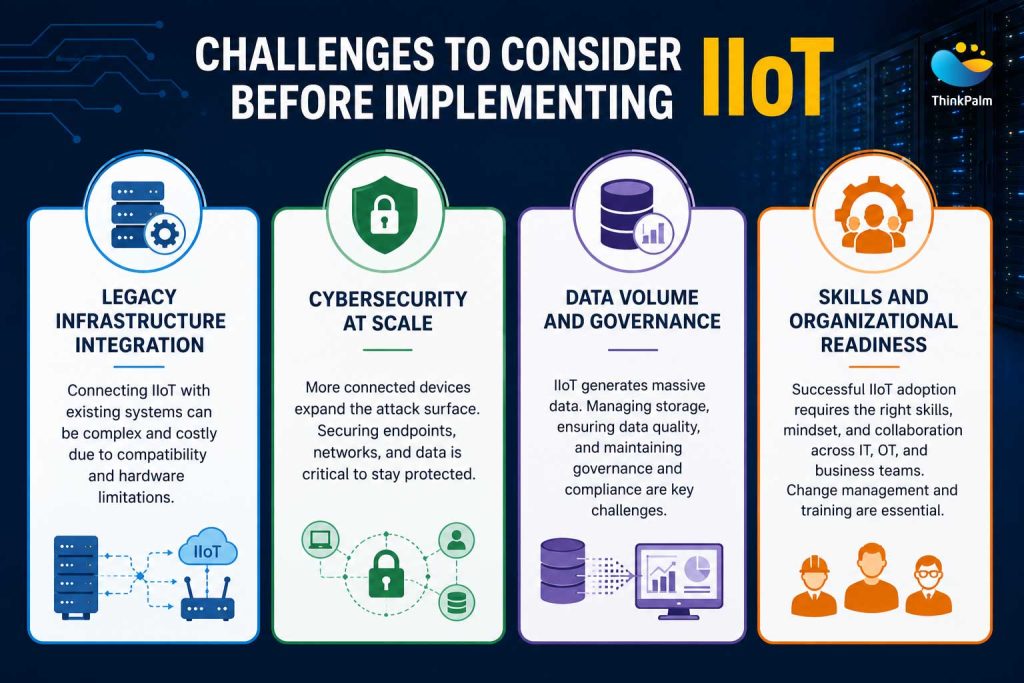
Challenges to consider before implementing IIoT
Older UPS systems, legacy PDUs, and proprietary cooling loops may not have the modern communication interfaces that a cutting-edge data center management platform relies on. To close this gap, you’ll need to incorporate protocol converters or edge gateways to bring your data layer together. By identifying these requirements early on, you can avoid any expensive integration surprises down the line.
Every new sensor would be a potential entry point for cyber threats. Without strict network segmentation, device authentication, and encryption, your network faces major security vulnerabilities. Therefore, measures need to be taken for strong security architecture as a built-in feature into your data center infrastructure monitoring system from day one, rather than retrofitted later.
Thousands of sensors generating continuous telemetry produce enormous data volumes. Organizations need clear policies on what data is retained, for how long, and who can access it particularly when that data is used for ESG reporting or compliance purposes.
When companies shift towards an AI-driven approach, the teams need to be geared enough to welcome the change. This requires expertise that spans networking, data analytics, AI model management, and cybersecurity. Moreover, a team that is ready to upskill or receive external expertise can bridge these gaps effectively.
Data centers have evolved far beyond static environments. Managing through isolated dashboards, periodic checks, and reactive maintenance practices are no longer practical. As infrastructures become more distributed, workloads become complex, and sustainability expectations keep rising. ThinkPalm helps organizations that require greater visibility and quicker decision-making as traditional DCIM tools may not be able to meet expectations. By enabling predictive maintenance for data centers, organizations can reduce downtime, improve operational resilience, and prepare their infrastructure for future demands.
See how NetvirE’s IIoT platform delivers predictive maintenance, real-time infrastructure monitoring, and automated sustainability reporting in a single unified platform.
Athira Gopakumar is a Digital Marketing Specialist in the tech industry, with a strong focus on IoT marketing. She specializes in data-driven strategies, leveraging SEO, content marketing, and market research to enhance brand visibility and lead generation for IoT solutions. Passionate about the intersection of technology and marketing, she stays ahead of industry trends to drive impactful campaigns. Outside of work, she enjoys traveling to new places and dancing to unwind.