AI in Maritime Operations: Crew, Predictive Maintenance, QHSE and Voyage Intelligence
Agentic AI
 Midhula Jeevan
August 28, 2026
Midhula Jeevan
August 28, 2026



 Midhula Jeevan
August 28, 2026
Midhula Jeevan
August 28, 2026
Shipping moves more than 80% of world trade, and for most of that history it has run on paper checklists, radio calls, and maintenance schedules built around the calendar rather than the equipment. That is changing fast, as AI in maritime operations moves from pilot projects into daily use on board every class of vessel. The global maritime AI market was valued at $4.32 billion in 2024 and is projected to grow at 40.6% a year through 2030, according to Grand View Research’s Maritime AI Market Report.
This is the first of a two-part guide to AI in maritime from ThinkPalm. This article covers the four domains closest to the vessel and its crew: crew management, predictive maintenance, QHSE, and voyage management. Part two moves further out to the wider enterprise — fleet operations, ERP, seafarer training, and port operations — and shows how all eight domains connect into a single operational picture.
Definition
AI in maritime refers to systems that learn from operational data such as sensor readings, voyage records, crew schedules, and maintenance logs. They use this data to predict, recommend, or automate decisions that a human would otherwise make based on experience and gut feel.
Traditional maritime software, including ERP systems, planned maintenance systems, and crewing platforms, follows fixed rules. For example, it might tell you to replace a part every 3,000 hours or schedule a crew rotation on a specific date.
Basic analytics and dashboards report on what has already happened. AI goes a step further by predicting what is likely to happen next. With agentic systems, multiple specialized AI agents can also coordinate tasks instead of relying on a single model to handle everything. These systems can recommend or take bounded actions based on predefined rules and permissions.
If you’re weighing where your own systems fall on this spectrum, ThinkPalm’s team can walk you through it during a fleet assessment.
Several pressures are converging at once, which is why 2026 looks different from the pilot-project years that came before it.
Fuel is 40–60% of the cost of running a vessel, so even small efficiency gains compound quickly across a fleet.
The Seafarer Workforce Report 2026 from BIMCO and the International Chamber of Shipping estimates a shortfall of 39,100 STCW-certified officers in 2026, with demand up 35% since 2021.
IMO’s Carbon Intensity Indicator (CII) now shapes charter rates, insurance, and port access — in 2026 it’s a commercial and financial performance driver, not just a compliance exercise.
The maritime sector logged 23,400 malware and 178 ransomware detections in just the first half of 2024, per Marlink, as more onboard systems connect to the network.
These four domains account for most of the AI already running in production on board vessels today. These systems are not just being piloted. They are relied on for daily decisions.
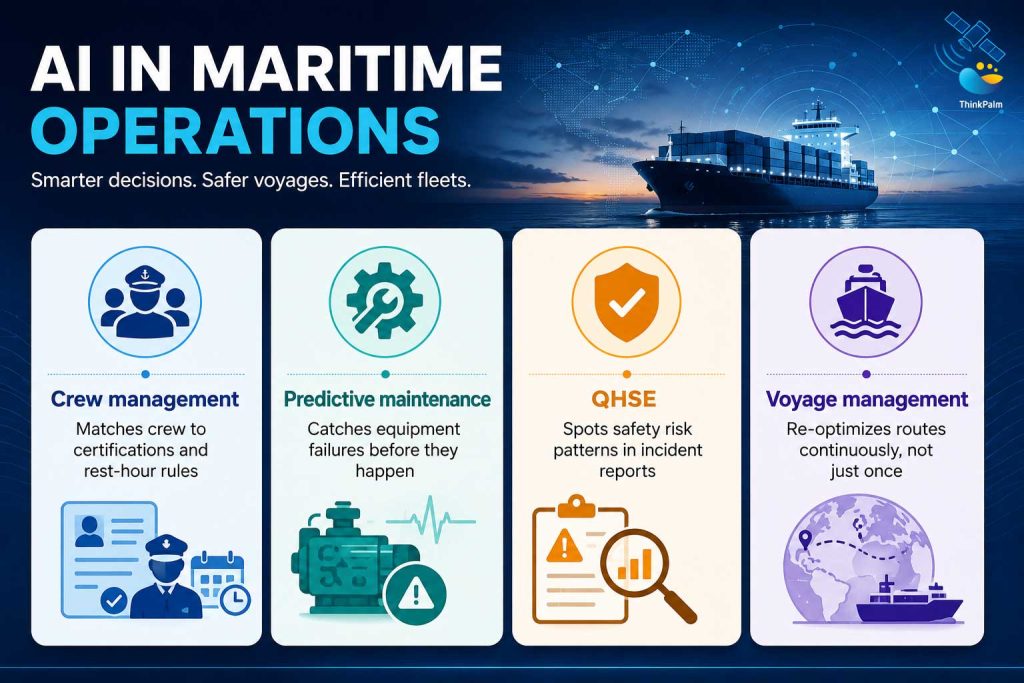
AI is transforming maritime operations with smarter crew management, predictive maintenance, safer practices, and optimized voyages.
Crew planning is a constraint-satisfaction puzzle involving certifications, rest-hour rules, nationality mix, contract length, and joining logistics. It is usually handled manually on spreadsheets by people who also have a dozen other jobs. The challenge is growing as the officer shortage tightens. AI helps by matching qualified crew to vessels based on certification expiry and rest-hour rules, flagging compliance risks before a port state control inspection rather than during one, and forecasting attrition risk based on rotation and workload patterns.
A vessel breakdown at sea creates a safety, schedule, and cost problem all at once, and calendar-based maintenance means replacing parts that are still fine while missing ones about to fail. Models trained on vibration, temperature, and pressure data from engines, pumps, and generators learn what “normal” looks like for a specific vessel class and flag deviations before failure.
| Old way: calendar-based | AI way: condition-based | |
|---|---|---|
| Approach | Replace a part every 3,000 hours, regardless of actual condition | Replace a part when sensor data shows real wear |
| Result | Over-servicing and missed early failures | Better spares planning, fewer unplanned failures, no over-ordering |
The limitation here matters: off-the-shelf models trained on generic industrial equipment tend to over-alert in marine conditions, causing engineers to lose trust in the alerts and quietly abandon the system.
For the full ROI picture on predictive maintenance — including the 30–40% downtime reduction figure and sensor-level detail — see ThinkPalm’s deep dive on maritime AI use cases and ROI.
Safety observations, near-misses, and incident reports pile up as unstructured text and PDFs that rarely get analyzed for patterns until after something serious happens. AI changes this by reading incident and near-miss reports for recurring risk patterns across a fleet, checking compliance documents against ISM Code and flag-state requirements, and scoring vessels or routes trending toward higher incident probability.
What AI adds to QHSE workflows:
This is a domain where a wrong or overconfident AI finding has real safety implications — human sign-off on any QHSE-related AI output is non-negotiable, not optional.
Fuel is the single largest controllable cost on a voyage, and changing weather, currents, and port windows can quickly make a departure route outdated. AI continuously re-optimizes route and speed against weather, currents, port congestion, and CII targets throughout the voyage, not just at departure.
Thinking about building this for your own fleet? These four use cases all run on the same foundation: AI agents that read data, flag what matters, and hand a clear decision to the right person. ThinkPalm’s team designs and builds that kind of agentic AI for maritime operators, from a single predictive maintenance model to a fully connected, fleet-wide system.
Explore Agentic AI Development ServicesCrew management, predictive maintenance, QHSE, and voyage AI draw on overlapping data types:
Data quality and integration matter more than the sophistication of any single model. A well-tuned predictive-maintenance model fed inconsistent sensor data from three different vendor formats will underperform a simpler model fed clean, well-integrated data.
A fair account of onboard AI has to include where it struggles, not just where it helps.
False alerts and crew trust. A model that over-alerts gets ignored within weeks — this is the single most common reason maritime AI deployments quietly get abandoned.
Data silos. Crew, maintenance, and voyage data often sit in separate systems that were never designed to talk to each other.
Connectivity limitations at sea. Satellite bandwidth is improving but remains a real constraint for real-time, high-frequency data transfer mid-ocean.
Human accountability. STCW, ISM, and MLC frameworks all assume a person is accountable for the decision — AI has to fit inside that accountability structure, not around it.
Most successful onboard AI deployments follow the same low-regret starting sequence:
Pick one with a clear, measurable cost today — fuel, downtime, or compliance risk — rather than starting with “we should have an AI strategy.”
Audit what sensor, crew, or voyage data already exists before buying anything — most gaps are integration gaps, not AI gaps.
Connect the data sources the pilot needs before layering AI on top.
One vessel class or one trade lane, not the whole fleet at once.
Crew, maintenance, QHSE, and voyage AI are the most mature domains in maritime AI today. Across all four, successful systems rely on clean, well-integrated, vessel-specific data rather than generic models bolted onto onboard workflows.
Traditional software tells you the rule. Analytics tells you the history. AI tells you what’s about to go wrong and, increasingly, what to do about it.
ThinkPalm builds domain-trained AI for maritime operations, from standalone predictive maintenance and vessel monitoring to fleet-wide, multi-agent decision support. Our solutions include ISO 27001:2022-certified data handling and on-premise deployment options for operators with data sovereignty requirements.
Your competitors are already piloting this. See how domain-trained AI can cut downtime, fill crew gaps smarter, and keep every voyage on the most efficient route — with ISO 27001-certified, on-premise deployment.
Midhula Jeevan is a passionate content writer with a focus on SEO and technical writing. With a love for words and a curiosity for the technical side, she blends creativity with strategy to craft content that stands out. When not writing, you could find her usually reading books, enjoying a good cup of coffee, or chasing golden sunsets.