AI Compliance Testing: How Automated Regulatory Testing Keeps FinTech Teams Audit-Ready
Testing as a Service (TaaS)
 Nandhini Thendayutham
August 27, 2026
Nandhini Thendayutham
August 27, 2026



 Nandhini Thendayutham
August 27, 2026
Nandhini Thendayutham
August 27, 2026
Every FinTech team is well aware of the chaos of audit week. It usually involves a frantic scramble to gather evidence, compliance officers hunting hard-to-find test coverage logs, and QA leads burning the midnight oil to track what was tested and when. It doesn’t have to be this way. But imagine if that whole process was already taken care of when teams keep PRDs, reviews, and baselines current throughout the cycle, not only in audit week.
This is where AI compliance testing comes into the picture.
Imagine you were part of a FinTech product team in Malta, building a payments platform regulated by the Malta Financial Services Authority (MFSA). The bi-weekly sprints and monthly PRD updates become a constant battle. On top of that, regulatory rules shift with every new policy revision.
Traditional compliance testing was designed as a point-in-time activity, i.e. something you do before an audit. Therefore, it was never a continuous practice woven into the development cycle.
The result? By the time an auditor arrives, the gap between what you tested and what actually shipped can be months wide. Although your test dashboard shows everything is fine, your product might be drifting away from regulatory rules. The result is a major risk.
Hence, there is a need to move towards AI compliance testing rather than relying on standard methods.
Compliance relied on Excel spreadsheets and manual requirement mapping, making audits time-consuming, error-prone, and difficult to maintain.
Platforms like HP Quality Center and Jira + Xray improved traceability, but compliance mapping still depended on manual decisions.
AI analyzes product requirements, classifies regulatory obligations, generates compliance test cases, and keeps audit evidence continuously up to date.
Definition
AI compliance testing means using artificial intelligence to handle your entire regulatory checkup automatically. It reads your product requirements documents and takes care of creating, sorting, classifying, and maintaining test cases; execution is triggered when QA runs a framework-scoped baseline. This implies that your team doesn’t have to do it manually, including human classification for each case or point-in-time review cycle.
For example, in regulated financial services, this means uploading a PRD for a product that must satisfy GFSC (Guernsey Financial Services Commission) or MFSA standards, and having the system:
The AI breaks the document into logical segments and scans each for compliance-relevant content and regulatory identifiers.
Using metadata extraction (direct regulatory IDs) and similarity inference (semantic comparison to framework sections), the system assigns each test case to GFSC or MFSA at generation time.
Each generated test case carries a persisted compliance Framework field, which is a stored database fact rather than a display-time filter that could be accidentally reset.
On demand, choose a PRD baseline (V2, V3, etc.), select GFSC or MFSA, ensure scripts exist for approved cases, then run the baseline. Only tests tagged to the selected framework are executed.
Every approval, rejection, execution result, and rejection reason is timestamped and user-attributed, creating a continuously maintained audit trail that simplifies audit preparation.
Related: If your team is new to AI-powered test workflows, see how AI test case generation works end-to-end from PRD upload to production-ready scripts in under two minutes.
Many testing tools claim to support compliance testing, but in practice they mostly let users attach labels like “GFSC” or “MFSA” to a test case.
That persists in the database, not only in view filters, the framework selector scopes which persisted tags are included in a baseline run. This means that if someone changes filters, migrates data, or updates the system, the connection between the test and the regulation may be lost. Whereas AI compliance automation works differently.
| Stage | Process | When Used |
|---|---|---|
| Chunk Metadata Resolution | Extracts explicit GFSC/MFSA requirement IDs and module references directly from the PRD segment that generated the test case. | Primary path – when the PRD contains embedded regulatory references. |
| Similarity Inference | Compares test case content semantically against GFSC and MFSA framework sections to determine the most likely regulatory assignment. | Fallback – when no explicit identifiers are found in the chunk. |
The database record includes either compliance Framework: “GFSC” or compliance Framework: “MFSA.” This helps with audit purposes as it is a traceable fact rather than just a temporary label. It remains intact through UI changes, framework version updates, and filter resets since it’s not tied to the UI at all.
Why This Matters for Your Next Audit
When an auditor asks for tests that validate MFSA requirements (for example, a specific module section), relying on a basic UI filter may not be enough. TestNova stores GFSC/MFSA classification on each test case in the database, so teams can retrieve MFSA-tagged cases as traceable, audit-defensible evidence scoped by persisted framework tags and linked requirement/module metadata where present.
Regulatory compliance testing is not a single activity. A mature compliance testing workflow spans five distinct modes, each serving a different moment in the product and regulatory lifecycle.
Upload a PRD, run Generate, and get compliance-tagged test cases anchored to the specification and regulatory framework.
When Predictive Analysis is enabled, re-uploading a PRD and running Generate compares versions and surfaces Added, Modified, and Removed compliance test cases (filtered by GFSC/MFSA). Semantic comparison distinguishes meaningful requirement changes from minor rephrasing, so teams review only what likely affects regulatory coverage, not the full suite on every edit.
A GFSC baseline execution runs only GFSC-tagged tests. An MFSA baseline runs only MFSA-tagged tests. Teams select a baseline version and framework before initiating the run. The filter is applied to the persisted tag, ensuring clean separation of regulatory evidence across jurisdictions.
When teams run a GFSC or MFSA baseline after each PRD version, they build a pass/fail history over time. A new failure after an update is visible in the latest baseline results; impact analysis shows which requirements changed. Root cause is then a comparison, not a reconstruction.
Every review action—approval, rejection, rejection reason, improvement suggestion—is logged against each test case with a timestamp and user attribution. This is the evidence layer: not just what was tested, but who reviewed it, who approved it, who flagged it, and why. That’s what an auditor actually wants to see.
When you rely on the traditional compliance model, it creates a big risk: your product updates fast, but your manual tests move slow. If you keep your compliance checks for the last minute, it leads to audit-week panic, expensive emergency code fixes, and unnecessary stress.
But shifting to a continuous, AI-powered compliance can solve this as it builds regulatory checks directly into your daily workflow. So, you already have the automated, timestamped proof you need to breeze through your next audit.
| Traditional Compliance Testing | Continuous Compliance Testing with AI |
|---|---|
| Test suite reviewed once per audit cycle | PRD re-upload triggers impact analysis; teams run framework baselines when ready. |
| Manual mapping of requirements to regulatory clauses | Automatic requirement-to-regulation tagging. |
| Framework classification is a human judgment call | Framework classification is a persisted database fact. |
| Evidence assembled in the week before audit | Audit trail accumulates as teams approve or reject cases and execute baselines, not only in audit week. |
| PRD changes silently break coverage | Impact analysis surfaces affected cases immediately. |
| Separate tools for testing and traceability | Test generation, execution, and evidence in one system. |
| No automated regression across PRD versions | Version-over-version regulatory regression history when teams run a baseline after each PRD version (not automatic on upload) |
💡Compliance Issues Caught Earlier
When compliance baselines are run after modified, added, or removed PRD content updates from the compliance dashboard, or via a custom pipeline calling suite execution, a drop in pass rate can signal regulatory risk before release. This helps teams identify and address compliance issues early, rather than discovering them during an audit.
The value of automated compliance testing doesn’t look the same across every role. Here’s how it plays out in practice across the teams that carry regulatory responsibility.
Generate a full GFSC or MFSA test baseline from the current PRD, select baseline and framework, run the baseline, and view the pass/fail scoreboard as audit evidence, with every test case traceable to its regulatory requirement. Evidence doesn’t need to be assembled. It’s already there.
When requirements change, impact analysis identifies which compliance test cases are affected. Teams review only the affected areas and not the entire test suite, so compliance coverage stays aligned without slowing down delivery.
The review panel gives QA leads an approval workflow for AI-generated compliance test cases before they enter the execution baseline. Rejection reasons are logged, creating a governance record that shows not only what was tested but also what was excluded and why.
Teams building products that must satisfy both GFSC and MFSA can maintain separate baselines for each framework within the same project. The framework selector cleanly isolates the two scopes: GFSC evidence is GFSC evidence, and MFSA evidence is MFSA evidence, always.
Teams can integrate generic suite execution
(
with script IDs) into CI/CD. By default, PRD re-upload runs impact analysis,
while regeneration, review, script generation, and baseline runs are
initiated in the product rather than automatically on git merge.
TestNova is ThinkPalm’s AI test automation platform, which is built to handle every stage of the QA workflow. It manages test planning, AI test case generation, execution, self-healing, and real-time dashboards. The compliance testing workflow embedded within TestNova is a specialized regulatory module. It shares the same generation engine and infrastructure.
This matters because regulatory checks do not need a separate process. The same AI that tests your API dashboard can generate compliance-tagged test cases for your regulatory validation. Everything happens inside the same platform against the same PRD. Therefore, it results in a significant reduction in the cost of maintaining compliance coverage.
| TestNova Component | What It Does in Compliance Testing |
|---|---|
| AI Test Case Generation | After upload, teams run Generate to read the PRD, detect compliance-relevant sections, and create test cases tagged to GFSC or MFSA at save time—not as a display-only filter. |
| Framework Selector | Scopes the execution baseline to GFSC or MFSA, ensuring clean separation of regulatory evidence across jurisdictions. |
| PRD Impact Analysis | When Predictive Analysis is enabled, re-uploading a PRD and running Generate compares versions and surfaces Added, Modified, and Removed compliance test cases (filtered to the selected framework) for review before rerunning baselines. |
| Test Case Review Panel | Approve, reject (with logged reason), or edit compliance-tagged test cases before they enter the execution baseline. |
| Script Generation | After approval, teams link or record a scenario flow per test case, then user-trigger Generate standalone scripts to produce Playwright (Python) executables |
| Self-Healing Automation | Platform self-healing for UI/scenario scripts; not a dedicated GFSC/MFSA baseline heal loop. |
| Compliance Scoreboard | Shows pass/fail from the latest framework-scoped baseline run—usable as audit evidence alongside review and execution history. |
| Real-Time Dashboard | Live execution progress during baseline runs plus scoreboard tab; broader dashboards are shared with general test execution. |
For the Compliance use case, approved cases with linked flows become Playwright standalone scripts (Python by default). The broader TestNova platform also supports API pytest scripts, additional frameworks, and GitHub sync. FinTech teams can trigger suite execute in CI/CD; in-product, compliance defaults to on-demand baseline runs after review and scripting, no separate compliance-only tools required.
AI compliance testing isn’t just about speeding up traditional testing. It has introduced several capabilities that we couldn’t achieve at scale before. These five essential features come together to shape a genuinely intelligent AI Compliance Automation practice:
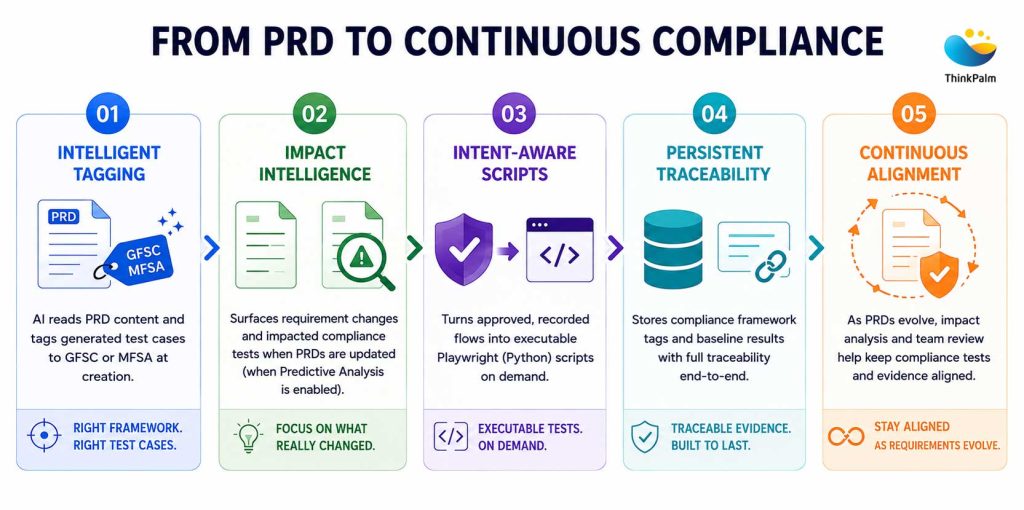
5 ways in which AI Is Reshaping Regulatory Compliance Testing
Before AI, human specialists had to tag every test case with its regulatory framework manually. They had to read the test and the regulation, then make a judgment call. This process was slow, inconsistent, and impossible to scale as product requirements grew.
Today, the backend pipeline changes that. It reads the full PRD, breaks it into segments, and automatically assigns regulatory framework rules to each generated test case.
This saves hours of manual labor as it now happens automatically during AI Test Case Generation. Every decision is fully traceable and saved instantly. This automation is the foundation for all other AI Compliance Testing capabilities.
When Predictive Analysis is enabled, re-uploading a PRD and running Generate triggers impact analysis. Instead of treating every text diff as equally important, the system compares requirement content across versions and surfaces which compliance test cases are Added, Modified, or Removed filtered by the selected framework (GFSC or MFSA).
Semantic comparison helps separate meaningful requirement changes from minor rephrasing, so teams focus review on updates that may affect compliance coverage not the entire suite on every PRD edit.
Turning a compliance test case into an executable script is different from building a standard functional test. A functional test only validates technical behavior, such as checking whether an API returns the correct status code. A compliance test validates regulatory intent, checking if that behavior satisfies a specific financial authority rule.
Approved compliance test cases with a linked or recorded scenario flow can be turned into Playwright (Python) standalone scripts when the team clicks Generate standalone scripts not automatically on approval. Scripts execute the recorded validation path; auditors still rely on test case titles, framework tags, and review history to see what regulatory behavior was intended.
Most tools only apply regulatory labels on the screen. If you select a compliance tag from a dropdown, the interface displays the tests associated with that tag.
However, that label only lives in the UI. If you change a filter, reset the view, or upgrade your software, that connection is lost.
In a genuine AI Compliance Automation workflow, the framework tag is permanently saved directly onto each test case record in the database at the moment it is generated. The classification easily survives version changes, interface updates, and filter resets. It does not rely on the UI at all.
In fast-moving industries, your tests must match both current product requirements and active regulations at the same time.
This is where continuous compliance testing adds real business value. When PRDs are updated, impact analysis and generation workflows help recreate and re-tag cases; QA reviews affected cases before baselines. It highlights changes using impact analysis to maintain a living compliance baseline without manual work.
Integrate suite execution into CI/CD; in-product, teams run baselines when PRDs and scripts are ready. A drop in passing scores warns you immediately. You catch bugs before production, not during an audit. Hence, compliance becomes a quality signal when baselines are executed, with live progress during the run.
AI compliance testing in TestNova transforms regulatory validation from an audit-week scramble into a workflow that teams can manage throughout the release cycle. It streams this process through GFSC/MFSA tagging during test generation, impact-aware reviews when PRDs change, persisted compliance evidence in the database, and framework-scoped baselines with scoreboard results. Compliance can remain continuous when teams keep PRDs current, review affected test cases, maintain the required scripts, and run baselines as needed not because every step runs automatically, but because test generation, compliance classification, review, execution, and evidence are brought together in a single platform.
TestNova’s AI test automation platform integrates compliance testing into the same system as test planning, generation, and execution no separate tools required. ThinkPalm helps organizations achieve faster reviews, stronger governance, and greater confidence that compliance coverage remains accurate, current, and ready for scrutiny at every release.
Discover how ThinkPalm’s Testing as a Service (TaaS) solutions help organizations automate testing, strengthen compliance coverage, and accelerate software quality at scale.
Nandhini Thendayutham is a Software Test Engineer at ThinkPalm Technologies, specializing in manual and automation testing for enterprise applications. She is passionate about software quality, AI-driven testing, and test automation, with hands-on experience in building reliable testing solutions. Outside of her technical pursuits, she enjoys reading.