AI-Led Legacy Modernization: Real-World Use Cases Across Industries
Agentic AI
 Chandni Nadarajan
May 19, 2026
Chandni Nadarajan
May 19, 2026



 Chandni Nadarajan
May 19, 2026
Chandni Nadarajan
May 19, 2026
Imagine walking into a high-tech bank today. You realize that their entire customer database runs on a computer system that was built in the 1980s. It turns out to be not just slow, but it doesn’t “talk” to mobile apps. Each time, the bank wishes to add a simple feature, the whole system starts crashing.
This is the reality for many businesses today. Even though it may seem they are driving modern Ferraris, but the engines are from forty years ago. Legacy system modernization is the process of upgrading these aging systems to keep up with today’s digital demands.
However, the challenge lies in doing this manually, as it is like trying to rebuild a plane while it’s flying. That’s where AI-led legacy modernization comes into play, whereby intelligent tools are used to automate the heavy lifting and turn outdated code into agile, future-ready software.
In Summary
AI-driven legacy modernization is changing the way companies upgrade old systems without disrupting critical operations. Organizations are increasingly turning to AI to incrementally modernize through automation, predictive insights, and continuous optimization instead of costly “Big Bang” migrations.
In this blog, we discuss how enterprises in Banking, Healthcare, Manufacturing, Telecom and Government sectors are leveraging AI for legacy system modernization.
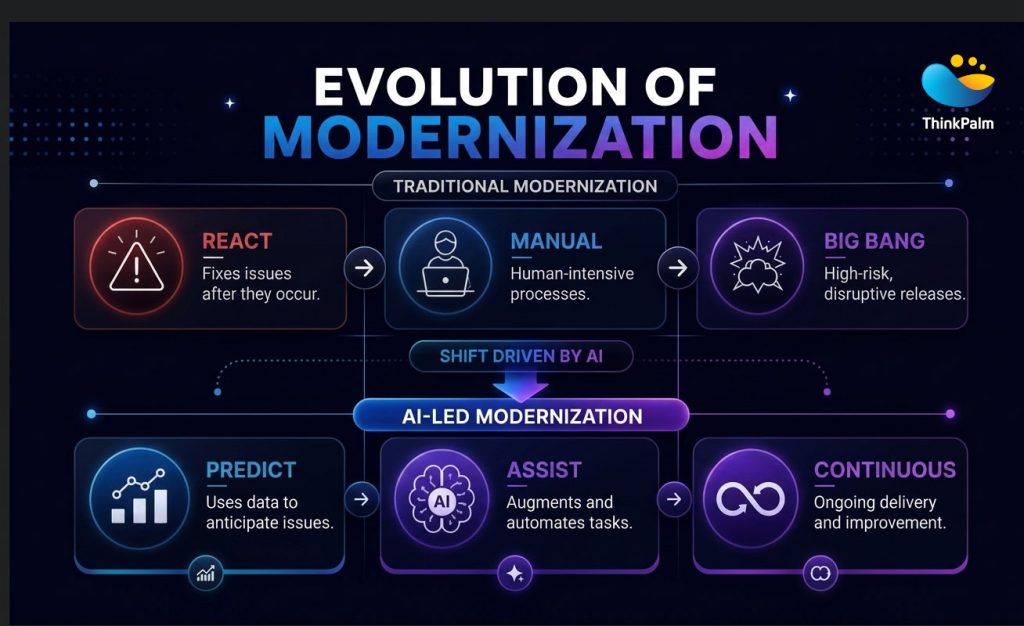
In the past, modernization was treated like a massive “surgical” event. This meant things were expensive, risky, and something you did only once every ten years. Today, things have changed, and the integration of AI turns modernization into a continuous process. This is because AI is altering the way business’ function, and user expectations also change along with it. The shift is primarily happening in how global industries approach their aging infrastructure.
Evolution of modernization
Traditionally, companies would only respond if there was a breakdown or any lag in the system. Now, with AI-led legacy modernization setting in, enterprises can identify bottlenecks before they happen.
The AI tools scan codebases and server logs, creating the path for predictive maintenance. Hence, predictions can be made regarding the parts of the legacy system that are likely to fail or become a security liability. In this manner, teams receive updates to modernize “just in time” rather than “too late.”
For instance, in the case of an IIoT platform, predictive maintenance capabilities provide a forecast of machine wear and tear. This helps with saving downtime massively.
Modernization is not just about upgrading systems, it starts with rethinking architecture. Explore how AI is transforming software architecture design for scalable, future-ready systems.
In the traditional approach of legacy system modernization, several developers would manually recode millions of lines of COBOL or Java code. This meant there was a chance of manual errors. But using AI for legacy system modernization makes it an effective co-pilot. AI doesn’t simply copy code. It understands the business logic, the functionality behind it, and suggests efficient ways to structure the new system.
The traditional “Big Bang” migration was often considered time-consuming and expensive. However, with AI-driven legacy modernization, companies can now strategize small “modernization pipelines.” Using a phased approach, automatic updates and testing of minor components of an existing system can also happen. Hence, this ensures the business continues to evolve without severe “technical debt”. This shift is further accelerated through AI-driven workflow optimization, enabling faster and more efficient modernization cycles.
Traditional “Big Bang” modernization projects were often expensive, time-consuming, and difficult to complete without disruption. Large-scale migrations frequently introduced delays, operational risks, and growing technical debt.
With AI-led legacy modernization, enterprises can now adopt a phased and continuous modernization approach instead of rebuilding entire systems at once. AI enables organizations to modernize smaller components incrementally through automated code analysis, testing, and workflow optimization.
As a result, businesses can accelerate transformation, reduce modernization risk, and continuously evolve their systems without disrupting critical operations.
In most companies, legacy systems continue to power critical operations. Still, companies continue operating with aging architectures, accumulated technical debt, and reliance on outdated technologies such as COBOL. This is because modernizing these systems is complex, costly, and risky. Moreover, many systems lack vendor support and skilled expertise, which slows down progress.
As a result, AI-led legacy modernization initiatives often exceed budgets and timelines. Hence, companies may have to divert key resources from core business functions. When these efforts don’t happen in the desired way, this leads to operational disruptions and other compliance risks. Therefore, companies are inclined to adopt smarter approaches, such as AI, for legacy system modernization.
Wondering where to begin your modernization journey? Explore our step-by-step guide to legacy system modernization with AI to learn how enterprises assess, prioritize, and modernize legacy systems with reduced risk and greater efficiency.
AI-led Modernization Patterns
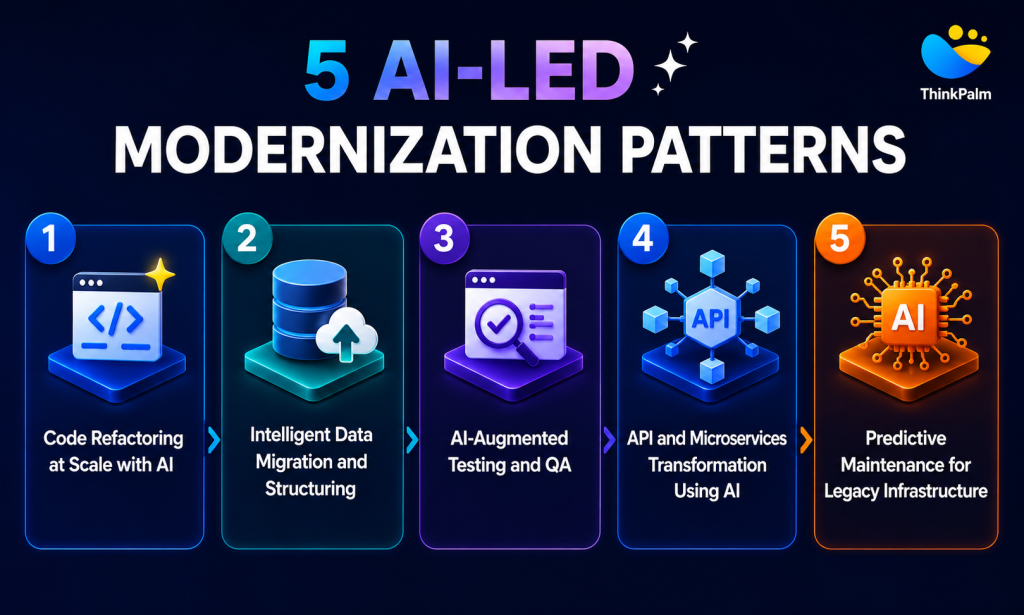
In the SaaS and BFSI (Banking, Financial Services, and Insurance.) sectors, core operations are carried out using a “monolithic” codebase. This monolithic system is a massive, interconnected web of code in which changing a small feature risks the entire system. This sort of complexity can slow down innovation.
The AI Intervention: The AI tools perform deep semantic analysis of the codebase, learn its actual intent. This means a developer does not have to manually hunt for dependencies. Instead, the AI gives a roadmap for cleaning up “spaghetti code.”
Strategic Outcome: By addressing technical debt at the source, companies achieve faster release cycles and a system that is much easier (and cheaper) to maintain.
Legacy data migration is one of the riskiest parts of modernization. This is because data is scattered across several systems in varied formats. Traditional migration is often slow and error prone.
Let us take an example of how patient records are maintained in the healthcare sector. It might be scattered across three different systems in varied formats. In Retail, inventory data from 200 physical stores might not sync with the e-commerce platform.
The AI Role: This is where using AI for legacy system modernization becomes handy. Teams do not have to write thousands of manual rules to move data. Instead, they can use machine learning to write these.
The Outcome: By using AI for legacy system modernization, the migration results in a ‘single source of truth’ bringing clean, usable data ecosystems.
Testing is often considered one of the biggest bottlenecks in legacy system modernization. This is mostly due to brittle scripts and high maintenance effort. Moreover, small changes can break large parts of the test suite. Hence, it slows down releases and increases costs.
Implementing legacy system modernization with AI makes testing more adaptive and less resource intensive through:
AI-powered legacy modernization shifts testing from a bottleneck to an accelerator enabling continuous delivery without compromising stability.
Monolithic architecture slows innovation. Any minor change impacts the entire system, making legacy system modernization complex and limiting scalability.
AI-led legacy modernization enables enterprises to modernize without disruption.
Legacy infrastructure often operates on a reactive principle which means “fix-after-failure” model. Consequently, a single system failure can impact production, delivery timelines, and overall business continuity for companies.
While implementing AI for legacy system modernization, organizations can shift from reactive to predictive operations instead of replacing existing infrastructure. They help with:
AI-powered legacy modernization turns infrastructure from a risk into a reliable, high-performing asset enabling greater operational resilience and cost control.
The real value of modernization lies in how effectively organizations turn legacy constraints into innovation opportunities.
See how
Agentic AI Solutions can help drive AI-powered legacy modernization with reduced risk and faster results.
A government agency was functioning using a decade-old core system. There was limited code access, insufficient documentation, and high dependency risks. This limited their ability to launch new digital services for citizens, slowing down legacy system modernization efforts.
By leveraging AI for legacy system modernization, the agency deployed GenAI to analyze millions of lines of code, extracting thousands of forgotten business rules, and mapping system dependencies. It created a well-defined modernization roadmap.
A Tier-1 bank struggled to launch new digital products as their IT operations were fragmented and were running on a decades-old core system. Hence, this made legacy system modernization slow, risky, and expensive.
The bank layered legacy system modernization with AI over its existing core and IT service management [ITSM] stack. These AI agents monitored logs and incidents, identified root causes, and automatically resolved routine issues before they escalated.
A healthcare platform was relying on a monolithic billing system. They wanted to exit this legacy data center. Because, in this sector, a system error would mean disruption to patient care and provider payments. Therefore, their AI-led legacy modernization initiative was both time-sensitive and risk-intensive.
The organization used AI for legacy system modernization to analyze code dependencies, to design a phased migration approach. The teams then accelerated the refactoring process with AI copilots. Also, generating automated test cases to check the accuracy of critical billing workflows.
This proved that AI-powered legacy modernization can handle even the most sensitive environments safely.
Many manufacturers depend on legacy MES and SCADA systems. This provides limited visibility into equipment health. Consequently, leading leading to unplanned downtime and lower efficiency, making legacy system modernization critical.
Organizations layered AI over existing systems to analyze sensor data, detect anomalies, and predict potential failures. This equipped them with proactive maintenance without replacing the core infrastructure.
“Gartner estimates that as many as 60% of AI initiatives will fail due to the absence of AI-ready data reinforcing that legacy data foundations are a primary barrier to AI success.”
In today’s world of AI-led modernization, companies need to compete with factors like speed, personalized experiences, and operational agility reigns. Hence, clinging to outdated legacy systems would not be sufficient. The need of the hour is to adapt to changing needs where systems that are monolithic in nature and expensive to maintain need to revamp. Soon, this could also bring about security threats and scalability issues.
Modern businesses are competing in the times where speed-to-market, operational agility, and hyper-personalized customer experiences define success. With competition running this high, clinging to outdated legacy systems is no longer an option. At ThinkPalm, we help companies modernize intelligently and transform into future-ready platforms. Legacy systems, often monolithic in nature and deeply embedded within business-critical operations, are becoming increasingly unsustainable. They are not only expensive to maintain but also expose business to security risks and make it difficult to scale with evolving needs.
AI helps in legacy system modernization by analyzing complex codebases, identifying dependencies, automating testing, enabling predictive maintenance, and optimizing workflows.
The benefits of AI-powered legacy modernization include faster transformation, reduced costs, improved system performance, enhanced scalability, and lower operational risk. Additionally, it also helps with continuous modernization instead of one-time, large-scale upgrades.
Industries such as banking, healthcare, manufacturing, retail, telecom, and the public sector benefit significantly. These sectors rely heavily on legacy systems and can use AI to improve efficiency, reduce downtime, and enable digital innovation.
Chandni Nadarajan is a content writer at ThinkPalm Technologies, specializing in B2B marketing content. With a passion for turning complex ideas into clear, engaging narratives, she blends strong research and storytelling skills to make technical topics accessible. Her expertise spans technology, automation, and digital business solutions.