Post-Quantum Cryptography for SD-WAN: Building a Quantum-Safe WAN
Networking
 Thenmozhi S
June 9, 2026
Thenmozhi S
June 9, 2026



 Thenmozhi S
June 9, 2026
Thenmozhi S
June 9, 2026
As businesses grow more digital, they rely heavily on cloud applications, remote work, and smart devices. This makes it important to have a network that can connect everything quickly, reliably, and securely. SD-WAN is designed to do exactly that—it simplifies network management while improving performance and reducing costs.
But as technology advances, so do security risks. A new and powerful type of computing, called quantum computing, could soon break the encryption methods that protect today’s networks. This creates a serious future risk for business data.
To stay ahead of this threat, organizations are beginning to adopt quantum-safe SD-WAN, which uses advanced encryption methods known as post-quantum cryptography (PQC). These new techniques are built to withstand even the power of quantum computers, helping ensure that networks remain secure in the years to come.
Key Takeaways
Read on while we explore how quantum-safe SD-WAN works, the role of post-quantum cryptography, key technologies like ML-KEM and lattice-based cryptography, and the steps businesses can take to prepare for the quantum era.
To understand what is quantum-safe SD-WAN, it’s important to first understand what is SD-WAN.
Definition
SD-WAN (Software-Defined Wide Area Network) is a modern networking solution that connects branch offices, data centers, and cloud applications through a centralized software-based system.
It uses multiple connection types, such as broadband, MPLS, and LTE, to intelligently route traffic based on network performance, helping businesses improve application experience, simplify management, and reduce connectivity costs.
However, traditional SD-WAN encryption may not be enough in the face of quantum computing.
With the continued development of quantum computing, enterprises are reassessing their approach to securing enterprise networks and valuable information. Modern enterprises are prioritizing the adoption of quantum-safe networking as traditional encryption methods are unlikely to stand up to future attacks by quantum computers.
Definition
Quantum-Safe SD-WAN is an advanced form of SD-WAN that uses post-quantum cryptography (PQC) to protect enterprise networks from future quantum computing threats. It integrates the flexibility and functionality of SD-WAN with quantum-resistant encryption techniques that ensure data security even with the advent of quantum computers.
A Quantum-Safe SD-WAN retains these essential features and incorporates post-quantum security protocols, including FIPS 203, FIPS 204, and FIPS 205. The standards cover traffic on the control plane as well as traffic on the data plane, and introduce quantum-resistant mechanisms for encryption, authentication, and secure key exchange.
Unlike traditional SD-WAN security, which relies on RSA and Elliptic Curve Cryptography (ECC), quantum-safe SD-WAN uses modern cryptographic approaches such as lattice cryptography, hash-based cryptography, and hybrid encryption models. The approaches are particularly designed to avoid being compromised by a quantum computer, yet are compatible with current network equipment.
In practice, a quantum-safe SD-WAN ensures secure tunnel establishment for IPsec and TLS connections, authenticated routing using technologies like BGP and VRF, and uninterrupted traffic flow during failover, path selection, and network scaling.
The integration of post-quantum cryptography remains transparent to users and applications, allowing organizations to maintain SD-WAN agility and performance without compromising security.
AI is also reshaping modern enterprise networking. Explore how AI transforms network management and monitoring in next-generation network environments.
The traditional SD-WAN architectures were created to tackle today’s cybersecurity threats, not those of quantum computing. With the development of quantum technology, companies have to find more robust encryption techniques that can protect enterprise traffic for the long-term.
The most important encryption techniques used in SD-WAN environments today are RSA, ECC, and AES. These algorithms are extremely robust against classical computers that use multiple cores or millions of transistors to attack them with brute force would take thousands of years or more to crack.
But quantum computing alters the face of security in a profound way. Current encryption methods are vulnerable in the future because quantum computers will be able to solve complex mathematical problems much faster than traditional computers.
Quantum computers have the potential to weaken or break the cryptographic algorithms that protect modern enterprise networks. Different encryption methods are affected in different ways depending on how they are designed.
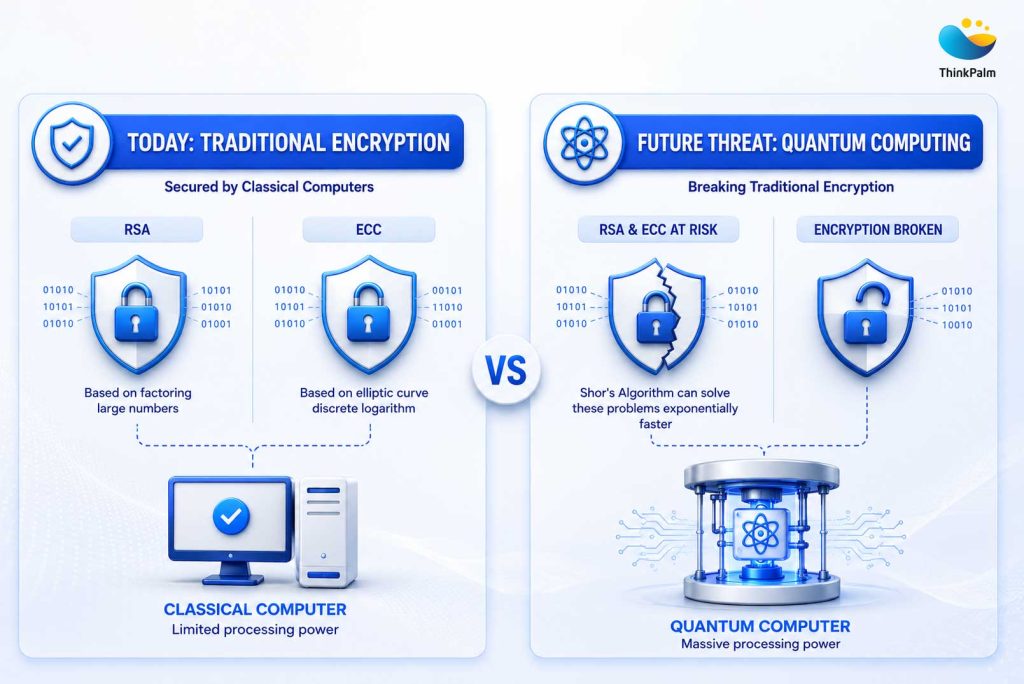
The Shift from Traditional Encryption to Quantum-Safe Security
Both RSA and ECC are popular public-key cryptography methods that protect VPNs, HTTPS traffic, and enterprise communications. They are secure because they solve mathematical problems that are hard to solve with classical computers.
RSA is based on factoring very large numbers, and ECC is based on the discrete logarithm problem. These algorithms are generally trusted today because classical computers are not efficient in solving them.
But quantum computers have the potential to solve these problems quickly with Shor’s algorithm. If a large-scale quantum computer can be made to be practical, encrypted traffic that’s secured using RSA or ECC could be easily decrypted in a matter of minutes or hours.
AES is one of the most commonly used symmetric encryption standards for securing enterprise data and network traffic. It is more resistant to quantum attacks than RSA and ECC, but is still affected by the capabilities of quantum computing.
Asymmetric encryption keys are used to secure data by AES. For instance, classical computers could take trillions of years to break through AES-128 using brute force.
But Grover’s algorithm can speed up this process in quantum computers, making AES-128 the same strength as a 64-bit key. While AES is still more secure than RSA or ECC, quantum computing undermines its security.
With sensitive customer, financial, and operational data, the shift to post-quantum security is growing increasingly pertinent for enterprises. It is essential for businesses to start taking proactive measures to prevent future cyber security threats.
Though quantum computers are still in their infancy, companies can’t wait. Today, cybercriminals are able to steal encrypted information and later be able to decrypt it when quantum technology is mature. Such “harvest now, decrypt later” tactics pose long-term threats to companies storing sensitive data.
Without post-quantum security, organizations may face:
This is why enterprises are increasingly investing in quantum-resilient networking strategies to future-proof their infrastructure.
Post-quantum cryptography is the foundation of quantum-safe networking. It presents novel cryptographic ideas that are able to withstand classical and quantum computer attacks.
Post-quantum cryptography (PQC) is the term for cryptographic algorithms which are resistant to both classical and quantum computer attacks. PQC is different from traditional methods of encryption because it is based on mathematical problems that it is thought are not solvable even by the most powerful quantum computer.
These include:
Post-quantum cryptography plays a role in enterprise encryption, digital signatures, authentication, and key exchange. It is vital to secure SD-WAN, cloud networking, financial systems, and other mission-critical infrastructure against future quantum attacks.
Want to understand how ML-KEM secures encrypted network tunnels? Read our guide on Post-Quantum TLS with ML-KEM to explore how quantum-safe encryption works in real-world enterprise communications.
A Quantum-Safe SD-WAN uses a number of high-level cryptographic algorithms and technologies to create secure channels and to safeguard enterprise traffic against future attacks.
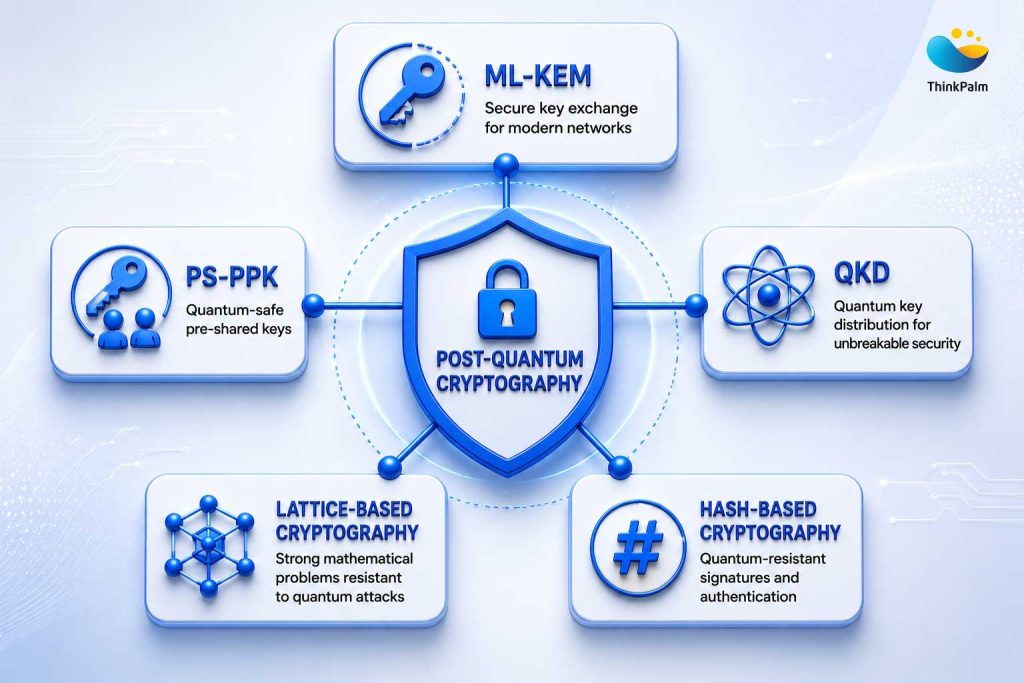
Core Technologies Powering Post-Quantum Cryptography
One of the most important post-quantum cryptography standards that is adopted for secure key exchange in enterprise networking environments is ML-KEM.
Multi-Level Key Encapsulation Mechanism (ML-KEM) is a lattice-based post-quantum cryptography algorithm for a secure key exchange. It makes sure that the intended recipient alone can safely decrypt and utilize the session key.
Typically, ML-KEM is employed to create secure IPsec and TLS tunnels between the branch offices and remote users to cloud platforms. It is frequently used with classical Diffie–Hellman (DH) in a hybrid implementation to ensure compatibility and performance.
Standardized in accordance with FIPS 203, it is one of the hottest technologies for the promotion of post-quantum security.
Using Post-Quantum Pre-Shared Key mechanisms, organizations can further enhance the security of VPN and SD-WAN tunnels without sacrificing ease of use and performance.
Post Quantum Pre-Shared Key (PS-PPK) is a quantum-resistant shared key mechanism for securing VPN, IPsec tunnels, and SD-WAN communications.
These keys can be produced by using post-quantum cryptography algorithms or sent by Quantum Key Distribution (QKD). PS-PPK can be used for quick and efficient authentication and ensures both control-plane and data-plane traffic are secured against future quantum attacks.
This method enables organizations to bolster their current SD-WAN security posture with little impact on performance.
The Quantum Distributed Key technologies make quantum mechanics directly available for secure communication systems, which offer an extremely high encryption security level.
Quantum Distributed Key (QDK) is based on the principles of quantum mechanics and Quantum Key Distribution (QKD) for the safe distribution and sharing of encryption keys.
In QDK systems, the cryptographic keys are sent on quantum channels, where any attempt to intercept the messages will immediately show up, thanks to the quantum no-cloning theorem.
In a Quantum-Safe SD-WAN architecture, QDK is generally employed in areas of high security, like government, defense, and critical infrastructure. It can be used in hybrid deployments alongside classical post-quantum cryptography for maximum security.
The main benefit of QDK is that it allows for provably secure key exchange with classical and quantum attacks.
One of the most robust bases for post-quantum security is lattice cryptography, which has a wide range of applications in contemporary quantum secure encryption systems.
Lattice cryptography uses lattice-based keys to support quantum-resistant encryption and digital signatures.
Researchers base them on mathematically challenging lattice problems, which they believe are quantum resistant, such as Learning with Errors (LWE).
Lattice-based keys are commonly employed in the ML-KEM to create secure encrypted tunnels and safeguard enterprise traffic in Quantum-Safe SD-WAN environments.
For quantum-resistant software integrity protection and authentication, hash-based cryptography provides a simple and very reliable solution.
In contrast to algebraic cryptography, Hash-Based Keys are digital signatures that are quantum-resistant based on one-way hash chains and Merkle Trees.
They are assumed to be collision-resistant to ensure their security, and they are very reliable for post-quantum security applications.
Commonly, SD-WAN deployments apply hash-based cryptography to sign firmware, verify software integrity, and authenticate the control plane.
Migrating to a Quantum-Safe SD-WAN is a strategic process that helps organizations strengthen long-term network security while preparing for the future of quantum computing.
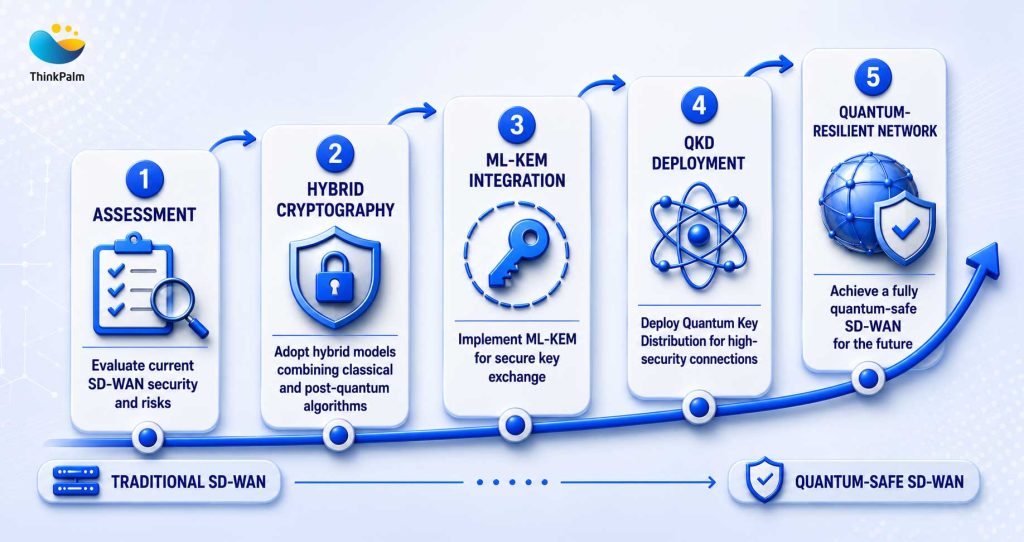
A Strategic Roadmap to Quantum-Safe SD-WAN Adoption
Migrating to a Quantum-Safe SD-WAN requires organizations to gradually integrate post-quantum cryptography into both the control plane and data plane of their network infrastructure.
This migration typically involves:
A successful migration strategy helps enterprises build Quantum-Resilient Networking architectures that remain secure, compliant, and scalable for the future while continuing to benefit from SD-WAN’s performance, agility, and intelligent traffic management.
Modern VPN protocols play a major role in securing enterprise traffic across distributed networks. Explore how WireGuard VPN enhances cryptographic security and VPN performance in modern networking environments.
At ThinkPalm, we explore quantum-safe SD-WAN as a key industry capability for enabling robust, flexible, and future-resilient secure communication across distributed ecosystems in evolving enterprise and cloud environments.
By leveraging hybrid cryptographic models that combine traditional encryption mechanisms with post-quantum cryptography (PQC), we aim to enhance resilience against emerging quantum-era threats while ensuring compatibility with existing network and security architectures.
This approach supports secure connectivity across multi-cloud environments, SaaS applications, branch networks, remote users, and edge computing deployments through dynamic, policy-driven security enforcement. It enables improved data protection, secure workload mobility, and consistent security posture across distributed infrastructures.
As quantum computing advances, businesses need to start updating their cybersecurity policies to safeguard enterprise communications and critical information from future threats.
Making the leap to Quantum-Safe SD-WAN is an urgent priority for organizations ready to make the leap into quantum. With the progress of quantum computing, today’s encryption might not be sufficient to protect enterprise communications and sensitive data.
Businesses strive to secure their network infrastructure in a future where quantum computers will become a reality. It is therefore essential to understand the various quantum cryptography technologies that are available to help achieve this goal.
In an era where quantum computers are increasingly becoming a reality, businesses must adopt technologies like ML-KEM, Post-Quantum Pre-Shared Key (PS-PPK), Quantum Distributed Key (QDK), lattice cryptography, and Quantum Key Distribution (QKD). This helps them ensure that they construct secure, future-proof network architectures.
In addition to defending enterprise networks from quantum threats, a Quantum-Safe SD-WAN solution also meets regulatory needs. It provides operational resilience and trust while maintaining the flexibility, scalability, and performance of modern SD-WAN architectures.
Assess quantum security risks, evaluate post-quantum readiness, and build a practical migration roadmap with ThinkPalm’s experts.
Talk to an ExpertThenmozhi S is a Senior Software Engineer specializing in Layer 2 networking and software development. She focuses on designing and implementing efficient solutions for modern wired networking platforms. In her free time, she enjoys reading books, listening to music, and is a longtime Reader's Digest enthusiast.