AI Test Case Generation in 2026: Benefits, Tools and How It Works
Testing as a Service (TaaS)
 Chandni Nadarajan
June 1, 2026
Chandni Nadarajan
June 1, 2026



 Chandni Nadarajan
June 1, 2026
Chandni Nadarajan
June 1, 2026
“Imagine a QA engineer preparing a late-night deployment after another fast-paced sprint. You may have added dozens of new features, and APIs have changed, leading to longer regression cycles. But the pressure to deliver flawless software remains the same. This scenario may be averted. Instead of manually writing hundreds of test scenarios, modern teams are now turning to AI test case generation to automatically create intelligent test cases from user stories, requirements, APIs, and application behavior.”
In 2026, with the rapid demand for faster release cycles and continuous delivery, manual testing alone may not suffice. This is where AI test case generation becomes valuable.
In Summary
AI test case generation helps QA and DevOps teams automatically create intelligent test scenarios. It uses AI, NLP, and machine learning to analyze user stories, APIs, requirements, and application behavior. This approach significantly expands test coverage and cuts manual effort. It also speeds up regression testing to support faster Agile and CI/CD software releases.
In this blog post, we shall learn how AI-generated test cases work, their benefits, challenges, enterprise use cases, and the best AI test case generation tools available today.
AI test case generation reduces the need to write test cases and leverages artificial intelligence, NLP, and machine learning to automate software testing.
In this process, test scenarios need not be written from scratch. Instead, technology pulls directly from requirements, user stories, APIs, or application behavior. Ultimately, it allows QA teams to build smarter test scenarios, eliminate manual work, and expand test coverage.
Traditionally, test case creation is often time-consuming. This is because QA engineers often spend hours analyzing requirements, identifying test scenarios, and documenting expected outcomes. As applications grow and become more complex, this manual approach becomes tedious to scale.
AI changes this process by analyzing application requirements and automatically suggesting:
Modern AI testing tools can read natural-language requirements and instantly turn them into structured test cases.
For Agile and DevOps teams, this means:
Exploring AI Beyond Test Case Generation? Discover how AI is revolutionizing software testing and modern QA workflows in our blog post.
AI test case generation follows a structured workflow.
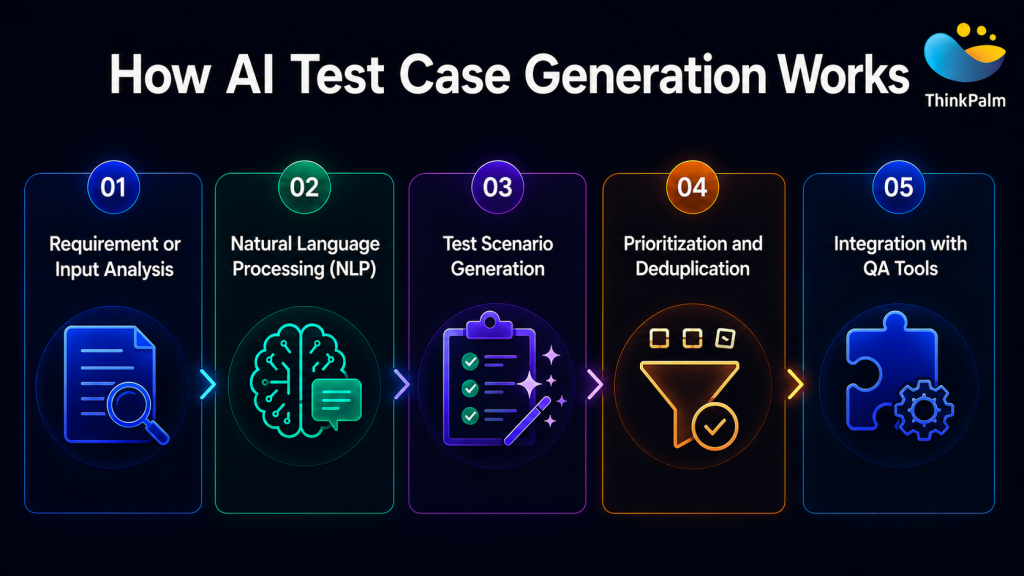
How AI Helps Generate Test Cases in 5 Smart Steps
The AI engine first analyzes inputs such as:
For example, if a user story says:
“As a user, I want to reset my password through email.”
The AI identifies:
NLP allows the AI to read and understand requirements written by humans.
The system extracts:
This allows the tool to convert plain English into structured test scenarios.
The AI then creates multiple test scenarios, including:
Unlike manual testing, AI instantly generates a massive variety of test combinations.
AI optimizes your test suite by filtering out duplicate scenarios and prioritizing high-risk test cases based on:
Most AI testing tools integrate with:
This allows teams to plug AI-generated test cases directly into their CI/CD pipelines.
There are several core technologies that power AI-assisted QA systems.
NLP acts as a translator. It allows the AI to read and understand human language like user stories, acceptance criteria, requirements, and BDD scenarios. It then turns those written notes into structured, actionable test cases.
Machine learning allows the system to improve through experience. By analyzing past bugs, old test repositories, and coverage gaps, the AI gets smarter over time. This continuous feedback loop helps predict exactly where new software failures are most likely to happen.
Modern tools use powerful LLMs (like GPT, Claude, and Gemini) to write detailed test scenarios from simple prompts.
For example, if you ask the AI to “generate positive, negative, and security API tests for a login endpoint,” it can instantly output dozens of relevant cases.
Some platforms pair machine learning with model-based testing. This allows the AI to automatically map out your application’s user journeys. By doing this, it generates intelligent test coverage that mirrors how real people use the software.
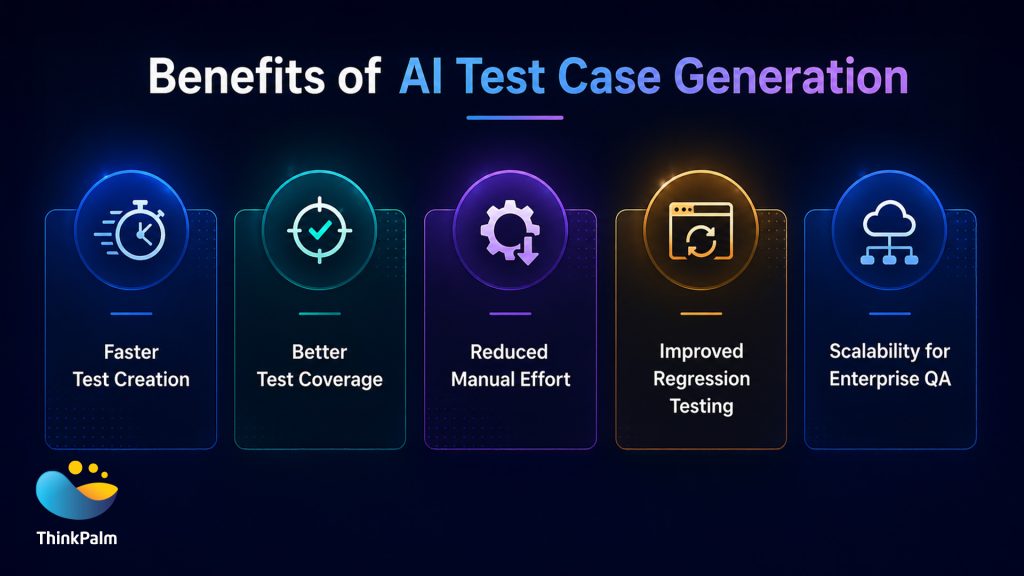
Benefits of AI test case generation for modern QA teams
AI-generated test cases can identify:
QA teams spend less time writing repetitive test cases and more time focusing on:
Large organizations handling multiple releases benefit from:
| Feature | Traditional Testing | AI Test Case Generation |
|---|---|---|
| Speed | Slow | Fast |
| Coverage | Limited | Extensive |
| Manual Effort | High | Low |
| Edge Case Detection | Limited | Strong |
| Scalability | Difficult | Easy |
| Maintenance | Time-consuming | Automated support |
Manual testing is still required for highly regulated or complex business apps, but AI-assisted QA effectively boosts efficiency.
One of the biggest advantages of AI in QA is the ability to generate test cases directly from user stories.
Example
User Story
“As a customer, I want to make online payments using a credit card.”
This process dramatically reduces manual effort.
API testing is one of the strongest use cases for AI-powered software testing.
Modern applications contain hundreds of APIs. Writing test cases manually for all scenarios is difficult.
AI tools can generate:
AI can also analyze:
This makes API test automation faster and more reliable.
AI-powered API testing helps teams generate smarter test scenarios and validate complex integrations faster. Enhance these capabilities with ThinkPalm’s Testing as a Service (TaaS) approach to scale testing efficiently across Agile and DevOps environments.
AI-driven test generation is no longer an experiment it is a necessity for fast-moving and heavily regulated industries. By creating test scenarios tailored to specific industry needs, companies can safely scale their software while meeting strict security and performance standards.
Banks and financial companies largely use AI for creating test cases for managing critical workflows. AI-driven test system models allow engineering groups to test high-stakes execution pathways comprehensively to secure end-user balances and systems.
Healthcare applications use AI-generated validation testing to handle sensitive patient information securely. Advanced generation processes verify functional consistency across multi-tier networks.
Retail businesses are increasingly turning to AI-generated tests to keep online stores running smoothly during busy shopping peaks. Automation isolates points of transaction friction to maintain check-out integrity.
Software-as-a-Service brands use AI to keep up with fast, daily feature rollouts. Testing cycles automatically conform to system adjustments to keep pace with agile application development environments.
The best AI testing tool for your team depends entirely on three things: the testing needs, scalability, and existing integrations.
| Tool | Best For | Key Features |
|---|---|---|
| Testnova | AI-powered enterprise QA | AI test case generation, user story-based testing, API test automation, intelligent regression testing, CI/CD integration |
| Testim | AI-assisted UI and web testing | Self-healing tests, AI-powered stable locators, fast test authoring, cross-browser execution, CI/CD support |
| Functionize | Enterprise-scale AI test automation | NLP-based test creation, autonomous self-healing tests, cloud-based execution, AI-driven maintenance |
| Mabl | DevOps and continuous testing teams | AI-native end-to-end testing, self-healing automation, web/API/mobile testing, continuous regression testing |
| Accelq | Codeless test automation | AI-powered codeless automation, API and UI testing, test maintenance automation, CI/CD integration |
Testnova has become a top choice for AI test case generation in 2026. This is because it can bring everything into one place, that is:
It reduces the manual testing hours, allowing QA teams to expand test coverage and ship software faster.
Although AI testing offers several advantages, it also presents several hurdles.
Generative AI tools sometimes output hallucinated or invalid test scenarios that may be far from reality.
Hence, it is essential that human oversight and expert review be taken into account.
Poorly written user stories lead to poor AI-generated outputs.
Clear requirements improve results significantly.
Highly specialized industries may require domain experts to validate generated test cases.
Organizations handling sensitive data should carefully review:
To get the best results from your AI testing tools, follow these simple best practices to keep your software reliable and your team moving fast.
The quality of an AI’s output depends entirely on what you feed it. Providing clean, well-structured user stories gives the AI the exact context it needs to build highly accurate test scenarios.
Think of AI as a powerful assistant rather than a total replacement for your team. Human oversight is still essential to catch inaccuracies, check complex edge cases, and apply real-world contextual judgment.
Bring AI into the mix during the requirement phase instead of waiting until the code is written. This strengthens your shift-left testing strategy, helping you catch gaps early when bugs are much cheaper to fix.
AI tools get better with practice, but they need your input. Actively correcting errors and grading outputs ensures the system learns from its mistakes and continuously improves its accuracy over time.
Not all test scenarios are equally important. Direct your AI tools toward your most critical, high-risk business workflows first to ensure your core user experience is always thoroughly covered.
Future AI systems may automatically:
AI models are beginning to generate tests from:
Self-healing capabilities will automatically fix broken tests, dramatically cutting down the time spent on script maintenance.
AI-generated test execution will become a seamless, everyday standard across all DevOps pipelines.
AI test case generation is becoming an essential part of modern software testing. As software delivery speeds increase, QA teams need smarter ways to maintain quality without slowing development.
By using AI-powered software testing tools, organizations can:
In 2026, AI-assisted QA is no longer optional for fast-moving engineering teams. It is becoming a competitive advantage. At ThinkPalm, we help organizations modernize QA processes through AI-powered testing, test automation, and intelligent quality engineering solutions that accelerate software delivery.
For organizations looking to modernize testing, adopting an AI test case generation platform like Testnova can significantly improve both productivity and software quality.
ThinkPalm combines deep testing expertise with AI-driven technology to help you deploy error-free software at speed. Let’s identify how intelligent test generation can accelerate your delivery timelines.
Chandni Nadarajan is a content writer at ThinkPalm Technologies, specializing in B2B marketing content. With a passion for turning complex ideas into clear, engaging narratives, she blends strong research and storytelling skills to make technical topics accessible. Her expertise spans technology, automation, and digital business solutions.