QKD Implementation with MACsec: A Practical Guide for Quantum-Safe Network Encryption
Networking
 Niyas NS
June 15, 2026
Niyas NS
June 15, 2026



 Niyas NS
June 15, 2026
Niyas NS
June 15, 2026
Imagine a global bank replicating important data between data centers. Everything looks perfectly safe, traffic is encrypted, compliance checks pass, and monitors are active. Yet, somewhere else, an attacker is quietly collecting and storing that encrypted traffic. They cannot read it today, but they are awaiting a future where powerful quantum computers can easily shatter modern encryption.
For organizations that must protect sensitive data, this creates an urgent security challenge. Traditional mathematical defenses will not survive against quantum-era threats.
This is why Quantum Key Distribution (QKD) is a game-changer. By using quantum physics instead of math to share keys, QKD catches eavesdroppers instantly. When paired with MACsec, it gives network engineers a practical, real-world framework for bulletproof encryption.
Quantum Key Distribution (QKD) and MACsec together provide a practical foundation for building quantum-safe network encryption at the Layer 2 level. While QKD enables secure key generation and distribution using the principles of quantum physics, MACsec protects high-speed Ethernet traffic across critical network infrastructure using those quantum-secure keys. As organizations prepare for emerging quantum threats and “Harvest Now, Decrypt Later” attacks, integrating QKD with MACsec provides a scalable and future-ready approach to securing sensitive enterprise communications.
In this guide, we explore how QKD implementation with MACsec works, where it fits into enterprise infrastructure, the deployment challenges involved, and how organizations can begin preparing their networks for the quantum era.
When people talk about quantum security, the conversation is almost always centered around the application layer i.e. things like HTTPS, VPNs, and certificate authorities. That’s understandable. But it leaves a significant gap exposed. Layer 2, the data-link layer where traffic moves between switches, routers, and core infrastructure before it ever reaches your applications, remains a massive blind spot.
However, there is a growing concern behind what security researchers call “Harvest Now, Decrypt Later” (HNDL). Sophisticated adversaries are already intercepting and storing encrypted network traffic today. The day is not far when quantum computers are powerful enough to break classical encryption; they can work through their archives.
MACsec and Quantum Key Distribution (QKD) are sets of tools that help tackle network defense. Layer 2 encryption isn’t just about safeguarding web traffic, it needs tougher protection. That’s where MACsec and QKD really stand out. Combine them, and you’ve got one of the most solid security setups you can get right now.
Definition
MACsec (Media Access Control Security), formally defined in the IEEE 802.1AE standard, is a Layer 2 security protocol that provides hop-by-hop encryption, authentication, and integrity protection for Ethernet traffic between directly connected network devices.
Think of it as a security layer that wraps every Ethernet frame as it moves across each link of switches, routers, aggregation points with zero plaintext exposure at any point in between.
MACsec relies on two logical components working together:
The Key Agreement Entity (KaY) finds peers on the network and sets up secure connections called Secure Associations between nodes. It uses the MACsec Key Agreement (MKA) protocol from IEEE 802.1X. That means devices can safely swap and update encryption keys without anyone having to jump in and do it manually.
The Secure Entity (SecY) takes care of encrypting and decrypting each network frame, using AES-GCM-128 or AES-GCM-256. To ensure nobody messes with the data, every frame includes a MACsec Security Tag (SecTAG) along with an Integrity Check Value (ICV). This setup ensures that the data stays authentic from start to finish.

Layered MACsec Architecture
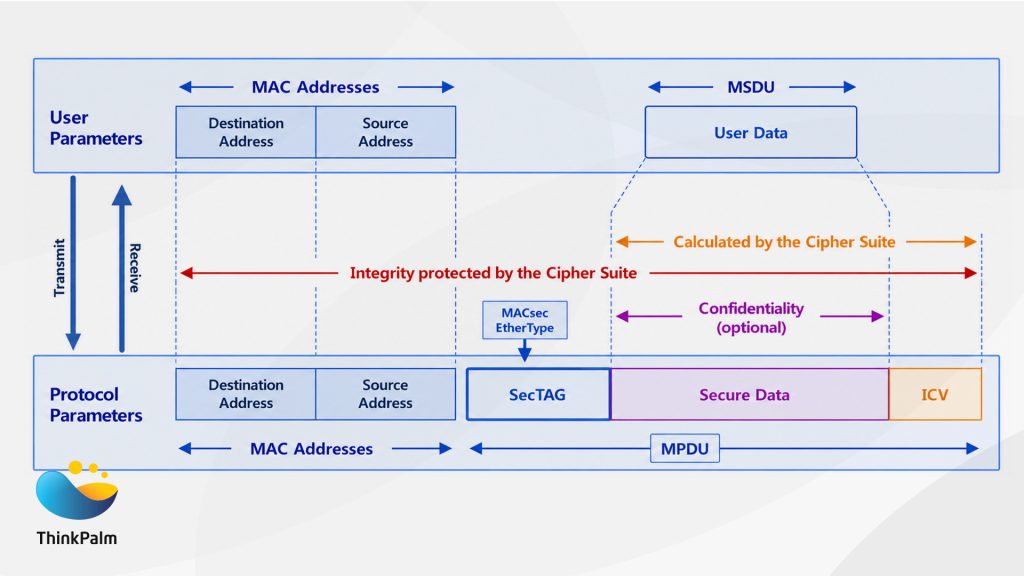
MACsec Encryption and Integrity Protection Layer Diagram
This is a common question. MACsec operates at the Ethernet frame level, which means it protects traffic that IPsec and TLS simply never see, including management-plane traffic, ARP, and low-level control protocols. The best part? It barely adds any delay. Hence, it is ideal for financial trading floors or high-speed industrial operations where every microsecond matters.
The Quantum Vulnerability in MACsec
“MACsec’s encryption cipher (AES-GCM-256) is considered quantum-safe with sufficient key length. The weak point is its key exchange mechanism, classical Diffie-Hellman, which relies on mathematical hardness problems that Shor’s algorithm (running on a quantum computer) is specifically designed to break. This is precisely what QKD is designed to fix.”
It solves one very specific problem, how can two parties create a shared secret key in a way that is completely safe from hackers? This means that an attacker has unlimited computer power.
Classical key exchanges (like Diffie-Hellman) hide keys behind complex mathematical puzzles. On the other hand, QKD derives its security from the laws of quantum physics instead of relying on Math. Additionally, QKD relies on two physical rules, the no-cloning theorem and the observer effect. Since information is carried on tiny particles of light called photons, you cannot copy these particles. This means you cannot look at or measure them without physically changing them. Therefore, even if an attempt is made to intercept or measure a quantum state, the disturbance would be detected.
Put simply, in the quantum world, you can’t spy without leaving footprints.
The most popular quantum key protocol is BB84. Here, we do not have to deal with complex math. Instead, let us learn with an example of polarized sunglasses and flashes of light.
Here’s what happens:
Alice (the sender) encodes random bits onto the polarization states of individual photons and sends them over a dedicated quantum channel, typically a dark fiber link.
Bob (the receiver) measures each photon using a randomly chosen basis.
Alice and Bob compare their basis choices over a classical authenticated channel and discard mismatched measurements.
What remains is a shared random key that only Alice and Bob possess.
If an eavesdropper (Eve) intercepts photons, she must measure them and measurement collapses in their quantum state, introducing detectable errors. Alice and Bob check a subset of the bits they shared. If high error rate observed? Key is discarded. If within tolerance? They’ve confirmed no eavesdropper was present.
QKD provides information-theoretic security, a security that does not depend on the assumed difficulty of any mathematical problem. It cannot be broken by any computer, quantum, or classical, no matter how powerful. This is fundamentally different from everything else in your security stack.
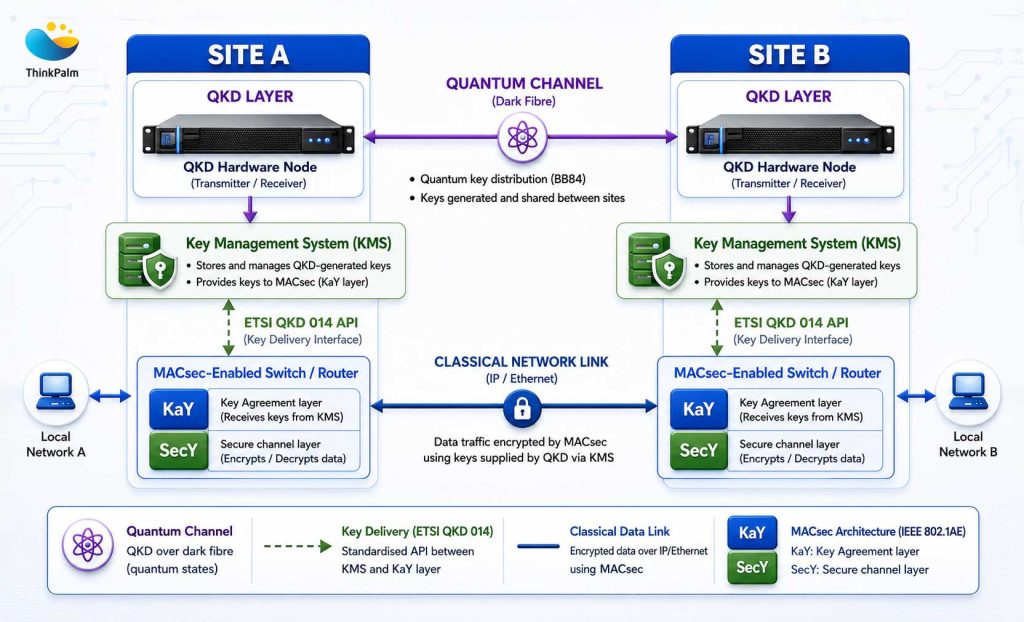
Network architecture diagram showing a QKD implementation with MACsec integration between two sites
QKD and MACsec are complementary technologies that solve different halves of the same problem. MACsec provides Layer-2 MACsec encryption and authentication. QKD provides a quantum-safe mechanism for generating and delivering the keys used by MACsec. Together, QKD and MACsec create a practical framework for quantum-resistant Layer 2 encryption across enterprise backbone networks.
The integration works by replacing MACsec’s classical key exchange mechanism with keys generated and delivered by the QKD system.
Because quantum hardware speaks a different language than standard networking switches, a Key Management System (KMS) acts as the vital software bridge between them. Here’s what it does:
In a live setup, QKD hardware at Site A and Site B continuously generate shared random key material over a dedicated quantum channel. The KMS at each site receives this material and makes it available to the local MACsec KaY.
When a network link requires a key, the MACsec KaY layer bypasses traditional Diffie-Hellman exchanges and requests a quantum key from the KMS via the ETSI QKD 014 API.
The MACsec SecY layer immediately uses this quantum-generated key for AES-GCM encryption of all Ethernet frames on the protected link.
Deploying a QKD-MACsec architecture is a highly strategic infrastructure project. Let us delve into a structured approach that would guide enterprise networks and security teams on how to safely transition from a traditional encryption to a quantum-safe network.
Pinpoint the links that need a post-quantum network security architecture. This could be related to inter-data center backbones, financial transaction networks, or replication paths. Map the physical fiber infrastructure between sites. Assess whether dedicated dark fiber is available. QKD requires a low-loss, low-noise optical path distinct from classical data traffic.
For a successful QKD implementation, choose hardware that meets ETSI GS QKD 011 and ETSI GS QKD 014 standards. Confirm your deployment fits within the standard quantum key distribution protocol distance limits (typically 80–120 km on single-mode fiber). Securely install the transmitter/receiver pairs at both ends of the link.
Deploy a Key Management System (KMS) at each site to harvest quantum-generated keys. Configure the KMS to deliver keys via the ETSI QKD 014 REST API. Automate tight key refresh intervals and monitor key pools to keep your MACsec quantum key distribution integration running continuously.
Confirm network switches and routers support MACsec (IEEE 802.1AE) with hardware-level encryption offload. Configure the KaY layer to retrieve keys from the local KMS via the ETSI API rather than performing standard MKA. Enable MACsec on the network interfaces you want to protect and select AES-256-GCM as your primary, high-security encryption method.
Define your Connectivity Association Key (CAK) policy. Traditional networks rotate keys every few weeks or months, with QKD, you can safely automate key rotation every few minutes or seconds with zero performance overhead. Align rotation policy with your regulatory obligations.
Validate end-to-end frame-level encryption using a protocol analyzer. Simulate a quantum channel disturbance and verify that the KMS detects the anomaly and withholds key material. Run performance benchmarks to confirm line-rate encryption and latency targets. Plan for a hybrid deployment phase in which QKD-supplied keys and classical MKA run side-by-side to ensure stability before the final cutover.
Enterprise-scale quantum-safe networking also depends on strong orchestration and infrastructure management capabilities.
Related Case Study: See how ThinkPalm transformed infrastructure management for a telecom giant with NetvirE.
Read the Case Study →While planning quantum-safe strategies, there are two distinct approaches for decision-makers. It is to address the quantum threat through fundamentally different mechanisms.
Post-Quantum Cryptography (PQC) is a software-based approach that relies on advanced mathematical formulas.
These math puzzles are rewritten, so they are too complex for even a powerful quantum computer to solve. In 2024, NIST finalized its first official post-quantum standards—ML-KEM, ML-DSA, and SLH-DSA—which are now being built directly into TLS 1.3 and application-layer protocols.
PQC provides broad coverage across your software stack at low cost. QKD provides the highest assurance for your most sensitive, high-value links. A true defense-in-depth strategy deploys PQC at the application layer and QKD at the network backbone, ensuring no single point of quantum vulnerability.
Effective cyber security depends on more than legacy defense-in-depth frameworks. Advances in post-quantum cryptography (PQC) like ML-KEM help organizations transition to quantum-safe architectures , secure TLS 1.3, and safeguard enterprise application-layer encryption.
A responsible assessment of QKD deployment must acknowledge the real obstacles. The technology is mature enough for production use in specific contexts, but it is not without constraints. Here are the four most significant challenges and practical paths forward.
The problem: Quantum signals weaken as they move through fiber, and you can’t just amplify them, doing that wrecks the quantum states. So, regular QKD only reaches about 80 – 120 km over standard single-mode fiber.
Solution: Set up trusted relay nodes in between for regional networks. For most data center connections, though, that 80 to 120 km range usually covers it.
The problem: QKD hardware and dedicated dark fiber aren’t cheap—you’re looking at serious upfront costs, which makes rolling it out everywhere hard to justify.
Solution: Start small. Roll out a pilot on just your two or three most sensitive links. The good news is that prices keep dropping as more vendors join the scene. Or you can check out telecom QKD-as-a-Service options instead.
The problem: Those relay nodes in the middle have to store key material in plaintext for a moment, turning them into targets if someone wants to attack your long-haul network.
Solution: Lock things down, use tamper-resistant hardware and strong multi-party security controls at each node. If you want the highest security, combine QKD with post-quantum cryptography (PQC), so someone would have to crack both at once.
The problem: Older networks might not have built-in support for ETSI QKD APIs or MACsec offloading at the hardware level. That makes upgrades necessary.
Solution: Run a MACsec hardware audit right away. Most enterprise switches made in the last five years handle MACsec without breaking a sweat. For the rest, just add standalone inline MACsec encryptors.
Related Case Study: See how ThinkPalm enhanced enterprise network device features and resolved key customer issues.
Read the Case Study →For regulated enterprises, QKD deployment isn’t just a technical decision, it’s a compliance and governance conversation. Here’s the current standards landscape to be aware of:
The European Telecommunications Standards Institute (ETSI) is the primary body governing QKD standards. Use ETSI GS QKD 011 to evaluate vendor hardware requirements and use ETSI GS QKD 014 as the REST API standard to deliver keys from a KMS to network devices. This API is the critical interface for a successful MACsec quantum key distribution integration.
While NIST does not currently have a QKD standard, it finalized its post-quantum cryptography standards in 2024: ML-KEM, ML-DSA, and SLH-DSA. These primarily apply to application-layer protocols and serve as the baseline expectations for enterprise PQC compliance.
Every industry has its own set of challenges. Banks, for example, need to stay flexible when it comes to their cryptography. Defense contractors aren’t just expected to upgrade, they’re told outright to build a network that can survive quantum threats. Healthcare companies, especially those managing patient records that stick around for years, can’t afford to write off the risk of quantum decryption. They need to see it as a real threat and put quantum-proof encryption at the top of their security priorities.
“Organizations in regulated sectors should treat their quantum-safe posture as a certifiable, auditable programme – not a background IT project. Third-party assessment against ETSI and NIST standards is becoming a reasonable expectation in procurement and partner due diligence processes.”
Companies that navigate the quantum transition most effectively are those that start building their quantum-safe posture before a mandate forces their hand. A phased approach lets enterprises control costs, build internal expertise, and progressively layer defenses.
Conduct a thorough cryptographic inventory to identify all encryption in use. Prioritize data sensitivity and longevity, then map your quantum exposure.
Define your target quantum-safe architecture. Select PQC standards for the application layer, identify your QKD target links, and establish your governance and budget.
Deploy QKD-MACsec on one or two priority links. Validate its integration with your KMS, MACsec hardware, and existing operations.
Expand QKD coverage across all high-priority links. Roll out PQC across application-layer protocols and smoothly integrate both into your change management workflows.
Certify your compliance with ETSI, NIST, and sector-specific standards, then complete a third-party audit for regulated environments.
The quantum threat is not theoretical. It is an active operational risk for any organization whose data must remain confidential beyond the next decade. QKD implementation with MACsec is today’s most robust answer to that risk at the network layer. The technology is proven, the standards are in place, and the vendor ecosystem has matured sufficiently for enterprise deployment on priority links.
As enterprises transition to quantum-safe networking, ThinkPalm brings proven expertise across SDN/NFV, enterprise communication systems, network virtualization, and secure connectivity solutions to help organizations build agile, future-ready network architectures.
The question for network and security leaders is no longer whether to act. It’s where to start and how fast to move.
Speak with our experts to evaluate QKD, MACsec, and post-quantum cryptography strategies tailored to your infrastructure. Ready to build your quantum-safe network architecture?
Book a meeting with usNiyas NS is a Senior Tech Lead and data communication protocol developer with deep expertise in L2/L3 protocol development, embedded networking, and carrier-grade platform software. His work covers routing and switching protocols, OpenWrt-based systems alongside network management technologies. He brings particular interest to the convergence of networking, automation, and AI-driven infrastructure.