BLE-Based Wi-Fi Provisioning: A Seamless Approach to Secure Device Onboarding
Wireless Connectivity
 Aleena Thankam Linson
April 28, 2026
Aleena Thankam Linson
April 28, 2026



 Aleena Thankam Linson
April 28, 2026
Aleena Thankam Linson
April 28, 2026
Have you ever tried to connect a smart device to Wi-Fi when it has no screen? No buttons, no display, and nothing to interact with. It could be a sensor on a factory floor, a smart bulb on the ceiling, or a tiny monitor built into a wall. Getting these devices online in the traditional way takes a lot of steps, a lot of manual work, and often means sharing your Wi-Fi password in ways that are not very secure.
This becomes a problem as more and more connected devices show up in homes, offices, and factories. The old methods of adding devices to a network were not built for this kind of scale.
It is to address this issue that the Wi-Fi Alliance created Wi-Fi Easy Connect, which is based on the Device Provisioning Protocol (DPP). Instead of sharing Wi-Fi passwords, it uses a smarter and safer method called public-key cryptography. This makes secure device Wi-Fi onboarding much easier and more reliable.
Now add BLE-based Wi-Fi provisioning to the mix, and things get even better. Bluetooth Low Energy works quietly in the background to help devices get discovered and set up without any manual input. No tapping, no scanning, and no extra steps.
Key Takeaways at a Glance
Wi-Fi Easy Connect is a standardized approach for securely onboarding devices to Wi-Fi networks. It is based on the Device Provisioning Protocol (DPP), which uses public-key cryptography. This eliminates the need to share Wi-Fi passwords directly, improving both security and scalability.
The onboarding process involves two key roles: a Configurator and an Enrollee. The Enrollee device provides bootstrapping information, typically in the form of a DPP URI, to the Configurator. Using this information, the Configurator establishes a secure connection, performs authentication, and provisions the network credentials. The device then connects to the Wi-Fi network using the received configuration.
Wi-Fi Easy Connect supports multiple methods for transferring this bootstrapping information, including QR-based onboarding, NFC, and out-of-band mechanisms such as Bluetooth Low Energy (BLE). These options provide flexibility, allowing the onboarding process to adapt to different device capabilities and deployment scenarios.
Getting headless IoT devices online does not have to be complicated. ThinkPalm’s Wi-Fi Easy Connect solution helps make secure, password-free provisioning a reality for your products.
Network administrators can use Bluetooth Low Energy (BLE) as an out-of-band mechanism to simplify the bootstrapping process in Wi-Fi Easy Connect. Instead of relying on external mechanisms, BLE Wi-Fi provisioning enables direct communication between the Enrollee device and a mobile application, which in turn makes BLE-based Wi-Fi onboarding seamless, especially for headless or inaccessible devices.
In this approach, BLE handles only bootstrapping, while the standard DPP workflow over Wi-Fi continues to manage the actual authentication and provisioning.
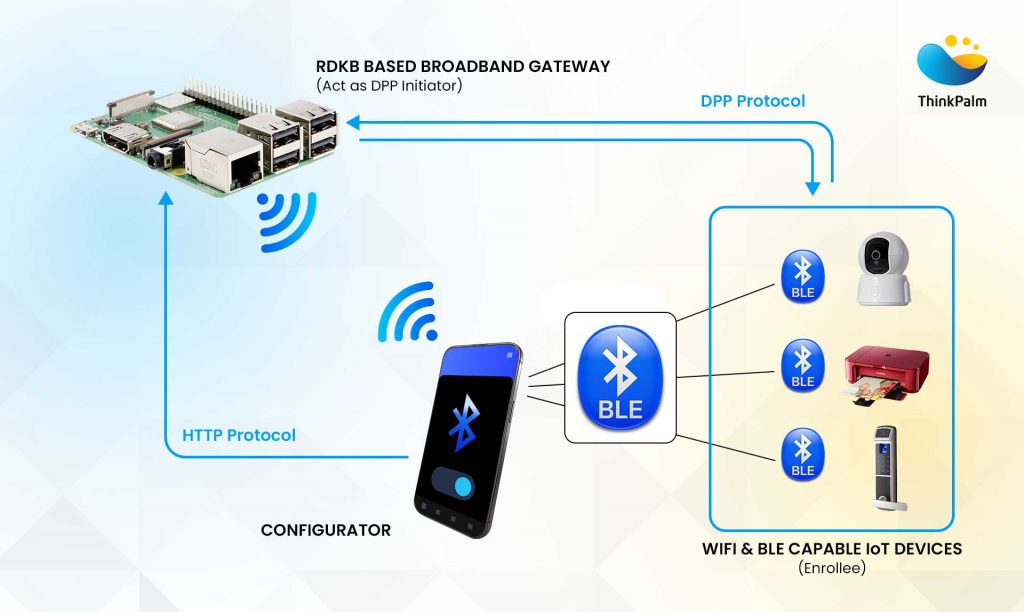
DPP-Based Secure Onboarding for Wi-Fi and BLE IoT Devices
The onboarding process begins at the Enrollee device. The device generates its DPP bootstrapping information in the form of a URI. This URI contains the necessary public information required to initiate a secure DPP session.
Once generated, the device exposes this URI and advertises its presence over BLE, allowing nearby devices to discover it.
A mobile application scans for available BLE devices and identifies the Enrollee. After establishing a BLE connection, the application retrieves the DPP URI directly from the device — a process known as DPP URI transfer. The application then forwards this URI to the RDK-B gateway.
This approach eliminates the need for manual input and simplifies the initial onboarding step, making secure BLE Wi-Fi provisioning practical for real-world deployments.
Once the device obtains the DPP URI, the BLE-based Wi-Fi provisioning process proceeds as follows:
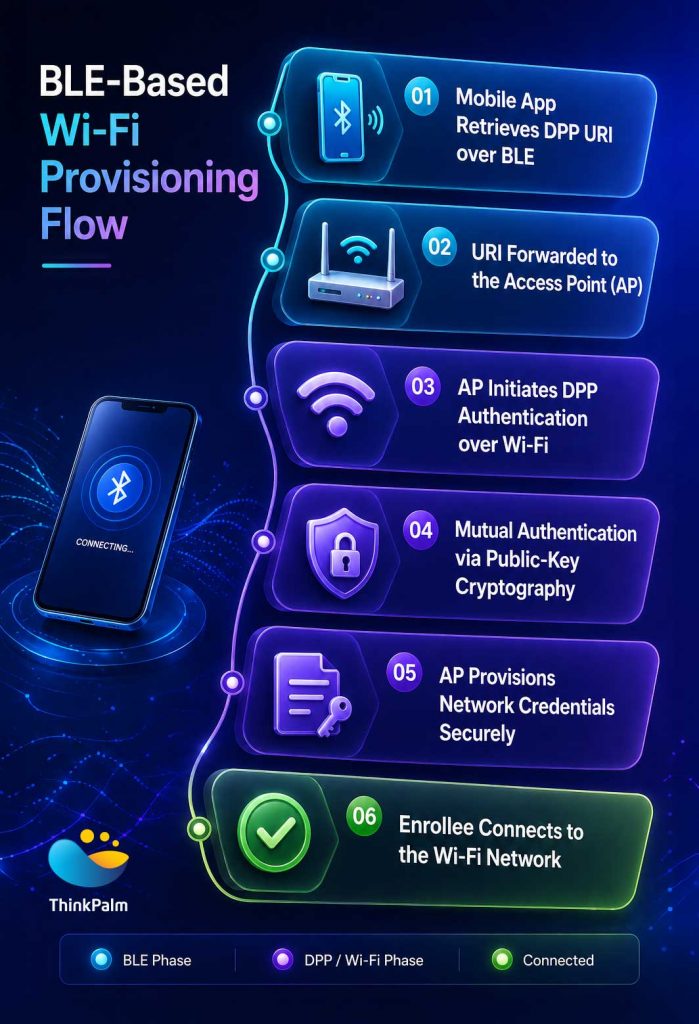
BLE-Enabled Secure Wi-Fi Provisioning Workflow
In this workflow, BLE facilitates the initial discovery and DPP URI transfer, while the Device Provisioning Protocol (DPP) ensures secure authentication and credential provisioning over Wi-Fi.
Want to understand how this plays out at the protocol level? Learn how Wi-Fi Easy Connect is implemented in RDK-B on a real gateway stack to see how headless devices are securely onboarded.
Using Bluetooth Low Energy (BLE) as the bootstrapping mechanism in Wi-Fi Easy Connect offers several practical advantages for modern IoT deployments.
BLE-based onboarding using Wi-Fi Easy Connect suits a wide range of real-world deployments:
Still relying on WPS? See why zero-touch Wi-Fi onboarding is replacing legacy setup methods across smart devices.
At ThinkPalm, we deliver BLE-based Wi-Fi Easy Connect solutions that make secure device onboarding fast, scalable, and production-ready.
From DPP URI transfer over BLE to full end-to-end secure BLE Wi-Fi provisioning, we have the hands-on engineering expertise to bring this capability to life across a wide range of IoT products and platforms.
Whether you are building smart home devices, industrial IoT systems, or enterprise-grade connected hardware, ThinkPalm brings the technical depth to onboard your devices the right way.
No workarounds. No credential sharing. Just clean, standards-based BLE Wi-Fi provisioning that works at scale.
To conclude, Wi-Fi Easy Connect simplifies secure device Wi-Fi onboarding by eliminating the need for direct password sharing and enabling a standardized provisioning workflow. By integrating BLE as the bootstrapping mechanism, the onboarding process becomes more seamless, accessible, and practical for real-world IoT deployments.
This approach combines the usability of BLE Wi-Fi provisioning with the strong security foundation of the Device Provisioning Protocol (DPP) — making it an effective solution for modern connected environments. The DPP URI transfer over BLE handles discovery cleanly, while DPP takes care of authentication and credential delivery.
As IoT ecosystems continue to expand, Wi-Fi Easy Connect using BLE provides a scalable and user-friendly path toward efficient and secure BLE Wi-Fi provisioning. It supports devices of all types and form factors.
BLE-based Wi-Fi provisioning is a method of connecting IoT devices to a Wi-Fi network using Bluetooth Low Energy as a background discovery channel. It combines this with the Device Provisioning Protocol (DPP) to handle secure authentication and credential delivery.
Traditional onboarding requires sharing Wi-Fi passwords and involves multiple manual steps. Wi-Fi Easy Connect applies public-key cryptography through DPP. So, no one shares passwords directly, making the process more secure and scalable.
DPP URI transfer is the process of sending a device’s bootstrapping information from the Enrollee to the Configurator. When done over BLE, it removes the need for manual input, making onboarding faster and more seamless.
Yes. BLE is only used to transfer public bootstrapping information. All sensitive operations like authentication and credential exchange happen within DPP over Wi-Fi, keeping the process fully secure.
Headless devices with no screens or buttons benefit the most. This includes smart home gadgets, industrial sensors, ceiling-mounted devices, and battery-powered IoT hardware.
No. BLE only handles the bootstrapping phase. Once the device receives the DPP URI and completes provisioning, BLE is no longer needed. The device connects purely over Wi-Fi.
Aleena Thankam Linson is a software engineer, experienced in embedded systems and software development. Works in the Wireless and Connectivity domain, focusing on building secure, efficient solutions for modern networking and IoT platforms.