If you have ever dealt with a scheduling nightmare, a sudden demand surge you weren’t staffed for, or a spreadsheet that took three people a full day to update, you already understand why AI in workforce management is becoming less of a “nice to have” and more of a competitive necessity.
The gap is widening fast. Industries that have embraced AI are now generating three times more revenue per employee than those that haven’t. And yet, a huge number of organizations are still running their people operations on legacy systems that were never designed for the pace or complexity of today’s workforce.
At its core, AI workforce management is the use of artificial intelligence to automate, analyze, and optimize how organizations plan, schedule, and manage their people. But it goes deeper than automating a few repetitive tasks.
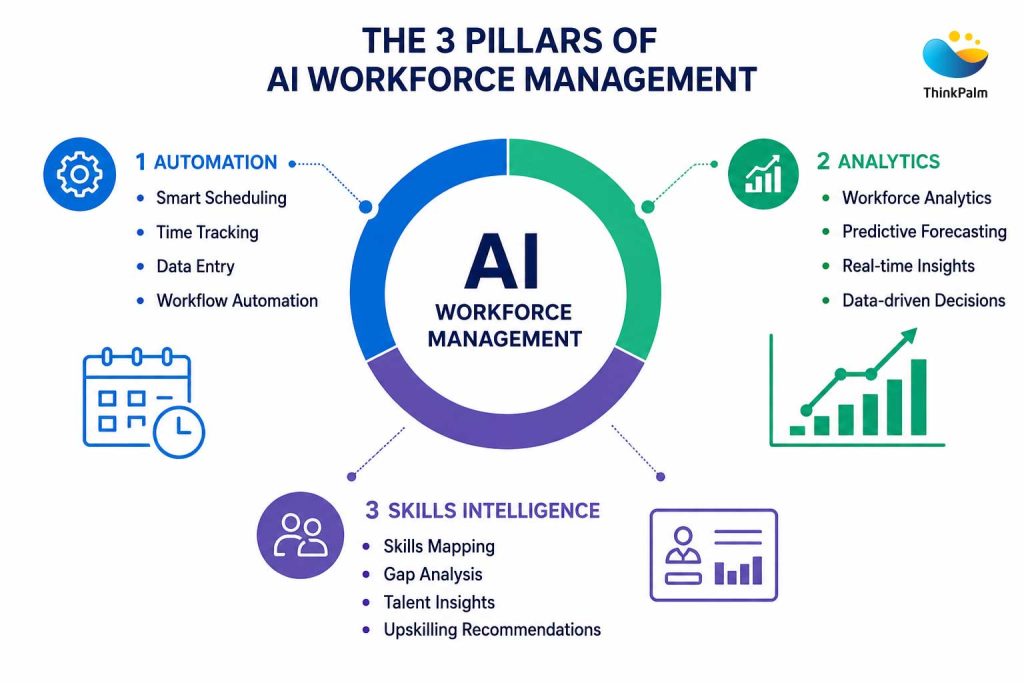
The building blocks of AI-powered workforce management
When done well, it combines three things working together:
Handling routine work like scheduling and data entry
Turning workforce data into real decisions
Understanding what your people can do today and where the gaps are for tomorrow
The role of AI in workforce management has shifted dramatically. It used to mean basic chatbots answering HR FAQs. Now it means systems that can forecast your staffing needs 90 days out, flag a flight risk before someone hands in their notice, and surface internal candidates for a new role before you ever post a job ad.
As organizations move beyond basic automation, many are exploring agentic AI systems that can independently coordinate tasks, make decisions, and execute workflows.
The Honest Reality
88% of HR leaders say their organization hasn’t yet realized significant business value from AI tools.
The tools exist. The gap is in how they’re implemented and embedded into actual workflows.
Source: Gartner
Here’s the honest truth about traditional workforce management: it was built for a simpler time. Manual scheduling still depends on spreadsheets, back-and-forth messages, and a lot of gut instinct. It works until it doesn’t, and when it breaks, it usually breaks at the worst possible moment.
Workforce management automation changes the equation in five key areas:
| Dimension | Manual / Legacy | AI-Powered |
|---|---|---|
| Speed | Hours to days for scheduling cycles | Real-time adjustments, seconds to process |
| Accuracy | Error-prone self-reporting, data silos | Live data feeds, automated reconciliation |
| Scalability | Needs ~2x staff as workload grows | Scales without proportional headcount increase |
| Compliance | Reactive, manual monitoring | Real-time flagging of policy and labor law gaps |
| Planning horizon | Reactive to recent history | Predictive forecasting 30 to 90 days out |
Legacy systems also carry a financial cost that often gets overlooked. Legacy systems also carry a financial cost that often gets overlooked. A single legacy HR platform costs an average of $30 million per organization to operate and maintain annually, and the industry spends over $2 billion a year just keeping outdated infrastructure alive.
This is where things get practical. AI-powered workforce management shows up across the employee lifecycle in ways that are already delivering measurable results across industries.
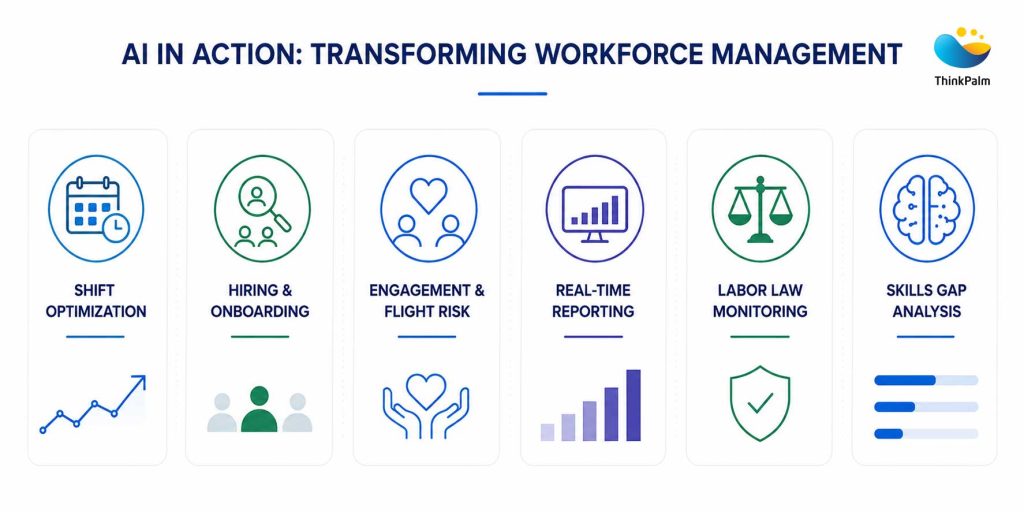
Applications of AI transforming workforce management
AI scheduling tools cut planning time by up to 40% by factoring in real-time demand signals like foot traffic, sales patterns, and seasonal trends, not just last week’s roster.
Language models assess skills fit, eliminate shortlisting bias, and screen candidates. This leads to quicker time to hire and higher quality at the top of the funnel.
AI surfaces patterns in engagement data that are invisible to a manager with 30 direct reports. Early warning signals let you intervene before someone hands in their notice.
AI dashboards provide real-time insight into workforce health, cost, and productivity, as opposed to being a collection of monthly reports from separate systems.
Monitoring shifts and labor law changes, as well as data protection regulations, is a full-time occupation. AI identifies gaps as they happen, before they become legal problems.
AI maps current workforce capabilities against future role requirements, then surfaces upskilling and reskilling priorities automatically.
These capabilities are part of a broader shift toward agentic AI in human capital management, where intelligent systems help automate and optimize HR processes across the employee lifecycle.
Our agentic AI solutions are built to handle the complex, multi-step workflows your teams spend too much time on — from onboarding to compliance to scheduling.
Workforce planning and workforce management are related but distinct. AI in workforce planning answers a harder question than “are we staffed correctly for Tuesday’s shift?” It asks: do we have the right people, with the right skills, in the right roles, for where the business is going?
Here’s what intelligent workforce management brings to that strategic layer:
For HR leaders, this strategic capability transforms workforce planning from an administrative function into a key driver of business growth and organizational resilience.
Related Reading: Discover how succession planning supported by HCM systems helps organizations mitigate leadership gaps and build a stronger talent pipeline.
Workforce optimization through AI is not just about operational efficiency; it’s also about strategic decision-making.
AI can automate repetitive tasks, improve resource utilization, enhance productivity, and provide actionable insights that help managers make faster, data-driven decisions.
By providing greater visibility into skills and performance trends, AI can support employee development and help create more targeted growth opportunities.
Organizations can make more informed workforce decisions, improve talent acquisition and retention, and better anticipate future workforce needs. Over time, AI-enabled workforce planning helps build a more agile organization that can adapt quickly to changing business demands.
Organizations pursuing broader AI workflow optimization initiatives often begin with workforce management because it delivers measurable operational improvements across departments.
The organizations struggling most with AI adoption are usually the ones that tried to do too much at once. Here’s a grounded approach to workforce management automation that actually works:
Before selecting any tool, map where your operations break down most often. Is scheduling the biggest drain? Is workforce planning running on gut feel? Your biggest pain point is your starting point.
“We want to use AI” is not a goal. “We want to reduce scheduling time by 30% in our contact center within six months” is something you can hold an implementation accountable to.
Pick one function, one team, or one location. Prove the value at a small scale before you commit to a full rollout. The organizations that skip this step usually regret it.
Research consistently shows that adapting your operating model to AI has a higher impact on productivity than AI training alone. Your teams need to know how to work with AI outputs, not just have access to a new dashboard.
Define your success metrics before you start, then hold the implementation accountable to them. What gets measured gets improved. Document what you learn in the pilot before you scale.
At ThinkPalm, we help organizations design and build AI solutions that fit their real workflows — not generic demos. Whether you need a custom AI system or just want to explore what’s possible, we’re here to help.
The path here is quite obvious. AI isn’t merely going to help your workforce managers in the years to come. It will be an enabling layer, appearing between your strategy to your teams and your day-to-day operations, and bringing decisions to the surface, flagging risks and managing the routine so your teams can focus on the work that matters to them.
Agentic AI, where systems autonomously handle complex multi-step workflows like onboarding coordination or compliance reporting, is already moving from pilot stage to enterprise-wide deployment. 82% of HR leaders plan to deploy agentic AI within the next 12 months. That shift is happening with or without you.
The businesses that begin to develop the proper data foundations, team skills, and practices now will gain a real advantage as these become table stakes. The gap won’t fill itself if you’re still dealing with your staff as you did five years ago.
AI in workforce management isn’t a distant technology trend anymore. It’s already changing how leading organizations hire, schedule, plan, and retain their people, and the results are showing up in productivity, revenue, and talent quality.
The good news is that you don’t have to transform everything overnight. Start with your biggest pain point, set a clear goal, run a real pilot, and build from there. The organizations winning with AI aren’t the ones who moved fastest — they’re the ones who moved most deliberately.
At ThinkPalm, we’ve helped businesses across industries bring AI into their core operations in a way that actually sticks. If you’re thinking about where AI fits in your workforce strategy, we’d love to be part of that conversation.
Midhula Jeevan is a passionate content writer with a focus on SEO and technical writing. With a love for words and a curiosity for the technical side, she blends creativity with strategy to craft content that stands out. When not writing, you could find her usually reading books, enjoying a good cup of coffee, or chasing golden sunsets.