 Athira Gopakumar
October 28, 2026
Picture a global manufacturing company that employs an AI chatbot to tackle questions from both employees and customers. Initially, this might seem to be a real time-saver, as it can efficiently handle the usual inquiries. However, as the company expands, employees begin to ask more complex questions that need access to internal documents, ERP systems, inventory data, and compliance policies. Unfortunately, the chatbot struggles to retrieve up-to-date information, complete multi-step tasks, or tailor its responses to fit the company’s specific workflows. Instead of making things easier, it ends up adding to the manual workload for teams.
This is where Custom AI Agents come into the picture.
Custom AI agents for enterprises are designed around an organization’s data, systems, and business processes. They can retrieve enterprise knowledge, interact with multiple applications, automate workflows, and support context-aware decision-making. In this blog, we explore how enterprises can identify the right use cases for AI agents, build and integrate them into existing workflows, address common implementation challenges, and measure their business impact.
Definition
A custom AI agent is a tailored AI system crafted specifically for your organization’s own workflows, data, and decision logic.
They differ from generic AI tools designed for broad use cases. It is not typically a one-size-fits-all kind of solution. Instead of just sitting around waiting for a prompt and spitting out text, it can pull information from your internal systems, apply your business rules, take action across various connected applications, and only pass things off to a human when real judgment is needed. That’s the key difference between a tool that merely answers questions and one that truly gets the job done.
Ready-made AI tools are great for enhancing individual productivity like drafting, summarizing, and brainstorming. But in real-world applications, they start to crack.
For a solo user drafting a memo, none of these matters. For a company trying to remove manual work from finance, HR, or customer service, it matters enormously.
Enterprise AI Agents are built to fix the gaps of generic tools. As AI agents for enterprises, they are designed to integrate with business systems, automate workflows, and support governance at scale. Listed below are a set of reasons that make them distinctive and set them apart from anything you can buy off a shelf:
They connect directly to your CRM, ERP, HR, and document platforms. This saves the hassle for employees to keep bouncing between five tabs to finish one task.
Role-based access, audit logging, and compliance controls are built into the foundation right from the beginning. Therefore, it does not have to be fitted later.
A single agent can handle end-to-end automation, i.e. it can pull data, apply logic, complete a task, and notify the right people. A human does not have to interfere in each and every step to pass the baton. This makes AI agents for business automation a strategic investment for enterprises looking to streamline operations while reducing manual effort.
As they are trained in your own documentation and history, the responses given by these agents reflect how your company operates. They do not offer generic advice as they learn from your company’s files.
This is exactly why many organizations are starting to see custom AI agents for enterprise use as essential infrastructure, rather than just a side experiment in their “real” tech stack. This shift in perspective is also driving the growing demand for AI agents across various sectors, including finance, operations, and customer service.
Modernizing legacy systems is often the first step toward enterprise AI adoption. Explore our blog on AI-Led Legacy Modernization: Real-World Use Cases Across Industries to see how businesses are integrating AI with existing systems to improve efficiency, scalability, and innovation.
| Feature | Off-the-Shelf AI | Custom AI Agents |
|---|---|---|
| Setup | Fast, plug-and-play | Built around your workflows |
| Customization | Limited | Fully tailored |
| Business context | Generic | Organization-specific |
| System integration | Basic, surface-level | Deep, native connections |
| Security & governance | Standard | Enterprise-grade controls |
| Automation depth | Single tasks | Full end-to-end processes |
| Growth path | Caps out quickly | Built to scale with you |
In short, if the goal is personal productivity, off-the-shelf tools do the job. But if the goal is operational transformation, then custom AI agents are the only path that actually gets you there.
This isn’t a theoretical debate anymore. Enterprise AI agents are moving from pilot projects into production workflows fast, and the numbers back it up.
40%
of enterprise applications predicted to integrate task-specific AI agents by the end of 2026, up from less than 5% in 2025
Source: Gartner
57%
of active AI agent adopters report direct operational cost savings within their first year of deployment, while 66% report measurable productivity gains
Source: PwC AI Agent Survey
The strongest returns tend to show up in the departments carrying the most repetitive, rule-based tasks in high-volume departments.
These examples prove how AI agents for enterprises accelerate productivity and reduce operational costs. Enterprises are now largely using AI for Business Process Automation to modernize operations across departments. Underneath each of the use cases sits the same core technology: LLM-powered AI agents that can reason over unstructured information, not just fill in a form.
Once you have decided to build custom AI agents, you need to have clear business objectives before proceeding with custom AI Agent development. Let us explore some of the steps that would help in building custom AI agents for enterprises:
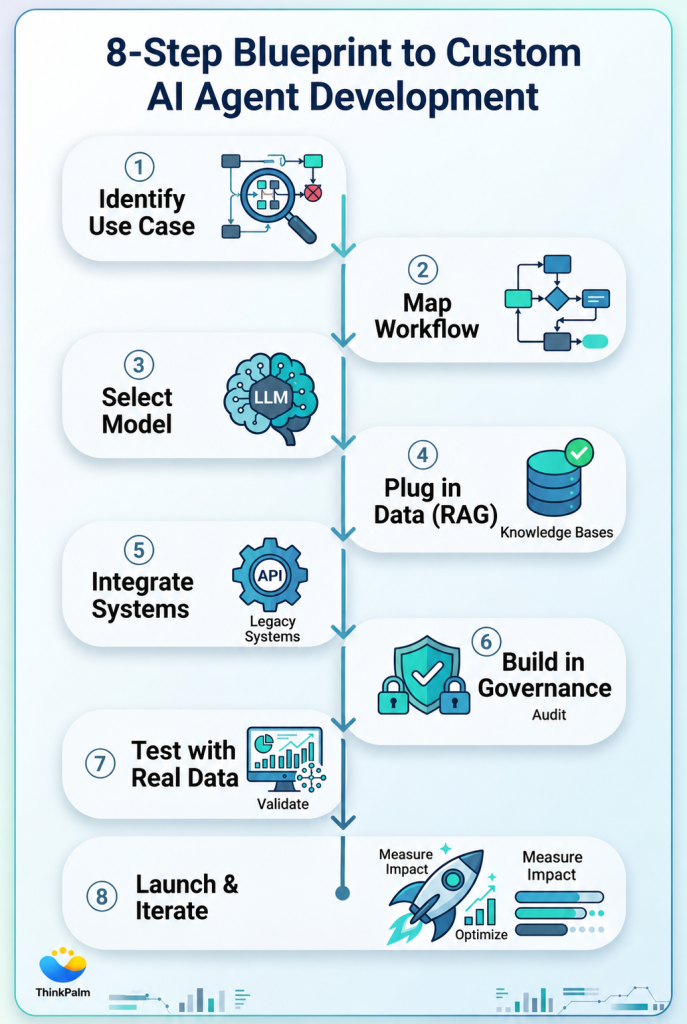
8-Step Blueprint to Custom AI Agent Development
Start by identifying a task that is repetitive, time-consuming, and costly to handle manually.
Make an outline of every single step, system hand-off, and edge case in your current process.
Choose suitable LLM-powered AI agents that suit the speed, accuracy, and budget needs of the task.
Use RAG (Retrieval-Augmented Generation) for enterprise AI agents so the agent can retrieve relevant information from your internal business knowledge sources to generate context-aware responses.
Connect the agent to your CRM, ERP, and internal software using secure APIs.
Build strict access rules, data permissions, and audit logs before rolling them out.
Evaluate performance using actual historical work scenarios rather than fake test data.
Go live, measure impact against core business metrics, and refine performance over time.
Most enterprises partner with an experienced AI development team to move through this faster, while keeping scalability and compliance intact from the start.
See how ThinkPalm designs agentic AI systems for enterprise teams.
Explore Agentic AI Development Services →Building effective AI agents means avoiding the common traps that derail early projects. These failure patterns reflect across industries, regardless of company size:
The winning strategy for most enterprises is usually a combination of both where off-the-shelf tools handle everyday tasks like writing drafts, summarizing docs, and managing schedules. Then custom AI agents can take care of the high-value operations that give your company a competitive edge in the market.
This balanced approach is fast becoming the standard enterprise blueprint, as it gives organizations the best mix of speed, cost efficiency, and total control over their core IP.
The goal isn’t choosing between custom and ready-made, it’s mapping the right tool to the right workflow.
If you’re evaluating custom AI agents for enterprises, these indicators can help determine whether your organization is ready to invest in a tailored AI solution:
If your needs stop at content drafting or meeting summaries, an off-the-shelf tool is still the right call. If you’re trying to remove manual work from how the business actually runs, custom AI Agent development is where the ROI lives.
Custom AI agents help enterprises go beyond one-off AI tasks. They connect business knowledge, applications, and actions into workflows that run end to end. But their value depends on how well they solve a specific business need and fit into the way your teams already work.
A successful implementation starts with a clearly defined use case, a well-mapped workflow, and goals you can measure. Once these are in place, you can connect the agent to the right business systems, set up security and governance controls, and test how it performs before rolling it out more widely. After launch, regular monitoring and fine-tuning keep the agent useful as your business needs change. From identifying the right use cases to integrating AI agents into enterprise systems, ThinkPalm helps businesses turn workflow automation goals into practical implementations.
You don’t need to automate everything at once. Start with one high-impact workflow and record where you stand today. Then track results such as task completion rates, processing time, accuracy, and manual effort saved. These numbers give you a practical base to build on as you bring AI agents to more teams and departments.
Ready to Automate Your Enterprise Workflows?
Athira Gopakumar is a Digital Marketing Specialist in the tech industry, with a strong focus on IoT marketing. She specializes in data-driven strategies, leveraging SEO, content marketing, and market research to enhance brand visibility and lead generation for IoT solutions. Passionate about the intersection of technology and marketing, she stays ahead of industry trends to drive impactful campaigns. Outside of work, she enjoys traveling to new places and dancing to unwind.
One message is all it takes to get started. Tell us what you need, and we’ll take it from there, no long forms, no waiting around.

