Vision 2030: Scaling Enterprise AI and Autonomous Systems
Artificial Intelligence
 Athira Gopakumar
October 13, 2026
Athira Gopakumar
October 13, 2026



 Athira Gopakumar
October 13, 2026
Athira Gopakumar
October 13, 2026
Most enterprises have already started their AI journey. Far fewer have actually scaled it. Pilots multiply across departments, proofs of concept get approved in quarterly reviews, and yet the majority of these initiatives never make it into daily operations at a meaningful scale. This is the gap between experimenting with AI and running a business on it.
By 2030, that gap will define which companies lead their industries and which ones spend the next decade catching up. Enterprise AI is no longer a side project owned by a data science team. It is becoming core infrastructure, as fundamental to how a company operates as its cloud platform or its ERP system. Alongside it, autonomous systems, including autonomous AI agents that can plan, decide, and act with limited human input, are moving from experimental tools to production systems that run real workflows.
This article lays out where enterprise AI stands today, why 2030 is shaping up to be a defining moment, and what a practical path from pilot to full-scale, intelligent enterprise actually looks like.
Definition
Enterprise AI refers to the organization-wide adoption of artificial intelligence to automate processes, enhance decision-making, and improve business performance across departments. Unlike consumer AI applications designed for individual use, Enterprise AI integrates with business systems, enterprise data, and workflows to deliver organization-wide intelligence.
Enterprise AI is the application of artificial intelligence technologies, including machine learning, natural language processing, computer vision, predictive analytics, generative AI, and increasingly agentic AI, across an organization’s operations, systems, and decision-making processes. Rather than a single tool solving a single problem, enterprise AI is a capability that touches multiple departments, integrates with existing business systems, and operates under the security and compliance standards a large organization requires.
This is what separates enterprise AI from the AI tools most people use individually. A useful way to think about it is that enterprise AI is built to serve an organization, not a person.
Consumer AI tools are designed for one person doing one task at a time. Someone might use a chatbot to draft an email or a coding assistant to debug a script. These tools are valuable, but they operate in isolation. They do not typically connect to a company’s CRM; they are not monitored for compliance across thousands of users, and they are not built to be governed at scale.
Enterprise AI works differently. It needs to:
A consumer AI tool helps an individual get more done. Enterprise AI, when implemented well, changes how the entire organization operates.
This shift is bigger than any single vendor’s roadmap. Our practical guide to enterprise agentic AI breaks down what enterprise-ready agentic AI actually requires.
The enterprise AI market is growing fast, and the growth is not evenly distributed. According to Arizton, the global enterprise AI market is projected to grow from roughly 24.2 billion dollars in 2024 to nearly 71 billion dollars by 2030, a compound annual growth rate of close to 20 percent. McKinsey has projected that AI could eventually automate up to 70 percent of business activities, a figure that signals just how far this technology is expected to reach into everyday operations.
Yet growth in spending has not translated into equivalent growth in maturity. Research consistently points to a “pilot purgatory” problem, where a large share of AI initiatives never graduate from experimentation into production. According to Boston University’s analysis of McKinsey’s State of AI survey, nearly two thirds of organizations have not scaled AI across the enterprise, even as adoption of individual AI tools has become close to universal. The bottleneck usually is not the technology itself. It is data readiness, unclear ownership, weak governance, and a lack of a coherent enterprise AI strategy connecting isolated projects to business outcomes.
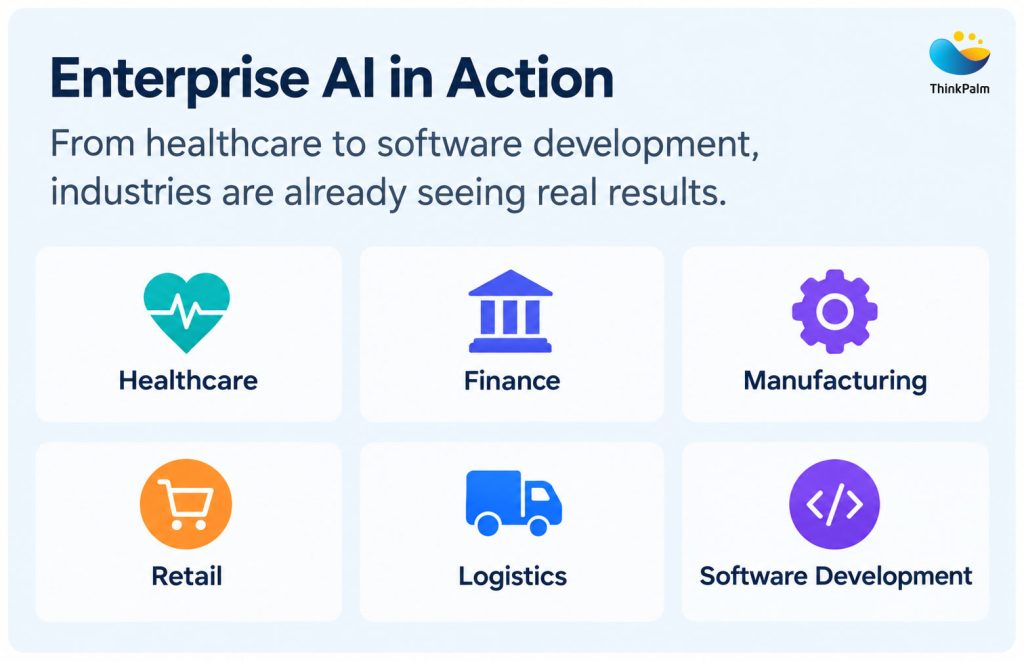
Industries where enterprise AI is applied.
Several forces are converging around 2030 that make this more than an arbitrary target year.
First, the technology itself has matured. Generative AI and agentic AI have moved from novelty to genuine production capability within the space of a few years, and the pace of that improvement shows no sign of slowing.
Second, competitive pressure is intensifying. As AI becomes accessible to every company in an industry, using it well stops being a differentiator and starts being table stakes. The advantage shifts to organizations that build AI-first processes shaped around their own data and workflows, rather than applying generic tools to existing ways of working.
Third, regulatory and governance frameworks are catching up. Fragmented AI regulation is expected to cover a large share of the world’s economies within the next few years, and enterprises that build governance discipline now will face far less disruption than those trying to retrofit it later.
By 2030, the question for most enterprises will no longer be whether to adopt AI. It will be whether they adopted it early enough, and thoughtfully enough, to have built a genuine advantage from it.
For years, enterprise automation meant scripted, rule-based systems. A workflow would trigger a specific action when a specific condition was met, and it would do exactly that action every time, nothing more. This kind of automation is reliable and still valuable, but it is fundamentally limited. It cannot adapt when a situation falls outside its predefined rules.
Autonomous AI agents represent a different category of capability. These are systems that can reason through a goal, break it into steps, decide which tools or data sources to use, execute those steps, and adjust their approach when something does not go as expected, all with limited ongoing human direction. This is the essence of autonomous systems in an enterprise context: software that does not wait for an instruction at every step, but instead works toward an outcome.
The distinction between a scripted task and true autonomy matters more than it might seem. To understand where autonomy begins, explore what are AI agents and how they work before deciding where it fits into your own workflows.
These three terms get used interchangeably in a lot of marketing content, but they describe meaningfully different levels of capability.
| Category | What It Does | Example |
|---|---|---|
| Enterprise automation | Executes a fixed, rule-based process with no judgment involved | A workflow that automatically routes an invoice to a manager once it exceeds a set dollar amount |
| Agentic AI | Reasons through a goal, plans multiple steps, and can use tools or data sources to complete a task | An agent that researches a customer account, drafts a personalized renewal proposal, and flags it for approval |
| Autonomous systems | Operates with a broader scope of independent decision-making, often coordinating multiple agents across a process with minimal human checkpoints | A multi-agent system that manages an end-to-end supply chain reordering process, adjusting forecasts and placing orders without a human triggering each step |
Understanding this distinction matters because it changes how much oversight a given system needs. Rule-based automation is predictable and low risk. Agentic AI introduces more flexibility and more responsibility for good governance. Fully autonomous systems require the most careful guardrails, because mistakes can scale as quickly as the system’s decisions do.
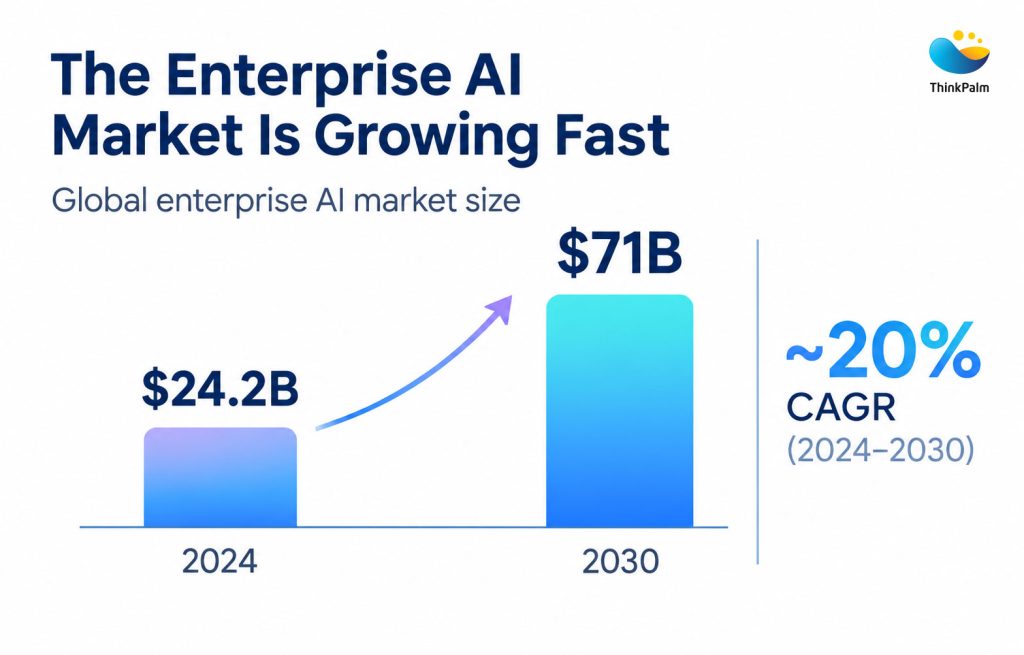
Projected growth of the global enterprise AI market from 2024 to 2030.
Scaling AI successfully starts well before any technology is selected. A successful AI transformation begins with strategy rather than technology, and organizations that scale AI effectively align every initiative with measurable business objectives rather than chasing “AI for AI’s sake.”
Start by identifying high-impact business challenges that AI can actually solve. Examples include:
When AI projects address measurable business outcomes, whether that is reducing cost per transaction, improving customer retention, or cutting cycle time on a specific process, organizations achieve faster adoption and stronger ROI.
AI is only as effective as the data it learns from. Businesses should focus on:
Clean, accessible, and well-governed data enables AI systems to generate accurate insights and reliable predictions. Many organizations only discover data infrastructure gaps after launching an initiative, which is far more expensive to fix than addressing it upfront.
Enterprises need to decide early whether they are building a centralized AI platform that serves multiple business units or a more distributed model where teams operate their own AI capabilities within shared standards. Neither approach is inherently better, but the choice shapes everything that follows. Modern cloud-native architectures make this decision easier to act on, allowing businesses to deploy scalable AI solutions across multiple departments without rebuilding infrastructure from scratch.
Responsible AI should be part of every enterprise AI strategy from day one, not something added after a problem occurs. Key considerations include:
Approval checkpoints, audit trails, and clear ownership need to exist before autonomy expands, not after.
An enterprise AI strategy that focuses only on technology and ignores how people’s roles will change is incomplete. The organizations that scale successfully tend to invest as much in reskilling and change management as they do in the AI systems themselves.
One of the biggest trends shaping Vision 2030 is the emergence of Autonomous AI Agents. Deloitte’s research, reported by the World Economic Forum, points to the agentic AI market growing from roughly 8.5 billion dollars in 2026 to an estimated 45 billion dollars by 2030, and the same research found that 74 percent of companies plan to deploy agentic AI within two years.
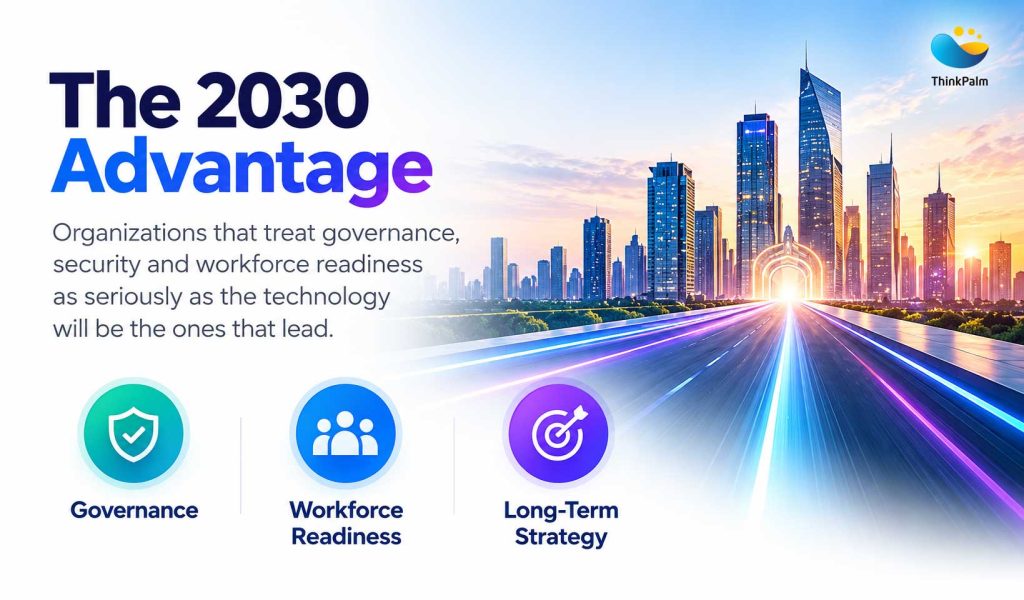
How organizations would benefit from the 2030 advantage.
This growth is being driven by a combination of better reasoning capabilities, persistent memory that lets agents retain context across sessions, and emerging interoperability standards that allow agents built on different platforms to work together. Major platforms including Salesforce, Microsoft, and ServiceNow have restructured significant parts of their product lines around agentic capabilities, which is itself a signal of how quickly this shift is being taken seriously at the enterprise level.
Unlike traditional chatbots, autonomous agents can:
Similarly, software development teams can use autonomous AI agents to generate code, review pull requests, identify vulnerabilities, automate testing, and monitor deployments.
These capabilities enable organizations to scale enterprise AI automation while allowing employees to focus on higher-value work.
Enterprise AI is not a single use case. It looks different depending on the industry, the regulatory environment, and the nature of the work being automated or augmented.
Enterprise AI supports clinical decision support, administrative automation, and operational efficiency. Predictive models flag patients at risk of readmission, while natural language processing reduces the documentation burden on clinical staff. Autonomous systems are increasingly used for scheduling and revenue cycle management, where decisions are largely operational rather than clinical, making them a reasonable early candidate for autonomy.
Beyond long-standing use cases like fraud detection and risk modeling, autonomous AI agents now assist with compliance monitoring, personalized financial advice at scale, and automated underwriting. Because financial decisions carry significant regulatory and reputational stakes, human review stays built into the highest-stakes decision points.
Predictive maintenance flags equipment issues before they cause downtime, and AI-driven quality control catches defects manual inspection often misses. Some manufacturers are piloting autonomous supply chain and production scheduling systems that adjust in real time to demand and equipment signals.
Enterprise AI powers demand forecasting, dynamic pricing, and personalized customer experiences at a scale no human team could match. Autonomous AI agents handle inventory reordering based on real-time sales data and manage a growing share of routine customer service inquiries end to end.
Autonomous coding agents now write tests, review pull requests and implement small features from a specification with limited supervision. It’s a useful case study in both directions: dramatically increased throughput, but a clear reminder that code which looks correct can still hide bugs or security issues without human review.
Thinking about where agentic AI fits into your roadmap? From identifying the right use cases to building the governance around them, we help enterprises turn autonomous AI agents into production-ready systems.
Explore Our Agentic AI Development Services →Moving from isolated pilots to enterprise-wide scale works best as a deliberate, phased process rather than an all-at-once rollout.
Assess data quality and accessibility, establish governance principles, and identify the two or three highest-value use cases based on clear business impact rather than novelty.
Move successful pilots into production with defined success metrics, and begin introducing agentic capabilities in lower-risk, operationally focused workflows where mistakes are recoverable.
Extend proven use cases across departments, connect previously siloed AI initiatives under a shared platform or standard, and begin coordinating multiple agents across a single end-to-end process.
Expand autonomy into higher-stakes workflows only where governance maturity supports it, with continuous monitoring and human oversight calibrated to the actual risk of each decision, not a blanket policy applied everywhere.
Certain practices consistently separate organizations that scale AI successfully from those that stay stuck in pilot mode.
Organizations that follow this kind of disciplined approach consistently improve operational efficiency with AI in measurable ways.
The endpoint of this trajectory is what is often called the intelligent enterprise: an organization where data is embedded across systems, processes, and decision points, and where AI operates as infrastructure rather than a bolt-on feature. In an intelligent enterprise, insights are generated continuously rather than pulled together for periodic reports, and autonomous AI agents handle a meaningful share of operational decisions under clear governance, freeing people to focus on judgment calls, strategy, and the kind of work that genuinely benefits from human oversight.
Getting there does not happen by accident. It is the result of a deliberate enterprise AI strategy, a realistic framework for scaling, and a willingness to invest in governance and people alongside the technology itself. The organizations that reach 2030 as intelligent enterprises will not necessarily be the ones that adopted AI earliest. They will be the ones that scaled it most deliberately.
Enterprise AI has moved well past the experimentation phase, and autonomous systems are rapidly becoming a core part of how leading organizations operate. The gap between companies that talk about AI and companies that run on it will only widen between now and 2030. Closing that gap does not require chasing every new capability as it emerges. It requires a clear strategy, a realistic view of where autonomy makes sense today, and the discipline to build governance and data foundations that can support growth rather than break under it.
The path to becoming an intelligent enterprise is available to any organization willing to treat AI as a long-term operating capability rather than a short-term project. The companies that start building that foundation now will be the ones setting the pace in 2030, not the ones trying to catch up to it.
This is exactly where ThinkPalm comes in. Our AI development services help enterprises move past the pilot stage, building the data foundations, governed autonomous agents, and scalable architecture needed to turn a promising proof of concept into a system that actually runs the business.
Ready to scale your enterprise AI strategy? Let’s talk about what that looks like for your business.
Athira Gopakumar is a Digital Marketing Specialist in the tech industry, with a strong focus on IoT marketing. She specializes in data-driven strategies, leveraging SEO, content marketing, and market research to enhance brand visibility and lead generation for IoT solutions. Passionate about the intersection of technology and marketing, she stays ahead of industry trends to drive impactful campaigns. Outside of work, she enjoys traveling to new places and dancing to unwind.