How to Build a Scalable, Data-Driven HR Software Test Automation Framework
Testing as a Service (TaaS)
 Priyanka K
April 23, 2026
Priyanka K
April 23, 2026



 Priyanka K
April 23, 2026
Priyanka K
April 23, 2026
The world of HR Tech systems looks simple on the surface. Imagine, a candidate applies for a job, gets selected, accepts the offer, and joins the organization. This process seems smooth and well-structured. However, behind this seemingly straightforward process lies a complex network of workflows, system dependencies, and compliance requirements that must align and work together.
After a candidate accepts a job offer through the organization’s Talent Acquisition system, the HR initiates the onboarding formalities. They begin collecting signed documents, make arrangements for laptops, setting up corporate email accounts, payroll systems, tax, and salary setups. This means multiple systems, teams, and integrations now need to work in sync to ensure a smooth transition.
But things rarely go as planned. On day one, chaos erupts. Login fails, no laptop, payroll ID mismatches. Eventually, onboarding stalls. Days are wasted chasing data across apps. This creates frustration for both the employer and the employee. The result? Instead of focusing on productivity, HR teams spend hours chasing data causing operational delays and early employee dissatisfaction. That’s where we need to think of HR Software Test Automation.
Blog in a nutshell
In this blog, we shall discuss the need for building a comprehensive HRMS Test Automation framework for covering modules like recruitment, onboarding, Payroll, and T3S systems. By combining hybrid architecture, data-driven testing, and CI/CD integration, businesses can ensure end-to-end test coverage and faster software releases. With strong QA strategy and AI-driven enhancements, HR software testing becomes more scalable, consistent, and future-ready.
The chief purpose behind this framework was to build a system to ensure that all parts of HRMS function well. In this way, the team can ensure a smooth HR workflow, every time there’s a new update in recruitment, payroll, or onboarding test automation framework.
The framework was meant to deliver strong test coverage across APIs, UI layers, and complete end-to-end scenarios for the entire product life cycle. In addition, integrating CI/CD pipelines would enable the team to receive faster feedback on every code change.
Above all, the framework was to be scalable to grow with evolving business needs and accommodating new features or additional HR modules. A robust, data-driven testing as a service strategy was also essential to maintain reliability and consistency, especially in environments in environments where test data changes frequently.
Building an HRMS test automation framework aims at handling complex, interconnected HR workflows. It can very well scale up business growth. It includes defining testing goals, selecting the right tools, designing a flexible architecture, managing dynamic HR data, and integrating automation into CI/CD pipelines to ensure reliable, maintainable, and future-ready HR software testing.
The HR workflow management system organizes a set of factors like employee IDs, job roles, grades, etc. Hence testing each module becomes crucial, with the help of test data for automation purposes. Several test strategies can be used to handle the framework using hybrid architecture:
| Layer | Description | Tools / Tech Stack |
| Test Runner Layer | Executes the tests, manages configuration, and tagging | Playwright + Cucumber |
| Business Logic Layer | Contains workflows like creating positions, approving offers, or exporting attachments | Custom TS Classes |
| Page Objects (UI) | Encapsulates UI locators and actions | Playwright |
| API Services Layer | REST API automation using reusable request builders | Axios / Supertest |
| Data Layer | Handles dynamic test data creation and cleanup | JSON / DB / Mock APIs |
| Reporting Layer | Generates execution reports, screenshots, and logs | Allure / HTML Reporter |
| Config Layer | Stores environment-specific settings | .env / config files |
The HR software systems rely on several interdependencies, like employee IDs, job roles, pay grades, etc. Therefore, managing test data is extremely important to attain the best results. These interdependencies need to be thoroughly verified to ensure better accuracy.
| Source | Usage |
| Mock APIs | Simulate third-party dependencies like Payroll or Document Sign APIs |
| Database (SQL/NoSQL) | Persistent test data storage |
| JSON/YAML Files | Lightweight configuration-driven data |
| Excel/CSV | Legacy or business-driven validation |
Effective succession planning hinges not just on identifying talent but developing leaders who can inspire teams and navigate change.
Explore why Emotional Intelligence is a key ingredient in leadership effectiveness .
There is a need for integrating test automation into the CI/CD pipeline, that helps in delivering faster, more reliable HR software releases. Furthermore, with CI/CD in place, every code change is automatically tested. This helps HRMS teams catch issues early and maintain confidence in each deployment.
How the CI/CD workflow operates:
| Function | Tool |
| Source Control | GitHub / Bitbucket |
| CI/CD | Jenkins / GitHub Actions |
| Test Execution | Playwright + Cucumber |
| Reporting | Allure / HTML Report |
| Notifications | Slack / Email |
| Environment Management | Docker / Node Env |
| Aspect | Traditional HR Testing | HR Test Automation |
| Execution Speed | Slow, manual | Fast, automated |
| Scalability | Limited | Highly scalable |
| Test Coverage | Basic workflows | End-to-end, cross-module |
| Data Handling | Static test data | Dynamic, data-driven |
| CI/CD Compatibility | Low | High |
| Reliability | Prone to human error | Consistent and repeatable |
Quality Assurance plays a pivotal role in making the test automation framework for HR software more enhanced and future ready. However, we need to realize that QA engineers are not just about writing test scripts. They shape the entire architecture, ensure test coverage, manage data, enable CI/CD integration, etc. In short, it is all about driving continuous improvement across the HR tech platform.
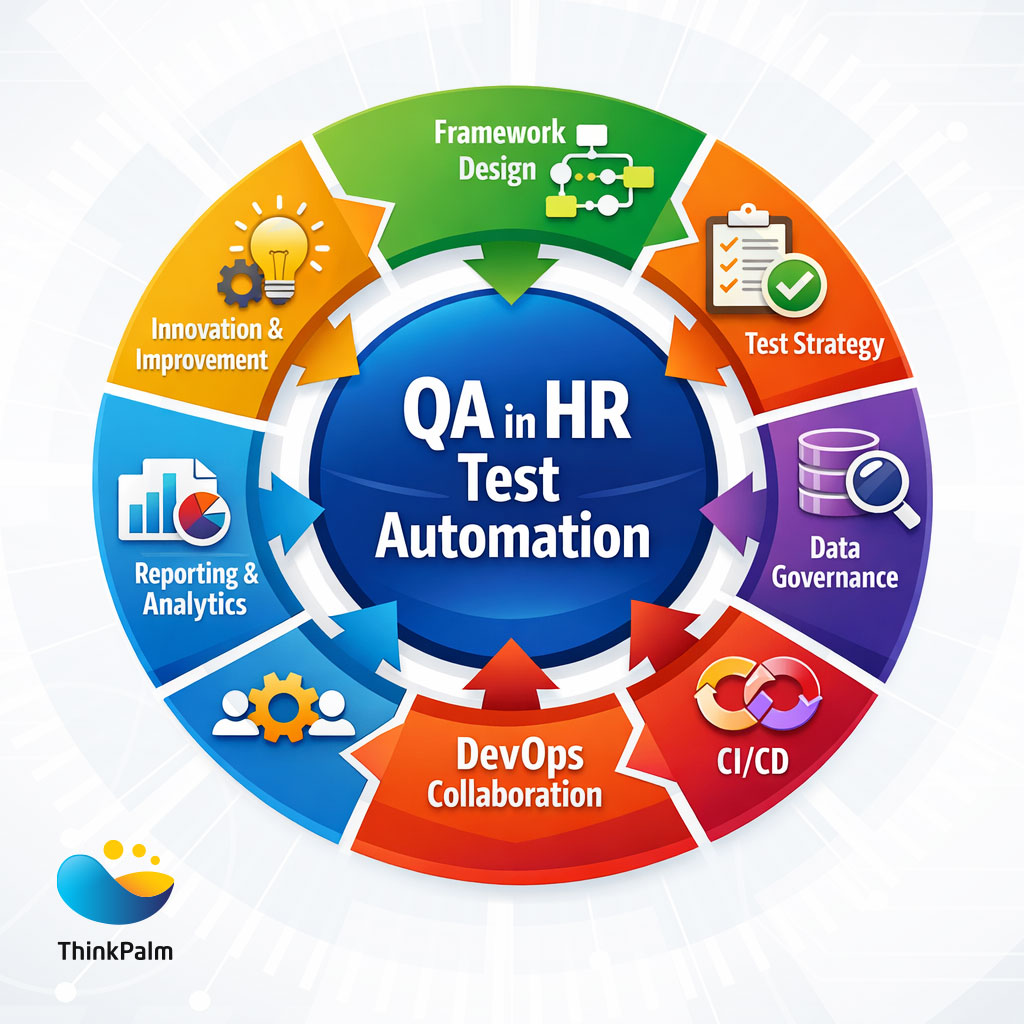
QA in HR Test Automation
QA architects plan the framework structure, design patterns, and reusable libraries. In this way, they try to align the automation architecture with various HR module workflows such as payroll, time sheet, onboarding, etc.
Key Benefit: QA supports the framework’s scalability, maintainability, and CI/CD compatibility
The QA teams plan a testing strategy covering UI, API, and end-to-end HR workflows.
This helps them to integrate high-risk business processes like onboarding, leave approvals, or payroll runs.
Key benefit: All test cases enable parallel execution and modular reuse across multiple releases.
The HR systems are to handle sensitive and interconnected data. Hence, QA formulates the rules for test data management. These rules are related to masking employee information, generating safe test data, maintaining versions, and running automated cleanup after execution.
Key benefit: Ensures that every environment be it, QA, staging, or UAT has consistent, reliable data.
QA engineers often plan the design in a way that they build reusable automation components such as page objects, utilities, and API wrappers. They constantly review and update the code for readability and maintainability. Therefore, they can ensure the automation framework follows QA best practices for HR tech platforms like proper naming, tagging, and version control.
QA ensures that the automation suite works well within the CI/CD pipeline. They also partner with DevOps to set up efficient test environments using Docker or cloud containers
Key benefit: Constantly monitors build stability and use analytics to track quality trends over time.
QA teams make the best of dashboards using tools like Allure or Grafana. This helps in highlighting test results, failures, and execution patterns. As a result, they can identify flaky tests, highlight performance issues, and recommend improvements.
Key benefit: Data-driven decisions equip the team to deliver better quality before each release.
QA teams focus on innovation and continuously look for ways and means to improve HR software test automation. Additionally, they experiment with AI-based test prioritization, self-healing locators, accessibility testing, and newer frameworks to keep the system modern and scalable.
Key benefits: Keeps the system updated with evolving trends to ensure better quality standards and gain a competitive edge in the market.
To sum up, these practices help with HR Technology Quality Assurance to ensure that HR software remains scalable, reliable, and future-ready for smoother deployments.
See how AI automation accelerated HR transformation. Read the Success Story to learn about 50% Faster Payroll Implementation
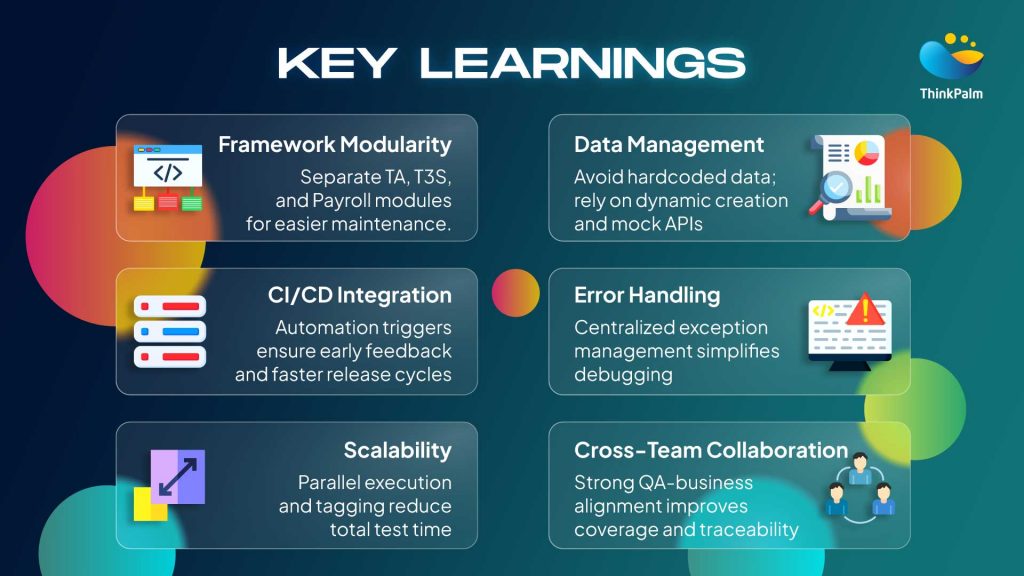
Key learnings from building a scalable HR software test automation framework
With further additions in the Test data management in HR applications, the automation framework can be further enhanced to make it more future ready in the following ways:
Using AI helps to decide which tests to run first. Hence, testing becomes faster and smarter.
Adding performance testing and accessibility testing, to ensure the HR software works quickly and is usable for everyone.
Using auto-healing locators, which automatically update themselves when the UI changes, reduces test failures.
Improving analytics dashboards, so teams can track test trends and quality issues more easily over time.
These advancements align with the broader shift toward intelligent HR ecosystems powered by agentic AI. Learn more in our blog on how Agentic AI is redefining HR workflows and accelerating digital transformation in HCM systems.
Building an HR Software Test Automation framework is not just about writing scripts but designing strong QA leadership moving away from traditional testing to delivering greater speed, product stability and long-term scalability. At ThinkPalm, we aim at embedding Automated Testing for HR Systems to maintain consistency across modules like Talent Acquisition (TA), Payroll, and T3S systems. By designing the architecture of the HR Software Test Automation framework, we are building a next-generation automation framework. Enhancing the platform with AI-driven test prioritization, auto-healing UI elements, and advanced analytics can make the system future-ready.
HR software manages complex, interconnected workflows across recruitment, onboarding, payroll, IT, and compliance. Test automation helps identify integration issues early, ensures data consistency across modules, and prevents workflow failures that can impact employee experience and business operations.
A scalable HRMS test automation framework uses layered architecture, reusable components, API-first testing, and data-driven strategies. It can easily accommodate new HR modules, changing workflows, and growing test coverage without increasing maintenance effort.
Data-driven testing allows HR applications to be validated using dynamic and environment-specific data such as employee IDs, job roles, and payroll details. This improves test accuracy, reduces false failures, and ensures reliable validation across QA, staging, and UAT environments.
Integrating test automation with CI/CD pipelines ensures that every code change is automatically tested. This enables faster feedback, early defect detection, consistent releases, and higher confidence in deploying updates. to HR systems.
Priyanka K is a Software Test Engineer at ThinkPalm Technologies, specializing in test automation for enterprise and workflow-driven applications. Beyond ensuring complex systems run smoothly, she is a tech enthusiast who loves exploring new tools and frameworks. A curious mind at heart, she enjoys reading, long walks and discovering small joys in everyday life.