What Is Vibe Coding? Everything You Need to Know
Artificial Intelligence
 Midhula Jeevan
May 5, 2026
Midhula Jeevan
May 5, 2026



 Midhula Jeevan
May 5, 2026
Midhula Jeevan
May 5, 2026
Building software typically means sitting in front of a computer and writing hundreds or sometimes thousands of lines of code manually. Being a complex task, developers had to remember complex programming languages, fix the bugs, and spend hours just to make even a small feature work.
But with the advent of AI and other developments in the field of technology, things are changing quickly.
A notable change is that today, developers can simply describe what they want in plain English, and the AI can generate the code for them. For instance, if you want to build a login page, create a small app, or organize your data, it’s not a big deal anymore. In many cases, you can just ask an AI tool, and it will work for you, producing the code within seconds.
This new way of building software is often called vibe coding.
Here’s the Gist
Vibe coding lets you build software by simply describing what you want in plain language, with AI handling the code. It is faster, more accessible, and opens the door for non-developers to build real products. But it comes with risks around code quality and security, so the best results come when you treat AI as a partner rather than a replacement.
So, what is vibe coding exactly? How does it work, and why are developers paying so much attention to it?
Let’s explore the concept in simple terms.
Vibe coding is a software development practice where a developer or even a non-developer describes what they want to build in plain, conversational language, and an AI large language model (LLM) generates the actual source code automatically.
It represents a radical departure from traditional software development. Imagine describing what you want in plain English, and watch an AI agent write, test, and debug the code autonomously.
The “vibe” refers to the intuitive, conversational nature of the interaction with the AI agents. You articulate the problem, set constraints, and guide the direction while the AI handles implementation details.
AI agents are at the heart of how vibe coding operates. Explore how AI agents are transforming developer workflows and what that means for the future of software building.
The story starts on February 2, 2025, with a single post on X (formerly Twitter) by Andrej Karpathy — a co-founder of OpenAI and former head of AI at Tesla, and one of the most respected researchers in artificial intelligence. His post described a new way of coding that felt almost counterintuitive by every traditional software engineering standard.
There’s a new kind of coding I call ‘vibe coding’, where you fully give in to the vibes, embrace exponentials, and forget that the code even exists.
— Andrej Karpathy, February 3, 2025
Karpathy described how he would talk to an AI tool using a voice-to-text app, barely touching the keyboard, and simply accepting all of its generated code changes without even reading them. When error messages appeared, he’d paste them straight back into the AI with no explanation. When bugs couldn’t be fixed, he would ask for random changes until they went away.
The post went viral, accumulating over 6.8 million views and igniting discussion across the entire tech industry, which signaled that AI-first development was no longer a niche idea, but a genuine shift in how the world thinks about building software.
Major outlets, including The New York Times, The Guardian, and Ars Technica, covered the concept within weeks. By March 2025, Merriam-Webster had listed the term as a “slang & trending” expression. By year’s end, Collins Dictionary named it the Word of the Year for 2025.
The process of vibe coding resembles collaborating with a highly capable junior developer. You provide specifications through natural language prompts, and the AI generates code, runs tests, identifies failures, and refines its approach through multiple iterations.
According to DataCamp, this autonomous loop continues until the code meets your requirements, dramatically compressing development cycles that traditionally demanded hours of manual coding and debugging.
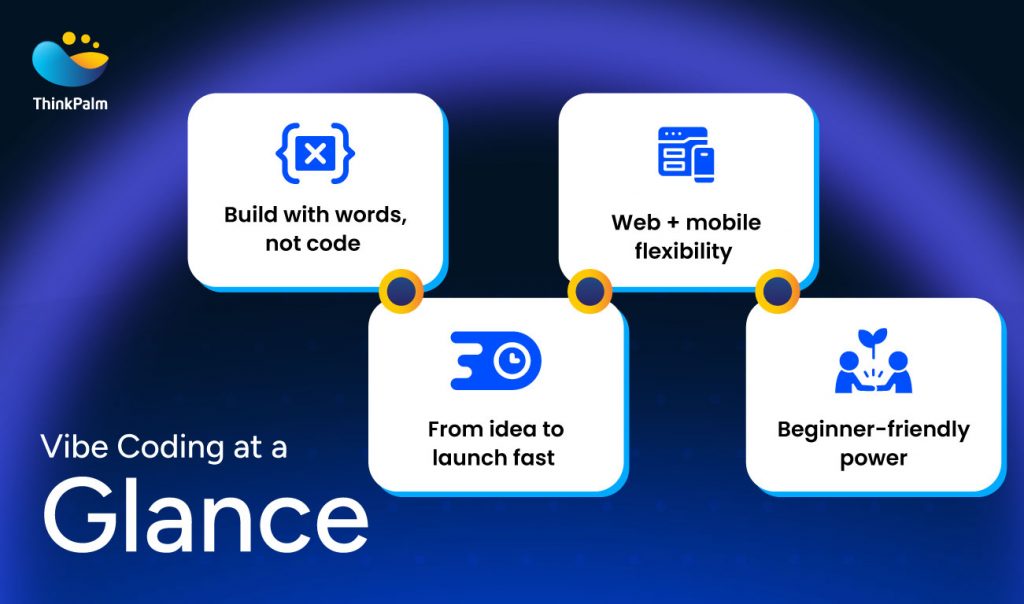
Vibe coding at a glance: faster, simpler, more accessible development.
The workflow typically looks like this:
This cycle can repeat dozens of times in the span of minutes, allowing a single person to produce in an afternoon what might traditionally have taken a team of developers’ weeks to build. If you have ever wondered what is vibe coding in practice, this loop is essentially it.
While analyzing the workflow, it typically follows three stages:
Some agents even handle deployment and monitoring.
The shift from traditional to AI-assisted development doesn’t stop at code generation. AI is now automating every stage of the software lifecycle. See how Artificial Intelligence (AI) will transform software development.
Let us now have a look at the major differences between traditional coding and vibe coding.
Traditional development has always demanded a certain kind of patience. You write precise syntax, wrestle with dependencies, debug line by line at midnight, and maintain sprawling codebases that only grow more complex over time. This kind of work is detailed and demanding. For a good reason, that level of control is exactly what keeps large, critical systems running reliably.
Vibe coding flips that on its head entirely. Instead of translating your idea into code yourself, you just… describe it. “Build a user authentication system with password reset functionality.” The AI takes it from there.
Here’s a side-by-side look at how the two approaches actually differ in practice:
| Feature | Traditional Coding | Vibe Coding |
|---|---|---|
| Input | Precise syntax & logic written by hand | Natural language prompts |
| Speed | Slower — every line is deliberate | Fast — entire features in minutes |
| Who can do it | Requires technical training | Accessible to non-developers too |
| Code understanding | Deep — you wrote it, you own it | Varies — AI wrote it, you review it |
| Debugging | Manual, line-by-line | Describe the problem, AI suggests fixes |
| Control | Granular and predictable | High-level; AI makes micro-decisions |
| Best for | Complex, long-lived production systems | Prototypes, MVPs, personal tools |
| Risk | Human error, slower iteration | Hidden bugs, security blind spots |
| Skill Required | Syntax, architecture, debugging | Prompt clarity, output judgment |
But here’s where it gets interesting — and honestly, a little uncomfortable. Traditional coding gives you something vibe coding can quietly erode: understanding. When you write the code yourself, you know what it does, why it does it, and what might break it. With vibe coding, you can end up with a fully functional system that you couldn’t fully explain if someone asked.
The real differentiator? Intent versus implementation. Traditional coding requires translating ideas into technical specifications yourself. Vibe coding lets you focus on what you’re building while delegating how to build it.
The LLM coding ecosystem has matured rapidly, offering developers multiple platforms to explore conversational programming. At the forefront sits OpenAI’s ChatGPT, which introduced millions to AI-assisted code generation through its natural language interface.
For developers seeking integrated development experiences, GitHub Copilot embeds directly into popular IDEs (Integrated Development Environments) like Visual Studio Code, suggesting completions and entire functions as you type.
To truly understand what is vibe coding in action, you only need to look at how these AI coding assistants have transformed the day-to-day experience of building software.
What once required switching between documentation tabs, Stack Overflow threads, and terminal windows can now happen in a single conversational interface. AI-assisted coding has made that friction almost disappear entirely.
However, several other tools have emerged to support different kinds of vibe coders, from first-time builders to seasoned engineers looking to move faster.
One tool that is gaining serious attention is Claude Code, an AI assistant built by Anthropic that works directly in the terminal. Unlike most vibe coding platforms, Claude Code understands your entire codebase and can handle multi-file edits, run tests, and manage Git operations without ever leaving the command line.
Understanding what is vibe coding also means understanding its limitations. While AI-generated code can speed up development, it also brings several challenges.
One major concern is code quality and security. Since the code is produced by a large language model, it may sometimes include outdated libraries, inefficient methods, or coding patterns that do not follow modern security standards. Without proper review, these issues can lead to vulnerabilities in the final product.
Another challenge involves intellectual property and ownership. Many vibe coding tools are trained on millions of public code repositories. Because of this, it can be unclear who actually owns the code that an AI generates.
Organizations need clear policies about whether AI-assisted code belongs to the developer, the company, or if certain licensing rules still apply.
There is also a longer-term concern related to developer skills. If developers rely too heavily on conversational or AI-assisted coding, they may slowly lose some of their deeper programming skills.
For example, debugging complex problems or understanding how systems work at a lower level can become harder. This can be risky if the AI produces code that looks correct but contains subtle bugs.
Another issue is dependence on specific AI tools. If a team builds its workflow around one particular vibe coding platform, it may become difficult to switch tools later.
AI platforms can change their features, update their models, or even experience downtime. Teams that rely too heavily on a single tool may struggle if those changes affect their development process.
For this reason, many experts suggest balancing prompt-based development with traditional programming knowledge. Developers should continue to review AI-generated code carefully and maintain strong coding fundamentals to avoid these potential limitations.
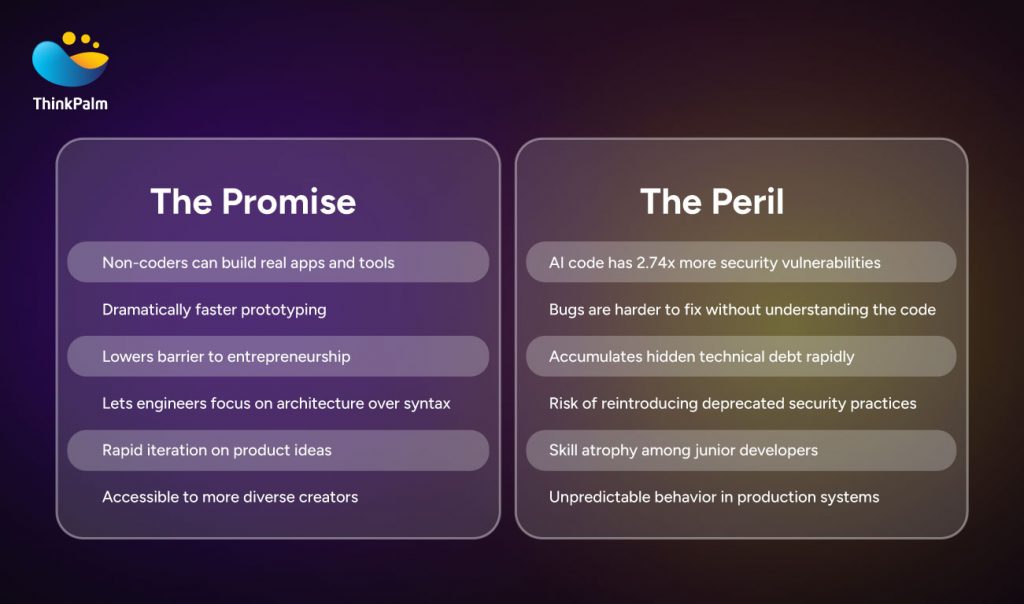
Advantages and disadvantages of vibe coding
The risks of vibe coding are real, but they’re manageable with the right approach and the right partner. See how ThinkPalm helped a global SaaS company cut development time significantly using AI-assisted development without compromising on quality or security.
So, who’s actually using vibe coding, and for what? The answer is a surprisingly wide range of people. Here’s where vibe coding tools are genuinely making a difference right now.
Vibe coding has been making headlines throughout early 2026 — from regulatory warnings to billion-dollar acquisitions to a standoff with Apple.
Dr. Richard Horne, CEO of the UK’s National Cyber Security Centre, urged the global security community to implement “vibe coding safeguards” at the RSA Conference in San Francisco. While acknowledging the productivity gains, he warned that AI-generated code is not yet reliably secure and called for early action from organizations to embed security principles before deployment.
Apple quietly prevented vibe coding apps including Replit and Vibecode from releasing updates to their iPhone apps unless modifications were made. The company cited App Store guidelines that prohibit apps from downloading or executing code that changes an app’s features after it has passed review. Apple confirmed its rules have not changed, but the move signals a fundamental tension between vibe coding platforms and Apple’s walled garden. Apple stated it has maintained communication with developers over at least three phone conversations in two months.
The man who invented the term returned to say LLMs have evolved to the point where vibe coding is now outdated. Karpathy’s new preferred term, “agentic engineering,” describes a workflow where developers orchestrate AI agents rather than write code directly — serving as oversight rather than implementers. “Agentic because the new default is that you are not writing the code directly 99% of the time,” he wrote.
If you want to stay ahead of the curve, it helps to understand what agentic AI really means and why it matters for your business right now. See how Agentic AI is automating every phase of software delivery.
Vibe coding isn’t a passing trend or a shortcut for lazy developers. It’s a genuine shift in how software gets built. And while the internet is full of hot takes and explainers on what is vibe coding, the more important question is what it means for the way your team actually works.
But here’s what the hype often skips over: vibe coding doesn’t make technical judgment obsolete. The AI handles the syntax. The scaffolding. The boilerplate. However, what it can’t do is understand your business, your users, or the specific tradeoffs your system needs to make.
The developers and teams getting the most out of vibe coding aren’t the ones treating it like a magic button. They’re the ones who bring clear thinking to their prompts, review what comes out with a critical eye, and know when to trust the AI and when to override it.
So, the teams that will get the most value from vibe coding are the ones that see AI as a development partner rather than a replacement. Not “the AI will handle it” but “the AI and I will build this together.”
At ThinkPalm, we help businesses stay ahead of this change through cutting-edge AI and automation solutions built for the way software is developed today. This mindset shift could be small in theory but enormous in practice.
Vibe coding isn’t eliminating traditional programming; it’s transforming how developers approach problem-solving. Prompt-based development augments existing workflows rather than replacing them entirely. Developers still need foundational knowledge to validate outputs, debug issues, and architect systems effectively. However, the nature of daily work is shifting from writing every line manually to orchestrating AI-generated solutions and refining results.
The phrase gained traction when Andrej Karpathy, former director of AI at Tesla, highlighted the shift in programming methodology during discussions about AI’s impact on development practices. The “vibe” metaphor captures how developers now work with intuitive prompts and iterative refinement rather than precise, manual syntax crafting.
AI-generated code creates both opportunities and challenges for newcomers. While prompt-based tools lower initial barriers and provide working examples quickly, they may obscure fundamental concepts that developers eventually need. The practical approach is hybrid: use AI to accelerate learning and build confidence but deliberately study the generated code to understand underlying principles. Without this foundation, developers struggle when AI suggestions fail or when complex debugging becomes necessary.
Midhula Jeevan is a passionate content writer with a focus on SEO and technical writing. With a love for words and a curiosity for the technical side, she blends creativity with strategy to craft content that stands out. When not writing, you could find her usually reading books, enjoying a good cup of coffee, or chasing golden sunsets.