Matter CSA Certification Process: A Complete Guide to Testing, Compliance, and Certification
Wireless Testing
 Anjana A K
April 22, 2026
Anjana A K
April 22, 2026



 Anjana A K
April 22, 2026
Anjana A K
April 22, 2026
It’s a busy morning. You step out of your house, and the door locks itself. The lights turn off. The thermostat adjusts to save energy. You did not open multiple apps. Everything just worked together, even though they were from different brands.
This happened because of Matter. Matter is a common standard that allows smart devices from different manufacturers to communicate and work together smoothly.
Powered by the Connectivity Standards Alliance (CSA), this protocol is breaking down the walls between tech ecosystems. With the Matter CSA protocol, the aim is to create a world where all the smart devices speak the same language.
Behind this seamless setup is the Matter CSA certification process. Through Matter certification, devices are tested to meet shared standards for compatibility and security. This Matter device certification process helps create connected spaces where smart technology feels simple, reliable, and easy to use.
A Quick Look at What’s Inside
The Matter CSA Certification Process ensures that smart devices from different brands can work together securely and reliably. This blog explains how Matter works, its protocol architecture, supported networks, and the steps required for Matter certification and CSA compliance. It also covers Matter testing setup, certification types, and how pre-certification testing helps reduce risks and speed up product launch.
To define, Matter CSA certification is a formal process that ensures smart devices follow a common set of rules so they can work together smoothly. To ensure the quality, this process is defined and managed by the Connectivity Standards Alliance. In order to provide certification, they focus on compatibility, security, and reliability.
Through the Matter CSA certification process, devices are tested to confirm they meet specific Matter compliance requirements. Once certified, these devices can communicate with other Matter-certified products, even if they are made by different manufacturers.
In simple terms, Matter certification helps remove compatibility issues and creates a more connected and user-friendly smart environment.
When a device goes through the Matter device certification process, it shows that the product meets the standards shared by the CSA.
For manufacturers, getting Matter CSA certified means that their devices can operate across multiple ecosystems without any additional customization. On the other hand, in the case of users, using a device that passed Matter Connectivity Standards Alliance Compliance helps in fewer setup problems, better security, and the devices work together as expected.
The Connectivity Standards Alliance (CSA) was earlier known as the Zigbee Alliance. It is a global organization that develops and promotes open standards for wireless connectivity in the Internet of Things ecosystem. The goal is to make devices from different brands work together in a secure, reliable, and simple way.
The importance of Connectivity Standards Alliance compliance lies across many industries. This includes smart homes, smart cities, healthcare, and even industrial IoT. By defining clear standards, the CSA helps create connected systems that are easier to deploy and manage.
One of the Connectivity Standards Alliance’s most important achievements is Matter, an open standard designed specifically for IoT devices. Below is a simple timeline that highlights how Matter has evolved over time.
Previously known as Project CHIP, or Connected Home over IP, Matter was created to act as a universal language for smart devices. It allows products from different brands and platforms to work together seamlessly.
While looking into the Matter protocol overview, one key advantage is that you can use devices from platforms like Google, Amazon, or Apple. These platforms already offer Matter-compatible hubs such as Google Nest, Amazon Echo, and Apple HomeKit, which help ensure smooth communication between devices while improving privacy, security, and ease of use for end users.

One of the easiest and simplest ways to identify Matter devices is by looking for the Matter logo. If a device has the Matter logo in it, it implies that the device adheres to the Matter standard.
And this ensures that it is compatible across various platforms and ecosystems. You can typically find the logo on the device itself, its packaging, or promotional materials.
If you are shopping for smart home products, always look for the Matter logo. Purchasing a Matter-compliant device can help you ensure that they seamlessly integrate with your existing devices.
However, if your existing device is not Matter-compliant, it typically cannot communicate directly with the other Matter devices.
Matter makes smart devices simpler to use by helping them work together securely, no matter the brand. Here is how it benefits the end users:
Matter uses a layered system to help smart devices communicate with each other. Each layer plays a specific role in making sure the devices work securely and smoothly. Let’s dive into the Matter protocol stack architecture!
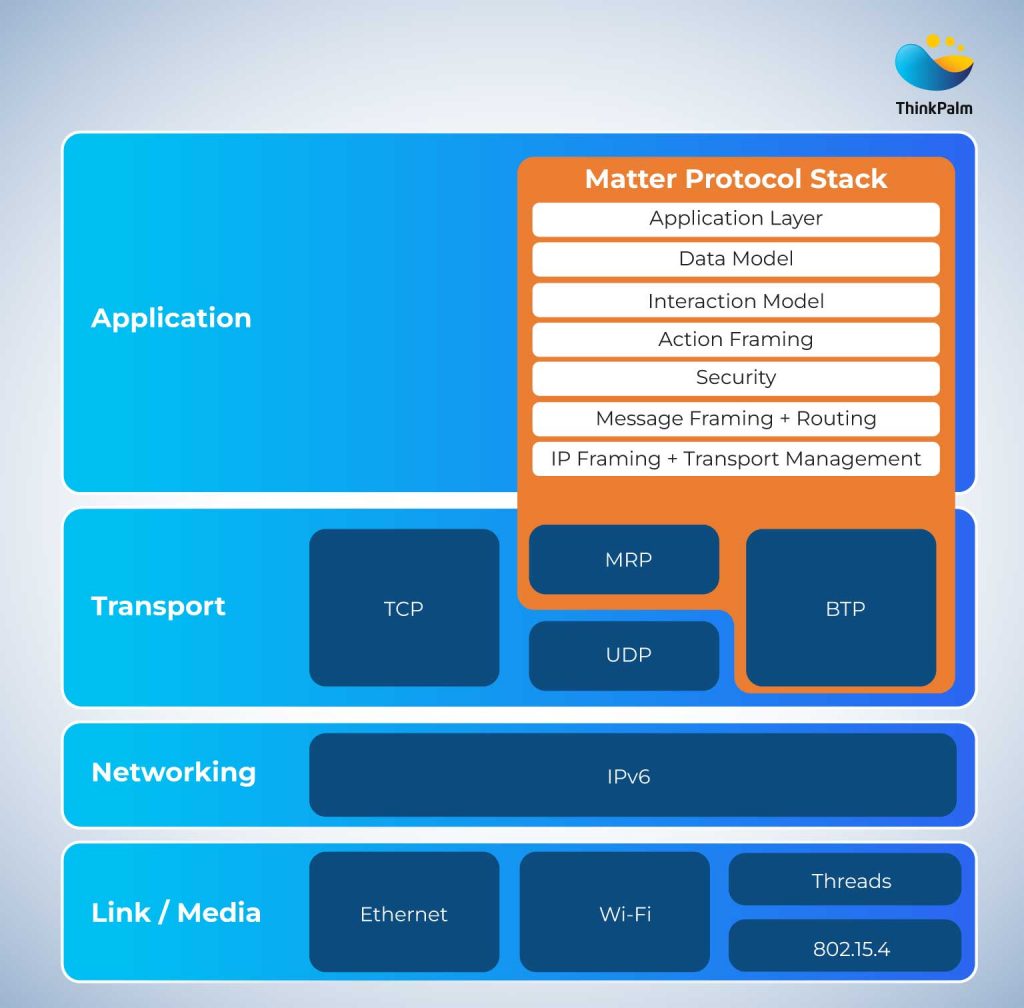
A breakdown of the Matter Protocol Stack architecture
This is the top layer of the architecture, and it is where the device’s core functionality lives. To make it clear, let’s take a look at an example. In a smart lighting system, the Application Layer manages tasks like turning the light on or off and also helps in changing the colour of the light. It is in this layer that the high-level business logic of the device operates.
Now the Data Model Layer defines the data and actions for each device. In the case of a smart bulb, it manages whether the light is on or off and its colour settings. This layer ensures that the device operates across all the different devices in the structured data that is recognized.
The Interaction Model Layer is responsible for defining interactions between devices, such as sending commands from one device to another. For instance, turning on a light or adjusting its brightness would be managed here. This layer operates on the data elements defined in the Data Model.
Once an interaction is decided (like turning the light on), it is serialized into a compact, binary format by the Action Framing Layer. This is where the interaction is turned into a message that is ready to be sent over the network.
Before the message is transmitted, it passes through the Security Layer. This is the layer which encrypts the message and adds a Message Authentication Code (MAC). What makes this best is that it ensures the message is protected from tampering and unauthorized access.
It is the Message Framing and Routing Layer that, after encryption, the message gets wrapped with the routing information. This includes information including destination address (Node ID). The aim of this layer is to ensure that the message reaches its intended device within the network.
Finally, the Transport Layer handles sending the message over the network using underlying protocols like transport protocol (TCP or Matter’s Message Reliability Protocol) for IP management of the data. This layer ensures the data is sent without errors.
As part of the Matter protocol overview, Matter networks are built on IPv6-based IoT communication, using an open standard that works across different link-layer technologies. The current specification supports three main options: Ethernet, Wi-Fi, and Thread.
Because Matter runs on IPv6, it can operate on any IPv6-compatible network, even when the network is local, firewalled, or not connected to the internet. This allows Matter devices to continue working reliably without external access.
Wi-Fi and Ethernet are commonly used for high-power, high-bandwidth devices, while Thread is designed for low-power devices and Low Power and Lossy Networks (LLNs).
As part of the Matter protocol overview, Matter supports different network setups so smart devices can communicate smoothly, whether the network is small or large.
In the simplest configuration, you connect all Matter devices to a single network, such as Wi-Fi, Ethernet, or Thread. If the network spans multiple segments, such as multiple Wi-Fi access points, the system bridges them at the link layer. Each device (called a “Node”) in the network communicates directly with every other Node.
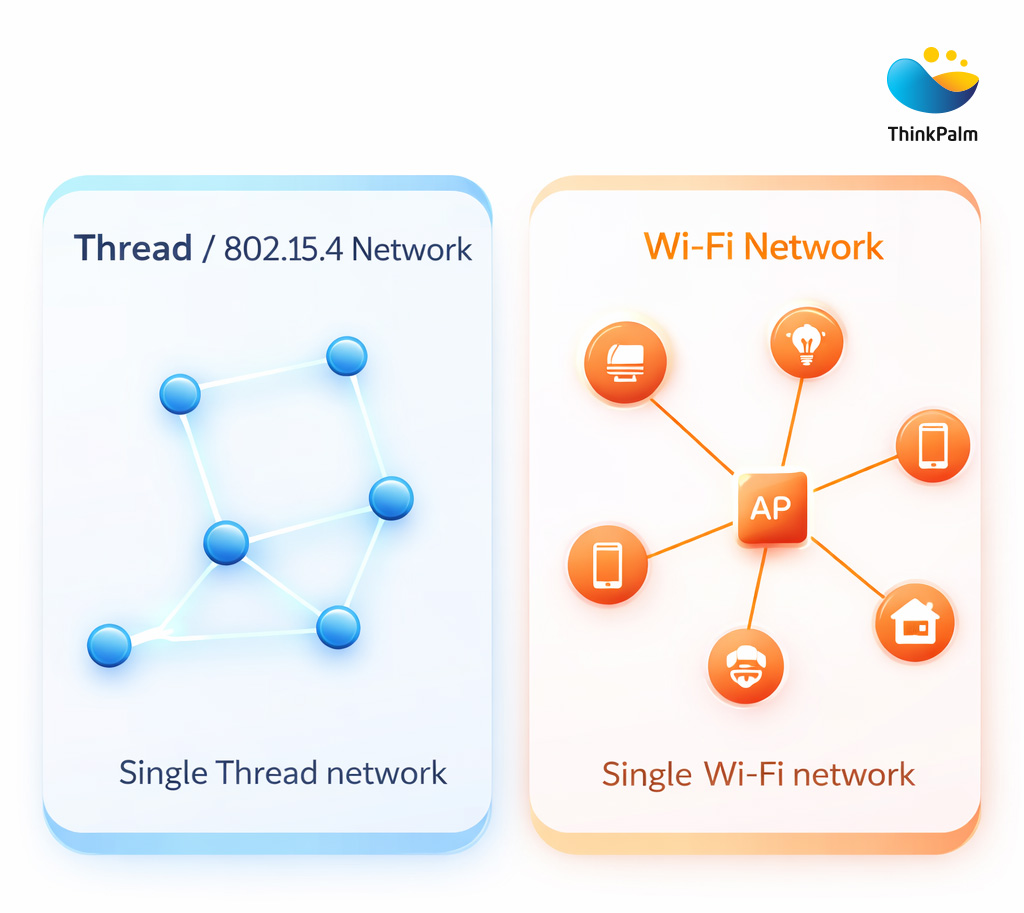
A side-by-side look at the connectivity frameworks of Thread and Wi-Fi networks
In this setup, a central hub (usually the home’s Wi-Fi or Ethernet network) connects multiple peripheral networks. A Border Router connects each peripheral network, such as a Thread network, to the hub. Communication between different networks must flow through these Border Routers, ensuring seamless integration across the entire setup. Matter supports multiple peripheral networks, making it flexible for larger installations.
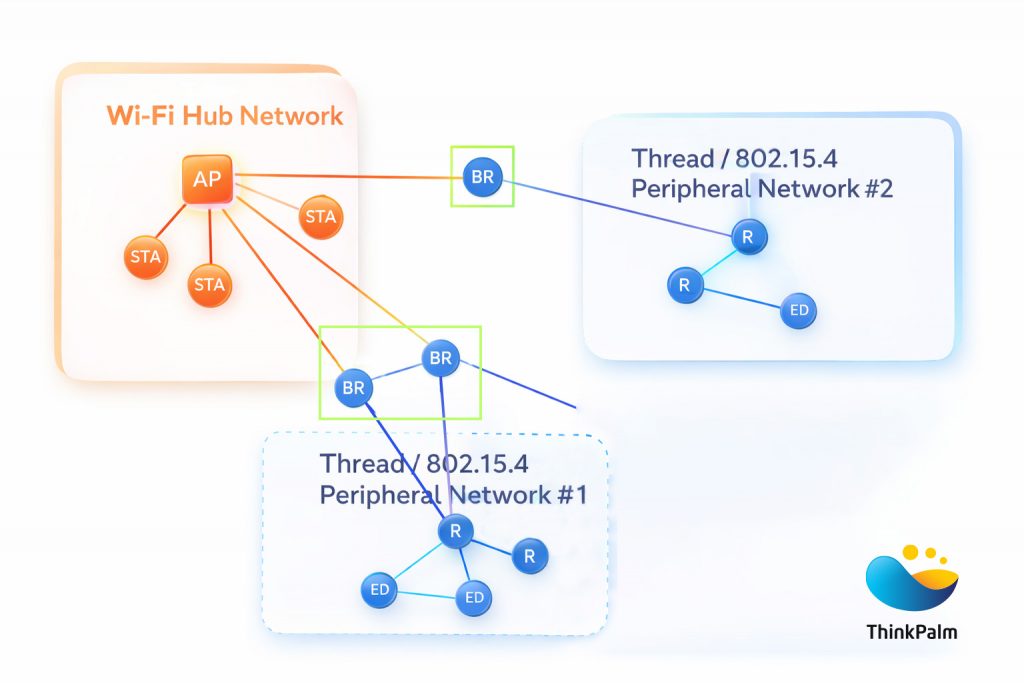
Thread and Wi-Fi network integration via Border Routers
In Matter, devices are built using a few core building blocks that define what they can do and how they behave.
To get a device Matter-certified, you must follow the steps defined by the Connectivity Standards Alliance (CSA). To help you navigate the Matter CSA Certification Process and meet all Matter compliance requirements, here is a simplified overview of what the journey looks like.
This structured approach ensures Connectivity Standards Alliance compliance and helps your product move smoothly through the Matter CSA Certification Process.
The Connectivity Standards Alliance offers Matter certification in different forms, depending on how the solution is built. Devices and platforms can be certified as hardware solutions, software components, or both.
To qualify as a compliant Matter Hardware Solution, the product must include all required clusters and device types defined in the Matter Standard.
Matter IoT testing and validation requires a structured setup to make sure devices behave correctly, communicate reliably, and meet Matter protocol testing requirements before certification.
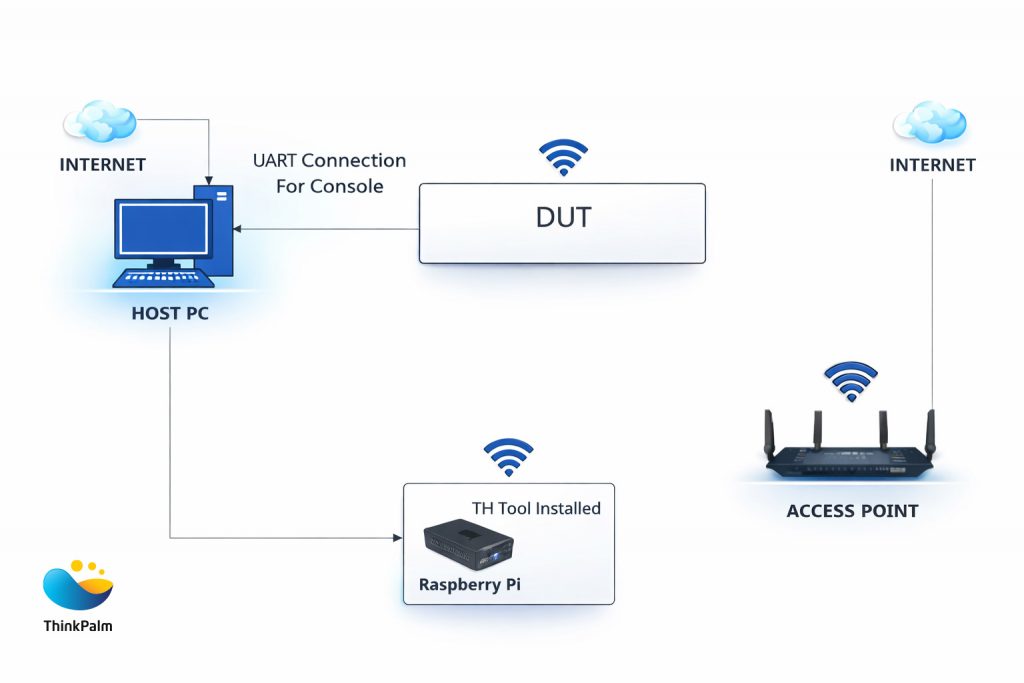
A typical setup for Device Under Test (DUT) performance benchmarking
Pre-requisites for Matter IoT Testing and Validation:
For effective Matter protocol testing, ensure the following:
At ThinkPalm, we provide end-to-end testing services for Matter certification, helping simplify the journey from development to market. Our dedicated testbeds and advanced tools support Matter IoT testing and validation, ensuring your product complies fully with Matter requirements.
We focus on Matter protocol testing during the pre-certification phase to identify issues early and reduce certification risks. With our structured testing approach, you can confidently navigate the certification process and launch reliable Matter-enabled devices faster.
The below are the various clusters we have tested:
| NO | TESTED CLUSTER |
| 1 | On/Off Cluster |
| 2 | Temperature Measurement Cluster |
| 3 | Relative Humidity Measurement Cluster |
| 4 | Thermostat User Configuration Cluster |
| 5 | Pump Configuration and Control Cluster |
| 6 | Level Control Cluster |
| 7 | Color Control Cluster |
| 8 | Occupancy Sensing Cluster |
| 9 | Flow Measurement Cluster |
| 11 | Window Covering Cluster |
| 12 | Thermostat Cluster |
| 13 | Software Diagnostics Cluster |
| 14 | Wi-Fi Network Diagnostics Cluster |
| 15 | Diagnostics Logs Cluster |
| 16 | Identity Cluster |
| 17 | Power Source Cluster |
| 18 | Power Source Configuration Cluster |
| 19 | Boolean State Cluster |
| 20 | Illuminance Measurement Cluster |
| 21 | Switch Cluster |
| 22 | Actions Cluster |
| 23 | Mode Select Cluster |
| 24 | Descriptor Cluster TestPlan |
| 25 | General Diagnostics Cluster |
| 26 | General Commissioning Cluster |
| 27 | User Label Cluster |
| 28 | Fixed Label Cluster |
| 29 | Localization Configuration Cluster |
| 30 | Unit Localization Cluster |
| 31 | Time Format Localization Cluster |
| 32 | Door Lock |
| 33 | Groups Cluster |
| 34 | Access Control Cluster |
| 35 | Time Synchronization Cluster |
| 36 | Carbon Monoxide Concentration Measurement Cluster |
| 37 | Carbon Dioxide Concentration Measurement Cluster |
| 38 | Nitogen Dioxide Concentration Measurement Cluster |
| 39 | Ozone Concentration Measurement Cluster |
| 40 | PM2.5 Concentration Measurement Cluster |
| 41 | Formaldehyde Concentration Measurement Cluster |
| 42 | PM2 Concentration Measurement Cluster |
| 43 | PM10 Concentration Measurement Cluster |
| 44 | Total Volatile Organic Compounds Concentration Measurement Cluster |
| 45 | Radon Concentration Measurement Cluster |
| 46 | Temperature Control Cluster |
| 47 | Washer Controls Cluster |
| 48 | Fan Control Cluster |
| 49 | Air Quality Cluster |
| 50 | HEPA Filter Monitoring Cluster |
| 51 | Activated Carbon Filter Monitoring Cluster |
| 52 | Refrigerator Alarm Cluster |
| 53 | Smoke and CO Alarm Cluster |
| 54 | Device Discovery |
| 55 | Basic Information Cluster |
| 56 | Node Operational Credentials Cluster |
| 57 | Group Communication |
The Matter standard, in its true potential, is transforming how smart devices interact by bringing uniformity across different brands and platforms for a seamless experience. This ability to connect without hassle improves interoperability, makes device control easier for users, and prioritizes security and privacy.
As manufacturers and developers adopt this universal language through the Matter CSA Certification Process, consumers can enjoy smarter homes and connected environments beyond traditional boundaries. Step forward and shape the future of connectivity with Matter and experience a smarter way of living.
Matter works on IPv6-based networks and supports Ethernet, Wi-Fi, and Thread. These networks allow Matter devices to communicate locally, even without constant internet access.
Before testing, manufacturers must become CSA members, obtain a Vendor ID, and ensure the device meets Matter compliance requirements. The product should also be ready for protocol and pre-certification testing.
Matter CSA certification process uses a common data model, standardized clusters, and strict certification rules. This ensures devices from different brands behave consistently across platforms like Google, Apple, and Amazon.
The Connectivity Standards Alliance develops the Matter standard and manages the certification program. It defines compliance requirements and authorizes test labs to ensure devices meet Matter specifications.
Anjana A K is a Test Lead at ThinkPalm Technologies, specializing in software testing and quality assurance for connectivity and IoT solutions. She has strong hands-on experience in Wi-Fi testing and Matter certification testing, with a focus on validating device interoperability, protocol compliance, and end-to-end connectivity across diverse network environments.