 Bennet S
November 17, 2026
Imagine your team is about to launch a new AI service, and each person in your team vouches different languages. If a senior engineer pushes ‘Rust’ for performance, another person might prefer ‘Go’ because of the availability of developers, and a third one may vote for Python, thinking that everyone already knows it. The reasons may seem good enough to be justified, but it creates confusion. That is why evaluating modern programming languages is so important. Picking a language just because it is popular can leave you with hiring shortages. However, chasing hype might leave you stuck with a tool nobody uses in a few years.
The software industry is evolving faster than ever. This is where grasping modern programming languages pays off. These languages are built for today’s problems: AI workloads, cloud-native systems, memory safety, and cross-platform delivery. The right choice depends on the problem you are solving, not on what is trending.
Definition
Modern programming languages are built or continuously evolve to address today’s core engineering demands, such as memory safety, strong type checking, built-in concurrency, cross-platform targets, and higher quality developer tooling.
Here, the term ‘modern’ refers to design objectives rather than a language’s launch date. For example, while Python is decades old, persistent updates keep it highly relevant as a modern programming language for enterprise software development, whereas some newer languages remain purely experimental.
Listed below are some common traits of modern programming languages:
Security is also pushing adoption. Infact, US cybersecurity agencies, including CISA, have encouraged organizations to plan a move toward memory-safe languages, which makes this a leadership topic, not only an engineering preference.
The choice of the language to be adopted depends upon the specific use case one must work on. Languages that look best on a benchmark can still be the wrong choice for your team. Therefore, score each candidate against the same criteria before the debate starts.
Let us examine some questions you could ask while focusing on certain criteria before undertaking your specific project:
| Criterion | Question to Ask |
|---|---|
| Fit for the problem | Is it designed for this workload (AI, systems, APIs, mobile)? |
| Maturity | Is it production-ready, newly stable or experimental? |
| Talent | Can we hire for it, and how long does onboarding take? |
| Ecosystem | Are libraries, frameworks and tooling mature enough? |
| Safety and security | Does it reduce memory and concurrency bugs by default? |
| Interoperability | Can it live alongside our current stack? |
| Long-term support | Who governs it, and how often do breaking changes land? |
A language that scores well on fit but poorly on talent and maturity is a pilot candidate, not a platform standard.
Modern programming languages for enterprise software development should not be evaluated in isolation. Engineering leaders must also consider how it fits with the application’s frameworks, databases, cloud infrastructure, and existing systems. Understanding how to choose the right technology stack can help teams assess these dependencies before committing to a particular technology.
With the advent of Artificial Intelligence, modern workloads demand technological solutions capable of processing extensive datasets, performing parallel computation, and using hardware acceleration capabilities. Consequently, most technical organizations employ multiple programming languages, with one tool for driving rapid experimentation, and another for high-performance production environments. Ultimately, choosing the right programming languages for ML depends on the workload, from model development and data processing to performance-critical inference and deployment.
Let us explore some of the programming languages for AI/ML development:
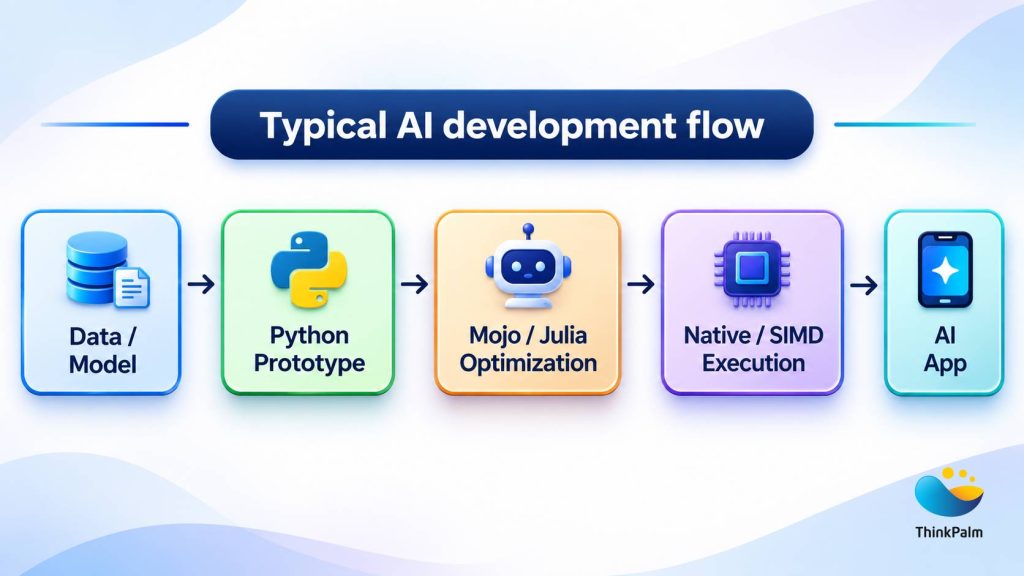
AI Development Workflow Using Modern Programming Languages
Python is ranked as one of the best programming languages for AI and ML development and continues to be the default standard for AI and data science. It has an extensive library ecosystem and an active community. However, its primary drawback is its execution speed. Therefore, the performance-critical parts are often written in C++, Rust, or newer languages.
The Mojo programming language was developed by Modular; it exhibits Python’s readability with the raw speed of C and C++. It features static typing, SIMD and hardware-level optimization for AI inference and numerical computing. Mojo reached its 1.0 release in August 2026, and Modular open-sourced the compiler under the Apache 2.0 license on 18 August 2026.
While designed to feel intuitive for Python developers, it lacks full source-compatibility with Python 3, meaning standard code cannot be copy-pasted directly. For engineering leaders, this makes Mojo programming language an ideal fit for high-performance inference and custom kernels, integrated behind a Python-based pipeline rather than deployed as a wholesale replacement.
Julia was designed specifically for numerical and scientific computing. It bridges the traditional gap between slow prototyping tools and fast production environments. Also, it is widely adopted across data science, simulations, mathematical modeling, and financial analytics.
As a best programming language for AI ML development, Rust is increasingly adopted in AI infrastructure, inference engines, and data processing because of its speed and memory safety. It is a better fit for the infrastructure around models than for experimentation.
| Language | Best for | Watch out for |
|---|---|---|
| Python | Model development, data pipelines, AI agents | Slower runtime on compute-heavy paths |
| Mojo | High-performance inference and kernels | Newer ecosystem, smaller talent pool |
| Julia | Scientific and numerical computing | Narrower enterprise adoption |
| Rust | AI infrastructure and data processing | Steeper learning curve |
Explore how ThinkPalm’s Agentic AI development services help you build scalable AI solutions.
Explore Agentic AI Development Services →Operating systems, firmware, databases, compilers, and networking tools require direct hardware access with minimal performance overhead. While C and C++ dominated this space for decades, three modern alternatives are now reshaping low-level engineering choices. Evaluating Rust vs Carbon vs Zig helps technical leaders select the right tool based on safety, simplicity, and production readiness.
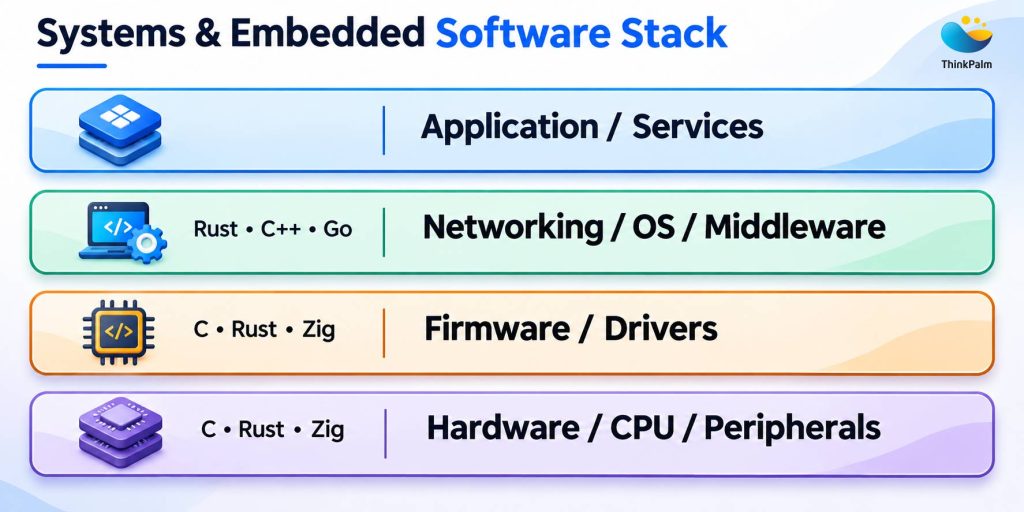
Modern Programming Languages for Systems and Embedded Software Development
Rust takes a unique approach to memory safety by using ownership and borrowing rules, all without relying on a garbage collector. This clever design helps eliminate many types of memory bugs, which is one reason it’s been embraced in projects like Firefox and Windows.
It’s especially well-suited for operating systems, firmware, networking software, device drivers, and applications where security is of utmost importance. However, the downside is a steep learning curve, which can delay initial development and limit the pool of potential hires.
Zig is designed as a simpler and modern replacement for ‘C.’ The language eliminates hidden control flow and exceptions. Moreover, it emphasizes explicit memory management, compile-time evaluation, effortless cross-compilation, and seamless C interoperability.
Even though the Bun runtime has been embraced by high-performance tools, engineering leaders need to take a close look at its current release roadmap and any potential breaking changes before deciding to standardize it across the entire enterprise.
Carbon is an experimental language from Google, announced in 2022 as a possible successor to C++. Its focus is easier migration from large C++ codebases through interoperability, with better readability and safer defaults. The project itself states that it is experimental and not ready for production use, so treat Carbon as something to watch, not something to build on.
When latency, memory cost, or security matter more than onboarding speed, Rust is a strong choice for performance-critical backend services and data-heavy components.
Today’s software depends heavily on distributed systems, REST APIs, microservices, and cloud-native setups. Picking the right cloud native programming language for API development ensures your servers can handle heavy traffic smoothly, start up quickly, and use very little memory.
For web-facing APIs and full-stack teams, TypeScript adds static typing to JavaScript and is a common default for large web applications. It pairs well with Go or Python services behind it.
Ballerina, developed by WSO2, takes a unique approach by incorporating networking directly into the language. This means that when you’re working with REST APIs, event-driven services, and cloud integrations, you can say goodbye to a lot of the usual boilerplate code. It’s a fantastic choice for teams that focus heavily on integration, but it’s not meant to be a one-size-fits-all alternative to languages like Go or Java.
Created by Google, Go is the backbone of modern cloud-native infrastructure powering tools like Docker and Kubernetes. Choose Go for cloud services and APIs where simplicity, fast onboarding, and strong concurrency matter most especially when leveraging goroutines for lightweight multi-tasking and high performance. With rapid compilation and simple syntax, Go remains a default choice for building scalable microservices and backend systems.
Certain applications must remain highly responsive during traffic spikes and automatically recover from crashes without dropping offline. Both Elixir and Gleam run on the Erlang Virtual Machine (BEAM), which was initially built for telecom switching and currently used by major enterprise messaging networks.
Built on an actor-based concurrency model, Elixir is ideal for high-concurrency environments like messaging platforms, IoT ecosystems, live chat applications, financial services, and telecom software.
Gleam is a functional programming language built on the Erlang Virtual Machine. By combining the reliability of the BEAM runtime with strong static typing, it offers a practical option for distributed systems, concurrent applications, real-time microservices, and modern backends where engineering teams prefer functional programming paired with strict compile-time safety checks.
Because Elixir and Gleam have smaller developer talent pools compared to mainstream options like Go or Java, they are best suited for mission-critical architectures where extreme reliability and zero downtime justify building a specialized engineering team.
Developing separate native applications for Android, iOS, desktop, and the web increases overhead and delays time-to-market. When making a cross platform mobile app development language decision, engineering teams generally rely on two primary approaches:
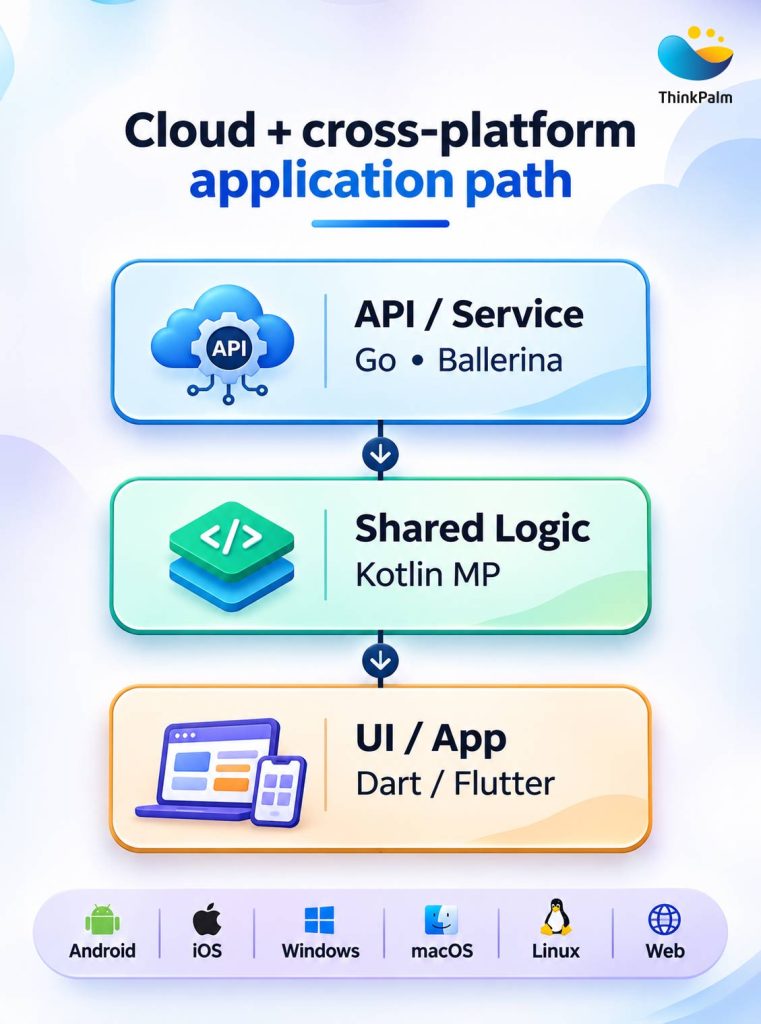
Modern programming languages in cloud-native and cross-platform development
Allows teams to share business logic across Android, iOS, desktop and backend services while keeping native user interfaces. Because Kotlin is Google’s preferred language for Android, it is an ideal fit for organizations that value a native look and feel and already operate within the Java ecosystem.
Powered by the Dart language, Flutter builds high-performance applications for Android, iOS, web, and desktop from a single codebase. It is well-suited for products that require a uniform interface across all platforms and rapid feature delivery.
Building apps for multiple platforms? Explore our blog on Flutter for cross-platform mobile app development to understand how teams can build applications for Android and iOS using a shared codebase.
For iOS-first products, Swift remains the native choice and pairs naturally with Kotlin on Android.
| Approach | Best for | Trade-off |
|---|---|---|
| Kotlin Multiplatform | Shared logic with native UI | Needs platform-specific UI work |
| Dart and Flutter | One codebase and consistent UI everywhere | Separate UI layer from native components |
| Swift plus Kotlin | Best native experience on each platform | Two codebases to maintain |
Maturity is the factor most often missing from language roundups. While emerging programming languages offer new approaches to performance, safety, and developer productivity, not all are ready for enterprise adoption.
Use this table to separate languages you can standardize from those you should pilot or only watch.
| Language | Maturity | Suggested stance |
|---|---|---|
| Python, TypeScript, Go, Kotlin, Swift | Established | Safe to standardize |
| Rust | Production-proven, steep learning curve | Adopt for new safety-critical or performance-critical components |
| Dart and Flutter | Established for cross-platform apps | Adopt where one codebase fits the product |
| Elixir and Gleam | Production-ready, smaller ecosystem | Adopt for reliability-critical services with a specialist team |
| Mojo | Reached 1.0 in August 2026, compiler open-sourced | Pilot for performance-critical AI work |
| Zig | Used in select production tools | Pilot; check release stability |
| Julia | Established in scientific computing | Adopt for numerical workloads |
| Ballerina | Niche, integration-focused | Evaluate for integration-heavy teams |
| Carbon, Vale | Experimental or early stage | Watch only |
| Use case | First choice | Alternatives | Main watch-out |
|---|---|---|---|
| AI and ML development | Python | Mojo, Julia | Runtime speed on compute-heavy paths |
| High-performance AI inference | Mojo or Rust | C++ | Newer ecosystems, smaller talent pools |
| Systems and operating software | Rust | Zig, C++ | Learning curve |
| Embedded firmware | C or Rust | Zig | Toolchain and vendor support |
| Cloud-native services and APIs | Go | Rust, TypeScript | Less expressive than other languages |
| API integration | Go or TypeScript | Ballerina | Specialist skills for Ballerina |
| Fault-tolerant real-time systems | Elixir | Gleam | Smaller hiring pool |
| Cross-platform mobile | Kotlin Multiplatform | Dart and Flutter | Native UI work or separate UI layer |
| Large C++ modernization | Stay on C++ for now | Rust for new modules, Carbon as a watch item | Carbon is not production-ready |
Explore how ThinkPalm’s test automation services help teams build resilient automated testing pipelines.
Explore Test Automation Services →Outline your specific technical specifications and limitations, covering performance, safety, latency, team size, and integration needs.
Evaluate two or three language candidates using your evaluation criteria table.
Select a low-risk project such as a non-critical service or a single performance-sensitive module designed to be completed in weeks rather than quarters.
Measure what really counts, including delivery speed, defect rates, performance, onboarding time, and developer feedback.
Formalize the language, expand the pilot, or scrap it entirely, ensuring you record your reasoning for future engineering teams.
Recognize that most real-world architectures become polyglot over time, so establish clean interfaces between different languages right from the start.
There isn’t just one perfect modern programming language out there. Instead, the best choice really depends on the specific workload, the team dynamics, and how much risk you’re willing to take. For example, Python continues to be the go-to for AI projects, while Rust and Go are great for handling various systems and cloud requirements. Kotlin and Dart make cross-platform development a breeze, and newer languages like Mojo deserve a thoughtful trial. As for Carbon, it’s one to keep an eye on for the future.
At ThinkPalm, our engineering teams help enterprises choose and build on the right stack for AI, cloud, mobile and connected products, from first assessment to production delivery.
Planning a New Product or Modernizing an Existing One?
Get an experienced view on the right language and architecture before you commit.
Bennet S is a Senior Software Engineer with 9+ years of experience in embedded systems, firmware development, and networking. She specializes in Embedded C, RTOS, Linux, network protocols, MQTT, BLE Mesh, and automotive embedded systems. Her expertise spans embedded firmware development for networking, IoT, and automotive applications, along with system- and protocol-level debugging and troubleshooting. She is passionate about solving complex technical challenges and building reliable embedded solutions.
One message is all it takes to get started. Tell us what you need, and we’ll take it from there, no long forms, no waiting around.

