What Is AI-Led Modernization? A Beginner’s Guide for Enterprises
Agentic AI
 Midhula Jeevan
June 29, 2026
Midhula Jeevan
June 29, 2026



 Midhula Jeevan
June 29, 2026
Midhula Jeevan
June 29, 2026
Every enterprise at some point reaches a critical juncture where yesterday’s technology becomes tomorrow’s bottleneck. To resolve this issue, AI-led modernization offers a fundamental shift in how organizations approach this challenge.
AI-driven modernization leverages machine learning algorithms to analyze legacy codebases, identify patterns, and automatically generate modernization pathways that would take teams months to map manually.
Read on to understand what AI-led modernization means, why it matters for your business, and how it differs from traditional approaches. Whether you’re a business leader, IT decision-maker, or someone just trying to make sense of the buzzwords flying around the boardroom — this one’s for you.
Definition
AI-led modernization is the process of using artificial intelligence to accelerate, automate, and de-risk the modernization of enterprise software and infrastructure. Machine learning, natural language processing, and agentic AI contribute to this.
With AI-accelerated modernization tools, enterprises do not need to rely on human developers entirely. Tasks, including auditing of the legacy code, mapping dependencies, and rewriting of applications line by line, can be done easily using these tools. AI can scan thousands of lines of legacy code in minutes, understand how components interact, flag risks, suggest refactoring strategies, and even generate new code.
The best part being the fact that all this can be done at a speed and scale that humans simply cannot match alone.
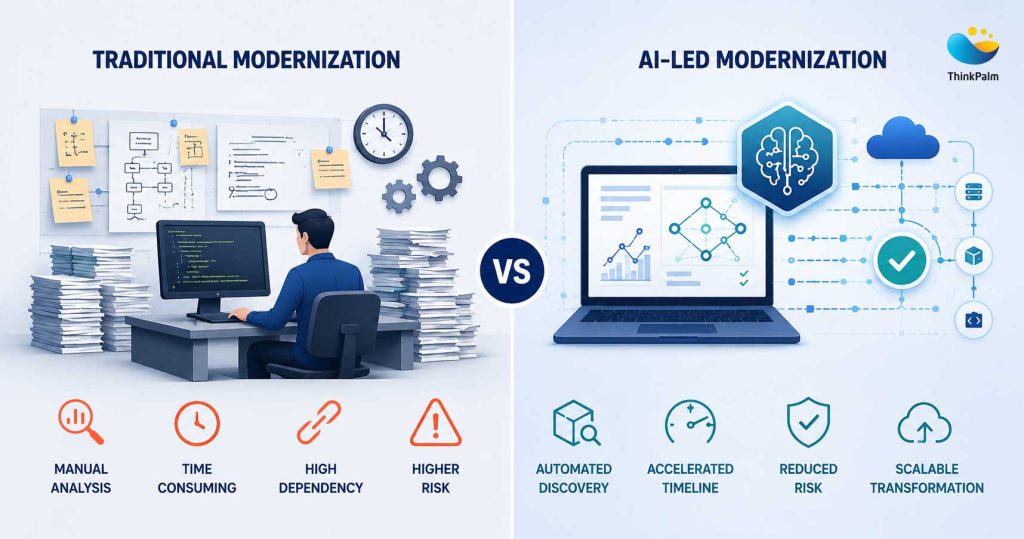
Comparing traditional modernization with AI-driven transformation
Discover how ThinkPalm helps enterprises automate operations, accelerate innovation, and unlock measurable business outcomes.
Here’s the reality: thousands of enterprises are still running critical operations on software that was built decades ago, often on mainframes or programming languages that most developers today have never even heard of. And while these systems have held things together for years, they’re becoming harder and more expensive to maintain. It becomes nearly impossible for this software to connect with newer tools, and increasingly risky from a security standpoint.
Legacy application modernization is the process of updating a software into something modern, efficient, and actually useful for today’s business needs.
So, where does AI-led modernization come in this picture?
Traditional modernization is slow and requires manual work. Developers have to read through mountains of old code, figure out how everything connects, and then carefully rewrite or rebuild it piece by piece. It works, but it takes forever and costs a lot.
AI-led modernization flips that script. Instead of relying entirely on human effort, it brings intelligent automation into every stage of the process. AI can scan millions of lines of legacy code in a fraction of time, spot hidden dependencies, and automatically generate a transformation roadmap that might otherwise take months to put together.
The key thing to understand is this: your legacy systems do not need to be thrown away. They just need to be transformed smartly, and AI gives you the tools to do exactly that.
You might be wondering: “Our legacy systems have worked fine for years, and why change now?”
Here’s the honest answer: the cost of doing nothing is rising fast.
Application modernization services exist precisely to help enterprises tackle these challenges without having to build the entire capability in-house. These are specialized teams and platforms that bring both the methodology and technology to modernize your systems efficiently and safely.
The contrast between AI-led vs traditional modernization approaches represents more than incremental improvement. It’s a fundamental shift in how enterprises transform their technology foundations. Understanding these distinctions helps organizations choose the right path forward and set realistic expectations for their modernization journey.
Traditional application modernization services typically follow a linear, manual-heavy process. Development teams manually analyze code, create documentation, rewrite applications piece by piece, and conduct extensive testing cycles. This approach often requires 12-18 months for large-scale transformations, with budgets frequently exceeding initial estimates by 30-40%. The method relies heavily on tribal knowledge from developers familiar with legacy systems, creating knowledge bottlenecks and project delays.
AI-led modernization transforms this paradigm entirely. Research shows AI-driven approaches can accelerate modernization timelines while reducing costs. Machine learning algorithms automatically analyze millions of lines of code, identify patterns, and generate modernization roadmaps in days rather than months.
However, AI-led approaches aren’t one-size-fits-all solutions. They work best for pattern-heavy code transformations but may struggle with highly customized business logic requiring a nuanced understanding.
Organizations often achieve optimal results by combining intelligent automation capabilities with strategic human oversight, letting AI handle repetitive analysis while architects focus on critical architectural decisions. This hybrid approach balances speed with thoughtful transformation design.
If a regular AI is a smart assistant, an agentic AI is that assistant that can actually get things done on its own.
Agentic AI automation is one of the most exciting developments in software modernization services right now. These are AI systems that don’t just wait for instructions. They can plan a task, execute it, find a solution for a problem, adapt, and keep going, all without someone constantly watching over them.
That’s a big deal. Here’s why.
Traditional automation is essentially a very obedient rule-follower. You set up a script, define the steps, and it does exactly what you told it to. It is considered to be great for repetitive, predictable tasks. Not so great when things get complicated or unexpected.
Agentic AI works differently. It can:
Think of it like a skilled project manager who figures things out as they go.
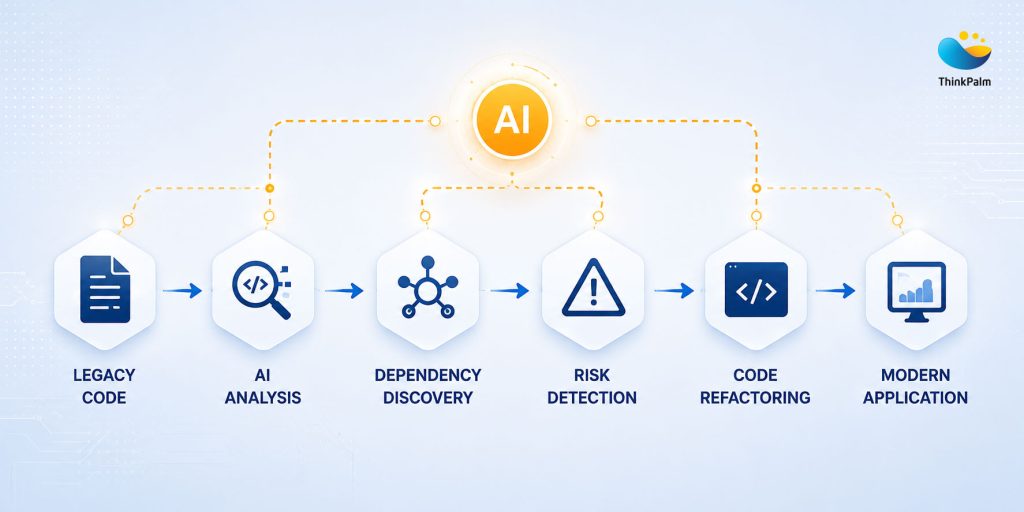
The AI-powered journey from legacy systems to modern applications
Here’s a real-world example that makes this click.
Say your team is in the middle of a database migration. Halfway through, the system starts slowing down. A traditional automation tool would either stop and wait for a human to fix it, or worse, keep going and make things worse.
An agentic AI agent? It detects the performance bottleneck on its own, adjusts memory allocation dynamically, and if something looks risky, it rolls back the problematic changes, all without anyone having to intervene.
Agentic AI doesn’t treat modernization as a one-time project you finish and forget. It introduces ongoing adaptive intelligence, which means your systems keep getting optimized even after the initial modernization is done, based on real-time feedback from the environment.
For enterprises thinking seriously about legacy system modernization services, this is the technology that changes the equation entirely.
Want to see how AI transforms every phase of software delivery? Read our in-depth guide on Agentic AI in SDLC to see how intelligent automation is reshaping the way enterprises build and modernize software.
Planning is one thing. Actually, putting AI to work in your modernization process is where real magic happens. Here’s how AI shows up practically across different stages of your transformation journey.
AI-led modernization is already helping enterprises modernize faster with real, measurable impact. Explore how different industries are applying it in real-world scenarios. Explore Real-World AI-Led Modernization Use Cases.
AI-led modernization is powerful, but it’s not a plug-and-play solution. Before diving in, there are a few honest realities worth keeping in mind.
AI-powered legacy system modernization services do require upfront investment in technology, tools, and the right talent. You’ll need people who understand both AI and your existing systems, and those skill sets don’t come cheap. The long-term savings are real, but it takes time to get there, so going in with a clear budget and realistic timeline matters.
AI is only as good as the data it works with. Legacy systems often carry years of inconsistent, incomplete, or poorly documented data. If that isn’t cleaned up before modernization begins, it can slow the entire process down significantly. A data readiness assessment early on can save a lot of headaches later.
The technology is only one piece of the puzzle. If your teams aren’t prepared for new workflows, tools, and ways of making decisions, even the best AI implementation will struggle to stick. Training and change management are just as important as the technical side.
The smartest approach is to start small. Pick a high-impact, lower-risk use case, prove the value, and then scale from there.
Budgeting for AI modernization? Read our guide on AI project cost estimation challenges and how to overcome them to plan smarter from the start.
Choosing the right partner for your modernization journey is just as important as choosing the right technology. Here’s what to keep in mind when evaluating your options.
This is where ThinkPalm stands out. With deep expertise in legacy system modernization, ThinkPalm helps enterprises navigate complex transformation challenges with a practical, AI-driven approach. From initial assessment all the way through to deployment and beyond, ThinkPalm works as a true technology partner, not just a vendor.
Discover how AI-powered modernization can help reduce technical debt, accelerate transformation initiatives, and prepare your enterprise for the future.
Legacy systems have served enterprises well, but holding onto them for too long comes at a real cost. Rising maintenance bills, security vulnerabilities, and the inability to move fast are challenges that only get harder to ignore over time.
AI-led modernization offers enterprises a smarter path forward. One that is faster, less risky, and built for the complexity that large organizations actually deal with. From intelligent code translation to agentic AI automation, the tools available today make transformation more achievable than ever before.
The key is starting with the right foundation: a clear strategy, realistic expectations, and a partner who knows what they’re doing.
If you’re ready to explore what modernization with AI could look like for your organization, ThinkPalm’s team of experts is here to help you take that first step. Get in touch today to start the conversation and to learn more about enterprise application modernization.
Midhula Jeevan is a passionate content writer with a focus on SEO and technical writing. With a love for words and a curiosity for the technical side, she blends creativity with strategy to craft content that stands out. When not writing, you could find her usually reading books, enjoying a good cup of coffee, or chasing golden sunsets.