 Chandni Nadarajan
November 19, 2026
Imagine it’s 6:45 a.m. and the night shift has just ended. A data center engineer walks through the doors, queues at the security desk, signs in, and picks up the handover notes. Then come the dashboards the engineer must observe: the building management system in one tab, service tickets in another, SCADA in a third, and CCTV on a wall screen.
Before the engineer fixes a single thing, an hour has already gone by. In this situation, the engineer is doing the job the way the systems force them to, i.e., by manually verifying individual systems to get a complete picture of what is happening. If the temperature spikes in a rack or an unexpected voltage fluctuation occurs, it requires immediate action.
For most data center operations teams, it involves a frantic search for alarms. This is where AI in data center operations plays a vital role, establishing unified visibility and a consolidated view of facility events before issues escalate.
In this blog, we look at how a telecom operator’s data center, which runs on disparate systems, can use AI agents in data center operations to replace manual search with a single, unified view. Following one engineer through a full shift, we cover what changes at arrival, handover, mid-shift and security, and what these changes mean for your team.
Data center operations are stuck in a reactive era, where problems surface late and depend on people. The various systems in data centers such as Building Management System (BMS), Energy Management System (EMS), Fire Alarm Systems, ITSM, CCTV and SCADA each tell only part of the story, but no one sees the whole picture. Every alert needs a human to investigate.
Data center engineers may have to move between dashboards, investigate alerts manually, and gather information together before deciding what to do next. This can delay problem detection, slow down decisions, and increase the risk of human error.
Like many enterprise facilities, the problem wasn’t a lack of data; it was a lack of unified context.
As data lies scattered across multiple systems, that fragmented visibility has a real cost. Here is how it shows up on a typical shift:
BMS, ITSM, CCTV and SCADA each show a fragment, and nobody sees the whole.
Engineers correlate data manually across static dashboards before they can act.
Every alert needs a human to investigate, so response depends on who is on shift.
Instead of starting a costly, multi-year “rip-and-replace” project to swap out working infrastructure, the operator added an intelligence layer on top of what it already had. A team of specialized AI agents was made to work across connected systems to understand events, assess risks and coordinate responses. The telecom operator deployed NetvirE as a non-intrusive, read-only intelligence layer.
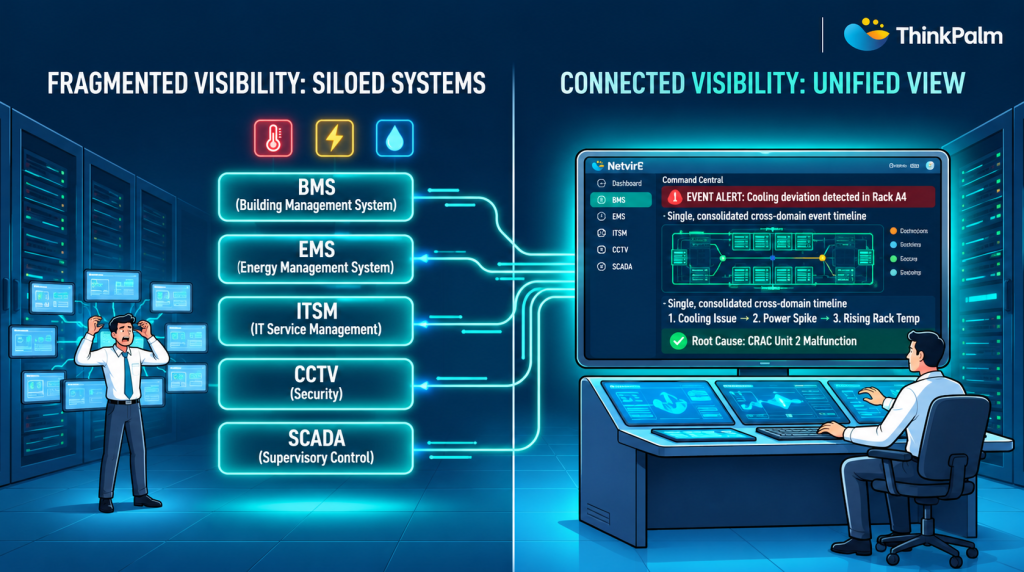
Fragmented data center monitoring systems versus a unified operations view
Their work follows four stages:
Agents sort signals from BMS, ITSM, CCTV and M&E as they arrive.
Connect each event with relevant information about its location, people, assets and service-level agreements (SLAs).
Bring information from multiple feeds into a consolidated view, highlighting risks and potential root causes.
Coordinate multi-system workflows in real time, with human oversight where decisions or interventions are required.
Instead of searching across systems to understand an incident, engineers can focus on evaluating the information and deciding what to do next.
None of this works with a single agent doing everything. It works because each agent has a clear job and their work is coordinated among them, which is the idea behind how multiple AI agents are orchestrated.
Imagine the same engineer working the same shift with the advent of Agentic AI in data center operations. Here is how the experience would change:
Why it matters: Authorized personnel can gain access more efficiently, while a more complete digital audit trail supports access reviews and visitor management.
Why it matters: Engineers can start their shift with a clearer understanding of current conditions and priorities, spending less time manually gathering information.
Why it matters: The issue is diagnosed, fixed and documented before it escalates, and PUE is optimized continuously instead of adjusted by hand. Engineers can focus on oversight and decisions rather than coordinating every step manually.
Why it matters: Security response is measured in seconds, with compliance documentation prepared for audit.
Across the shift, the pattern is the same. Work that depended on one person checking one screen at a time becomes a connected process, with agents doing the gathering and the engineer making the call. So, what makes that possible behind the scenes?
The four moments above rest on one foundation: a data center command center that brings signals from every system into a single view. This is what AI in data center operations looks like under the hood. Four capabilities do the heavy lifting:
When a fault occurs, NetvirE links signals across power, cooling, environmental, and video feeds to compile a single incident narrative.
The AI engine reasons over correlated events, pinpoints the probable root cause, and routes the incident directly to the appropriate subject expert.
The Data Center Head approves, rejects, or enriches every RCA finding before action is taken, feeding context back into the platform to continually refine its intelligence.
Operators can ask conversational questions (e.g., “What caused the temperature spike in Rack B4?”) and receive traceable, data-backed answers in real time.
Put together, the four moments change the shape of the engineer’s day. Manual data gathering becomes automated synthesis, siloed information becomes cross-domain intelligence, and reactive firefighting becomes earlier, better-informed action. Here is what the numbers could look like:
| Touchpoint | Projected Result | What Changes |
|---|---|---|
| Arrival | Over 90% | Faster facility access |
| Handover | Under 1 minute | To prepare shift data |
| Security | Under 10 seconds | To detect a security threat |
| Compliance | 100% | Audit-ready compliance records |
Does your operations team rely on manual data collection, toggle between multiple software screens, or struggle to explain recurring downtime events? If so, your current tools may be holding you back.
Your data center already produces more data than your team can read. The BMS, EMS, power and cooling controls, CCTV and access control all report faithfully. What they can’t do is tell you which signal matters and why. That missing context is what slows repairs, drives up energy use, allows avoidable downtime and fills engineers’ shifts with routine checks.
At ThinkPalm we help the operations team move from scattered signals to connected decisions. Our NetvirE IIoT platform brings data from your existing systems into a single view, and our agentic AI solutions put specialized agents to work on the routine gathering, correlation, and documentation.
Ready to cut repair times and eliminate operational silos in your facility?
Chandni Nadarajan is a content writer at ThinkPalm Technologies, specializing in B2B marketing content. With a passion for turning complex ideas into clear, engaging narratives, she blends strong research and storytelling skills to make technical topics accessible. Her expertise spans technology, automation, and digital business solutions.
One message is all it takes to get started. Tell us what you need, and we’ll take it from there, no long forms, no waiting around.

