Multi-Agent Systems: Vertical vs Horizontal AI Architectures Explained for Enterprise AI
Agentic AI
 Athira Gopakumar
August 24, 2026
Athira Gopakumar
August 24, 2026



 Athira Gopakumar
August 24, 2026
Athira Gopakumar
August 24, 2026
If you have spent any time around enterprise AI teams lately, you have probably noticed the conversation shifting. It used to be about which chatbot to deploy. Now it is about how many AI agents you need, how they should talk to each other, and who is in charge when three of them disagree.
That shift has a name: Multi-Agent Systems. Instead of routing every task through one large model and hoping it handles the nuance, organizations are building teams of specialized AI agents that each own a piece of the problem. One understands intent, one pulls data, and one checks compliance. And one executes the action. Together, they get the task done, more reliably, than a single generalist model ever could on its own.
But building a team is not the hard part. Structuring it is. And that is where the real architectural decision comes in. A lot of questions pop up in this process. Should your AI agents be organized around industries and workflows, or around reusable capabilities that serve the whole business? In other words, do you build a Vertical AI architecture, a Horizontal AI architecture, or something that blends both?
This article walks through what multi-agent systems actually are, how the underlying architecture is put together, what separates vertical from horizontal approaches, and how the agents inside these systems coordinate to get work done. By the end, you should have a clear framework for deciding what fits your organization, not just a list of definitions.
At their core, multi-agent systems are AI frameworks where multiple autonomous agents work together to accomplish something that would overwhelm a single model. Each agent has its own scope, its own logic, and its own job to do. None of them are trying to be a jack of all trades.
Definition — Multi-Agent Systems
Multi-Agent Systems are AI frameworks where multiple autonomous AI agents work together, each handling a specific task, to complete complex workflows that a single AI model can’t manage alone.
To make it more understandable, let’s think about a customer service workflow. One AI agent reads the incoming message and figures out what the customer actually wants. Another checks the account records. A third processes the refund. A fourth updates the CRM so nothing falls through the cracks. A fifth quietly watches the whole exchange to make sure it stays compliant. No single model is doing all of that. It is a coordinated effort, and that coordination is the entire point of multi-agent AI.
What makes this possible at scale is Agentic AI: the ability for agents to reason through a problem, plan the next step, and delegate what they cannot do themselves. They can also adjust when something does not go as expected. That is a very different posture than traditional automation, which just follows a fixed script. Agentic AI gives each agent enough judgment to act like a competent teammate rather than a rigid rule engine.
New to Agentic AI? If you want the fuller picture before diving deeper into Multi-Agent Systems, we break down what sets Agentic AI apart from traditional automation and generative models. Read: What is Agentic AI? →
Before you get into vertical versus horizontal AI architecture, it helps to understand what actually holds a multi-agent architecture together. Skip this part and you end up with a pile of clever agents that cannot reliably work as a system. Get it right and you have something enterprises can actually trust in production.
There are four pieces that show up in almost every serious AI agent architecture:
This is what decides which agent handles which piece of work, and in what order. This is usually a coordinator or orchestrator agent that receives the request and figures out who needs to be involved.
Agents need somewhere to store context, whether that is the current state of a customer case, the output of a previous step, or shared knowledge that multiple agents draw on. Without this, agents end up repeating work or losing track of what has already happened.
When you have several agents making decisions, they will occasionally disagree, overlap, or attempt something outside their scope. A mature multi-agent systems architecture builds rules for who has final say and what gets escalated to a human.
You cannot govern what you cannot see. Enterprises need visibility into what each agent did, why it did it, and where things went wrong, especially in regulated industries where every action needs an audit trail.
These four building blocks are what separate a genuinely production-ready multi-agent architecture from a set of scripts that happen to call an API. Once they are in place, the next question becomes how you want to organize the agents themselves, and that is where vertical and horizontal approaches come in.
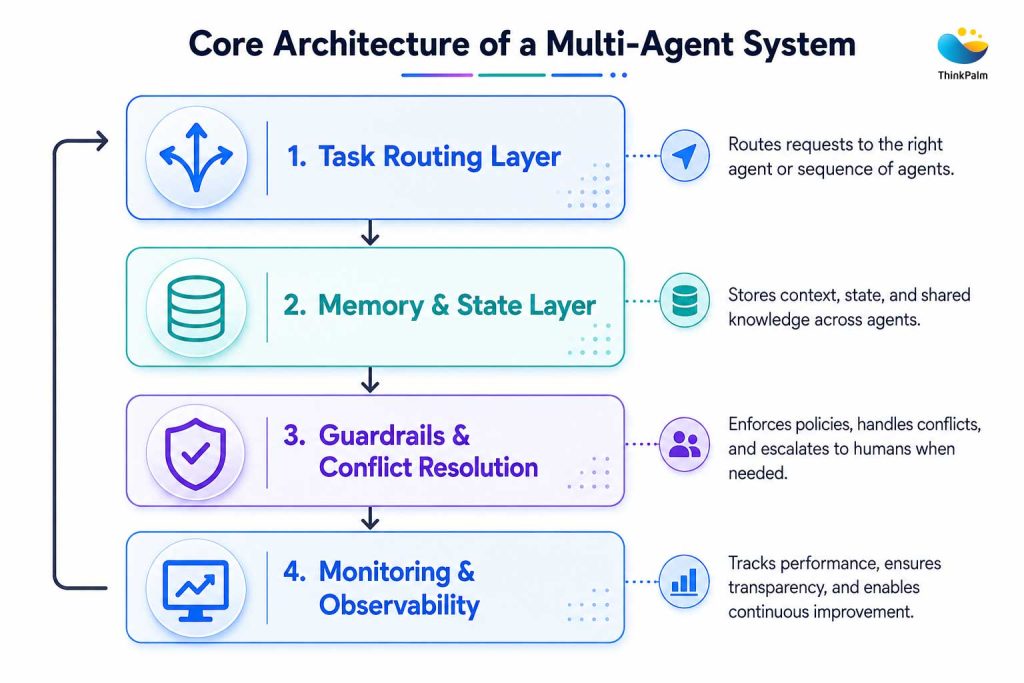
The core layers that power coordination and collaboration in multi-agent systems.
A Vertical AI architecture organizes your agents around a specific industry or department. Every agent in the system is built to understand one domain deeply, and nothing else.
For example, in healthcare, a Vertical AI architecture may include:
All agents focus exclusively on healthcare-related tasks.
Similarly, in financial services, a Vertical AI architecture could include:
The primary advantage of a Vertical AI architecture is deep domain expertise. Since every agent is optimized for a specific industry, businesses benefit from higher accuracy, industry-specific compliance, better workflow optimization, faster implementation, and specialized knowledge. Organizations operating in highly regulated industries often prefer a Vertical AI architecture because it aligns closely with business processes and compliance requirements.
A Horizontal AI architecture flips the logic. Instead of building agents for one industry, you build reusable capabilities that any department can plug into.
A document processing agent is a good example. HR can use it to process onboarding paperwork. Finance can use it for invoices. Legal can use it for contracts. Procurement can use it for vendor forms. It is the same underlying agent, applied wherever documents need to be read and structured.
Other common examples include language translation agents, scheduling agents, data extraction agents, knowledge retrieval agents, and workflow orchestration agents. None of them care what industry you are in. They just do their job wherever they are called.
The appeal of a Horizontal AI architecture is efficiency at scale. You are not rebuilding the same capability five times for five departments.
The benefits of Horizontal AI architecture include:
A Horizontal AI architecture is especially valuable for enterprises seeking enterprise-wide AI adoption without duplicating development efforts.
Both approaches support Multi-Agent Systems, but they are solving different problems. Here is how they stack up side by side.
| Factor | Vertical AI Architecture | Horizontal AI Architecture |
|---|---|---|
| Focus | Industry-specific | Cross-functional capabilities |
| Agent expertise | Deep domain specialization | General, reusable services |
| Scalability | Limited to one domain | Enterprise-wide |
| Reusability | Lower | High |
| Compliance | Strong industry alignment | Shared governance model |
| Development speed | Faster for a single industry | Faster across multiple teams |
| Governance and observability overhead | Concentrated within one domain, easier to audit deeply | Distributed across many use cases, requires broader oversight |
| Best fit | Healthcare, banking, manufacturing | HR, finance, IT, customer support |
In practice, most large enterprises do not pick a lane and stay there. A bank might use vertical agents for fraud detection, where domain depth really matters, while relying on horizontal agents for document processing and shared workflow orchestration across departments. That hybrid model, part Vertical AI architecture, part Horizontal AI architecture, tends to be where mature organizations land once they get past the pilot stage.
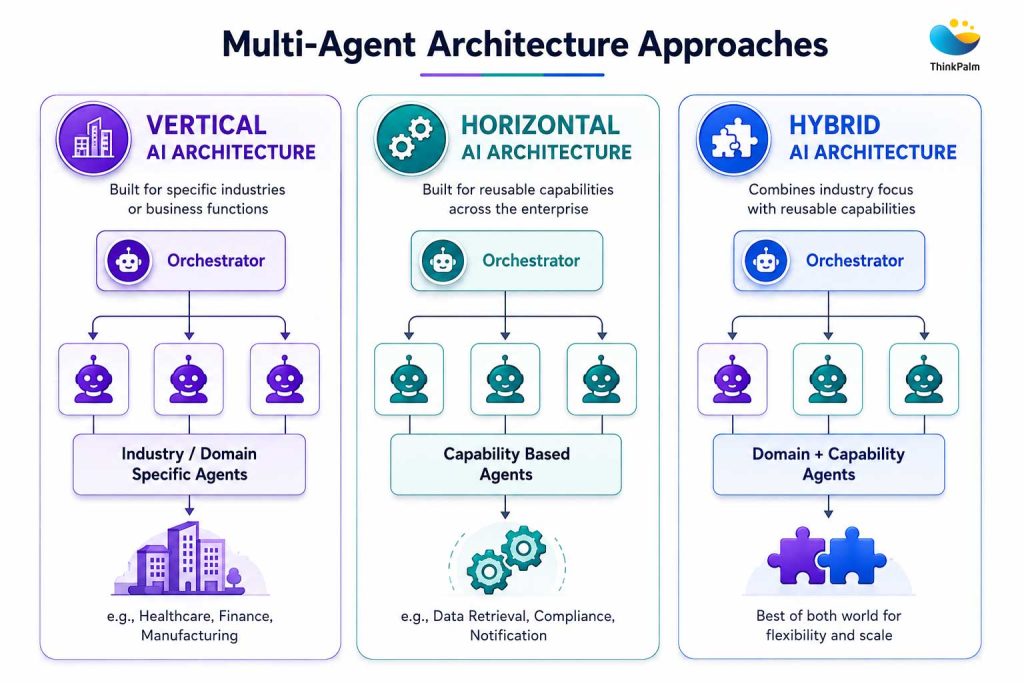
Comparing vertical, horizontal, and hybrid multi-agent architectures.
Deciding on a vertical, horizontal, or hybrid model tells you how your agents are organized. It does not tell you how they actually coordinate moment to moment. That is a separate design question, and it is one that gets overlooked far too often.
There are a handful of orchestration patterns in real multi-agent systems architecture that show up again and again:
Agents work one after another, each picking up where the last one left off. Good for workflows with a clear, linear order, like intake, then verification, and then approval.
A manager agent oversees a group of specialist agents, assigning tasks and reviewing their output before anything moves forward. This mirrors how a human team lead operates, and it is popular because it keeps a single point of accountability.
A central hub agent routes each request to the right specialist and merges the results. This works well when you have many possible paths a request could take, like a helpdesk that might involve HR, IT, or finance depending on the question.
One agent works on a task until it hits the edge of its scope, then hands it off to another agent better suited to continue. Useful when a workflow naturally crosses domains, like a support conversation that starts as a billing question and turns into a technical issue.
Choosing the wrong pattern is one of the more common mistakes teams make when scaling a multi-agent architecture. A sequential setup on a workflow that actually needs parallel execution will just be slow. A fully decentralized, peer-to-peer setup on a workflow that needs a clear audit trail will be hard to govern. Most production systems end up combining a couple of these patterns rather than picking just one, using a hierarchical structure at the top level and something simpler within each branch.
Once you have picked up a pattern, here is roughly how a request moves through a well-built multi-agent AI workflow.
A coordinator agent receives the request and figures out which agents need to be involved.
A planning agent breaks the objective into smaller, manageable subtasks.
Each subtask goes to the AI agent best equipped to handle it.
Where possible, multiple agents work simultaneously instead of waiting in line for each other.
Agents exchange context through shared memory, APIs, or an orchestration layer, so nobody is working blindly.
A quality assurance agent checks the output before it moves forward, catching mistakes before they compound.
The coordinator pulls everything together into one coherent result.
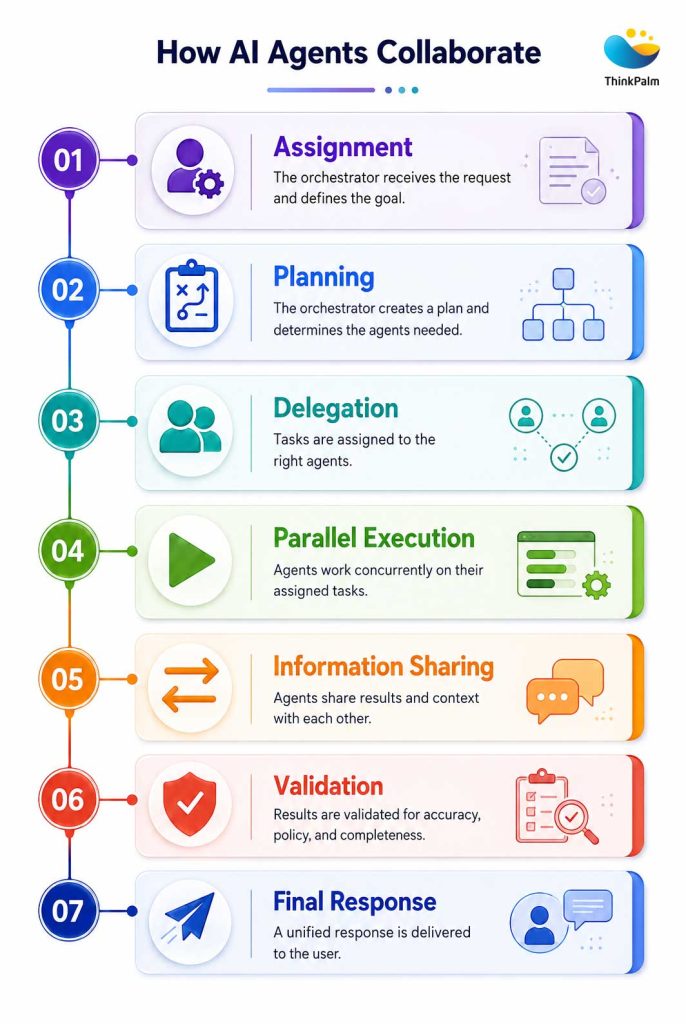
A step-by-step view of AI agent collaboration.
What makes this genuinely different from older automation is the judgment baked into each step. Agentic AI lets agents reason about priorities, recover when something fails partway through, and adjust their approach without a human rewriting the workflow every time conditions change. That is the difference between a system that breaks the moment something unexpected happens and one that adapts.
It would be misleading to talk about multi-agent systems without being honest about where they tend to go wrong. Most failures fall into a few recognizable buckets.
Coordination breakdowns: Agents step on each other’s work, duplicate effort, or contradict one another when the routing logic is not clearly defined. This usually traces back to a multi-agent architecture that was never given clear rules for who owns what.
Security and access control gaps: Every agent that touches sensitive data or takes real action is a potential exposure point. Without strict access controls, a multi-agent systems architecture can quietly become a bigger attack surface than a single application ever was.
State and data consistency issues: If agents are not sharing an accurate, up-to-date picture of what has already happened, you get repeated work at best and conflicting decisions at worst.
Governance overhead: The more agents you add, the harder it becomes to keep audit trails clean and prove compliance, particularly in industries where regulators expect a clear record of every decision.
Integration friction: Connecting agents to existing ERP, CRM, and cloud systems is rarely as clean as it looks in a demo, and it is often where projects lose momentum.
None of these are reasons to avoid multi-agent systems. They are reasons to design them from the start, which is exactly why the architectural building blocks covered earlier, along with routing, memory, guardrails, and observability, matter as much as they do.
The theory only matters if it holds up in practice, and across industries. Below are some uses of multi-agent systems which are applied to the enterprise.
AI agents work together to understand intent, pull account details, resolve straightforward issues, escalate the complicated ones, and generate a response that actually fits the situation. The result is faster resolution and fewer frustrated customers stuck in a queue.
Patient scheduling, medical documentation, diagnostic assistance, insurance verification, and clinical workflow coordination are all being automated through multi-agent systems. A Vertical AI architecture tends to be the right call here, given how much regulatory precision the domain demands.
Fraud detection, loan approvals, risk analysis, compliance monitoring, and transaction verification all benefit from multiple specialized agents working in parallel rather than one system trying to do everything.
Predictive maintenance, inventory optimization, quality inspection, supply chain coordination, and production scheduling all move faster when agents can share information and make decisions collaboratively in near real time.
Development teams are using Agentic AI through Multi-Agent Systems to handle code generation, automated testing, security analysis, documentation, and deployment, with each agent focused on one stage of the pipeline instead of one model trying to do all of it.
There is no universal answer here, but there is a reliable way to think about it. Before committing to a Vertical, Horizontal, or a hybrid AI architecture, walking through these questions could be highly beneficial.
If compliance requirements are strict and the cost of a mistake is high, lean toward a Vertical AI architecture that can go deep on domain-specific rules.
If HR, finance, and legal all need document processing or scheduling, a Horizontal AI architecture avoids rebuilding the same thing in five different ways.
If enterprise-wide AI agent architecture adoption is the goal, reusability matters more than depth in any single domain.
An elegant multi-agent architecture on paper is worthless if it cannot connect cleanly to your ERP, CRM, and existing APIs.
Strong governance, meaning secure communication between agents, clear access controls, and a real audit trail, is non-negotiable once agents start taking action rather than just answering questions.
As Agentic AI matures, you will want to add new agents without tearing down the system you already built. Flexibility now saves a lot of pain later.
For most enterprises, the honest answer ends up being a hybrid multi-agent systems architecture: vertical depth where the domain demands it, horizontal reuse where efficiency matters more, and shared orchestration tying it all together.
Deciding between vertical, horizontal, and hybrid isn’t something you have to figure out alone. ThinkPalm’s Agentic AI team helps enterprises design, build, and govern multi-agent systems that actually hold up in production.
Explore Agentic AI Development ServicesThe future of enterprise AI is headed toward deeper collaboration, not just smarter individual models. As large language models keep getting more capable, Agentic AI will push multi-agent systems further into territory that once required a human in the loop: setting long-term goals, coordinating across agents, learning from what worked and what didn’t, and carrying out increasingly complex workflows with far less hand-holding.
A few capabilities are already starting to define what comes next for multi-agent systems:
Alongside this, organizations are likely to move toward standardized multi-agent systems architecture frameworks, which should make it far easier to connect AI agents across cloud platforms, enterprise applications, and broader business ecosystems without custom-building every integration.
The businesses that invest early in a scalable multi-agent architecture won’t just be keeping pace. They’ll be the ones positioned to move faster, run leaner, and stay ahead as intelligent automation becomes the default rather than the exception.
Choosing between a Vertical AI architecture, a Horizontal AI architecture, or a hybrid of both isn’t really about picking up a trend. It’s about matching your multi-agent architecture to how your business actually operates. Along with how regulated your industry is, and how much you need agents to be reused across departments versus specialized within one. Get that decision right, and the rest, orchestration patterns, governance, integration, becomes far easier to design around.
What’s clear across every industry we look at is that multi-agent systems are no longer an experiment sitting in an innovation lab. They’re becoming the default way enterprises handle workflows that are too complex, too fast-moving, or too cross-functional for a single model to manage alone.
At ThinkPalm, we’ve spent time building and testing AI agent architecture for exactly these kinds of enterprise scenarios, from designing the orchestration layer that keeps multiple agents working in sync, to helping teams decide where a vertical, domain-specific agent makes sense versus a reusable, horizontal one. If you’re evaluating how Agentic AI and multi-agent systems fit into your own roadmap, that’s a conversation we’re always happy to have.
Ready to talk through how Agentic AI and multi-agent systems fit into your roadmap? Let’s discuss where a vertical, horizontal, or hybrid architecture makes the most sense for your business.
Athira Gopakumar is a Digital Marketing Specialist in the tech industry, with a strong focus on IoT marketing. She specializes in data-driven strategies, leveraging SEO, content marketing, and market research to enhance brand visibility and lead generation for IoT solutions. Passionate about the intersection of technology and marketing, she stays ahead of industry trends to drive impactful campaigns. Outside of work, she enjoys traveling to new places and dancing to unwind.