AI Testing in HR Systems: The Next Big Decision Factor in HRMS Partner Selection
Testing as a Service (TaaS)
 Chandni Nadarajan
June 11, 2026
Chandni Nadarajan
June 11, 2026



 Chandni Nadarajan
June 11, 2026
Chandni Nadarajan
June 11, 2026
Imagine a hiring decision being made in less than 8 seconds. A company used an AI-powered HR platform, screened thousands of resumes, and shortlisted the top candidates for a leadership role. The system analyzed candidate experience, performance data, career progression, and predictive workforce metrics before recommending the “best-fit” candidate.
However, something unusual was noticed. Surprisingly, several highly qualified candidates from certain backgrounds were consistently rejected. The AI was working well, and the platform continued to deliver results as designed. Unfortunately, the system had quietly learned bias from historical data.
What seemed like an efficient hiring automation system quickly turned into a compliance and ethical crisis. This is the new reality that requires AI testing in HR systems.
In Brief
AI is transforming HR systems, making testing more complex and critical to business outcomes than ever. Organizations must now evaluate HRMS partners based on AI testing capabilities, predictive analytics validation, integration testing expertise, and compliance readiness. This blog highlights the essential factors to consider when choosing a partner who can ensure reliable, ethical, and scalable AI-powered HR platforms.
PART 1
“Choosing the right HRMS testing partner is the foundation for reliable, compliant, and scalable HR platforms.”
This blog builds on insights from Part 1, where we explored the key decision factors for selecting an HRMS testing partner.
Modern HR platforms do not just function as digital filing cabinets. They utilize machine learning capabilities, natural language processing, and predictive analytics to make decisions on hiring, onboarding, payroll management, succession planning, compliance, etc. for greater operational efficiency.
With the increasing workforce management pressures, companies have realized the benefits of automating workflows using data-driven insights. Unlike traditional HR systems that rely on predefined rules, AI learns from patterns and historical data to make autonomous decisions? This can reduce manual effort and labor. However, there lies the hidden risk of bias detection in HR systems. Therefore, HR teams need to be cautious that the underlying algorithms are fair, transparent, and compliant with evolving regulations.
For example: An HR software management platform can be used to identify future leaders within a company for succession planning. The AI in HR can turn into biased decisions if it is trained to make decisions by looking at the traits of the current leadership team. As a result, it may favour candidates who attended the same university or have a passion for the same sport. This can eventually kill diversity and innovation in your leadership pipeline. Here bias in AI affects fairness, judgement and decision-making. A structured approach to reducing leadership risk through succession planning can help organizations make more objective and future-focused talent decisions.
As organizations increasingly rely on intelligent HR platforms for hiring, payroll predictions, workforce analytics, and performance management, the risk is no longer just system failure, it is decision failure. AI-validation in HR platforms must not only function correctly but also make fair, transparent, and compliant decisions.
Traditional modes of testing were often time-consuming and prone to errors. However, with the emergence of AI-Powered HR Software Testing, things have changed, and we are able to rectify certain pitfalls.
Industry Insight
“Gartner predicts that by 2027, 75% of recruitment processes will include AI proficiency tests and certifications to evaluate how candidates collaborate with machine intelligence.”
— Gartner [Source]
This shows how AI is deeply embedded in HR systems. Hence, the need for testing to ensure fairness, accuracy, and compliance.
The ability to test AI components alongside traditional HR and Payroll System Testing and HRMS Integration Testing is becoming a differentiator in HRMS testing partner shortlisting.
AI-Powered HR Software Testing plays a vital role in improving workforce productivity, talent management, and compliance in a fruitful manner. Therefore, these platforms need to be tested at all levels in terms of functionality, scalability, and quality assessment.
This is where AI validation in HR platforms, HR analytics testing and validation, and bias detection in HR systems become critical. Traditional quality assurance for HR software is no longer enough when predictive models and intelligent algorithms are making decisions that impact employee careers and organizational compliance. Organizations seeking long-term success should also focus on ensuring HR system reliability through HCM testing. This enables HR platforms to support payroll, talent management, and workforce planning with greater confidence.
Buyers today evaluate AI Testing capability as a core selection criterion. However, there are certain risks involved while implementing these modern features. The emergence of AI-Powered HR Software Testing, can help in the following ways:
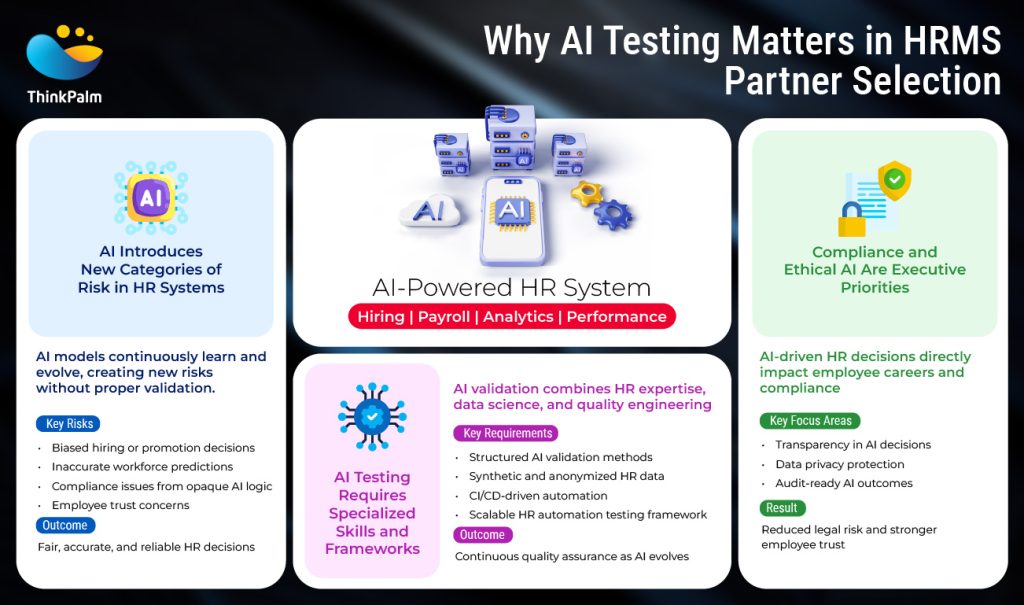
Illustration of AI testing and validation in HR systems for accurate workforce decisions
In a traditional rule-based application, the system follows a pre-defined set of rules. But AI models continuously learn and adapt with each interaction. Therefore, organizations need to constantly evaluate their validity. Otherwise, it ends up giving results leading to:
Therefore, testing must go beyond functionality to include fairness and reliability. Given the case where an HR system is integrated with payroll, performance management, and recruitment platforms, the predictive engines depend on data flowing from all these systems. In this case, predictive analytics testing in HR software is essential as inaccurate data can lead to incorrect workforce predictions.
AI validation combines domain knowledge, data science understanding, and quality engineering expertise. To keep your system reliable, organizations can benefit from partners who bring:
This ensures HR platform quality assurance even as AI models evolve with new data.
HR decisions form the basis of employee livelihoods and their careers. Hence testing should be able to answer questions like:
Transparency: Why did the AI make a specific decision?
Data privacy protection: Is sensitive employee data protected at every step?
Auditability of AI outcomes: Can a detailed history of AI outcomes be provided for regulators?
A partner with strong HR Platform Quality Assurance and compliance awareness helps organizations adopt AI responsibly while minimizing legal exposure.
The goal of AI testing is not to slow innovation but to enable it safely. With the right expertise, organizations can confidently deploy intelligent HR capabilities while maintaining accuracy, fairness, and trust.
This requires a partner with expertise in both HCM software testing and AI validation to ensure modern HR platforms perform reliably and responsibly. At ThinkPalm, we bring a specialized approach to HRMS Testing that goes beyond traditional validation. We combine domain knowledge in HR and payroll workflows with advanced automation and AI capabilities to help organizations deploy reliable, scalable HR platforms.
Even in AI-powered HR environments, where testing conversational agents, recommendation engines, and predictive analytics models become critical, we strive to provide fairness, accuracy, and compliance.
Organizations looking for a strategic HRMS Testing Partner benefit from a well-devised HR Automation Testing Framework, accelerating release cycles, and reducing operational risks across modern HCM landscapes. Without specialized skillsets, businesses may be faced with several risks late in the deployment cycle leading to costly rework and loss of trust. Hence, it’s essential that we choose the right HRMS testing partner so that business-critical HR operations remain accurate, secure, and compliant.
Ensure fairness, accuracy, and compliance across AI-powered HR platforms with specialized HRMS testing and validation from ThinkPalm.
Chandni Nadarajan is a content writer at ThinkPalm Technologies, specializing in B2B marketing content. With a passion for turning complex ideas into clear, engaging narratives, she blends strong research and storytelling skills to make technical topics accessible. Her expertise spans technology, automation, and digital business solutions.